From Booking to Keys: The Dubai Off-Plan Purchase Timeline, Step by Step
Buying an off-plan property in Dubai involves more than choosing an apartment, paying a booking amount, and waiting for construction to finish. The Dubai off-plan purchase timeline typically moves through project and developer checks, reservation, signing the Sale and Purchase Agreement (SPA), registration of the transaction, staged payments, construction monitoring, handover, and final title registration. The exact sequence and duration depend on the project, contract, payment plan, and regulat
Updated 25 October 2026
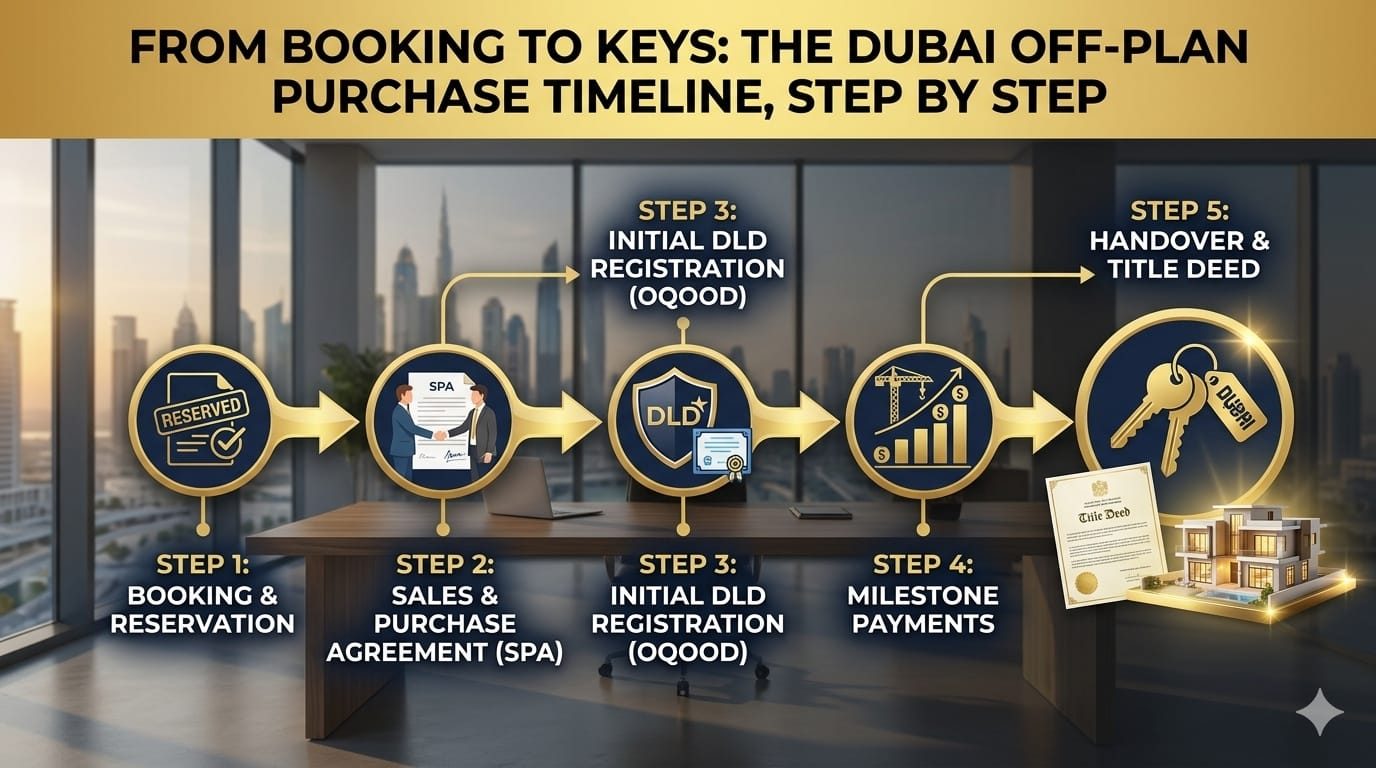
Buying an off-plan property in Dubai involves more than choosing an apartment, paying a booking amount, and waiting for construction to finish. The Dubai off-plan purchase timeline typically moves through project and developer checks, reservation, signing the Sale and Purchase Agreement (SPA), registration of the transaction, staged payments, construction monitoring, handover, and final title registration. The exact sequence and duration depend on the project, contract, payment plan, and regulatory requirements.
For an overseas buyer or NRI, understanding these stages before committing money can help prevent avoidable surprises. The important question is not simply when will I get the keys? It is also what must happen before each payment, which documents should I receive, and how can I independently verify progress?
Quick Answer: How Long Does It Take to Buy an Off-Plan Property in Dubai?
The Dubai off-plan purchase timeline starts with due diligence and booking, followed by the SPA, initial registration through the applicable Dubai Land Department process, and payments linked to the agreed schedule. Construction then continues until the developer confirms completion and arranges handover. After the relevant completion, payment, and registration requirements are met, the Title Deed can be issued. There is no single timeline for every project: use the SPA and verified project information to assess dates and obligations.
Dubai Off-Plan Purchase Timeline at a Glance
Stage | What happens | What the buyer should check |
1. Research and due diligence | Compare projects, developers, locations, and unit options | Project status, developer credentials, escrow information, and SPA terms |
2. Reservation and booking | Select a unit and complete the reservation process | Booking terms, refund conditions, payment recipient, and reservation expiry |
3. SPA signing | The buyer and developer formalise the sale | Unit details, total price, payment schedule, completion provisions, and default clauses |
4. Initial registration | The developer registers the off-plan transaction through the applicable DLD process | Registration confirmation, buyer details, and unit information |
5. Construction and instalments | Construction progresses while payments fall due under the contract | Verified progress, receipts, payment deadlines, and written updates |
6. Completion and inspection | The developer prepares the unit for handover | Snagging, outstanding works, completion notices, and handover requirements |
7. Handover and final registration | Keys and access are arranged after applicable requirements are met | Final statement, service charges, handover documents, and Title Deed status |
Important: These are practical stages, not a guaranteed timetable. Some activities can overlap, and registration or handover procedures may differ by project and transaction.
Stage 1: Research the Project Before Booking
The most effective way to reduce risk is to carry out due diligence before paying a reservation amount. Marketing material can help you understand a project's positioning, but it is not a substitute for checking official records and contractual documents.
Verify the developer and project
Start with the Dubai Land Department (DLD) and its official services. Use the Project Status Enquiry service or the Dubai REST application to investigate available project information, including reported completion status and other project details.
The DLD's project-status service allows users to search using project information such as the project name or number. Availability of individual fields can vary. Where possible, compare what you find with the developer's written information rather than relying on a sales presentation alone.
Check:
- Whether the project appears in the relevant official records.
- The developer's registered identity and the project's status.
- Whether escrow-account information is available and consistent with the project.
- The unit's location, size, layout, and stated specifications.
- The expected completion date and the contract's provisions for delay.
- The payment plan, cancellation terms, and consequences of missed payments.
DLD's official FAQ on real estate escrow accounts explains that project escrow accounts are designed to hold money collected for off-plan units and support regulated project development. Escrow arrangements are an important safeguard, but they should not be interpreted as a guarantee of on-time completion, investment returns, or an automatic refund in every dispute.
Evaluate the property as an investment
A property can be attractive in a brochure and still be unsuitable for your financial objectives. Consider the intended use before comparing prices.
For a future home, examine the commute, community facilities, access to schools, and likely move-in timing. For a rental investment, assess the potential tenant market, competing supply, recurring charges, and realistic rent assumptions. For a resale strategy, review the contractual transfer provisions and do not assume that a buyer can sell at any time without conditions.
Read more about the decision-making process in Ritu Kant's off-plan property buying guide.
Before booking: Make sure you can explain why the unit suits your budget and objectives without relying solely on projected appreciation or a sales representative's estimate.
Stage 2: Reserve the Unit and Understand the Booking Terms
Once you have selected a unit, the developer or its authorised sales channel may ask you to complete a reservation form and pay a booking amount. The amount, payment method, and time allowed to proceed vary by project.
A reservation is an early step in the transaction. It should not be treated as a substitute for reading the SPA or confirming the applicable registration process.
What to check before paying
Request written confirmation of:
- The unit number, floor, layout, and stated area.
- The purchase price and currency.
- The amount due at reservation and the deadline for the next payment.
- Whether the reservation amount is credited towards the purchase price.
- The circumstances in which the amount may be refunded or retained.
- The date by which the SPA must be signed.
- The authorised recipient and payment instructions.
Do not assume that a booking payment is refundable simply because the SPA has not yet been signed. The reservation document may already contain binding conditions. If any term is unclear, obtain written clarification and independent legal advice before transferring funds.
Example: A booking deadline
Suppose a buyer reserves a unit on the understanding that the SPA will follow within a specified period. The buyer should establish what happens if the SPA is not signed by that deadline. The answer depends on the reservation terms and applicable law, not on a general assumption that the buyer can cancel without cost.
Keep the reservation form, payment receipt, correspondence, and any revised terms in one file. These records can become important if the transaction changes or a dispute arises.
Stage 3: Review and Sign the Sale and Purchase Agreement
The Sale and Purchase Agreement (SPA) sets out the contractual relationship between the buyer and developer. It is one of the most important documents in the Dubai off-plan purchase timeline.
Read the full agreement before signing. A brochure, floor plan, or verbal explanation may not contain all the conditions that govern the transaction.
Key SPA clauses to review
1. Unit description and specifications
Confirm the unit identifier, location, stated area, layout, parking allocation if applicable, and included specifications. Check how the agreement treats changes to plans or materials.
2. Purchase price and instalments
Make sure the total price, initial payments, later instalments, due dates, and payment triggers are clear. If instalments are linked to construction milestones, understand how those milestones are confirmed.
3. Completion and handover
Identify the stated completion date, any permitted extension provisions, the process for notifying the buyer, and the contractual consequences of delay. A marketing estimate is not necessarily the same as the completion commitment in the SPA.
4. Default and cancellation
Understand the consequences of late payment, failure to meet contractual obligations, or a request to cancel. Do not rely on informal assurances about refunds or extensions.
5. Resale and assignment
If you might sell before completion, review whether assignment is permitted and what approvals, fees, payment thresholds, or other conditions may apply.
6. Disputes and notices
Check how formal notices must be delivered and which procedures govern disputes. Buyers living outside the UAE should ensure they can receive and act on important notices promptly.
For a substantial commitment, consider having a qualified UAE property lawyer review the SPA. This is particularly valuable if the buyer is based overseas, the contract contains unfamiliar provisions, or the investment depends on a tight resale or financing strategy.
Stage 4: Complete the Applicable Initial Registration
After the SPA is signed, the off-plan transaction must be handled through the relevant registration process. Buyers should understand the difference between a signed agreement and official registration.
The DLD's Request to Register the Initial Sale service describes the process for registering off-plan units in the provisional register. The service information identifies the signed sale and purchase contract among the required documents and explains that the output is a provisional registration e-certificate.
The DLD service page also states that the sale contract should be registered in the provisional register within 90 days from the date of signing. Buyers should confirm how this requirement applies to their particular transaction and follow up with the developer if confirmation is delayed.
What is Oqood?
Oqood is commonly associated with the registration of off-plan sale transactions in Dubai's interim or provisional registration system. It provides evidence that the relevant transaction has been recorded through the applicable process.
It is not the same document as the final Title Deed. The buyer should keep the registration confirmation and check that the buyer's name, unit details, and transaction information are accurate.
What to do if registration confirmation is delayed
- Ask the developer for the registration status in writing.
- Request the relevant certificate or official confirmation when issued.
- Check that the unit and buyer details match the SPA.
- Retain all correspondence and payment records.
- If the issue remains unresolved, consult DLD's official channels or obtain independent legal advice.
Do not assume that signing the SPA alone proves that every registration step has been completed.
Stage 5: Make Instalments and Monitor Construction
The construction period is often the longest phase of an off-plan purchase. It can last months or years, depending on the project and its contractual completion schedule. There is no reliable universal duration for all Dubai developments.
During this phase, the buyer needs to manage two parallel responsibilities: meeting contractual payment obligations and monitoring the information available about the project.
Follow the payment plan in the SPA
Create a payment calendar that records:
- The amount and due date of each instalment.
- The contractual event or milestone that triggers payment.
- The payment method and authorised recipient.
- The receipt or confirmation for each completed payment.
- Any correspondence concerning revised dates or amounts.
If an instalment is described as construction-linked, verify the relevant milestone and documentation rather than relying only on an informal update. If you believe a demand is inconsistent with the SPA, raise the issue promptly and obtain advice before withholding a payment, because non-payment can have contractual consequences.
Track the project's progress
Use the DLD's Project Status Enquiry and Dubai REST where relevant information is available. Compare official information with written developer updates and any formal construction notices.
A useful monitoring routine includes:
- Reviewing available official project information periodically.
- Saving progress updates and payment confirmations.
- Checking whether the expected completion date has changed.
- Asking for clarification when progress reports conflict.
- Updating your personal cash-flow plan if the expected timeline shifts.
Project-status information is a monitoring tool, not a guarantee that a unit will be delivered on a particular date. A reported completion percentage should not be interpreted as a precise prediction of the remaining construction time.
Understand escrow without overstating its protection
Dubai's escrow framework is intended to regulate funds collected for off-plan development. The DLD's published FAQs describe the role of project escrow accounts and explain that the funds are associated with the development of the relevant project.
However, an escrow framework does not eliminate every risk. It does not independently guarantee the developer's commercial success, construction quality, market value, or a particular completion date. If a project is delayed, cancelled, or subject to a dispute, the applicable legal and contractual process matters.
Buyers should verify the project's available official details and seek legal guidance if they receive a cancellation notice, a demand that appears inconsistent with the contract, or information suggesting a material delay.
Stage 6: Prepare for Completion and Inspect the Property
As the project approaches completion, the developer will typically communicate the next steps for inspection, outstanding payments, documentation, and handover. The exact process depends on the project and the SPA.
A completion announcement should prompt preparation, not an assumption that every requirement has already been met.
Arrange a proper inspection
When inspection is offered, examine the unit carefully. Depending on the property, relevant items may include:
- Doors, windows, locks, and visible finishes.
- Plumbing fixtures and water drainage.
- Electrical fittings and switches.
- Air conditioning and ventilation.
- Kitchen and bathroom installations.
- Visible cracks, damage, or incomplete work.
- The unit's apparent conformity with the agreed specifications.
Record defects with photographs and written notes. Submit the snagging list through the developer's prescribed process and keep evidence of submission. Clarify which items will be corrected, how completion will be confirmed, and whether any follow-up inspection is available.
Do not assume that identifying a defect automatically gives the buyer a right to delay every payment or refuse every handover obligation. The correct response depends on the SPA, applicable law, and the nature of the defect. Obtain legal advice where a material issue affects acceptance or payment.
Request a written handover statement
Before completing handover, establish what remains payable and which documents are required. Ask for an itemised statement of outstanding instalments, fees, service charges, or other contractual amounts.
Check the figures against your records. If the statement includes an unfamiliar charge, request its contractual or official basis in writing.
Stage 7: Complete Handover and Receive the Keys
The keys mark a major milestone, but handover is not simply a ceremonial event. It is a documented process that may involve payment reconciliation, inspection, access arrangements, and confirmation that the applicable conditions have been met.
Before accepting handover, organise the following:
- The final account statement and payment receipts.
- The handover or possession documentation.
- Access cards, keys, parking details, and any relevant access instructions.
- Utility connection information and move-in requirements.
- Building management and service-charge contact details.
- The outstanding-defect list and written follow-up arrangements.
- Confirmation of the property's registration and Title Deed status.
If the buyer cannot attend in person, ask the developer what arrangements are permitted for an authorised representative and what documents are required.
Does getting the keys mean the Title Deed has been issued?
Not necessarily. Physical handover and final title registration are related but distinct steps. The status of the Title Deed should be confirmed through the relevant official process rather than inferred from receiving keys or taking possession.
The DLD offers a Title Deed Verification service to check the validity of a Title Deed issued by the department.
Stage 8: Confirm Final Registration and Keep Your Property Records
After the applicable completion, contractual payment, and registration requirements have been met, the final title-registration process can be completed. The precise steps depend on the property, developer, and transaction.
The DLD's official property sale registration information describes registration procedures for completed property sales and lists the electronic Title Deed among the possible issued documents. For an off-plan buyer moving from provisional registration to final registration, confirm the specific procedure that applies to the unit with the developer and DLD.
Your post-handover record folder
Keep digital and physical copies of:
- The signed SPA and any amendments.
- The booking or reservation form.
- Oqood or other applicable initial registration confirmation.
- All payment receipts and final account statements.
- Handover documentation and snagging correspondence.
- The final Title Deed and verification confirmation, when issued.
- Service-charge information, warranties, manuals, and building-management contacts.
- Relevant communications with the developer, broker, lender, or legal adviser.
A well-organised record folder is useful for future maintenance, refinancing enquiries, resale, or resolving questions about the transaction.
How Much Time Should You Allow for Each Stage?
There is no single official duration that applies to every Dubai off-plan purchase. The SPA, construction schedule, registration requirements, and project-specific circumstances determine the actual timeline.
Stage | Timing guidance | What can affect it |
Due diligence | Depends on how quickly documents can be verified | Complexity of the project, buyer's checks, and legal review |
Booking and SPA | Depends on reservation deadlines and contract review | Availability of documents, negotiations, and buyer readiness |
Initial registration | Follow the applicable DLD process and service requirements | Complete documents and developer processing |
Construction | Use the project's contractual schedule; it may span months or years | Construction progress, approvals, and project-specific circumstances |
Inspection and handover | Begins when the developer reaches the relevant stage and issues instructions | Completion, snagging, outstanding payments, and documentation |
Final title registration | Depends on meeting applicable requirements | Completion status, contractual obligations, and registration procedures |
These are qualitative planning guidelines, not promised durations or statistical averages. Avoid basing a purchase decision on a generic claim that all projects take a fixed number of months from booking to keys.
Example: Following a Hypothetical Off-Plan Purchase
Consider a buyer who reserves an apartment in a newly launched Dubai development. The buyer reviews the SPA, confirms the unit details, and follows the developer's registration process. During construction, the buyer records each instalment and checks official project information. When the developer announces completion, the buyer inspects the unit, documents defects, and reviews the final account statement.
After the applicable contractual and registration requirements are satisfied, the buyer completes handover and confirms the status of the Title Deed through official channels.
This example illustrates the sequence rather than a guaranteed schedule. The purchase may move faster or slower depending on the project and transaction.
Common Mistakes That Can Delay the Process
1. Paying before understanding the booking terms
A buyer may focus on securing a unit and overlook refund provisions, deadlines, or the consequences of not proceeding. Read the reservation terms before transferring money.
2. Treating the SPA and registration as the same thing
A signed contract and confirmation of initial registration are different records. Track both and follow up on the registration confirmation.
3. Ignoring payment notices
Missed instalments can create contractual problems. Keep a calendar and clarify disputed demands promptly instead of ignoring reminders.
4. Relying only on sales updates
Sales communications are useful, but buyers should independently check official project information where available and retain written evidence.
5. Assuming handover guarantees immediate title issuance
Keys, possession, and final registration are distinct milestones. Confirm the status of each rather than assuming one proves the others.
6. Leaving snagging and final accounts until the last moment
Prepare an inspection checklist and reconcile payments before handover. Raise unclear charges or material defects in writing.
A Practical Checklist for Overseas Buyers and NRIs
If you are purchasing from outside the UAE, build the following into your process.
Before booking
- Verify the developer and project through official sources.
- Review the unit, total price, and payment plan.
- Check the reservation amount and refund conditions.
- Budget for additional costs and currency movements.
- Obtain independent advice on material legal or financial questions.
After signing
- Keep the signed SPA and all amendments.
- Track initial registration and save the confirmation.
- Set reminders for every instalment.
- Store receipts and formal notices in a shared, secure record folder.
- Review project progress through official sources where available.
Before handover
- Review the final account statement.
- Arrange an inspection and document defects.
- Confirm access, utilities, and building-management arrangements.
- Keep the handover record and any agreed snagging follow-up.
After handover
- Verify the Title Deed status through the DLD.
- Retain the final registration document.
- Organise warranties, service-charge records, and property-management contacts.
For a structured overview of the buying process, see Buying Off-Plan Property in Dubai. You can also learn about the advisory approach on the process page and the advisory page.
Frequently Asked Questions
1. What is the first step in buying off-plan property in Dubai?
Start by researching the project and developer, checking available official project information, reviewing the unit and payment plan, and understanding the reservation terms. Do not treat marketing material as a substitute for due diligence.
2. What happens after booking an off-plan property?
The buyer typically proceeds to review and sign the SPA, complete the required payments, and follow the applicable initial-registration process. The exact order and deadlines depend on the reservation terms, contract, and transaction.
3. What is Oqood in Dubai?
Oqood is associated with registering off-plan sale transactions in Dubai's interim or provisional registration system. Buyers should retain the relevant registration confirmation and verify the transaction details. Oqood is not the same as the final Title Deed.
4. How long does the Dubai off-plan purchase process take?
There is no universal duration. The booking and registration stages depend on documentation and processing, while construction can span months or years according to the project's schedule. The SPA and official project information are the best starting points for assessing a particular purchase.
5. Can an off-plan property be delayed?
Yes, delays can occur. The buyer should review the SPA's completion provisions, monitor official project information, keep written records, and obtain legal advice if a delay materially affects contractual rights or obligations.
6. Can I sell my off-plan property before handover?
A transfer or resale may be possible, but it depends on the SPA, payment status, applicable rules, and any required developer or DLD procedures. Check the specific transaction requirements before relying on a resale strategy.
7. Does receiving the keys mean I own the property with a Title Deed?
Not necessarily. Handover and final title registration are separate steps. Confirm the registration status and verify the Title Deed through the DLD when it has been issued.
8. How can I check whether a Dubai off-plan project is progressing?
Use the DLD's Project Status Enquiry service or Dubai REST where applicable. Compare the information available with written developer updates. Project-status information is not a guarantee of a particular completion date.
9. Is an off-plan purchase safe because the project has an escrow account?
An escrow account is an important regulatory safeguard for off-plan development funds, but it does not eliminate every investment, construction, or contractual risk. Verify the project information and understand the agreement before committing funds.
10. What documents should I keep after buying off-plan property?
Keep the reservation form, SPA, registration confirmation, payment receipts, formal notices, handover and snagging records, final account statement, and Title Deed when issued. These documents support future verification, management, refinancing enquiries, and resale.
Final Thoughts
The Dubai off-plan purchase timeline is easier to manage when each stage has a clear purpose and a documented outcome. Booking reserves the unit under the agreed terms; the SPA defines the contractual obligations; initial registration records the off-plan transaction; construction requires payment and progress monitoring; and handover must be followed by confirmation of the final registration position.
For buyers, especially NRIs and international families, the most useful approach is to verify what can be verified, document every important step, and avoid treating an estimated date as a guarantee. A carefully reviewed contract, a realistic financial plan, and regular checks through official channels can help make the process more informed and manageable.
About the Author
Ritu Kant Ojha is a Dubai-based real estate investment advisor and the founder of Proact Luxury Real Estate (RERA BRN 71195). An IIM Lucknow alumnus and former financial journalist at Bloomberg and CNBC, he has spent two decades covering and analysing capital markets before moving into property advisory. He works with NRI and international families buying in the UAE, with a focus on independent due diligence, structured decision-making, and long-term asset strategy. He is the author of The Only Difference (2026), which sets out the ADVICEdge framework for evaluating financial advisors, and Real Conversations In Digital Age (2019).