How Off-Plan Resale (Assignment) Works in Dubai: Process, Conditions and Timing
Off-plan resale in Dubai, usually called an assignment, lets you sell a property before it is finished by transferring your rights and remaining payment obligations under the sale and purchase agreement (SPA) to a new buyer. It is legal and common, but it is not a free-for-all. The developer has to agree, the transfer has to be recorded with the Dubai Land Department (DLD), and the numbers only work if you understand the fees and the cash the next buyer needs. Quick Answer To resell an off-pl
Updated 2 November 2026
Off-plan resale in Dubai, usually called an assignment, lets you sell a property before it is finished by transferring your rights and remaining payment obligations under the sale and purchase agreement (SPA) to a new buyer. It is legal and common, but it is not a free-for-all. The developer has to agree, the transfer has to be recorded with the Dubai Land Department (DLD), and the numbers only work if you understand the fees and the cash the next buyer needs.
Quick Answer
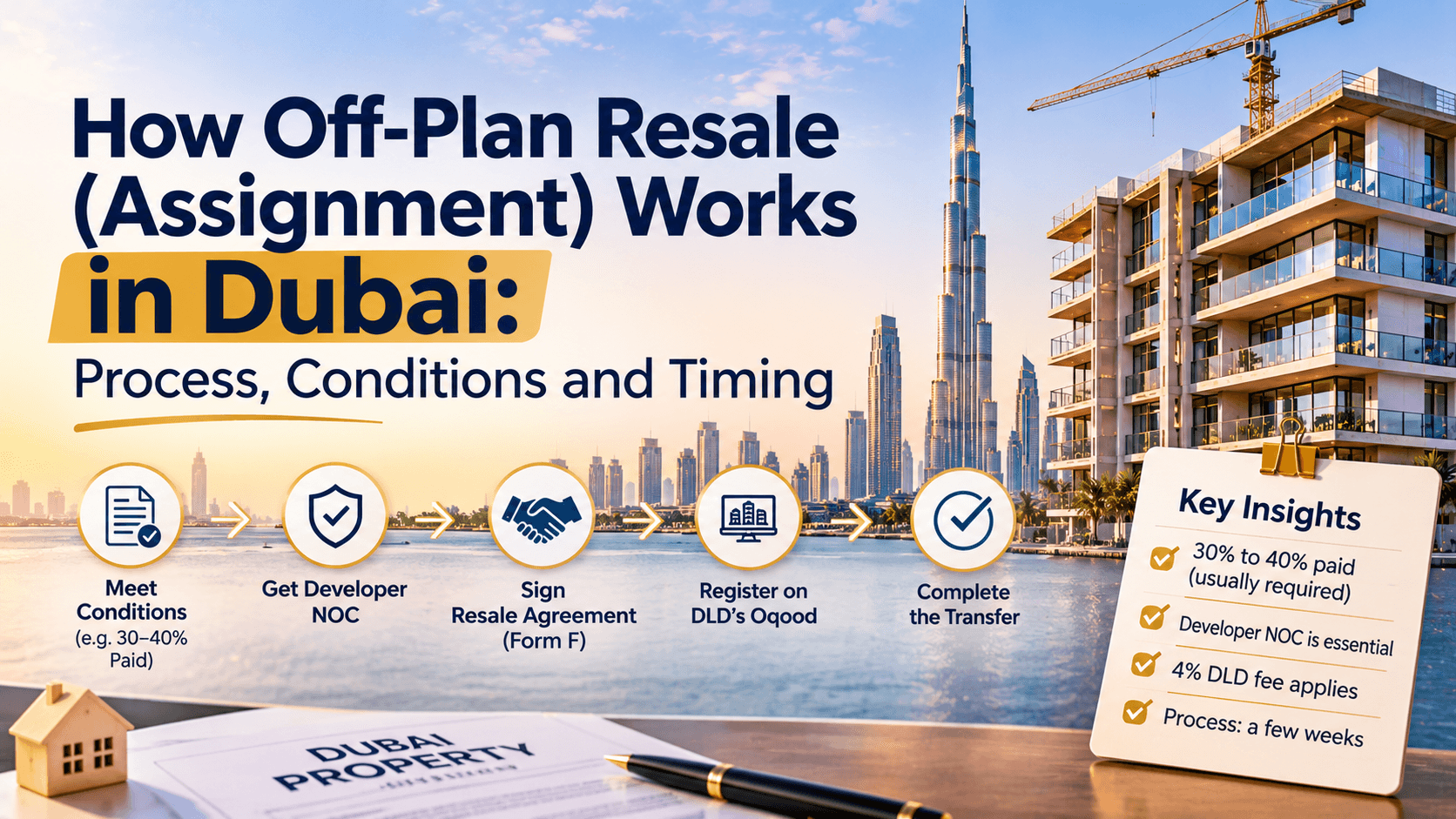
To resell an off-plan unit in Dubai, you usually need to have paid the minimum percentage set in your SPA (commonly 30% to 40%), have no payments overdue, and obtain the developer's No Objection Certificate (NOC). You then sign a resale agreement with the buyer, pay the transfer costs, and have the sale recorded on the DLD's Oqood register. With clean paperwork, the process typically takes a few weeks.
What an off-plan assignment actually is
When you buy off-plan, you are not buying a finished apartment. You are buying a contractual right to receive one at handover, in return for paying the price in instalments. The SPA records that right, and the sale is registered on the DLD's Interim Real Property Register, known as Oqood.
An assignment transfers that package to someone else: the right to the unit and the duty to pay the remaining instalments. The developer stays the same. The buyer on the contract changes.
That is why an assignment differs from a normal resale of a completed home. A completed property is sold by transferring a title deed. An off-plan unit has no title deed yet, so what moves is a registered contractual position.
Why the law matters here
Dubai Law No. 13 of 2008 created the Interim Real Property Register. In summary, it says dispositions of off-plan units that transfer or restrict ownership are void unless they are entered on that register. In plain terms: a private deal between two people that is not registered with the DLD does not protect the buyer. The law is published on the Dubai Legislation Portal, which is a primary source (Law No. 13 of 2008, Dubai Legislation Portal).
A legal explainer by Dubai lawyer Ashish Mehta, published by Khaleej Times on 17 May 2026, describes Oqood as the platform on which off-plan sale agreements are registered, with an Oqood certificate issued as evidence of the buyer's rights (Khaleej Times, 2026). That article is secondary legal commentary, useful for context but not a substitute for the law itself or for advice on your contract.
Conditions you must meet before you can resell
Most delays and failed assignments trace back to one of these conditions.
1. The minimum payment threshold
Developers usually require you to have paid a minimum share of the price before they will approve a resale. Across several 2026 guides, the commonly cited range is 30% to 40% of the contract value, though it varies by developer and project.
Two cautions on this number:
- Source quality varies. Most of the figures come from brokerage and advisory websites, which are secondary sources. Some attribute the threshold to RERA guidance, while others call it a developer policy. The reliable answer is in your own SPA.
- Some projects run lower or higher. One broker guide notes that some launch-phase projects have set the threshold at 30% to attract short-term investors. Treat that as an example, not a rule.
2. The developer's No Objection Certificate (NOC)
The NOC is the developer's written consent to the transfer. Without it, the DLD will not process the change of buyer. This is the gate, and the developer controls it.
3. Payments up to date
If an instalment is overdue, expect the NOC to be refused or delayed. Overdue amounts, late fees and any pending snagging or administrative balances usually need to be cleared first.
4. A properly registered contract
Your original SPA should already be registered on Oqood. If it is not, fix that first.
5. No unresolved mortgage or other restriction
If the unit has a bank financing arrangement attached, you will need the lender's consent and release before the transfer can complete. Plan for this early, because it adds steps.
6. A project that allows it
Check your SPA and the developer's resale policy for any lock-in period, resale window or restriction. Policies differ between developers, and the SPA is the document that binds you.
Step-by-step: how the resale process works
Step 1: Read your SPA and ask the developer for their resale policy
Find the minimum paid percentage, any lock-in, the NOC procedure and the fee schedule. Ask for the fees in writing before you apply. A guide published in 2026 notes that NOC fees are generally non-refundable even if the deal later falls through (Janus Hermes, 2026).
Step 2: Get your statement of account
Ask the developer for an up-to-date account showing what you have paid, what is outstanding and the next due date. A buyer's first question will be exactly this, and the figure sets your sale price floor.
Step 3: Price the unit and find a buyer
Your asking price is made of two parts: what you have paid to date, plus a premium (or minus a discount) reflecting the market. A buyer pays you for the instalments you have already paid and any premium, then takes over the remaining instalments directly with the developer.
Use a RERA-registered broker. Check the broker's registration and the advertising permit on the listing.
Step 4: Sign the resale agreement
The seller and buyer sign a Form F, the RERA-standard memorandum of understanding for the sale. It records the price, the parties and who pays which fees. Agree the fee split here. Market convention is that the buyer bears the 4% DLD fee, but it is negotiable, so write whatever you agree into the document.
Step 5: Apply for the developer NOC
Submit the application with the paperwork the developer asks for, typically IDs, the SPA, payment receipts, the signed Form F and the NOC fee. Developers differ on speed.
Step 6: Pay the fees and complete the transfer
Once the NOC is in hand, the transfer is completed with the DLD, usually through a DLD-registered trustee centre or the developer's own process depending on the project. The DLD fee is paid and the Oqood record is updated to show the new buyer.
Step 7: The buyer takes over the payment plan
The buyer receives the updated Oqood certificate and is now the contractual party for the remaining instalments. From this point, future payments are due from them to the developer's escrow account, not to you.
What it costs: fees and who normally pays
Fees are where seller expectations most often go wrong. The table below shows the common items. The percentages and amounts are approximate, taken from secondary sources published in 2025 and 2026, and individual developers vary.
Cost item | Typical amount (approximate) | Who usually pays |
DLD registration fee | 4% of the sale price | Buyer by convention, negotiable |
Small DLD admin charges | Low double or triple digits in AED | Buyer |
Developer NOC fee | About AED 500 to AED 5,000, plus VAT on some | Seller |
Developer assignment or transfer fee | 0% to about 5% of the original price on some projects | Seller, sometimes split |
Trustee or registration centre fee | Varies by process | Usually buyer, per Form F |
Agent commission | Commonly around 2% plus VAT | Each side, as agreed |
Sources for the ranges: Dealr.ae, 2026 and Real Estate Club Dubai, 2026, both secondary sources. The same guides report that some developers charge an assignment fee of roughly 2% to 5% of the original price. Developer fee practice differs by project, so insist on a written fee schedule. If a figure matters to your decision, confirm it with the developer and the DLD.
A worked example (illustrative only)
Take a unit bought for AED 2,000,000, with 40% (AED 800,000) paid. The seller finds a buyer at AED 2,300,000.
Item | Amount (AED) |
Resale price of the unit | 2,300,000 |
Buyer takes over remaining instalments | 1,200,000 |
Buyer pays the seller up front (paid amount plus premium) | 1,100,000 |
Seller's gross gain over paid amount | 300,000 |
Agent commission, 2% plus 5% VAT (seller side) | (48,300) |
Developer NOC fee (assumed) | (3,000) |
Seller's gain before any developer assignment fee | 248,700 |
If the developer charges 2% of the original price | (40,000) |
Seller's gain after that fee | 208,700 |
On the buyer's side, the DLD fee on AED 2,300,000 at 4% is AED 92,000, and the buyer also pays their agent's commission and any trustee charges. So the buyer's immediate cash need is well above AED 1,100,000, before the remaining AED 1,200,000 of instalments.
Two points are easy to miss. First, if you paid the 4% registration fee when you booked, that money is already spent, and it reduces your real profit. Second, a 15% price rise on the unit looks like a 37.5% gain on the AED 800,000 you have paid in. That is leverage, and it works in reverse when prices fall.
How long it takes
Timing depends mostly on how fast you find a buyer and how quickly the developer processes the NOC. Ranges below are approximate and drawn from the secondary sources cited above.
Stage | Typical duration (approximate) |
Review SPA, collect account statement | 1 to 3 days |
Find a buyer and sign Form F | Days to weeks, depending on market and price |
Developer NOC | About 2 to 10 working days in guides that give figures |
Fee payment and transfer | 1 to 3 days |
Updated Oqood record and new buyer certificate | Same day to a few days |
If the paperwork is clean and a buyer is ready, a few weeks is realistic. Selling the unit is usually the slow part, not the paperwork.
Timing: when does it make sense to sell?
The legal timing and the market timing are different questions.
Legal timing. You cannot sell until you cross the paid threshold in your SPA, so check which instalment gets you there. If you are just under it, paying the shortfall can unlock the sale, but only if the numbers still work after the extra capital is tied up.
Payment-plan timing. Look at the schedule. If a large instalment is approaching, a buyer takes that on, which may make the unit easier to sell before it falls due. Our guide to post-handover payment plans explains why the structure of the plan matters as much as the headline price.
Market timing. Premiums on assignments depend on demand in that project, on competing launches nearby and on overall sentiment. When the market is strong, sellers can ask for a premium. When it softens, assignments often sell at or below what the seller has paid, which is why you will see discounted resales. See our piece on below-original-price off-plan assignments for how that side of the market works.
Handover timing. As handover approaches, assignments compete with completed units for sale. Once the title deed is issued, you are no longer assigning a contract but doing an ordinary resale, with its own process and costs. The wider cost-of-buying breakdown helps compare the two routes.
A practical test: would you still want to own this unit at handover if you could not sell it? If the answer is no, you are relying entirely on the resale market, which is a thin base for an investment decision.
Risks for sellers and buyers
For sellers
- The developer refuses or delays the NOC.
- You have not reached the paid threshold and cannot sell yet.
- Fees cut into the profit more than expected.
- The buyer cannot fund the paid amount plus premium, and the sale collapses after you have paid the NOC fee.
For buyers
- Paying the seller directly, without a signed Form F and a clear transfer route, leaves you exposed. Pay only through the agreed legal process.
- Taking over a unit with arrears or an undisclosed dispute. Ask for the developer's statement of account and confirm it.
- Overpaying a premium on a project with heavy upcoming supply.
- Limited financing. Banks treat off-plan resales differently from completed homes, so ask any lender early what they will and will not finance.
- Assuming the original handover date is guaranteed. A resale buyer inherits the developer's delivery risk.
On tax, secondary sources note that the UAE does not levy a personal capital gains tax on property profits, but federal corporate tax rules can apply if property trading is done through a company or as a business. Confirm your position with a tax adviser, especially if you hold units through an entity or flip regularly.
A checklist before you commit
- Read the SPA for the paid threshold, lock-in and resale clauses.
- Get the developer's fee schedule in writing.
- Request an up-to-date statement of account.
- Confirm the unit is registered on Oqood in the seller's name.
- Check the broker's RERA registration.
- Agree the fee split in the Form F.
- Confirm that all buyer payments go through the agreed legal route and escrow-linked developer account.
- Model the net outcome after every fee, not just the headline price. Our yield calculator helps with the holding economics.
- Ask who is advising you and how they are paid. The free advisor check is built for that.
For wider context on buying off-plan in the first place, see our off-plan investing guide.
Frequently asked questions
Can I sell my off-plan property in Dubai before handover?
Yes, through an assignment, subject to your SPA and the developer's NOC. Most developers require a minimum percentage paid first.
What percentage must I have paid before I can resell?
Commonly 30% to 40%, but the exact figure is in your SPA and differs by developer. Brokerage guides report this range; confirm it with your developer.
Is the developer's NOC always required?
In practice, yes. Without it, the DLD will not process the transfer of an off-plan unit to a new buyer.
How much are the fees?
The DLD fee is commonly 4% of the sale price. The NOC fee is reported at roughly AED 500 to AED 5,000. Some developers also charge an assignment fee of up to about 5% of the original price. Agent commission is commonly around 2%. All figures are approximate.
Who pays the 4% DLD fee?
Market convention is that the buyer pays, but it is negotiable and the Form F records the agreed split.
How long does the process take?
Once you have a buyer and the NOC is requested, the developer step is often a matter of days and the whole process a few weeks. Finding the buyer is usually the slow part.
Can the buyer use a mortgage?
Sometimes, but financing for off-plan resales is more restricted than for completed units and varies by lender. Ask early.
Do I pay capital gains tax on the profit?
Secondary sources report no personal capital gains tax on property profits in the UAE. Corporate tax rules may apply to trading through a company. Take tax advice for your situation.
Sources and how we classify them
- Primary: Dubai Law No. 13 of 2008 Regulating the Interim Real Property Register, Dubai Legislation Portal.
- Secondary, professional commentary: Khaleej Times Legal View by Ashish Mehta, 17 May 2026.
- Secondary, commercial guides used for fees and thresholds (approximate values): Dealr.ae (2026), Real Estate Club Dubai (2026), Janus Hermes (2026).
Fee levels and developer policies change, and they differ by project. Treat every number here as a guide, and confirm it against your SPA and with the developer before acting.
About the author
Ritu Kant Ojha is a Dubai-based real estate investment advisor and the founder of Proact Luxury Real Estate (RERA BRN 71195). An IIM Lucknow alumnus and former financial journalist at Bloomberg and CNBC, he has spent two decades covering and analysing capital markets before moving into property advisory. He works with NRI and international families buying in the UAE, with a focus on independent due diligence, structured decision-making, and long-term asset strategy. He is the author of The Only Difference (2026), which sets out the ADVICEdge framework for evaluating financial advisors, and Real Conversations In Digital Age (2019).
Thinking of selling or buying an off-plan assignment? Request a review or message on WhatsApp.