Red Flags in Dubai Off-Plan Sales Pitches: What Overseas Buyers Should Question
The biggest red flags in Dubai off-plan sales pitches are pressure to pay fast, promises of guaranteed returns or a visa, missing permit and escrow details, and costs that stay vague. Ask for every claim in writing. Check the ad permit, the broker, the developer and the project escrow account against official Dubai Land Department (DLD) records. Compare the pitch with the contract. If answers change or stop, pause. A real deal can wait a few days. Red flags in Dubai off-plan sales pitches are e
Updated 15 October 2026
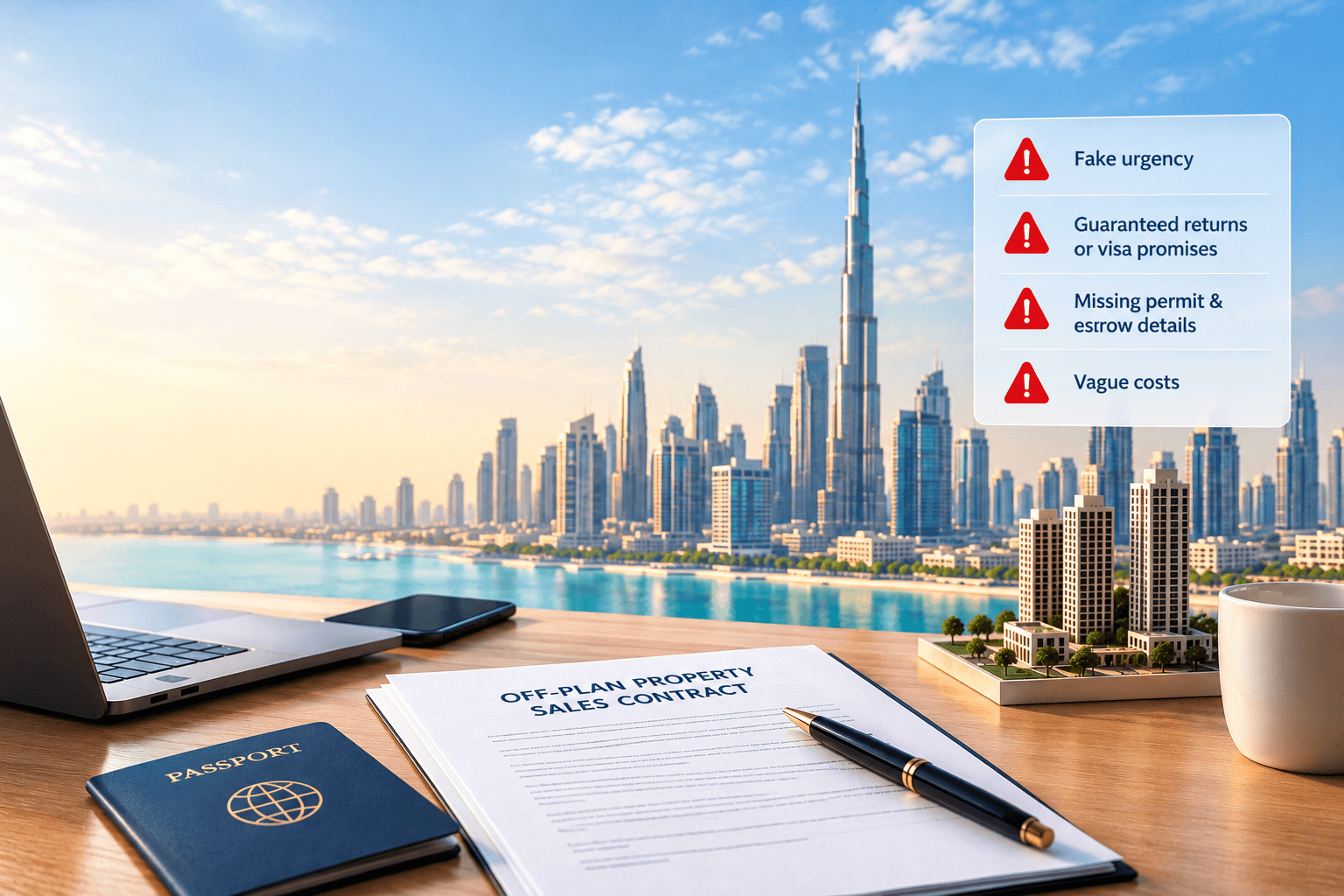
The biggest red flags in Dubai off-plan sales pitches are pressure to pay fast, promises of guaranteed returns or a visa, missing permit and escrow details, and costs that stay vague. Ask for every claim in writing. Check the ad permit, the broker, the developer and the project escrow account against official Dubai Land Department (DLD) records. Compare the pitch with the contract. If answers change or stop, pause. A real deal can wait a few days.
Red flags in Dubai off-plan sales pitches are easy to miss when you are far away. The deck looks great. The agent is friendly. The launch is "closing tonight." You cannot walk the site, so the pitch is all you have. This guide lists the warning signs, what to ask when you see them, and where to check the answer.
It is written for overseas buyers. Maybe you are in India, the UK, the US or Singapore. Maybe you are buying for the first time. The goal is not to scare you away from Dubai. The goal is to help you ask better questions before you send money.
Why Overseas Buyers Hear the Loudest Pitches
Dubai is a very busy market. Gulf News, citing DLD data, reported on 1 January 2026 that 2025 sales reached about AED 682.49 billion across 214,912 transactions. Value rose 30.64% from AED 522.36 billion in 2024, and the number of sales rose 18.82% from 180,860.
A big part of that is off-plan. This means you buy a home that is still being built. DXB Interact, which analyses DLD transaction data, put off-plan at 65% of 2025 sales value and 69% of sales volume. Its totals (AED 686.8 billion, 215,736 sales) are slightly higher than the DLD-reported figures above because the two sources count the data differently. Treat the shares as a good guide, not an exact count.
With this many launches, sellers compete hard for attention. Overseas buyers get the most polished pitch because they cannot check things in person. Our note on why off-plan keeps pulling investors in explains the appeal. This guide is about the other side: what to question before you say yes.
The Red Flags at a Glance
Use this table as a quick scan. The sections after it explain each row.
Red flag | What you may hear | What to ask | Where to check |
Fake urgency | "Only 2 units left. Price goes up tonight." | Can I have 5 days to review the contract? | Contract draft, your lawyer |
Guaranteed returns | "Guaranteed 10% rent." | Where is this written in the contract? | Contract, rental data |
Visa promise | "You will get the Golden Visa." | Has DLD confirmed this unit qualifies? | DLD, your lawyer |
No ad permit | A brochure with no permit number | What is the Trakheesi permit number? | DLD |
Vague escrow | "Do not worry, it is safe." | What is the escrow account for this project? | DLD project records, Dubai REST |
Easy payment plan | "Just 1% a month." | What are the late payment terms? | Sale agreement |
Hidden costs | "Only the price, nothing else." | Give me a full cost list in writing | Written cost sheet |
Wrong payee | "Send it to this account." | Is this the project escrow account? | Project record |
Weak broker proof | No broker number shared | What is your BRN and permit? | Dubai REST |
Selective track record | Only the best project shown | List all past projects with handover dates | Public records, DLD |
Red Flags in the Pitch Itself
1. Pressure and Fake Urgency
"Only two units left." "Prices go up at midnight." "Another buyer is on the phone." These lines try to make you decide before you check.
Launches are real, and good units do sell. But a contract takes time to read, and your bank transfer takes time too. A seller who is confident in the deal will give you a few days. Our philosophy is simple: the best option is the one that survives scrutiny, not urgency.
What to ask: "Can you hold this unit for five working days while my lawyer reads the contract?" If the answer is no, think about why.
2. Guaranteed Returns and Rental Promises
Be careful with any pitch that says a return is "guaranteed." Rent and resale prices depend on the market, the building and the year. Nobody can promise them.
Some offers do include a rental guarantee. If so, it should be written in the contract, with the amount, the period, and who pays. A promise from a salesperson on WhatsApp is not a contract term.
What to ask:
- Is the guarantee in the sale agreement or a separate signed document?
- Who pays it, the developer or the agent's company?
- What happens if the payer stops paying?
- Is the guarantee included in the price you pay, so you fund it yourself?
You can test the rent claim yourself. Compare the pitch with the official rent index. Our guide to the RERA rental index calculator shows how.
3. Golden Visa Promises
Many pitches use the Golden Visa as bait. The usual number is AED 2 million of property. Can an off-plan unit count? Sometimes, but it is not automatic. A May 2024 circular from a Dubai law firm says that for off-plan units the final decision is at DLD's discretion, and that you can ask DLD in advance for a binding answer.
Published guides do not agree on the off-plan rules, and rules have changed in recent years. I could not find one primary DLD page that settles every off-plan case. So treat "guaranteed visa" as a red flag. Ask DLD, the immigration authority (GDRFA) or a UAE lawyer before you rely on it.
What to ask: "Has DLD confirmed this unit qualifies? Can you show me in writing, and what if it does not?"
4. No Advertising Permit Number
In Dubai, real estate ads need a permit. In a DLD release dated 20 October 2020, DLD said its regulator, RERA, requires companies to get a permit through the Trakheesi system before any marketing campaign, and to show the permit number in all real estate ads. Buyers can report ads without a permit through the Real Estate Violations System. In the same release, DLD said it had fined 10 companies and warned 30 others.
So a flyer, post or website with no permit number is a warning sign. It does not prove fraud, but it is a rule break, and it is easy to check.
What to ask: "What is the permit number for this advert?"
5. Vague Answers About Escrow and the Developer
"Your money is safe" is not an answer. You want the escrow account for the project, the legal name of the developer, and proof they match.
Law No. 8 of 2007 applies to developers who sell units off-plan and take payments from buyers. In simple words, the law requires an escrow account opened in the name of the project and used only for building that project. DLD's FAQ says buyers can track the status of projects on the DLD website. Laws can be amended, so ask a UAE lawyer to confirm the rules that apply to your purchase.
What to ask: "What is the escrow account for this project, and does it match what I see in the official project record?"
6. A Payment Plan That Looks Too Easy
Long payment plans help many buyers. A plan with small payments during construction and more after handover can be a fair tool. The red flag is when the plan is the only thing being sold.
Look at what sits behind it:
- Is the price higher because of the plan?
- What happens if you miss a payment? Are there fines, or can the unit be cancelled?
- Do the big payments land right before handover, when you may not have cash?
- Are you counting your currency exchange rate? A weak home currency can raise your real cost.
Heavy payment calls are one reason some buyers end up selling early. Our note on distressed off-plan assignments in Dubai shows how that can go.
What to ask: "Please send the full payment schedule and the late payment clause."
7. Costs Left Out of the Pitch
The price in the brochure is not your full cost. Costs people often forget:
- DLD registration fee. This is commonly quoted as 4% of the property value, plus small admin fees. Who pays, and when, can differ by deal, so get it in writing.
- Fee "waivers." Some launches offer to cover the DLD fee. Ask if the price was raised to pay for it.
- Service charges. These are yearly fees for running the building. Ask for the current budget per square foot, and compare it with RERA-approved rates for similar buildings.
- Agent and legal fees. Ask whether any are on top.
For a clear view of the costs after you buy, read our guide on the real cost of flats in Dubai.
What to ask: "Please give me one sheet with every cost from booking to handover, in AED."
8. Pretty Renders and Loose Claims
Renders are art. They are not the building. Be careful with:
- "Sea view" or "skyline view" with no floor plan or tower position to prove it
- "Five minutes from the metro" with no map or walking time
- Sizes that are not the same as in the contract
- Handover dates that differ between the brochure and the sales agreement
The contract wins. If the brochure says one thing and the contract says another, ask the seller to fix the contract, not to "trust me."
What to ask: "Where in the contract is this claim written?"
9. Asking You to Pay Into the Wrong Account
This is the loudest red flag of all. Pay only into the escrow account that matches the project record. Do not pay into a personal account, an agent's account, a different company, or any non-project account. Do not pay "booking fees" or "admin fees" on the side.
Be careful with offers to pay in cash or crypto, or to send money by a third party on your behalf. If the payee name does not match the developer or the project escrow account, stop. Re-check the account name and number before every transfer, even if you have paid before.
What to ask: "Please show me where this account appears in the official project record."
10. Weak Proof That the Broker Is Licensed
The person pitching you also needs checking. Brokers in Dubai need a licence. DLD has said that customers can verify licensed brokers through the Dubai REST app, on its Dubai Brokers page.
What to ask: "What is your broker number and your company's permit? I will check them on Dubai REST."
11. A Selective Track Record
Sellers love to show the best past project. Ask for all of them. A developer with five past projects should be able to list them, with launch dates and real handover dates. If the seller only shows the shiny one, ask about the others.
This is the order we work in: delivery record before the brochure. Check what the developer has actually handed over, and when, before you spend time on renders and payment plans.
What to ask: "Please list every project you have launched, with the planned and actual handover dates."
12. "Easy Exit" and Resale Claims
"You can sell before handover and double your money" is a sales line, not a plan. Selling an off-plan unit (called an assignment) depends on the contract, the developer's rules and how much of the price you have paid. Fees may apply on both sides. Resale prices can fall as well as rise.
What to ask: "What are the developer's rules and fees for assigning my unit, and from what payment stage?"
What I've seen
A London-based client came to me with an off-plan contract that included a verbal offer of eight percent net rental yield, guaranteed for two years. The agent said the guarantee letter would follow separately after the booking fee was paid. I asked my client to send me the contract draft first. There was no guarantee clause anywhere in the document. When we asked for it to be included in the contract before payment, the developer's team said that was not how they operated. My client did not pay. A promise that cannot be put in writing is not a commitment — it is a sales tactic.
A Worked Example: Pitch Versus Contract
This example is made up. It only shows how to compare words and paper.
What the agent said | What the contract draft shows | Your action |
"Handover in Q4 2028" | "Q4 2028, plus 12 months grace" | Ask what the grace clause allows |
"Guaranteed 8% rent for 3 years" | No rental clause | Ask for a signed addendum or treat it as no guarantee |
"No extra costs" | Admin fee and service charge deposit listed | Ask for the total cost sheet |
"Pay to this account" | Contract names a different escrow account | Pay only to the contract account |
A grace period is the extra time a developer gets after the stated handover date. A July 2026 update from a Dubai law firm says most Dubai off-plan contracts give six to twelve months of grace, and that a delay inside that window is generally not a breach. So a 12-month grace clause can move your real handover date a full year.
If the words and the paper do not match, believe the paper. Then ask the seller why they are different.
Questions to Ask Before You Pay
Put these in an email, so you have a record:
- What is the full legal name of the developer, and its licence number?
- What is the project registration number and the escrow account?
- What is the Trakheesi permit number for this offer?
- What is the broker's number and company permit?
- Can I see the full sale agreement before I pay a booking amount?
- What is the full cost list, from booking to handover?
- What is the payment schedule, and what are the late payment terms?
- What is the planned handover date, and what grace period does the contract allow?
- Which past projects has this developer handed over, and when?
- What are the rules and fees if I want to sell before handover?
A good seller answers these in writing. A weak seller goes quiet, changes the topic, or pushes you to "decide first."
How to Protect Yourself from Abroad
- Slow the pace. Set your own deadline. Do not let the seller set it.
- Keep everything in writing. Use email. Take screenshots of ads and chats.
- Check on official tools. Use DLD records and the Dubai REST app for projects, developers and brokers, and the permit number for the ad.
- Use a UAE lawyer. Have the sale agreement reviewed before you pay.
- Pay safely. Use bank transfers to the named escrow account only, and keep the receipt.
- Watch the exchange rate. Work out your total cost in your own currency, with a cushion.
- Do not be shy. Good sellers expect questions from overseas buyers.
What a Good Pitch Looks Like
A good pitch has the opposite signs. The seller gives you the permit number and the broker number. The escrow details match the official record. The cost sheet is clear. The handover date and grace period are in the contract. The seller lists past projects, including late ones, and explains them. You get time to think.
None of this guarantees a great deal, but it shows a seller who is willing to be checked.
Frequently Asked Questions
What is the biggest red flag in a Dubai off-plan pitch?
Pressure to pay quickly, especially into an account that does not match the project escrow account. Everything else can be checked slowly. A wrong payee is hard to fix after the money leaves.
Is a guaranteed rental return a scam?
Not always. Some developers offer written rental guarantees. The red flag is a guarantee that is only spoken, or not in the contract. Ask who pays it, for how long, and whether the price includes it.
Does off-plan always qualify for the Golden Visa?
No. Off-plan eligibility is not automatic, and published guides disagree on the details. A Dubai law firm circular says the final decision is at DLD's discretion. Confirm with DLD, GDRFA or a UAE lawyer before you rely on it.
How do I check that an ad is real?
Look for the permit number in the ad. Then check the broker on the Dubai REST app. DLD says ads without permits can be reported through its Real Estate Violations System.
Who pays the DLD fee on an off-plan purchase?
Sources differ, and deals differ. Some launches offer to cover the fee. Ask the seller to state in writing who pays, how much and when, and confirm it with a lawyer.
Should I pay a booking fee before I read the contract?
Try not to. If you must reserve a unit, ask what the booking amount is, whether it is refundable, and whether it goes into the project escrow account.
Your Next Step
If a pitch has landed in your inbox and something feels off, send us the details and we can walk through the red flags with you. Start with a conversation about your plan, or browse more Dubai property insights.
About the Author
Ritu Kant Ojha is a Dubai-based real estate investment advisor and the founder of Proact Luxury Real Estate (RERA BRN 71195). An IIM Lucknow alumnus and former financial journalist at Bloomberg and CNBC, he has spent two decades covering and analysing capital markets before moving into property advisory. He works with NRI and international families buying in the UAE, with a focus on independent due diligence, structured decision-making, and long-term asset strategy. He is the author of The Only Difference (2026), which sets out the ADVICEdge framework for evaluating financial advisors, and Real Conversations In Digital Age (2019).
This article is for education. It is not legal or financial advice. Rules, fees and app menus can change, so confirm the latest details with the Dubai Land Department and a UAE lawyer before you pay. See our Trust and Disclosures page.