
When deciding between new and old Dubai apartments, building age alone does not determine value. Dubai Land Department data shows that newly handed-over units frequently face immediate tenant supply spikes that depress initial rents, while buyers of older tenanted units legally inherit existing lease terms. You must compare matched properties based on actual operating outcomes.
For a buyer making decisions in 2027, treating 2026 figures as the latest available data reveals the actual cost of ownership beyond developer marketing. Understanding these distinct asset stages protects your capital. This analysis breaks down how off-plan, newly completed, and established properties compare on exact prices, verified rent evidence, physical upkeep, layout utility, and resale depth.
A proper assessment divides the market into three distinct asset stages.
First, off-plan properties remain under construction, offering no completed apartment to inspect and no operating rental history. The buyer is purchasing a developer contract, a set of architectural plans, and an escrow schedule regulated by Dubai law.
Second, newly handed-over properties are finished and ready for physical inspection, but their operating record is extremely short. The paint is fresh, the lobby smells new, and the amenities look pristine. Yet the building has not weathered a full lease cycle, the owners' association has not established its reserve fund, and actual tenant demand remains unproven.
Third, established resale properties offer a long operating history, giving buyers proven yield data while requiring closer checks on physical condition. These assets provide transaction trails, registered tenancy records, and historical maintenance patterns, but they also expose buyers to deferred building maintenance, outdated finishes, and capital refurbishment costs that can immediately dilute yield.
Evaluating these three stages requires evidence. I compare off-plan, newly handed-over, and established Dubai apartments on matched prices, verified rent evidence, physical upkeep, layout utility, and resale depth. For overseas investors building long-term family wealth, understanding the nuances of Buying Property in Dubai for Foreigners starts with stripping away marketing rhetoric and examining what each property asset stage actually delivers to the balance sheet.
How I Compare Like With Like
Comparing an off-plan penthouse in Business Bay with an older studio in International City tells me nothing about the value of age. I require a valid comparison to match the community first, isolating the analysis to the same neighbourhood or a highly similar adjacent tower. When I examine a two-bedroom apartment in Dubai Marina, I benchmark it against other two-bedroom units in Dubai Marina with similar canal or sea orientation, rather than pulling numbers from Jumeirah Village Circle or Downtown Dubai.
I then match the exact unit specifications, aligning the bedroom count, registered area, floor level, view orientation, parking allocation, furnishing status, and physical condition. A vacant unit holds a different market value than a tenanted one because Dubai tenancy laws mandate specific legal notice for eviction. When a buyer acquires a tenanted apartment let below prevailing market rates, the buyer inherits the existing tenancy contract, which restricts immediate rental yield and complicates personal occupancy plans.
Once the physical attributes align, I set aside portal asking prices and build my baseline from transaction records in the Dubai Land Department Real Estate Data. I use its fields for transaction dates and amounts, property sizes, room counts and project names.
Using this verified data, I calculate the precise price difference between asset stages. A premium needs mathematical proof for the specific target asset rather than relying on a generic Dubai-wide percentage. I do not assume all new apartments carry a fixed thirty percent premium over older stock, because that figure fluctuates widely depending on micro-location, developer reputation, and immediate infrastructure delivery.
I use a standard matched calculation to define this premium:
Matched new-build premium (%) = (median new-unit price per area − median older-unit price per area) ÷ median older-unit price per area × 100
I subtract the median older-unit price per area from the median new-unit price per area, divide the result by the older-unit baseline, and multiply by 100. This formula works only when the underlying comparables are genuinely equivalent. If I compare a brand-new high-floor apartment facing the Burj Khalifa against a low-floor older unit facing a parking structure, the mathematical premium reflects the view and elevation rather than the true age differential.
DLD property data records sizes in square metres. When I evaluate listings marketed in square feet, I convert every unit measurement consistently using standard conversion factors so that the price per unit area remains accurate across the dataset.
If an off-plan payment plan forms part of the comparison, I display the total contractual price and the payment timing separately from the immediate cost of a ready resale unit. A deferred payment schedule holds financial value, but conflating it with a ready-asset purchase price distorts capital allocation planning. Staggered developer instalments spread the buyer’s cash outlay over several years, yet the nominal purchase price is frequently marked up by the developer to compensate for that delayed cash collection. I measure that deferred capital benefit against the immediate income generation of a ready property.
The Three Asset Stages Compared
I evaluate each property type against identical operational criteria. This approach removes emotional bias, allowing the evidence to dictate the outcome.
| Evaluation Criterion | Off-Plan (Under Construction) | Newly Handed-Over (0-2 Years) | Established Resale (3+ Years) |
|---|---|---|---|
| Price Evidence | Developer contractual price and structured payment schedule, lacking secondary sales verification until construction milestones advance | Recent completed DLD transfers for identical newly ready units, capturing initial handover market clearing values | Extensive historical DLD transfer data tracking multi-year appreciation cycles, macro corrections, and sustained resale pricing |
| Rental Income | Projected yields based on developer marketing calculations and speculative area absorption assumptions | Actual achieved post-handover leases with limited renewal history, vulnerable to initial supply spikes as owners compete for tenants | Registered DLD rental index history and long-term operating yield proof across varying market environments and tenant demographics |
| Upkeep & Maintenance | Covered by developer warranty until handover completion, zero operational service charges during the construction phase | Defect liability period active, initial service charges freshly approved by DLD, unproven long-term building reserve fund | Actual unit statements, known major works, verified reserve fund status, requires calculated immediate refurbishment allowance |
| Layout Verification | Architectural floor plans, virtual renders, and show apartment representations that often conceal structural columns and pipe drops | Physical walkthrough, professional remote snagging inspection available, verifying exact delivered fixtures and room utility | Physical inspection of actual wear, past tenant modifications, MEP degradation, and true circulation space |
| Resale Liquidity | Restricted by developer assignment thresholds and paid percentage requirements, limited buyer pool during construction | Proven by recent secondary market transfers in the specific building, highly attractive to buyers wanting immediate modern occupancy | Supported by established turnover velocity, consistent distinct buyers, clear mortgage eligibility, and verifiable title transfers |
New Apartments: Price, Evidence and Risk
A quoted price from a developer is a claim I test before advising a buyer to commit capital. Buying an apartment off-plan differs materially from buying a completed new apartment. Each path carries distinct risks and requires a specific due diligence process to protect the downside scenario alongside the potential upside.
Off-Plan: Separate Price, Delivery and Income Assumptions
Purchasing an off-plan property means buying a contractual promise based on projected figures. I cannot inspect the completed unit, touch the joinery, verify the acoustic insulation, or verify operating rent.
To assess delivery progress, I use the official Dubai Land Department Project Status Enquiry. I can search by land number, project number or project name and view the completion percentage and project details.
Dubai mandates escrow accounts for uncompleted developments to protect buyer funds. Under Dubai Law No. 8 of 2007, developers selling off-plan units are required to route purchaser payments into a dedicated escrow account tied directly to that specific project and land plot.
The current regulations state that 5 percent of the total amount paid into the escrow account is retained for one year after project completion. This retention addresses defects apparent at completion or arising within a year after handover, though the Real Estate Regulatory Agency may grant exceptions in specific circumstances. I treat this as a structured defect safeguard rather than a complete warranty or a guarantee of investment returns. It provides a financial cushion to rectify structural flaws, yet it does not insulate the buyer from market shifts, rental fluctuations, or project handover delays.
When modelling yield on an off-plan unit, I separate projected rent from achieved rent. Developers frequently market high expected yields based on optimistic market conditions and best-case occupancy rates. I strip these projections down to model the downside scenario, calculating the yield based on verifiable secondary market rents in nearby completed buildings. If a developer promises a nine percent gross yield in an emerging master plan, but comparable completed stock three streets away rents at six percent gross, I run the financial model on the six percent figure.
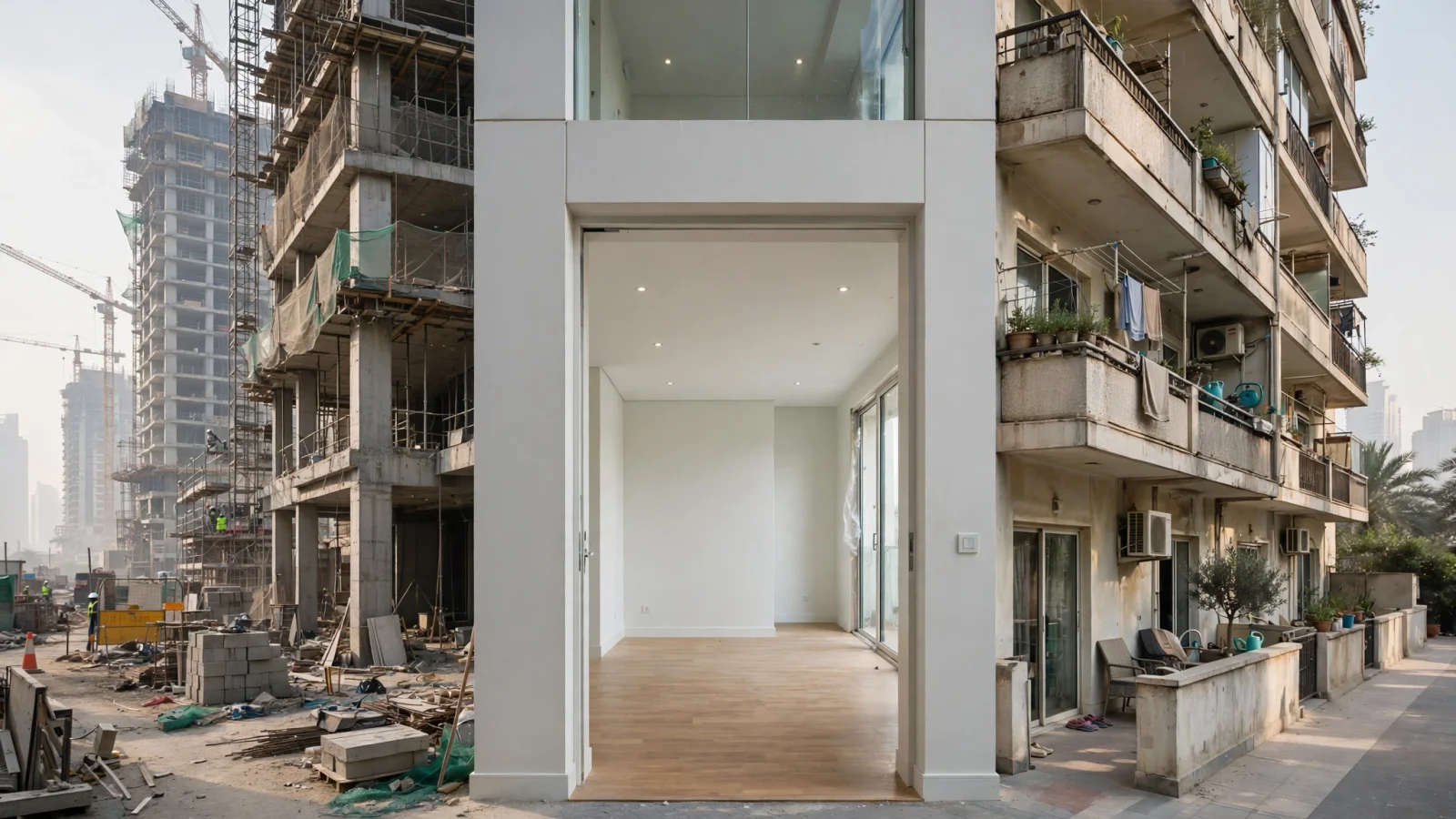
Newly Handed Over: Inspect Before Assigning a Premium
A newly handed-over apartment allows physical due diligence while lacking a long operating history. A fresh finish does not guarantee low running costs, consistent rent, or future buyer interest.
Non-resident Indian investors managing acquisitions remotely cannot rely on developer photographs, wide-angle lenses, or staging furniture. I advise securing a dated video walkthrough alongside a professional snagging inspection. A professional snagging company tests the plumbing pressure, electrical circuits, thermal imaging for air-conditioning leaks, tile hollows, and window seals to generate a detailed defect report before handover is accepted.
During the initial one-year defect liability period, the developer remains legally obligated to rectify non-structural defects documented in that snagging report. I advise buyers to document defects before releasing the final payment and taking possession. Otherwise, getting subcontractors to return to repair faulty silicone seals or unbalanced ducted air conditioning becomes an uphill struggle.
Reviewing current, approved service-charge information protects operating margins. Developers sometimes estimate low service charges during the sales phase to make projected net yields look appealing to off-plan purchasers. The owners' association and the property management company finalise the actual operational budget once the building becomes fully functional, and this budget must be formally approved by RERA. I check these approved figures against similar operational buildings in the district to ensure the net yield calculation remains accurate.
I base rental income estimates strictly on lease contracts signed since the handover date. A newly delivered building often sees identical units hitting the rental market simultaneously, creating a supply spike that can temporarily depress rental prices. If 400 landlords take delivery of their two-bedroom apartments in the same tower within the same sixty-day window, competition can put downward pressure on rents. Investors who must service mortgages may lower their asking rents to secure immediate tenancies. I account for this initial leasing phase and potential vacancy downtime before assuming the building's tenant profile will stabilise.
Older Dubai Apartments: Track Record and Costs
Established resale properties provide the data that newer buildings lack. A long operational record helps me test registered rents and completed transfer values, though past performance never guarantees future tenant demand.
An older building requires a specific verification process. I start by checking the current lease and tenancy status. Dubai law dictates that the new owner inherits the existing lease terms if the property is currently rented. Buyers intending to move in or sell the unit vacant are required to serve a formal 12-month eviction notice upon transfer, delivered through a notary public or registered post, specifying one of the statutory reasons for eviction such as personal use or sale.
If the sitting tenant pays rent significantly below the current market rate, I do not assume the new owner can immediately raise that rent to market levels upon acquiring the title. Any rent increase is governed by the statutory framework detailed in my Dubai RERA Rental Index guide, which restricts rental adjustments based on how far the contract rent sits below the official benchmark. An older property might look cheap on a headline price per square metre, but if the tenant's rent is thirty percent below market and cannot be adjusted quickly, immediate cash return will lag until the tenancy resets.
I then review rent evidence for comparable units in the building alongside historical service-charge statements. Reviewing the actual unit statements verifies there are no outstanding arrears blocking the transfer. In Dubai, a developer will refuse to issue the mandatory No Objection Certificate for transfer until all historic service charges, maintenance fees, and administrative penalties are cleared to the last Dirham.
Condition remains the primary variable affecting an older property's value. I account for building age and physical wear, while investigating any planned major works. I never assume an older apartment is cheaper to buy or maintain. The matched transactions and calculated costs dictate the final verdict. I include a realistic refurbishment allowance in the acquisition budget. Upgrading an ageing kitchen, replacing worn bathroom fixtures, resealing double-glazed windows, or overhauling an internal ducted fan coil unit requires immediate capital, reducing net yield during the first year of ownership.
I also evaluate the building's central mechanical, electrical, and plumbing infrastructure. A fifteen-year-old tower with neglected chillers, leaking cooling pipes, or outdated lift motors will face substantial capital calls. If the building's reserve fund has not accumulated sufficient capital over its operational lifespan, those repair costs land directly on unit owners as emergency special levies.

How Rent, Upkeep, Layout and Resale Affect Value
The ADVICEdge framework requires me to compare actual operating outcomes against concrete resale evidence. I do not base investment advice on headline gross rent or superficial building age. To assess whether an asset fits a buyer’s portfolio, I break down the core operational metrics.
Rental Evidence and Net Income
When advising Indian diaspora investors working abroad, I consistently see a focus on gross rental yields. Gross yield alone gives an incomplete picture. An advertised eight percent gross return does not show how much cash will reach a buyer's bank account at the end of the calendar year. I model operating income before financing and personal tax to reveal the true cash flow.
My operating income formula takes the gross expected rent and immediately deducts an allowance for vacancy and tenant turnover downtime:
Operating income before financing and personal tax = rent after vacancy and downtime − service charges − management and letting costs − maintenance and landlord-paid costs
From that figure, I subtract the verified service charges alongside professional property management fees and standard ongoing maintenance costs. If the apartment requires tenant turnover painting, deep cleaning, minor plumbing fixes, or landlord-paid building insurance, those expenses come out of operating income before the owner touches a single Dirham of profit.
I use the Dubai Land Department Rental Index when assessing a rent assumption. I base that review on the contract end date, index type, property type, area and bedroom count requested by its calculator.
Once I establish the operating income, I define the yield's cost basis. A strategy requiring an immediate AED 100,000 refurbishment means that cost sits in the denominator alongside the purchase price, DLD transfer fees, broker fees, and trustee administration charges. Calculating a yield against purchase price alone produces a false sense of security.
Mortgage cash flow remains entirely separate from the unlevered property yield. Mixing leverage effects into the base property yield masks the asset's true performance. I first establish what the brick-and-mortar property delivers on its own merits, then test how debt service, interest rate fluctuations, and bank arrangement fees alter the net return.
To model these cash flows accurately, investors can use the ADVICEdge net-yield calculator. This tool integrates gross rent, vacancy assumptions, RERA-approved service charges, professional property management fees, and financing parameters into a single transparent calculation, while allowing users to add refurbishment allowances where an older unit demands capital work. I also offer free tools, including a RERA rental index calculator and the ADVICEdge Advisor Check, which help buyers assess rent assumptions and advisory fit.
For overseas buyers, I present the property's Dirham-level economics first. The UAE Dirham is pegged to the US Dollar, offering currency stability to investors dealing with fluctuating home currencies. Personal tax liabilities and cross-border remittance costs depend entirely on residency status. An NRI based in the United Kingdom faces a completely different tax position regarding foreign rental income than an NRI residing in Singapore or a diaspora family operating from Mumbai. Establishing a clean UAE baseline allows a local tax professional to apply the buyer's personal tax treatment accurately without confusing property-level operating cash flows with domestic tax obligations.
To examine how rental caps and statutory increases function under local regulations, buyers can cross-reference the RERA Rental Index Dubai Calculator alongside official regulatory benchmarks. A calculator provides a baseline, but it never replaces thorough, building-specific due diligence.
Service Charges and Physical Upkeep
Service charges dictate a large portion of operating costs. Building age does not automatically determine maintenance expenses. Some older buildings feature excellent management with healthy reserve funds, whereas some poorly managed new towers face immediate cash flow crises.
I use the official Dubai Land Department Service Charge Index to check service-charge information by project, usage and year.
According to the Dubai Land Department Frequently Asked Questions, service charges vary significantly by project. The calculation incorporates the specific services provided and the extent of the common areas, dividing the burden across the total number of units. A boutique low-rise building with twenty apartments, two swimming pools, 24-hour concierge, and extensive landscaping will carry a far higher per-square-metre service charge than a 500-unit tower where common area expenses are spread across a massive owner base.
The DLD explicitly states that the index result does not include individual unit arrears. This distinction is critical for buyers. While the official index tells a buyer that a project carries an approved charge of AED 16 per square foot, it does not reveal whether thirty percent of the building's unit owners have defaulted on their fees. When collections lag, the owners' association must cut service levels, leading to neglected cooling systems, dirty facades, broken gym equipment, and deteriorating common corridors.
I advise buyers to review the actual unit statement from the seller before signing a Memorandum of Understanding. If the current owner holds significant service charge arrears, the developer or owners' association blocks the No Objection Certificate required for the DLD transfer. Reviewing the building's financial health also reveals impending major works. A chiller system requiring replacement next year results in a sudden special levy that eliminates anticipated yield.
Layout and Resale Evidence
Age rarely dictates how well an apartment functions for a tenant. Layout efficiency drives long-term livability, which is why I compare actual floor plans on a strict square-metre basis.
Evaluating a floor plan requires looking past the total registered area. The DLD unit data identifies fields such as unit size, floor level, and balcony area. These data points provide a structural overview without confirming whether a layout works well in person.
I inspect the internal circulation space. A 90-square-metre apartment with a long, dark corridor, oversized structural columns cutting into the living room, and an unusable angular balcony offers less usable living space than an 80-square-metre apartment with an open, square footprint. Many newer builds prioritise flashy exterior architectural curves at the expense of internal furniture placement, leaving tenants with curved walls that make placing standard wardrobes and dining tables difficult.
I evaluate bedroom privacy and natural light penetration to ensure the space remains practical. In poorly planned units, master bedroom doors open directly onto the kitchen, or guest bathrooms sit awkwardly across the living room. I recommend that remote buyers arrange a detailed video inspection to capture these spatial realities, highlighting tight corners and awkward room dimensions that static photos hide.
Measuring resale liquidity reveals how easily a buyer can exit the investment. I count the recent completed sales for comparable units within the specific building, separating actual DLD transfers from lingering portal asking prices. When planning future capital repatriation, I recommend reviewing the principles of Selling Property in Dubai to understand how secondary market sales execute in practice.
High transaction volume can indicate strong secondary market liquidity. The DLD transaction fields record the final clearing price without showing the days on market. A recorded transfer confirms the amount paid, yet it leaves out whether the seller waited three weeks or nine months. I cross-reference the transfer data with local market activity to estimate a realistic exit timeline. For insight into historical resilience and liquidity, my analysis on Why Dubai Real Estate Historically Outperforms Global Crises details how transaction volumes behave during market shifts.
A Remote Buyer's Checklist for Dubai Apartments
Managing an acquisition from abroad adds logistical friction. A buyer in London or Singapore cannot drop by the land registry office to resolve paperwork or visit the building lobby to speak with the concierge, so I use a structured checklist to review legal, operational, and financial details before capital is transferred.
Completed New Apartments Checklist
- Professional remote snagging inspection: I recommend commissioning a licensed inspection firm to review the apartment before completing final settlement. The inspection should cover air-conditioning airflow, electrical phases, plumbing drainage, tile hollows, and door balances, with all snagging items documented for the developer to rectify under the one-year defect liability warranty.
- Dated continuous video walkthrough: I ask the buyer's representative to film a single, uncut video walkthrough starting from the building drop-off area, through the security lobby, into the lift, along the common corridor, and through every room of the unit. This reveals actual daylight levels, corridor maintenance, ambient traffic noise, and view obstructions that staged photos conceal.
- Approved service charge verification: I advise pulling the project's current approved service charges from the DLD Service Charge Index rather than accepting developer sales projections. The buyer should verify the per-square-metre rate and confirm what services, chillers, and common amenities that charge covers.
- Post-handover lease registry check: I recommend reviewing actual tenancy contracts registered with DLD in that specific building since handover. Buyers can assess the real rents achieved by early landlords to establish a rental baseline, discounting any developer rental guarantees that may be artificially subsidised.
- Title deed and handover notice review: I advise confirming that the developer has received the completion certificate from Dubai Municipality, that the building is fully cleared for legal occupancy, and that individual title deeds are actively being issued to unit purchasers.
Established Resale Apartments Checklist
- Lease status and eviction notice audit: If the property is tenanted, I ask buyers to obtain the current registered tenancy contract, deposit receipt, and proof of rental payment history. If they intend to take possession or market the property vacant, they should verify whether a valid, notarised 12-month eviction notice has been legally served to the sitting tenant.
- Service charge clearance statement: I recommend demanding an official, up-to-date statement of account directly from the owners' association management company showing zero arrears. Buyers should confirm that all historical service charges, cooling fees, and developer administrative penalties have been cleared by the seller.
- Refurbishment and MEP condition report: I recommend commissioning a professional MEP and building condition survey to assess the health of the internal fan coil units, water heaters, plumbing stacks, and electrical distribution boards. Buyers should quantify immediate refurbishment requirements in a line-item budget before finalising a purchase offer.
- Historical DLD transfer review: I recommend pulling a 36-month history of completed transactions in the specific building from DLD data. Buyers should check price per square metre trends across identical floor plans to verify that the acquisition price reflects market reality rather than an inflated asking price.
- No Objection Certificate (NOC) requirements: I advise reviewing the master developer or building management requirements for issuing the NOC required for transfer. Buyers should confirm whether any unapproved internal alterations by previous owners require reinstatement or retrospective regularisation before the transfer can legally proceed.
Which Option Fits My Holding Period?
The buyer's holding period and liquidity needs dictate the correct asset stage. I do not declare a universal winner between new and old apartments. I deliver a conditional verdict based on capital requirements.
An off-plan apartment suits a buyer with a longer investment horizon. This route requires having no immediate need for rental income while holding a tolerance for delivery timelines. If a buyer's capital can remain committed for three to four years without requiring ongoing cash flow to service personal liabilities, an off-plan acquisition with a sensible developer payment plan allows them to stagger capital contributions while benefiting from price appreciation if the underlying master development matures successfully. I advise buyers to select this option only after checking the official project status on the DLD portal and understanding the limited scope of the escrow defect safeguard.
A newly handed-over apartment serves an investor wanting to inspect the finished physical asset immediately. The buyer gains a pristine unit with modern amenities, provided the acquisition price is fully supported by actual rent and comparable sale evidence. This choice requires accepting a short operating history and managing yield discovery during the first tenancy cycle. It fits buyers who refuse to take delivery risk but desire high aesthetic appeal, modern building finishes, and low immediate repair expenditures.
An established resale apartment fits a buyer demanding an immediate, verifiable transaction history and operating cash flow. The buyer secures proven yield data by rigorously budgeting for current condition and a calculated refurbishment allowance. This path suits conservative diaspora investors who prioritise consistent yield, established tenant pools, mature community infrastructure, and transparent service-charge histories over cosmetic novelty.
The ADVICEdge framework, consisting of alignment, depth, voice, integrity, and compassion, drives every assessment I make.
Alignment means ensuring the apartment matches the buyer's exact holding period, liquidity requirements, and personal wealth objectives, rather than pushing inventory that happens to be available.
Depth requires checking the raw rent and transaction evidence from official land department records rather than accepting marketing projections at face value.
Voice means stating clearly when an investment looks unsuitable for a buyer's portfolio, even if that means walking away from a transaction.
Integrity requires prioritising capital preservation. I ask buyers to evaluate the exact terms that apply to their specific acquisition before proceeding.
Compassion involves recognising the unique stress remote ownership places on diaspora families who are allocating hard-earned capital across time zones. I set out this framework for evaluating advisors in my book, The Only Difference (2026), which builds on my earlier work, Real Conversations In Digital Age (2019).
A resilient portfolio relies on verifiable evidence rather than assumptions about building age or glossy facades. You can verify a prospective purchase using the ADVICEdge framework and my dedicated tools to ensure the asset matches your long-term wealth strategy.
Book a no-obligation intro call with Ritu Kant Ojha Real Estate Advisory to discuss your Dubai property acquisition.
Ask Ritu Kant
Have a question about your purchase? Ask me directly.
Tell me what you are considering. I read every message myself and reply within one working day.