
Choosing between a fixed and variable mortgage in Dubai depends entirely on your planned holding period and liquidity. According to the CBUAE mortgage regulations, lenders must stress-test your loan at two to four percentage points above the current interest rate, meaning your approval rests on surviving the scheduled post-introductory payment shock.
For buyers finalising a Dubai property acquisition in 2027, treating a bank’s introductory rate as the lifetime cost of debt creates immediate cash flow risk. This article breaks down the mechanics of the rate reset, your exposure to market benchmarks, and the final exit costs that determine your net return.
Buyers reviewing loan illustrations from a distance often assume that a quoted rate applies for the full loan duration. In the UAE market, a locked rate indicates a temporary introductory period. After that specific window closes, the contract reverts to a shifting benchmark. In my advisory work, I evaluate every property acquisition and its associated debt using a five-point framework called ADVICEdge. I use this methodology to assess alignment, depth, voice, integrity and compassion.
I set out the ADVICEdge framework for evaluating advisors in my book, The Only Difference (2026), and I also wrote Real Conversations In Digital Age (2019). I offer the free ADVICEdge Advisor Check for readers who want to assess the advice they receive.
Applying the ADVICEdge framework to property debt requires mapping the entire payment trajectory. I model the outstanding principal balance at your expected sale date, the penalties for settling the debt early, and the cash flow impact of a rate shock. This diligence helps protect overseas capital from predictable structural traps.
Evaluating a Dubai Fixed vs Variable Mortgage
Comparing a Dubai fixed vs variable mortgage requires placing competing structures side by side against the actual events that occur during an investment lifecycle. Lenders apply their own proprietary margins, reset formulas, and early settlement conditions to these products. Neither structure proves universally cheaper. Determining the better option requires testing the contract terms against your personal liquidity constraints and investment horizon.
I build the comparison around payment certainty, the mechanics of the rate reset, exposure to market benchmarks, and the final exit costs. Every contract operates differently, but the regulatory framework enforces standard disclosure categories that allow a direct structural comparison.
| Feature | Introductory Fixed or Hybrid Structure | Variable Structure |
|---|---|---|
| Payment predictability | The monthly instalment remains identical during the stated fixed window, providing exact cash flow certainty for that specific duration. | The payment changes when the underlying benchmark shifts, introducing immediate cash flow volatility based on the bank's review schedule. |
| After the introductory period | The loan automatically reverts to a floating rate calculated via a defined benchmark plus a lender margin, removing the initial payment certainty. | The borrower remains fully exposed to the contractual reset mechanism established at the start of the loan, subject to any documented floor or cap. |
| If market rates fall | The borrower continues paying the higher locked rate until the fixed window ends, or must pay an early settlement penalty to break the contract and refinance. | The required payment decreases at the next scheduled review date, directly passing the cost reduction to the borrower without triggering break costs. |
| Selling early | Exiting during the fixed window typically triggers specific contractual break costs alongside standard mortgage release administration charges. | The borrower pays standard partial or full settlement charges up to the regulatory limit, plus administrative charges for clearing the title. |
| Potential fit | Suits a buyer who demands payment stability during a defined holding period and can financially absorb the subsequent rate reset or the costs of a planned exit. | Suits a buyer holding sufficient liquid capital to absorb payment increases and whose long-term strategy can tolerate ongoing rate changes. |
Sorting a spreadsheet by the year-one interest rate ignores subsequent phases of the investment. I compare the mortgage against the specific month you plan to sell the asset. The best structure for a family intending to hold a villa for fifteen years looks distinct from the ideal structure for an investor planning to divest an apartment in year four.
Fixed and Hybrid Structures: Predictability Before the Reset
I use the published HSBC UAE mortgage rates as a concrete example because its fixed-rate home loan offers fixed periods of one, two, three or five years, followed by a variable period. I note that the rate and monthly repayments remain unchanged during the selected fixed period, after which the loan automatically moves to a variable rate based on three-month EIBOR plus HSBC's fixed go-to margin.
This hybrid mechanism provides immediate value by delivering payment certainty at the beginning of your investment. You know precisely what the lender will debit from your account each month during the introductory phase. This predictability helps stabilise your cash flow after funding a down payment and clearing Dubai Land Department transfer costs.
The predictability ends the moment the fixed term expires. Risk sits at this reset boundary. Before signing the facility letter, I ask clients to obtain the exact reversion formula in writing from the lending institution. The contract will state the specific benchmark tenor, the fixed percentage margin applied by the bank, and the frequency of subsequent rate reviews. I do not assume the promotional rate will continue or that the reversion rate will match the lowest advertised variable product available at that future date.
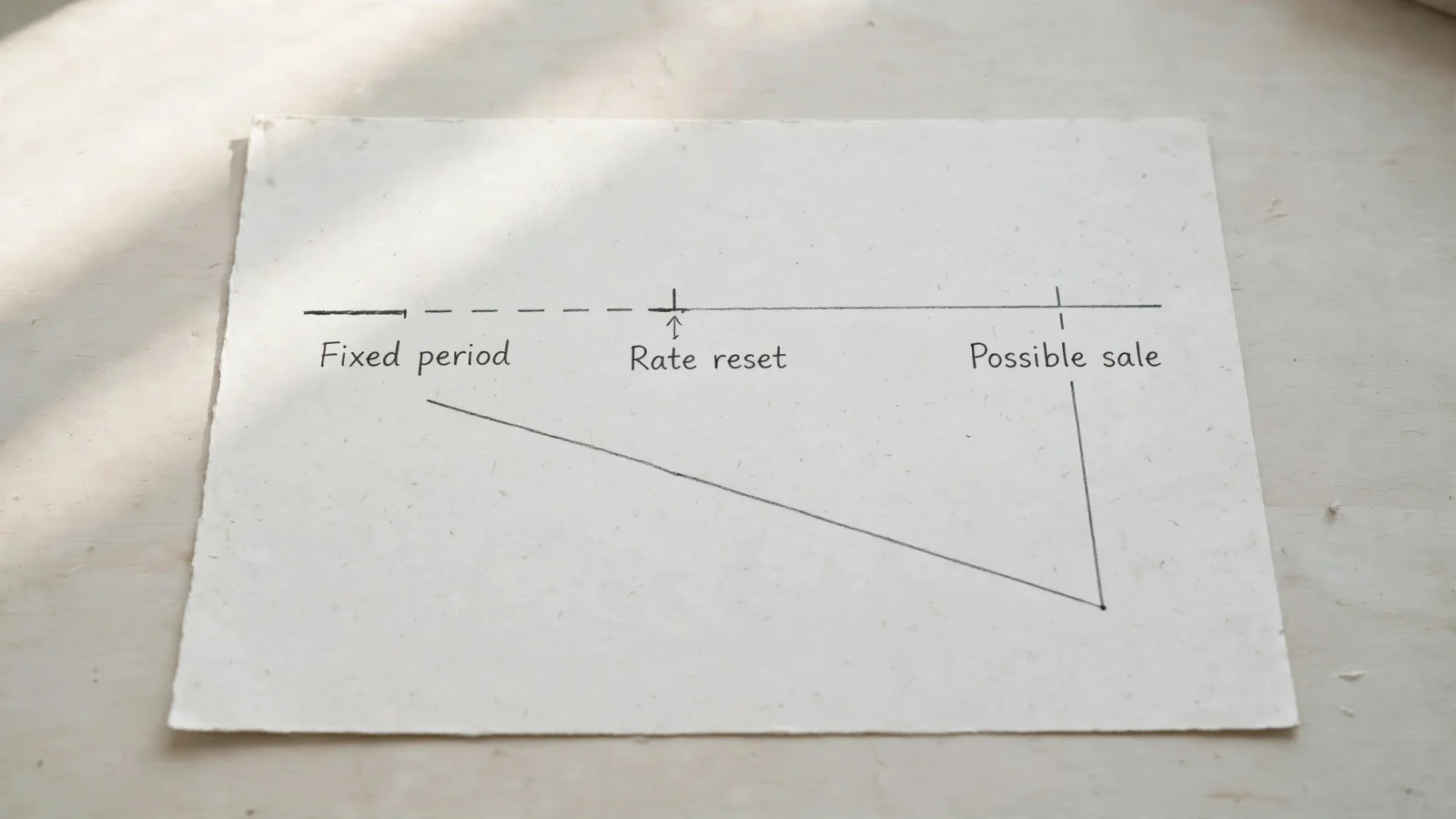
If you plan to sell the property in year four, a three-year fixed product exposes you to one year of floating rate uncertainty. Falling market rates during your fixed window mean your payment remains artificially high. I explain that switching to a lower variable product may seem attractive, but banks anticipate this scenario. They hedge their own funding costs when offering a fixed rate, protecting that position by applying break penalties if you exit the contract before the agreed date.
Understanding the break penalty calculation allows you to model the true cost of flexibility. When I model an exit from a five-year fixed product in year three, I include the penalty the bank calculates based on the outstanding principal and the remaining duration of the fixed window. This penalty reduces your net equity upon sale.
Variable Structures: EIBOR and the Cost of Cash
A variable structure links your monthly debt obligation to the broader financial market. The underlying benchmark for Dirham-denominated loans is the Emirates Interbank Offered Rate. The bank does not charge the raw benchmark figure. The final mortgage rate combines a selected EIBOR tenor with a permanent lender margin.
The Central Bank of the UAE manages and publishes these benchmark figures. The latest EIBOR figures available at my research cut-off on 16 October 2026 demonstrate the spread across different time horizons. With a value date of 20 October, the official fixing lists the one-month rate at 4.09702 percent, the three-month rate at 4.20500 percent, and the six-month rate at 4.45624 percent.
These figures represent specific benchmark snapshots rather than direct retail mortgage quotes. Selecting a product linked to three-month EIBOR means the lender typically reviews and adjusts the rate every quarter. HSBC describes a quarterly review mechanism for its specific three-month EIBOR product. Alternatively, the Emirates NBD Key Facts Statement outlines distinct one-month or six-month options, subjecting the borrower to monthly or six-monthly reviews.
The review frequency determines how quickly a macroeconomic shift reaches your bank account. A one-month review period immediately passes rate cuts through to your instalment, while also instantly increasing your payment when the central bank hikes rates. A six-month review period smoothes out short-term volatility, deferring the impact of any rate change until the next scheduled contractual date.
A variable structure passes the interest rate risk from the bank's balance sheet to yours. I check the exact lender margin printed in the Key Facts Statement. If the three-month benchmark sits at 4.20500 percent and the bank applies a margin of 1.5 percent, your effective rate becomes 5.70500 percent. The lender will also specify any floor or cap in the loan documentation. A floor protects the bank by establishing a minimum interest rate even if the central bank drops rates to zero. A cap protects you by establishing an absolute ceiling if inflation drives borrowing costs to historic highs.
I consider this structure suitable for investors who maintain significant liquidity. If your cash reserves can absorb a sudden spike in the monthly debit, you can accept the rate volatility in exchange for the product's flexibility. You benefit from immediate downward adjustments during an easing cycle without paying a break penalty to access those lower payments. I discuss how these mechanics interact with broader economic cycles in my analysis of why Dubai real estate historically outperforms global crises, noting that flexible debt structures allow well-capitalised investors to ride out temporary rate spikes without forced selling.
Stress-Test Your Monthly Instalments Across the Holding Period
I treat the initial monthly instalment printed on the first page of a banking illustration as only one data point in a real estate transaction. I project the cash flow across your entire intended holding period. The Central Bank of the UAE mandates underwriting standards to prevent systemic defaults.
I rely on the official CBUAE mortgage regulations: in the DBR assessment, mortgage loan providers must stress-test the loan at two to four percentage points above its current interest rate, with the margin depending on the level of rates in the cycle. I also note that, where an introductory rate applies, the stress test should be referenced to the rate that will apply when the introductory period ends.
I also run a parallel stress test on your household finances. A theoretical calculation demonstrates the impact. Consider a simplified amortisation model based on a loan of AED 1,000,000 spread over a standard twenty-year term. Assume the bank offers an introductory rate of 4.5 percent for the first thirty-six months. The contract states that the rate then reverts to a variable structure sitting exactly two percentage points higher at 6.5 percent. This mathematical assumption for analysis excludes arrangement costs, mandatory life insurance, and property transaction costs.
During the initial phase at 4.5 percent, your monthly instalment sits at approximately AED 6,326. You make thirty-six payments at this level. Because early mortgage payments consist predominantly of interest rather than principal, the remaining loan balance after three full years drops to only AED 901,000.
When the fixed period ends and the rate resets to 6.5 percent, the bank recalculates your obligation based on the AED 901,000 balance spread over the remaining seventeen years. Your new monthly instalment immediately jumps to AED 7,310.
This AED 984 monthly increase requires immediate funding. I account for the possibility that rental income may not cover the shortfall, or that you may need to remit additional funds from your home country. This mathematical jump helps explain why the CBUAE requires lenders to run the stress test during the underwriting phase. The regulator wants to ensure you can survive the reset.
I ask prospective lenders for a written illustration showing the base case, a higher-rate scenario, and a lower-rate scenario. I look for the scheduled principal balance at the end of year three, year five, and year seven. Without these figures, I cannot assess your equity position. The failure to map the amortisation curve represents the single largest error overseas buyers make when financing property remotely.

Map the Loan Against Rent, Sale Costs and Currency
I do not compare the monthly mortgage debit directly with the advertised gross rent, because that leaves out the costs of ownership. I compare debt service against the net rent available after deducting service charges, property management costs, maintenance reserves, and expected vacancy periods.
I test developer rent projections against documented costs and your intended holding period before treating them as an input to a mortgage decision. This keeps the financing assessment tied to the buyer’s circumstances and the costs that can affect the outcome.
The CBUAE recognises this operational reality in its underwriting standards. The regulations require lenders to deduct at least two months of rent from the income calculation when assessing an investment property. The central bank applies this mandatory deduction to construct a safety margin. A tenant might decide not to renew, and finding a qualified replacement requires time. The property needs cleaning, repainting, and minor maintenance before the next occupant signs the tenancy contract. During this normal void period, the bank still expects its monthly mortgage payment on the designated date.
I advise clients to use the Rera Rental Index Dubai Calculator to verify the official rent bands in their target community. This tool provides a strict regulatory baseline for upcoming contract renewals, though it does not predict future market rent or calculate your mortgage affordability. If you plan to buy properties in Dubai Marina, model the specific service charges for that exact tower against the debt. A high-floor apartment might generate excellent gross yield, but heavy service charges and an aggressive mortgage reset can turn the asset cash-flow negative in year four.
I also account for your anticipated sale date. Selling a property triggers specific transaction costs, and the outstanding mortgage balance must be cleared before the Dubai Land Department executes the title transfer to the new buyer. I ask clients to check the bank's administrative charges for releasing the mortgage pledge.
I review the early settlement charges applicable at your target sale date. Selecting a variable product does not guarantee a cost-free exit, as the bank will charge a settlement penalty subject to the central bank limits. I maintain a detailed guide outlining the cost of flats in Dubai to help buyers map these transaction expenses. If your equity is thin, the combination of a brokerage cost, a mortgage release charge, and an early settlement penalty can consume your capital gain.
Overseas investors face an additional variable: currency exposure. The UAE Dirham is strictly pegged to the US Dollar, and the mortgage contract is denominated in Dirhams. If your primary corporate income or personal savings sit in British Pounds, Euros, or Indian Rupees, the home-currency cost of your AED mortgage payment fluctuates every month.
A strengthening US Dollar makes the Dubai debt more expensive in your local currency, whereas a weakening Dollar reduces the cost. A local Dubai rent stream only hedges this currency risk if the net rent covers the mortgage payment and all ongoing ownership costs. If the property sits vacant for two months, I account for the need to purchase Dirhams on the open market using your home currency to service the bank debt, exposing your capital to foreign exchange volatility.
Non-Resident Eligibility and Written Terms
Holding a specific passport does not guarantee a mortgage approval. Non-resident eligibility remains highly fragmented and specific to the individual lending institution. The CBUAE sets a maximum debt-burden ratio of 50 percent of gross salary and regular income. This figure serves as a regulatory ceiling for the entire banking system, rather than an invitation for an investor to maximize leverage. Individual banks routinely apply stricter limits to applicants residing outside the UAE.
Lenders impose their own internal risk frameworks on overseas borrowers. I rely on the published ADCB standard mortgage terms to confirm a maximum loan tenor of 15 years for non-residents and an eligibility list that includes India, the United States, the United Kingdom, Canada, Singapore, and Australia.
These specific parameters published by ADCB do not represent universal rules applied across every bank in the Emirates. A different bank might decline the application entirely or demand a 60 percent down payment. HSBC states that applicants living outside the UAE may apply for its variable EIBOR product if they already hold HSBC Premier or Private Bank status.
I make sure clients understand that regulations require the down payment to come from the borrower's own verified resources. A personal loan from a bank in London or Singapore cannot legally fund the equity portion of a Dubai property purchase. The compliance department will track the source of funds down to the originating account.
I rely on the CBUAE Consumer Protection Standards, which require licensed financial institutions serving consumers to disclose key product features, risks, costs, interest or profit rates and relevant terms in plain, accessible language. I also note that the standards require related calculations and references to be accurate.
I review these written documents line by line. I have examined files where buyers secured a marginally lower introductory rate, only to discover punitive exit penalties that destroyed their net yield when they decided to sell four years later. The documents define the operational parameters.
Acquiring property prior to completion means a banking pre-approval acts merely as a preliminary financing check rather than a guarantee of final funding. When researching off plan villas in Dubai, the bank will impose specific requirements regarding the developer's track record, the escrow account status, and the exact construction milestone before releasing any capital. ADCB notes clearly that its maximum loan-to-value ratio depends on the specific construction stage of the project.
Self-employed overseas buyers face steeper documentation hurdles. The lender will demand audited company financials, corporate bank statements, and tax returns from your jurisdiction of residence. They apply heavy haircuts to irregular business income before running the affordability calculation. Gathering this documentation requires weeks of preparation before submitting the initial application.
My Decision Rule: Match the Structure to the Exit
A rigorous analysis of your mortgage options requires mapping the debt structure directly against your specific exit strategy. I base my recommendations entirely on your defined holding period, risk tolerance, and available cash reserves, rather than a generic macroeconomic forecast regarding central bank policy.
A fixed or hybrid structure serves an investor who requires absolute payment predictability during a defined, medium-term holding window. Keeping the property for exactly five years to coincide with a specific life event makes a five-year fixed product highly effective for locking down your primary operational cost. You consciously accept that you might overpay if market rates fall sharply. In exchange, you secure protection against rate spikes that could break your cash flow model. I check the specific break costs if life forces an earlier sale.
A variable structure serves a buyer holding deep liquidity who can comfortably absorb a sudden increase in the monthly debit. This investor accepts the rate volatility to secure the financial benefit from downward shifts in the central bank benchmark. This structure generally provides more flexibility regarding partial capital repayments, allowing the borrower to aggressively pay down the principal during strong earning years. I check the specific overpayment limits detailed in the Key Facts Statement.
A downside scenario that breaks your financial model means you must reduce your leverage or delay the purchase. At Proact Luxury Real Estate, I apply this stress-testing discipline to every transaction. I model the base case and the failure case before you sign a reservation form or hand over a deposit cheque.
I evaluate the market comprehensively to focus entirely on the alignment of the asset with your long-term wealth strategy. The debt structure must serve that strategy without dictating it.
Evaluate your readiness for a property acquisition by applying the ADVICEdge framework to your financing timeline. Model the reset, map the exit costs, and ask for the written Key Facts Statement before committing any capital.
Book a no-obligation intro call with Ritu Kant Ojha Real Estate Advisory; I personally work with every client.
Ask Ritu Kant
Have a question about your purchase? Ask me directly.
Tell me what you are considering. I read every message myself and reply within one working day.