
A Dubai mortgage pre-approval confirms an initial assessment of your creditworthiness, but it does not guarantee final funding. According to HSBC guidelines, an Approval in Principle is an early indication of borrowing capacity based on your income. The final loan depends entirely on a separate evaluation of the specific property you intend to buy.
For a buyer making a property decision in 2027, treating a preliminary bank letter as guaranteed cash puts your deposit at risk if the valuation falls short. Using the latest available lending data from 2026, this article outlines how lenders verify property eligibility, the impact of valuation gaps, and how to protect your equity before signing a contract.
The Limits of a Dubai Mortgage Pre-Approval
I use an early lending indication as a baseline for how much a bank may be willing to lend. The HSBC guide calls it an Approval in Principle (AIP), also known as a decision in principle or mortgage offer in principle, and describes it as an initial assessment of creditworthiness and ability to repay. HSBC states that this pre-approval is not a guarantee of a home loan.
The process leaves the real estate asset out of the equation. Because the lender has not yet seen the property you intend to buy, the pre-approval remains conditional. The Emirates Islamic pre-approval conditions state that any final offer depends on the specific property, its independent valuation, the submitted legal documents, and other internal banking policies. The bank verifies the building's presence on its approved lending list and confirms the developer's track record, ensuring the unit represents adequate security for the loan amount requested.
An Approval in Principle indicates that you may qualify as a borrower, but it does not confirm that a specific apartment or villa qualifies for the same funding. The bank may reduce the approved amount if the property is smaller than its minimum square footage requirement, or decline it if the building carries unresolved structural or legal issues. Relying on an initial review without understanding the subsequent property eligibility checks can lead to a transaction collapsing.
Strategic Timing for the Application
Timing the mortgage application requires balancing careful preparation with document validity. I advise applying once you define your budget and gather your core financial paperwork, long before submitting a binding offer on a specific unit. Securing an AIP gives you the confidence to negotiate, knowing a bank has reviewed your file and verified your basic borrowing capacity. Waiting until after you sign a Memorandum of Understanding introduces serious timing risks. The contractual finance deadline negotiated with the seller might expire before the bank begins its initial review.
I advise applying when the property search is active, so the approval remains useful while it is valid. AIP validity depends on the lender: HSBC says its mortgage in principle is generally valid for up to 60 calendar days and that the period varies by institution. I confirm the stated expiry date and ask the chosen lender about revalidation and any fees.
I treat an AIP as an early step before a full mortgage application. HSBC says its AIP takes an average of 60 minutes when the correct documents are submitted during working hours, but also states that pre-approval is not a guarantee of a home loan. I use the AIP for early planning and coordinate the sale timetable with the lender’s full mortgage decision.
Variations in Non-Resident Lending Terms
I start with the CBUAE’s LTV ceilings, while recognising that mortgage providers can adopt more conservative limits and must distinguish owner-occupier and investor lending. The CBUAE mortgage regulations set the maximum LTV for an expatriate’s first owner-occupied home at 80% for a property valued below AED 5 million and 70% for one valued above AED 5 million. The maximum is 60% for a second or subsequent house or an investment property, and 50% for off-plan purchases.
I treat HSBC’s non-resident guidance as a lender-specific product example. It advertises borrowing of up to 60% of the property’s value for non-residents and says applicants must be HSBC Premier or Private Bank customers, or be eligible for an account. I assess other lenders separately, because HSBC’s published offer does not establish their eligibility rules or loan terms.
I assess borrowing capacity against the CBUAE’s affordability rules. The CBUAE mortgage regulations set the maximum DBR at 50% of gross salary and any regular income from a defined and specific source, and the maximum mortgage tenor at 25 years. Lenders must take account of other debt-servicing obligations, including credit-card debt, when assessing repayment capacity. For investment properties, the regulations require a deduction of at least two months’ rental income in the DBR calculation to account for non-rental periods. I therefore do not count a full year of advertised rent as fully qualifying income in my affordability models. Separately, the regulations require lenders to stress-test the loan at 2 to 4 percentage points above the current interest rate, depending on the interest-rate cycle.
For a non-resident, the document requirements add another layer of complexity to the lender selection process. Overseas buyers must provide cross-border financial records such as attested bank statements and domestic tax returns. The acceptable jurisdictions and required attestations change depending on the bank's internal compliance department, and banks often apply a haircut to foreign currency income to account for exchange rate volatility. I advise clients to confirm their exact residency classification and the required overseas-income documentation before relying on a preliminary discussion. If you are evaluating properties under construction, comparing these strict ready-property criteria with the rules detailed in an off-plan buying guide clarifies your funding options.
Budgeting Cash Beyond the Down Payment
I ask remote buyers to distinguish the down payment from the full purchase budget. The CBUAE mortgage regulations define a down payment as the buyer’s upfront contribution towards the purchase price, which reduces the loan against the property. They state that this contribution should come from the borrower’s own resources, not from other borrowing such as personal loans or credit cards. The regulations also require lenders to verify income and other financial information and maintain documentary evidence of their assessment.
A seller-side security deposit sits separate from your mortgage equity. When you sign a transaction document, the seller typically requires a deposit to secure the property while you arrange your final financing. Brokers often describe a 10% cheque as standard market practice, though this remains a negotiable contractual term rather than a universal legal rule. I ensure the signed documents specify the deposit amount and identify the neutral holding party, while detailing the conditions governing its refund if the bank valuation falls short or the lender retracts the initial approval.
I budget for transaction and finance costs separately from the down payment. HSBC’s non-resident guidance says its fees may include a mortgage arrangement fee and a valuation fee, while Land Department costs may include mortgage and property registration fees. The Dubai Land Department lists a 0.25% mortgage-registration fee for an ordinary mortgage with an ordinary or usufruct title deed, and service-partner fees of AED 4,000 plus VAT for the ordinary route or AED 5,000 plus VAT for provisional Oqood registration. I use these as the published fee figures and confirm which route and charges apply to each buyer.
If you are acquiring projects under construction, the cash flow model changes. Developer milestone payments follow a construction schedule rather than a bank's underwriting timeline. You can review off-plan payment plans in Dubai to understand these structures, but I remind buyers that a scheduled developer instalment is not confirmed mortgage finance. Relying on a future bank loan to meet an impending construction milestone creates a funding risk, as lending policies and your own financial circumstances can shift before handover.
Calculating the Impact of a Valuation Gap
The final loan amount is assessed against the bank's appraised value, not simply your negotiated purchase price. The CBUAE defines the Loan-to-Value ratio by reference to this independent appraisal. Because the bank appoints its own valuation firm to assess the asset, a conservative appraiser can alter your required cash contribution. Valuers use recent comparative transactions recorded at the Land Department, which lag behind current asking prices in a rising market.
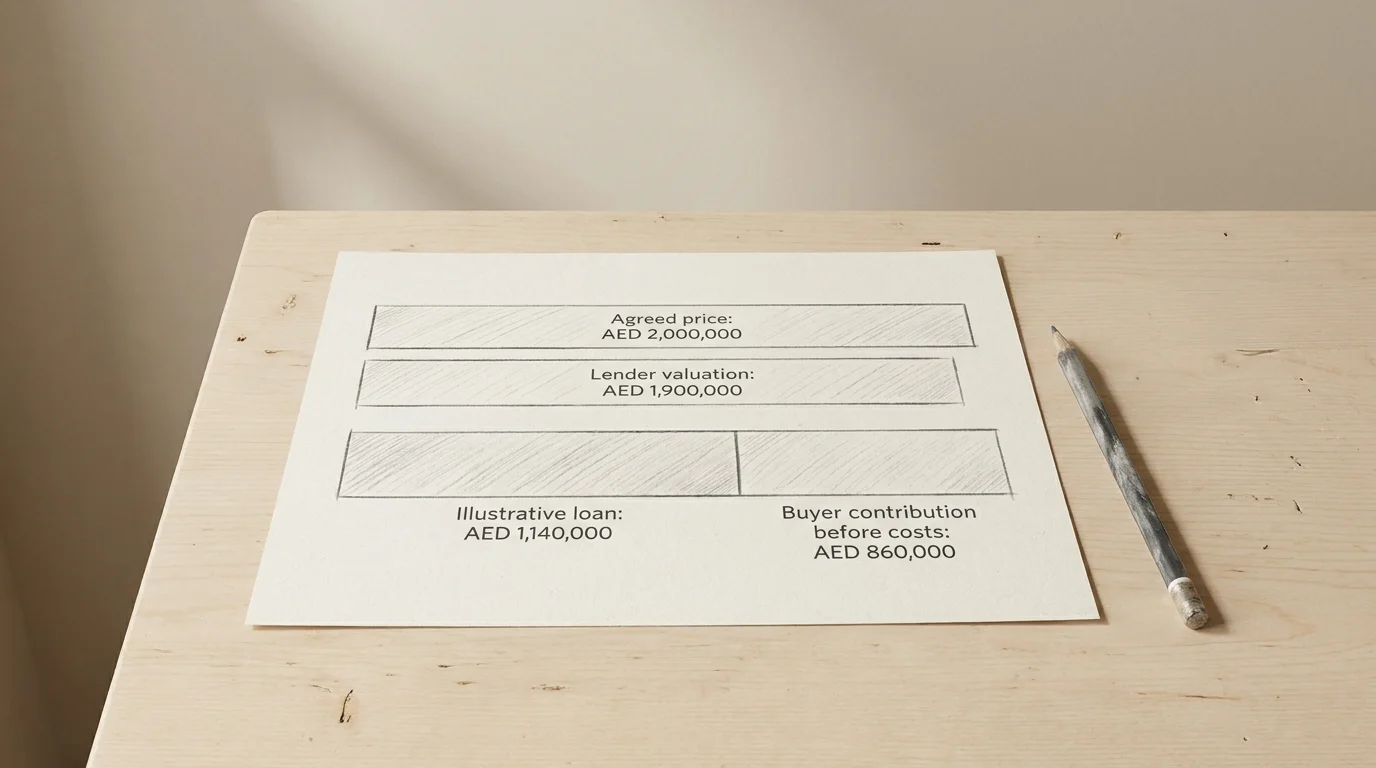
Consider a specific calculation to demonstrate this risk. Assume an overseas buyer agrees to purchase a ready property for AED 2,000,000. The lender sends a surveyor who values the property at AED 1,900,000. If we apply an illustrative LTV of 60% on that appraised value, the theoretical loan becomes AED 1,140,000. This calculation leaves the buyer needing AED 860,000 to cover the purchase price before any transaction or finance costs are added.
If the valuer had matched the agreed purchase price of AED 2,000,000 at the same 60% LTV assumption, the theoretical loan would reach AED 1,200,000, and the buyer's contribution would sit at AED 800,000. In this scenario, the lower valuation adds AED 60,000 to the cash required to close the deal. The Emirates Islamic pre-approval conditions reinforce this mechanism, stating the bank arranges its own valuation and retains the right to decline any property it considers unsuitable for financing.
The 60% figure used here serves as an illustrative benchmark rather than a fixed NRI lending term. Actual offers adjust based on the specific building and your income profile alongside the bank's internal risk metrics. I connect this downside scenario to your offer planning. Before signing a binding contract, I ask whether you have enough verified equity to cover a valuation shortfall. If you do not, I would first explore a lower price with the seller. If the seller will not renegotiate and the shortfall exceeds your available liquidity, I would advise against proceeding. Understanding this calculation helps you judge whether you can complete the transaction within your available funds.
Pre-Signing Verification Checks
I translate the broad figures of an Approval in Principle into clear, property-specific assumptions before allowing a client to sign any purchase agreement. A preliminary approval letter remains conditional when you hand over the deposit cheque, so I focus on the terms that will govern the final offer. The first confirmation involves your residency status. I verify whether the bank classifies you as a resident or non-resident, and ensure they understand your intended use for the property. A bank assessing a file as an owner-occupied residence may withdraw or revise its offer if it discovers the unit is tenanted.
I document the lender’s maximum LTV and the precise value basis it uses, then model the buyer’s cash contribution against a conservative valuation estimate and establish a dedicated valuation reserve. I also confirm the lender accepts the specific project and developer, and record the AIP expiry date, revalidation process and final approval deadlines. The cost plan includes every bank fee and arrangement charge, along with the life insurance premium.
The signing logistics require equal attention, particularly for overseas investors. We clarify exactly which documents require an in-person signature and whether the bank permits a legal Power of Attorney to execute the final mortgage contracts. I also recommend having an independent conveyancer review the sale document. The contract must contain a clear finance deadline and explicit clauses detailing the consequences if the final loan approval is lower than expected or delayed by the bank. I never imply that one standard mortgage protection clause applies to every Dubai property sale. The wording is negotiable and must be tailored to protect your deposit.
This verification anchors my work. I map the shifting lender terms to a unit-specific cash scenario and test every valuation assumption to flag incentive conflicts without promising a guaranteed approval. This methodology reflects the ADVICEdge framework, comprising alignment, depth, voice, integrity, and compassion. I apply this framework to ensure the financial advice serves the buyer's long-term wealth preservation. You can review the details of this approach in the ADVICEdge hub.

Tracking the Progression to Final Registration
The period between receiving an Approval in Principle and securing the final mortgage registration represents a volatile phase of a property acquisition. I track these distinct stages to help ensure the transaction does not collapse. The sequence moves from the initial borrower review to the formal property selection. Once the offer is accepted, the bank initiates the valuation and conducts its unit eligibility checks. Following the valuation report, the file moves into final borrower and document underwriting. Only after passing this stage does the bank issue the final offer, which leads to the mortgage registration at the Dubai Land Department.
A valid AIP does not remove the risks during this sequence. A low valuation report or missing cross-border tax documents can reduce or stop the financing, even while the initial approval letter remains well within its validity period. The lender's underwriters conduct a final review of your credit file just before issuing the final offer. Any new debt taken out in your home country during the property search can alter the debt-burden ratio calculation and put the approval at risk.
For remote buyers, I track DLD registration and bank signing as separate steps. For trustee-office applications, I note that the DLD mortgage-registration page lists a passport copy for non-resident foreigners and a legal power of attorney if a representative acts. I also note that HSBC’s non-resident guidance requires the borrower to provide a signature in person on the loan document, so I treat the DLD representative process as separate from HSBC’s in-person signing requirement. I confirm the bank’s signing requirement and schedule it around the contractual deadlines.
I advise buyers to base the finance deadline in their offer on lender-confirmed underwriting timelines, rather than a selling agent's preferred transfer date. Structuring the offer around a conservative loan estimate ensures you only commit verified cash you hold today. If your search takes longer than expected, I refresh the initial approval before you submit a binding offer.
Book a no-obligation intro call with Ritu Kant Ojha Real Estate Advisory, where Ritu Kant personally works with every client.
Ask Ritu Kant
Have a question about your purchase? Ask me directly.
Tell me what you are considering. I read every message myself and reply within one working day.