Dubai Title Deed Verification Before You Reserve
I show overseas buyers how I verify a Dubai title deed, confirm seller authority and check registered restrictions before reserving.
Updated 22 November 2026
Verifying a Dubai property title requires checking the current deed, owner identity, and property status directly through Dubai Land Department (DLD) portals. According to Dubai Law No. (7) of 2006, title deeds hold absolute evidentiary value, but checking a physical certificate remains insufficient because recent legal blocks or municipal restrictions only appear on the live registry systems.
For a buyer making decisions in 2027, this verification sequence matters because visual checks of PDF documents leave you exposed to unresolved mortgages, unapproved structural modifications, or active rental disputes. I will show you the exact sequence to confirm the seller's legal authority, validate the title deed, and uncover hidden restrictions before you send a non-refundable deposit.
I use a consistent process to replace assumptions with documented checks. I confirm the deed, match the owner, check for registered encumbrances, and establish signatory authority before recommending a reservation payment. Many buyers assume that an estate agent's draft contract or a stamped booking form protects their capital. In practice, a private sales agreement creates personal contractual obligations between the parties, but it does not establish or alter registered real estate rights under Dubai law. If the seller lacks clear title, or if a third party holds a prior registered interest, the buyer may face protracted recovery proceedings while their funds sit in escrow or an agency account.
I treat title examination as a technical audit rather than a routine administrative formality. When an investor evaluates a prime apartment in Downtown Dubai or a luxury villa on Palm Jumeirah, the presentation materials often look pristine. Broker marketing decks showcase floor plans, lifestyle amenities, and rental yield projections. None of those assets matter if the seller is a minority co-owner lacking the authority of their partners, or if the property carries an undisclosed private mortgage registered with the land registry. By managing the verification sequence from the outset, I help overseas clients reduce the risk of committing capital to assets that cannot legally transfer on the agreed timeline.
Validating the owner and property limits
I begin with a narrow title check. The DLD Verify Title Deed service verifies the validity of a Certificate of Title issued by the Land Department.
I base my verification on Dubai Law No. (7) of 2006, which regulates real property registration in the Emirate of Dubai. Article 7 states that the Property Register records all real-property rights and amendments, while Article 9 requires transactions that create, transfer, amend or extinguish those rights to be recorded before they are valid. This makes registration necessary for a valid transfer, and Article 24 gives title deeds absolute evidentiary value in verifying real-property rights.
The same law specifies under Article 22 that conditions, undertakings, or restrictions concerning a property right appear in the property-unit record. A physical title deed printed three years ago lacks visibility into a court seizure registered yesterday. A seller can present an original green-bordered paper certificate or an authentic electronic title deed that was verified as genuine six months prior. Yet, if an interim judgment or financial restraint was attached to that unit last week, the document in hand will disclose nothing about the new restriction. I treat deed validation as the start of the process because separating deed validity from property status helps protect capital.
These checks focus on completed, ready properties. Buyers looking at off-plan villas in Dubai face a different documentation standard because the developer registers sales and legal actions on the initial register, often called Oqood, before transferring the completed unit to the Real Estate Register. Purchasing an off-plan assignment requires verifying the initial registration and the developer's contract records instead of expecting a completed-property title deed. The Land Department makes a procedural distinction between the initial property register and the definitive Real Estate Register. Until an off-plan development completes, obtains its building completion certificate, and issues final accounts, the buyer holds a beneficial contractual right recorded on that initial ledger. A ready secondary-market asset, by contrast, must show an unrestricted certificate on the final register.
The practical consequence for an overseas diaspora buyer is straightforward. When I review an off-plan resale, I inspect the developer's sales and purchase agreement alongside the interim Oqood certificate, confirming that milestone payments match developer statements. When I review a ready villa or flat, I inspect the formal title deed, the register entry, and the physical building unit boundaries. Conflating these two legal stages can lead buyers to demand ready title deeds from off-plan sellers who cannot supply them, or to accept incomplete developer booking confirmations from ready-property sellers who ought to provide an absolute title deed issued directly by the Land Department.
Required documentation for a preliminary check
A rigorous check requires specific inputs. I instruct buyers to request the current DLD title deed, the property map, and clear copies of the seller's identification before taking any further steps. Without these three primary instruments, any analysis of pricing or yield remains premature.
I record the deed number, the year of issue, the property type, the exact unit identifier, and every registered owner's name. A spelling error in a name or a reversed digit in a unit number can cause transfer delays at the trustee office. I then read the property map to confirm the allocated parking spaces and the precise footprint, as a unit marketed with two parking bays might only have one recorded on the official map. The property map is an indispensable companion to the title deed. In multi-unit apartment complexes or gated communities, private developers frequently allocate storage lockers, terrace spaces, or vehicle bays under informal assignment letters that were never formally registered as appurtenances on the official unit deed. Checking the Land Department site plan and unit map reveals whether those spaces form part of the permanent registered real estate interest or merely represent temporary licenses revocable by the building owners' association.
I compare the name on the deed with the seller's identification. DLD's standard property sale registration instructions require Emirates IDs for both the seller and buyer for identity verification, or a valid passport for non-resident foreigners. I use those documents to check the seller's identity.
I run this information through the DLD systems myself rather than relying on a PDF or web link supplied by the seller or their broker. Digital documents face alteration risks, making a direct check important to the ADVICEdge principle of depth. A broker may share a PDF with an authentic-looking QR code that directs the user to an unverified third-party clone site rather than the official government portal. Bypassing the supplied files allows me to query the government database directly through official interfaces.
When gathering these initial records, I also check whether the property is subject to a tenancy contract. If the unit is tenanted, I request the registered Ejari certificate alongside the title deed. A tenant living in the property under an unregistered private lease introduces immediate operational friction for a buyer planning to occupy the home. If the seller served an eviction notice, I inspect the registered postal receipt and notary public attestation for that notice. Aligning the physical title deed with the seller's identity documents and tenancy records helps me identify any competing possessory claims before completion.

Step 1: Verifying the deed and owner in the DLD system
The mechanical check happens on the official Dubai Land Department website or through the Dubai REST application. DLD describes this specific validation service as immediate, requiring no login for basic document verification. This accessibility allows buyers to establish initial authenticity without navigating bureaucratic hurdles or waiting for manual agent approvals.
I select the option to Validate Owner and Property, an interface that demands precise inputs. I type the deed number, the issue year, the property type, and the exact owner name as written on the deed. Submitting these details queries the live Real Estate Register. If a buyer chooses the simpler Validate Property path, the portal confirms only that a title deed matching that specific certificate number exists for the selected plot. It does not confirm that the individual named in the sales agreement is the registered legal proprietor. Choosing Validate Owner and Property forces the portal to cross-reference the owner's legal name against the title number in a single query, confirming that the current record matches the person marketing the property.
I compare the validation result on my screen with the PDF deed the seller provided, checking the property map, the exact unit number, and the seller's legal identity document side by side. I check each field for an exact match. If the system confirms the owner name, I then verify that this name matches the passport or Emirates ID presented for the transaction, as a system match never replaces checking the physical identity document.
Discrepancies occur without necessarily indicating malicious intent. An owner might have registered the property using a middle name absent from their current passport, or a married owner might have changed their surname. An ownership share among three siblings might display differently on an older deed where shares were altered following an inheritance distribution. If a name, spelling, ownership share, or unit identifier differs from the identity document, I pause the transaction to ask DLD or a registration trustee for clarification. A discrepancy requires a formal correction before a transfer can proceed, yet it does not automatically prove fraud.
In some cases, a property title deed lists an expired passport number from twenty years ago, issued by a country where passport renewals do not retain the previous document number. When an Indian or British national renews their travel document, the passport number changes entirely. If the Land Department register still links the property to the old passport record, the registration trustee cannot proceed with the transfer until the seller submits an official data amendment request to update their identification record. Uncovering this mismatch during pre-reservation checks gives the seller time to update their DLD profile while contractual terms are finalised, reducing the risk of delays at the completion table.
I also pay close attention to the property type classification returned by the system. The portal categorises the asset as an apartment, villa, commercial unit, or plot. If an investor intends to buy a residential villa in an established district, but the system returns a commercial designation, that distinction affects mortgage eligibility, utility tariffs, and future resale value. Verifying these core details directly on the portal establishes a reliable basis for the subsequent due diligence layers.
Step 2: Confirming signatory authority for the seller
Once the ownership details align, I establish who possesses the legal authority to sign the transfer documents. The person communicating with the buyer is often an agent, a family member, or a corporate representative. I confirm their authority before advising a buyer to sign a reservation form or disburse initial funds.
When a property has several registered owners, every individual must sign the transfer or grant a formal proxy. It is common to see properties held jointly by a husband and wife, or shared equally among business partners. A single co-owner cannot bind the other owners to a sale contract unless they possess an explicit, notarised mandate. If an agreement is signed by only one joint owner, the entire transaction remains unenforceable against the remaining shares, leaving the buyer with an unregistrable interest and tied-up reservation capital. Corporate-owned properties demand that the signatory hold documented authority for the exact interest being sold, backed by a board resolution and a certificate of incumbency. If a buyer requires a specific holding structure, such as an LLC formation in Dubai, we align the purchasing entity's authority documents well before the transfer date to avoid corporate documentation rejections by the trustee.
When a seller acts through a Power of Attorney, I review the instrument closely. I look for clear authority to sell the specific property and check how the proceeds are to be handled.
DLD applies strict time limits to these instruments. The current rules list a two-year validity period for a POA covering a sale, mortgage, or gift, while a POA for purchasing property carries a five-year validity period. The clock starts from the date of notarisation. I check the calendar to ensure the document will remain valid through the expected transfer date, accounting for any developer clearance delays or trustee appointment backlogs. If an instrument was notarised twenty-three months ago, relying on it for a transaction requiring four weeks to obtain bank releases and developer approvals adds legal and practical risk. The proxy could expire mid-transaction, leaving the buyer unable to conclude the transfer until the principal executes a new power of attorney.
An overseas seller often issues a POA outside the United Arab Emirates. A foreign instrument holds no legal standing in Dubai until it completes a specific ratification sequence. DLD guidance states that a foreign-issued POA must be formally ratified by the notary public and the foreign ministry in the country of origin, before proceeding to the UAE Embassy in that country. Finally, it requires attestation by the UAE Ministry of Foreign Affairs in Dubai, followed by local legal translation into Arabic.
I track this sequence carefully. A seller in London or Mumbai holding a locally notarised document may be weeks away from having a usable proxy in Dubai. Missing any of these steps may prevent the instrument from being accepted for registration. I do not accept scanned QR codes or PDF screenshots as proof of signatory authority because a digital image cannot confirm that the principal is still alive or that the instrument has not been revoked by the issuing court. I recommend asking the issuing notary and DLD, or a licensed registration trustee, to confirm the instrument's current acceptance before the buyer commits funds.
Step 3: Checking the property report and status
Deed validity and registered property status answer different questions. A valid deed confirms past registration, whereas a property status check reveals current restrictions. I use two separate DLD checks to establish a broader picture, avoiding the assumption that deed validation acts as a single clear-title button.
Many buyers make the mistake of stopping at deed authentication. They verify that the seller's name appears on the registry, conclude that the title is clean, and proceed directly to paying a deposit. That omission may leave them exposed to court orders, execution proceedings, or municipal stop-work notices that attach to the land rather than the individual. To protect our clients, we use two complementary Land Department tools that inspect both the financial and municipal status of the asset.
Request the Detailed Property Report
The DLD Detailed Property Report acts as my primary tool for uncovering registered encumbrances. DLD describes this service as covering owner, property, mortgage, seizure, suspension, and project details for a single property unit.
The service carries specific charges, with the official page listing an online or app cost of AED 70, comprising an AED 50 service charge, an AED 10 knowledge charge, and an AED 10 innovation charge. Requesting the report through a physical trustee centre costs AED 120, which includes service-partner costs and VAT. The stated service time is ten minutes. I clarify to buyers that these are report-service charges, rather than an estimate of total purchase costs. These administrative charges form part of the cost of checking for title defects.
DLD states that no documents are required for an online or app request, though it does require an account sign-in or creation. The public instructions do not specify whether a prospective buyer can pull another person's property record without the owner initiating the request. To bypass access friction for an overseas buyer, I advise asking the seller to generate and share a fresh, official report, or I confirm the access route directly with DLD or a registration trustee. If the seller cannot or will not provide the report, I clarify the reason and confirm the available access route with DLD or a registration trustee before advising the buyer to proceed.
I record the exact date and time the report is issued. If a material delay occurs before the final transfer, I ask for a refreshed check, since a seizure or a court block can hit a property record at any time. Refreshing the report serves as a practical safeguard I recommend, outside of any published DLD rule. In transactions that take sixty to ninety days to complete due to complex international banking transfers or corporate structuring, an encumbrance can be registered long after the initial contract signing. Maintaining a live audit trail helps protect the buyer up to the point they hand over manager's cheques at the registration trustee office.
Run a separate Property Status Enquiry
The detailed report covers legal encumbrances, while administrative blocks require a different search. I run the DLD Property Status Enquiry using the title deed number, property number, Makani number, or municipality number.
This live interface returns a different set of data. I review the restrained-information section and the property-blocking section to check whether a developer has blocked a transfer due to unpaid service charges or unapproved interior fit-outs. I check the Dubai Municipality violation section, which highlights unapproved structural modifications to a villa. An owner who added an unpermitted pergola, extended a room without municipal permits, or converted a garage into living space can trigger a municipal block that prevents title transfer until the property is reinstated or retroactive fines are settled.
I also review the active rental-dispute section, because a tenant contesting an eviction notice before the Rental Dispute Centre can block a transfer, altering a buyer's plan to move into the property. If an active case exists, the Land Department register flags the dispute, alerting the prospective purchaser that vacant possession cannot be guaranteed on completion.
I state clearly to buyers that this enquiry supplements the Detailed Property Report rather than replacing it. Together, they provide the depth required by the ADVICEdge framework. By examining municipality violations and rental disputes alongside formal mortgages, I build a clearer picture of the asset's registered and administrative status. Understanding these layers can help clients assess Dubai real estate price drop forecasts alongside potential holding costs, including municipal penalties or costs associated with legal disputes.
Step 4: Resolving mortgages and registered restrictions
A registered mortgage does not automatically end a purchase, but it changes the evidence and sequence of completion I require.
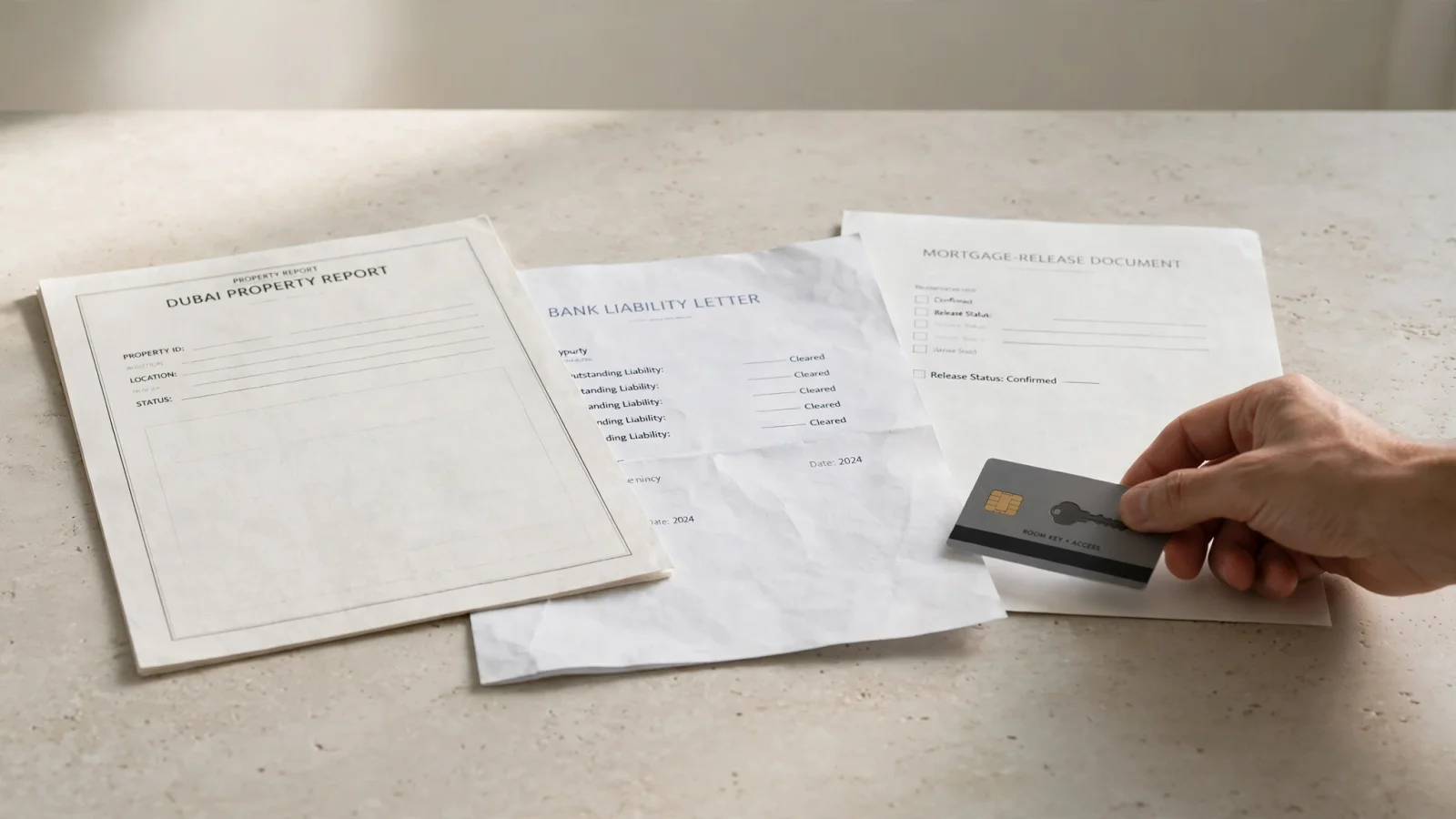
DLD operates a specific mortgaged-sale procedure. The instructions call for a liability letter from the financing bank, or a developer letter showing the exact amount outstanding on an off-plan payment plan. DLD confirms that the sale procedure concludes after the submission of the mortgage-release letter.
I obtain the exact liability amount and the bank's release sequence in writing, because a buyer settling a seller's mortgage takes on risk. The bank must confirm exactly how long it takes to clear the liability and release the original title deed once funds arrive. If an overseas buyer disburses cash directly to settle a seller's home loan without a trustee-supervised escrow or a formal blocking mechanism, they become an unsecured creditor. Should the seller default, face a separate court judgment, or refuse to complete the transfer after their loan is cleared, the buyer faces a costly legal fight to recover their capital. I seek this documented sequence before I recommend any material non-refundable payment.
Under standard registration trustee procedures in Dubai, a mortgaged property transfer follows a structured path. The buyer brings a manager's cheque payable directly to the seller's lending bank for the precise liability amount stated in the official liability letter, alongside separate cheques for the seller's equity and statutory transfer costs. The trustee registers a property block in favour of the buyer, ensuring that no subsequent claims or judgments can attach to the unit while the bank processes the mortgage redemption. Only when the bank issues the formal electronic mortgage-release certificate does the trustee execute the final transfer of ownership, handing the fresh title deed to the buyer. This sequence is designed to reduce unsecured exposure by linking the bank's release to the transfer.
If the status enquiry reveals a seizure, a suspension, a developer block, or a municipality restriction, I identify the responsible authority and obtain its formal clearance route. A seller's verbal assurance that a block will be lifted tomorrow does not establish clearance, and the restriction remains until the authority removes it from the register. If a court execution order caused the seizure, only the executing court can issue the release instruction to the Land Department. Attempting to sign a sale agreement while relying on an informal promise to clear a judicial attachment can leave the buyer unable to complete the transfer.
DLD also lists a developer electronic No Objection Certificate as a requirement for sale-registration preparation in freehold areas. The e-NOC confirms the seller owes no outstanding service charges to the developer. The e-NOC is mandatory for transfer, yet it does not replace ownership verification or DLD status checks. The developer only verifies its own ledger, ignoring the Dubai court system or the municipality register. An e-NOC confirms that building service charges, district cooling charges, and developer administration balances are zero. It tells you nothing about whether the owner's bank has initiated foreclosure proceedings or whether a third party has filed an attachment claim in the Dubai courts.
Ritu Kant Ojha Real Estate Advisory helps buyers organise these documents. We identify the unanswered questions, map the required follow-up, and sequence the clearance before reservation. We do not claim to issue official clearance or make a purchase risk-free. We use integrity and voice to tell a buyer exactly what remains unverified, ensuring they understand the gap between a seller's promise and the government register. When advising someone on how to buy properties in Dubai Marina, this precise mapping helps identify trapped-deposit risks and structural liabilities before a contract becomes legally enforceable.
Reaching a pre-reservation decision
My verification process produces a clear decision record, and I advise against moving forward until specific conditions are met. I do not treat claims of competing offers as a reason to skip checks, since rushing can expose overseas buyers to avoidable errors. I assess the documentation and the seller's response to reasonable requests before advising a buyer to proceed.
First, the deed and property identifiers must match the DLD database exactly. Second, the owner's identity and any signatory authority must be confirmed through official documents. Third, I review a current Detailed Property Report alongside a separate Property Status Enquiry. Finally, any registered mortgage, seizure, or block must have a documented, verifiable resolution route.
I recommend avoiding any material non-refundable reservation payment until these checks return satisfactory results. If a seller presses for an immediate deposit on an unverified property, I advise pausing the transaction. I discuss how to assess seller motivation in our guide on finding genuine motivated sellers in Dubai. If a seller resists producing an up-to-date property report or demands cash deposits paid directly to a private account, I clarify the reason for that pressure and verify the documents before proceeding.
If a market opportunity demands an immediate payment before the bank liability letter arrives, I advise drafting written terms. The reservation agreement needs to explain exactly what happens to the deposit if the DLD verification fails or if the required clearance is denied. The contract must state that the deposit is fully refundable under those specific conditions. I specify that all deposit cheques or escrow funds must be held by a licensed Real Estate Registration Trustee or a RERA-regulated brokerage escrow account rather than released to the seller. This serves as my buyer-protection recommendation, not a rule enforced by the Land Department.
For my non-UAE buyers, I enforce an additional eligibility check. Validating the seller's deed proves the seller owns the property, but it does not establish the buyer's eligibility to acquire it. Dubai Law No. 7 of 2006 restricts foreign ownership to specific areas designated by the Ruler. The DLD property-status interface displays a nationality eligibility note, categorising land as freehold or non-freehold. If a foreign investor inadvertently agrees to purchase a property in an area reserved exclusively for UAE or GCC nationals, the Land Department will reject the transfer at the trustee desk, regardless of how much money has exchanged hands privately. I ensure the NRI buyer is legally permitted to hold the intended interest before we proceed to contracting.
Title checks remain separate from investment suitability, since a property can hold a clean title and still be a poor investment. An unencumbered unit in an area with declining tenant demand, poor maintenance standards, or high district cooling charges is still a flawed financial decision. I assess suitability against the buyer's wealth-preservation goals, liquidity needs, and intended holding period. I never base investment advice on a developer's projected yields. A title deed confirms historical ownership and legal transferability, but it cannot project future cash flow or capital appreciation.
This approach defines the ADVICEdge framework: alignment with the buyer's goals, depth of research, an authoritative voice, integrity, and compassion for the remote investor's position. Applying a rigorous, document-led sequence allows me to tell a buyer exactly what remains unverified, ensuring they can pause a transaction or walk away from a flawed asset.
For an overseas buyer, using DLD validation, live property reports, and written mortgage-clearance steps determines whether a Dubai property is legally ready for reservation. These checks establish present ownership and expose registered restrictions, meaning you verify the legal reality before evaluating the financial suitability of the investment.
Book a no-obligation intro call at https://ritukant.com; Ritu Kant personally works with every client.
Ask Ritu Kant
Have a question about your purchase? Ask me directly.
Tell me what you are considering. I read every message myself and reply within one working day.