JVC vs Arjan Investment: How I’d Decide
I compare JVC and Arjan using 2026 rent, resale and supply evidence, with a clear test for choosing neither.
Updated 22 November 2026
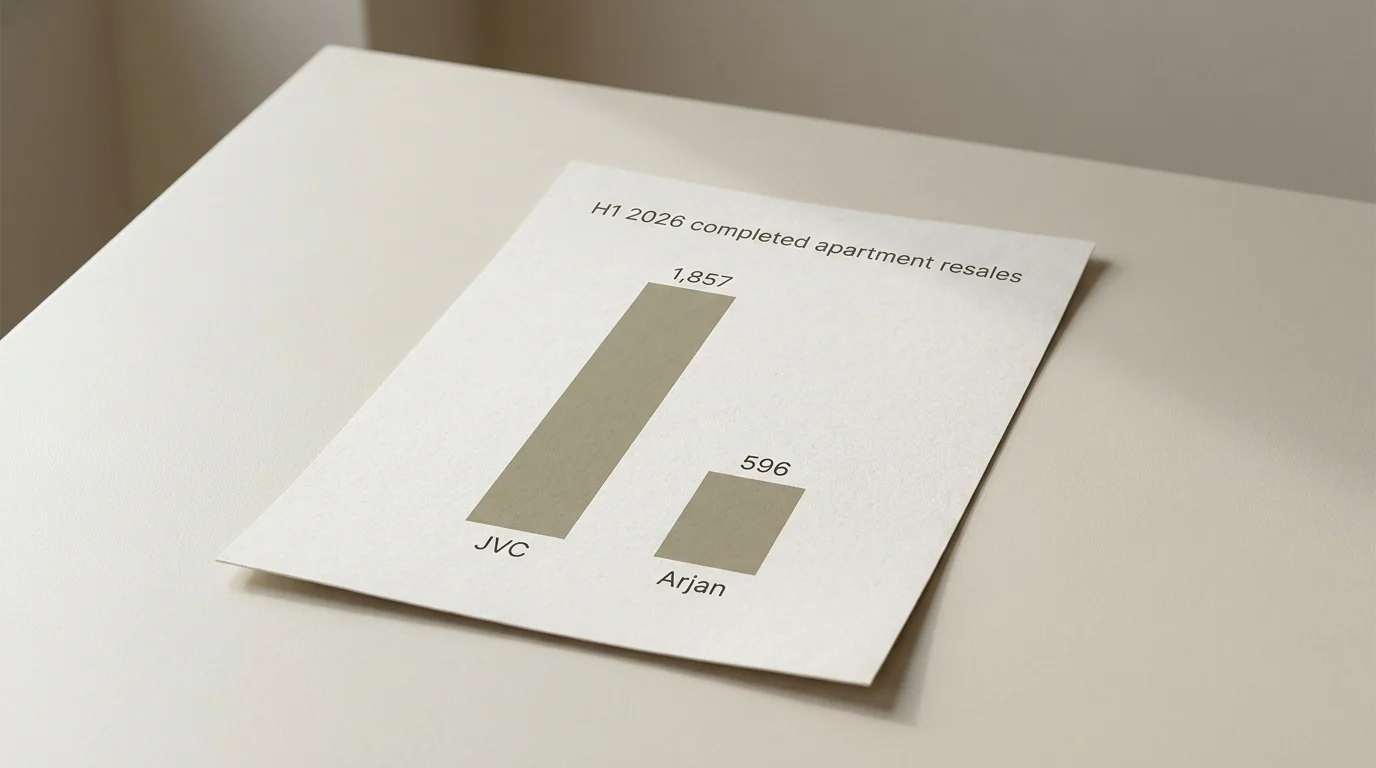
JVC offers significantly higher secondary market liquidity than Arjan, recording 1,857 completed apartment resales in the first half of 2026 compared to Arjan’s 596, according to Dubai Data records. While Arjan showed a higher 4.9% same-building price increase over the same period, JVC provides a denser trail of comparable transactions for buyers pricing an exit.
For buyers allocating capital in 2027, choosing between these two suburban districts requires looking past marketing claims. Assessing the latest available 2026 transaction data reveals how these areas actually perform on liquidity, realistic rental yields, and exit timelines. This article compares matched-building price changes and verified leasing records to establish decision thresholds before shortlisting any property.
I base no investment choice on an area-wide gross-yield headline. Committing funds requires building-level evidence, verified acquisition costs, and a clear test for rejecting both options.
When evaluating a JVC vs Arjan investment, I match specific building data to the buyer’s holding period. JVC recorded roughly three times as many completed apartment resales as Arjan in the first half of 2026, while Arjan demonstrated a higher same-building price change over the same period. Since neither measure guarantees that a specific property will deliver a required exit price or future yield, I start every client engagement at Ritu Kant Ojha Real Estate Advisory by setting decision rules before shortlisting inventory.
The table below outlines the macro evidence for both locations. These community figures cover the twelve complete months to October 2026, excluding the current partial month to account for registration lags. The data relies on official Dubai Land Department (DLD) and Ejari records aggregated by Dubai Data, a brokerage-operated platform. For precise title checks, I note that DLD maps JVC to the administrative area of Al Barsha South Fourth, while Arjan maps to Al Barshaa South Third.
I treat these administrative boundaries as necessary because title deeds and official land registries do not use colloquial marketing names. A search for Jumeirah Village Circle inside official government records will show transactions filed under Al Barsha South Fourth. Similarly, Arjan transactions appear under Al Barshaa South Third. Mixing these administrative zones creates distorted comparisons, particularly when I review historical price movements across adjacent suburban parcels. Platforms like Dubai Data provide convenient aggregations, but they remain third-party brokerages rather than statutory bodies. I check every aggregate figure against individual contract filings on the official DLD portal.

Market Evidence (Nov 2025 – Oct 2026) | JVC | Arjan | What the Metric Means |
|---|---|---|---|
Registered All-Property Sales | 11,674 (down 38.4% YoY) | 3,857 (up 11.4% YoY) | Includes off-plan transactions. This measures total recorded contract volume, not available resale liquidity. |
Off-Plan Share of Sales | 59.5% | 64.0% | Represents the proportion of sales that were incomplete properties. It does not predict future handover schedules. |
Completed Apartment Resales (H1 2026) | 1,857 (down 22.8% YoY) | 596 (up 1.4% YoY) | Excludes off-plan. This counts secondary market trades for finished apartments. |
Same-Building Price Change (H1 2026) | +0.7% (across 132 buildings) | +4.9% (across 37 buildings) | Compares matched existing buildings traded in both periods. Sample sizes differ. |
JVC: Deeper Resale Activity alongside Falling Volume
JVC attracts capital because it offers a large, established secondary market. Between November 2025 and October 2026, the community recorded 11,674 registered all-property sales. This volume provides a dense trail of comparable transactions for buyers pricing an offer. The median registered sale price sat at AED 1.05 million during this period, and the median price per square foot reached AED 1,481, marking a 2.6% increase year on year.
I interpret these medians cautiously because unit mix dictates the area average. The JVC sales profile leans heavily towards one-bedroom apartments. Comparing an area median directly against a specific property ignores the premium that smaller footprints usually command on a per-square-foot basis. Furthermore, 59.5% of these registered transactions were off-plan purchases, which inflates total sales volume without adding immediate liquidity for investors seeking to trade completed homes.
The total transaction volume also contracted sharply over this twelve-month period. A 38.4% drop in registered sales year on year points to cooling transaction velocity across the broader community. This drop does not mean property values collapsed, but it shows that the frenetic contract volume seen in earlier cycles moderated. When total volume drops while median prices per square foot rise slightly by 2.6%, buyer selectivity increases. Investors become more cautious, and poorly situated developments may sit on the market longer before securing a buyer.
I use completed resale records to assess market activity. JVC recorded 1,857 completed apartment resales worth AED 1.93 billion in the first half of 2026. I cite the H1 2026 resale report for a typical deal of AED 970,000 and a median price of AED 1,320 per square foot.
The downside is that this resale volume fell by 22.8% compared to the same period in the previous year. A broad area-level transaction count cannot indicate how quickly an individual flat will sell. Across 132 qualifying JVC buildings, the same-building price change was a nominal 0.7%. That flat trajectory indicates price resistance in the secondary market, requiring sellers to hold firm or accept lower bids. While a larger transaction pool provides pricing visibility, a fast exit remains unlikely if a specific unit lacks parking, sits near a construction site, or carries high service charges.
Building quality across JVC varies widely. Because the master development permits multiple private developers to build on individual plots, construction standards, chiller arrangements, and building management differ between adjacent structures. A building with district cooling charges managed by a dedicated owner association functions very differently from an older tower relying on split air-conditioning units with deferred maintenance. When I assess a JVC purchase, I treat the master community name as general location information. Capital preservation depends on the financial health and operational upkeep of the specific physical structure.
Arjan: A Smaller Pool, Stronger Matched-Building Change
Arjan presents a distinct trade-off for property investors. Total transaction depth is lower, but select price metrics trended upward. The community recorded 3,857 registered all-property sales in the year to October 2026, marking an 11.4% year-on-year increase. The median registered sale price was AED 940,000, while the median price per square foot climbed 13.9% to AED 1,578.
That double-digit percentage increase requires immediate qualification. Studios accounted for 43% of Arjan’s registered sales during this twelve-month window. Because studios trade at a higher price per square foot than larger apartments, this heavy concentration pulls the community average upward. The 13.9% increase reflects this underlying unit mix and should not be described as pure capital appreciation for an existing owner. An investor who buys a two-bedroom apartment expecting a matching 13.9% lift may find that larger layouts did not experience that rate of expansion.
Isolating completed apartment resales for H1 2026 strips away the 64.0% off-plan share and shows Arjan recording 596 transactions. This figure represents a 1.4% increase year on year, totalling AED 574.49 million in value. The median completed resale deal stood at AED 856,000, equating to AED 1,380 per square foot. Here again, completed ready stock traded at a lower rate per square foot than the area-wide median of AED 1,578. This reinforces the point that off-plan pricing can carry a premium over finished buildings without proving the value of a completed property.
I focus on Arjan's historical matched-building price movement. The matched-building price per square foot rose by 4.9% in H1 2026 versus H1 2025 across 37 buildings that traded in both periods. I use this rise as historical evidence when modelling a medium-term hold, and I advise buyers to price an eventual exit conservatively.
A smaller resale footprint creates practical friction when an owner needs to liquidate. In Arjan, with only 596 resales recorded across six months, an investor selling a property competes for the attention of a narrower pool of secondary-market buyers. If mortgage interest rates rise or regional demand cools, secondary liquidity in smaller suburban nodes may dry up faster than in large, dense districts. Mortgage valuers rely on recent closed transactions within the same development or immediate radius to support loan underwriting. If a building has only two registered transfers in the preceding quarter, a conservative bank valuation can derail a buyer's mortgage approval, forcing the seller to renegotiate or lose the transaction.
Rental Returns: Compare the Same Unit Type
Gross yields indicate what a property generates before costs, leaving net cash flow undefined. The table below uses registered Ejari contracts and median ready-home prices from Dubai Data for the twelve months to October 2026. This data includes contract renewals, so it reflects existing tenant agreements alongside new leases.
Unit Type | JVC Median Rent | JVC Ready Price | JVC Gross Yield | Arjan Median Rent | Arjan Ready Price | Arjan Gross Yield |
|---|---|---|---|---|---|---|
Studio | AED 48,000 (7,746 contracts) | AED 615,000 | 7.80% | AED 46,000 (4,264 contracts) | AED 590,000 | 7.73% |
1-Bedroom | AED 70,000 (15,758 contracts) | AED 1.00 million | 7.00% | AED 68,000 (4,816 contracts) | AED 1.00 million | 6.80% |
2-Bedroom | AED 95,000 (4,553 contracts) | AED 1.50 million | 6.33% | AED 94,000 (2,382 contracts) | AED 1.45 million | 6.45% |
3-Bedroom | AED 140,000 (506 contracts) | AED 2.26 million | 6.19% | AED 150,000 (190 contracts) | AED 2.10 million | 7.14% |
The studio, one-bedroom, and two-bedroom gross yields are close between the two areas. I do not select a community based on a fractional difference in gross yield. Studios deliver 7.80% in JVC and 7.73% in Arjan, a gap of seven basis points that can be wiped out by a minor difference in annual maintenance costs. For one-bedroom units, JVC records a 7.00% gross yield against Arjan's 6.80%, while two-bedroom properties show 6.33% in JVC compared to 6.45% in Arjan. Choosing between these locations based purely on these figures creates false precision.
One-bedroom apartments represent the highest contract volume in both locations, providing reliable baseline data. Ejari registrations, however, do not measure unique tenants or total occupancy. A high contract count includes mid-year changes and multi-year renewals, offering no guarantee that a newly handed-over unit will let easily in its first month. In JVC, the 15,758 registered one-bedroom leases show substantial ongoing leasing velocity, but they also reflect a large pool of competing landlords. If several adjacent developments hand over at the same time, tenants gain negotiating power. Individual owners may then need to offer rent-free periods or multiple cheques to avoid prolonged vacancy.
Arjan displays a higher gross yield for three-bedroom units, prompting a necessary look at the sample size. That 7.14% figure comes from a limited pool of 190 registered contracts and 39 ready-home sales. By contrast, the JVC metric relies on 506 contracts and 89 ready sales. I treat Arjan’s three-bedroom yield as a prompt to evaluate specific buildings, because small sample sizes are highly sensitive to outlier transactions, such as a premium penthouse leasing above market rate. I consider it flawed to underwrite an individual capital commitment using an area-wide metric derived from 39 transactions.
I treat gross yields as a starting point and deduct operating costs before estimating spendable income. I use Dubai Data's JVC yield figures, which are reported before service charges, vacancy and transaction costs. I calculate a studio's net cash return from its unit-specific expenses. For an additional check on rent changes, I point buyers to the free RERA rental index calculator on the website, then advise them to confirm the applicable renewal rules and figures with official RERA information.
Consider a practical example. A 450-square-foot studio in JVC purchased for AED 615,000 generates AED 48,000 in gross annual rent. If the building levies a service charge of AED 16 per square foot, the annual service charge is AED 7,200. Professional property management costs take roughly 5% of the gross rent, removing another AED 2,400. Routine annual maintenance and minor tenant repairs consume another AED 1,500. Before accounting for vacancy, the initial cash return drops from AED 48,000 to AED 36,900. The yield on purchase price contracts from 7.80% gross to roughly 6.00% net, even before factoring in DLD registration costs, brokerage charges at acquisition, or mortgage financing costs.
I note that BrickDXB reports Arjan gross yields of 6.2% for studios and 5.5% for one-bedroom apartments for the 12 months to 18 November 2026. I advise clients to build net-yield models from verified individual lease amounts.
When I evaluate rental income, I include statutory tenancy protections in the calculations. In Dubai, the official RERA rental calculator governs rent increases for existing tenants upon lease renewal. If market rents spike across a community, an owner cannot automatically adjust an existing contract to match that jump. RERA caps renewal increases based on how far the current rent sits below the official community benchmark. This mechanism protects tenant retention, but it means that an investor holding an occupied unit may see yields lag behind prevailing market asking prices for extended periods.
Upcoming Supply Verification: Moving Beyond Sales Shares
I often see buyers confuse a high off-plan sales share with an immediate supply glut. The 59.5% JVC and 64.0% Arjan off-plan figures describe the mix of registered purchase contracts over the last year. They do not quantify how many homes are due to complete next month, nor do they map the bedroom types entering the rental market.
A high off-plan transaction share indicates developer sales activity. In both communities, master developers and private builders have launched numerous mid-rise projects backed by aggressive marketing campaigns. Because off-plan properties are sold from architectural renderings and structured payment terms, they attract individual retail investors who lack the capital to purchase ready stock outright. This dynamic drives high sales volumes, but it provides no operational evidence about when those buildings will complete, how many units will pass physical handover inspections, or whether the surrounding road infrastructure can handle the resulting tenant density.
I do not publish future-supply totals aggregated by community name without checking projects individually. I use the DLD Real Estate Data portal to review project records, including recorded completion percentages and inspection and completion dates, alongside its building and unit records.
Relying on marketing timelines creates cash-flow risks for buyers. When a developer advertises handover in the fourth quarter, investors may plan mortgage financing or capital liquidity around that date. If the project's official DLD inspection record shows construction standing at only 55%, the project is unlikely to deliver on schedule. Handover delays of twelve to eighteen months are common in private suburban developments. During such a delay, the buyer's capital remains locked in an escrow account without producing rental income, while any pre-arranged financing commitments or interest rate locks may lapse.
To protect capital, I compare an off-plan project’s specific unit mix and projected handover date with completed buildings that already demonstrate registered rent and resale liquidity. I do not treat a post-handover payment plan or a developer’s guaranteed-return projection as a verified rental yield. A payment plan functions as a financing mechanism rather than generating property income. If a developer offers a guaranteed 8% return for three years, that guarantee may be priced into an inflated purchase price. Once the contractual guarantee period expires, the owner may have to lease the unit at prevailing open-market rates, resulting in lower rental income and a downward valuation adjustment.
This verification forms the basis of how I approach off-plan property decisions. I assess project and building evidence against the buyer’s targeted holding period, exit liquidity needs, and stress-tested cost assumptions. I check project escrow status and registration history through official records. Separately, I offer the free ADVICEdge Advisor Check for buyers who want to assess an adviser against the ADVICEdge principles.
My Verdict: JVC, Arjan or Neither
Rather than rely passively on area rankings, I use an active decision framework for each buyer’s capital. I apply specific thresholds before advising a purchase.
The Decision | When It Fits | Supporting Evidence | The Primary Risk |
|---|---|---|---|
Shortlist JVC | I would consider it when a buyer values a larger secondary market and the chosen unit clears their net-return hurdle. | 1,857 H1 2026 resales. High density of comparable trades helps price an exit accurately. | Resale volume fell 22.8% YoY. Recorded depth does not guarantee a unit will sell fast. |
Shortlist Arjan | I would consider it when building-level rent, acquisition costs, and exit data align with the buyer’s medium-term holding plan. | +4.9% same-building H1 price change across 37 buildings. | Smaller resale pool (596 H1 trades) means fewer active buyers and less pricing visibility. |
Choose Neither | I recommend neither when the stress-tested net yield fails the buyer’s minimum requirement, or their cash flow cannot survive a void period. | The unit carries high service charges, poor layouts, or lacks verified recent rental contracts. | Holding an illiquid asset that drains cash reserves through unmodelled friction costs. |

I enforce a strict "neither" threshold. If no specific ready unit passes a buyer’s personal net-yield hurdle after verified rent, vacancy, service charges, management, maintenance, acquisition costs, and financing are deducted, I consider holding capital the safer choice. I also advise buyers to reject the investment if they cannot carry the property through a period without rent and a slower resale cycle.
I see some investors enter the market assuming suburban Dubai real estate is an automatic income generator. I do not treat it that way. If an investor purchases a unit that generates a nominal 7% gross yield, but the building’s service charges sit at AED 22 per square foot while cooling inefficiencies drive tenant turnover, the net return can degrade to 4%. When bank borrowing rates on investment properties sit near 5%, operational cash flow turns negative. Holding a property with negative net cash flow while waiting for speculative capital appreciation is an unhedged gamble that I refuse to recommend.
I test resilience through a downside scenario. I model a 10% rent reduction upon renewal and factor in six consecutive months without a tenant. I then deduct an extra 5% from the expected resale price to account for a quick exit. I apply these stress assumptions to net yield modelling using actual borrowing costs and service charge quotes. If this test forces a distressed sale, triggers a margin call on other borrowing, or drags returns below the buyer’s absolute minimum, I recommend waiting for better inventory.
In a six-month vacancy scenario, the financial damage compounds rapidly. An owner must continue paying building service charges every quarter, regardless of whether a tenant occupies the premises. For a two-bedroom apartment with annual service charges of AED 18,000, half a year of vacancy forces the investor to inject AED 9,000 of fresh capital into building maintenance, on top of absorbing AED 47,500 in lost gross rental revenue. If the acquisition was financed with a 60% mortgage, six months of debt service payments must also be covered directly from external savings. An investor without sufficient liquid reserves can quickly face cash constraints, turning a planned wealth-building exercise into an operational drain.
Acquisition friction also punishes premature exits. Purchasing ready property in Dubai involves a 4% DLD transfer cost, property acquisition costs, administrative trustee charges of roughly AED 4,200, and valuation charges if using bank financing. That means starting capital is down roughly 6% to 7% on day one. If an investor is forced to exit within two years due to cash-flow pressure, they must pay further disposal costs alongside title deed discharge charges. If the asset only achieves JVC’s 0.7% same-building growth rate, an early exit guarantees a permanent capital loss after transaction expenses.
Remote-Buyer Checks and Cross-Border Questions
Overseas buyers carry the heaviest verification burden. If a buyer lives in London, Singapore, or Mumbai, they cannot walk the JVC streetscape to check if a developer’s promised park remains a sandlot waiting for a high-rise. I establish a strict evidence trail and a complete cost picture before advising a remote first-time buyer to deploy funds.
Verify the Property, Project and Adviser
Remote due diligence begins with unglamorous administrative checks. For ready properties, I advise buyers to confirm the title deed status and ensure the seller legally owns the unit outright or has a verified mortgage clearance plan. I ask them to pull the exact Ejari history for the target building and review historical rental data for identical layouts, rather than rely on broker projections for the future. I also ask them to request the official service-charge statement issued by the management company through the Mollak system. This confirms the exact historical rate per square foot and whether the building carries accumulated arrears that could disrupt building services.
For off-plan acquisitions, I advise buyers to review the Sales and Purchase Agreement (SPA) alongside the official DLD registration. They should check the project’s physical status on the DLD portal and verify the escrow account details directly with the bank listed. I also ask them to ensure the project is registered under the developer’s corporate entity on the land department database, and to confirm that all initial payments flow exclusively into the project-specific escrow account rather than a general corporate operating account.
I apply the five-point ADVICEdge framework to every remote acquisition. I begin with alignment, matching the asset to the family’s holding period and liquidity constraints rather than chasing arbitrary launch events. I provide depth through building-level transaction evidence instead of broad area averages, examining historical transfers in the target building. I maintain my voice by explaining structural trade-offs plainly and showing the downside scenarios developers omit. Integrity means I disclose data limits before a client signs any document. Compassion recognises the practical, highly rational anxiety of sending large capital reserves across borders without a trusted local presence.
When I conduct remote checks, I scrutinise building-level layout variations. Two apartments in the same JVC tower with identical registered floor areas can generate different rental demand based on their internal configuration. A layout with long, unusable corridors and dark living areas may sit vacant longer than an efficient open-plan layout with natural light. Remote buyers often rely on high-angle photographs and digital brochures that obscure structural columns, undersized balconies, or views obstructed by neighbouring mid-rises. I advise them to request unedited video walkthroughs, measure actual furniture clearance, and check the parking spot allocation directly on the title deed to prevent expensive surprises upon completion.
Treat NRI Tax and Repatriation as Unverified
For Indian nationals and the broader South Asian diaspora, cross-border compliance can dictate the viability of an investment. Indian tax, Foreign Exchange Management Act (FEMA) rules, and capital repatriation claims remain unverified in this evidence set. I advise buyers not to accept a quoted tax rate, remittance limit, or treaty treatment from a real estate brochure until they have verified it against current official Indian guidance and qualified cross-border tax counsel.
Several structural questions need answers before a reservation form is signed. I ask buyers to establish their precise tax residence for the current fiscal year and declare any global asset reporting obligations in multiple jurisdictions. Under the Indian Income-tax Act, residential status depends on physical days spent in India during the relevant financial year. An investor who miscalculates their residency status can find their Dubai rental income or capital gains subject to taxation in India, reducing the anticipated net yield.
I also ask buyers to confirm how they will fund the deposit and subsequent instalments, anticipating the source-of-funds documentation their sending bank will demand under strict compliance regimes. Indian resident individuals remitting funds overseas must comply with the Reserve Bank of India’s Liberalised Remittance Scheme (LRS), which imposes specific annual caps and tax collected at source provisions. Non-Resident Indians funding purchases through overseas foreign-currency accounts or Non-Resident External (NRE) and Non-Resident Ordinary (NRO) accounts must follow distinct banking routes to support the future movement of capital.
I ask buyers to understand how Dubai rental income and eventual sale proceeds will be treated by their home tax authority. They also need to map the specific mechanics of moving those proceeds across borders when they eventually exit the asset. Repatriating sale proceeds back to an Indian bank account requires specific tax clearance certificates, such as Form 15CA and Form 15CB certifications issued by a chartered accountant, demonstrating that applicable tax liabilities have been addressed. If an investor purchases an off-plan unit in Arjan, holds it for five years, and then sells it at a capital gain, moving those funds requires documented proof of the original acquisition flow, registration records, and clear transaction tracking.
Finally, cross-border investors allocating capital in 2027 must establish their ownership structure before initiating any transfer. Determining whether to hold a property in an individual name, jointly, or through a corporate entity dictates your long-term tax position and succession planning. Because Dubai real estate held by non-Muslim individuals requires registered wills with the local courts to prevent inheritance complications, ignoring these legal realities to secure a rapid reservation deposit jeopardises the family's wealth preservation.
Book a no-obligation introductory call to establish your decision rules before shortlisting inventory.
Ask Ritu Kant
Have a question about your purchase? Ask me directly.
Tell me what you are considering. I read every message myself and reply within one working day.