Dubai Escrow Account Verification Before Payment
I show overseas buyers how to check a Dubai off-plan project’s DLD record, designated escrow account and payment instructions before sending an instalment.
Updated 22 November 2026
Verifying a Dubai off-plan escrow account requires checking the developer's registered project record and matching the destination bank details. Under Dubai Law No. 8 of 2007, every off-plan development must maintain a separate escrow account to ring-fence investor capital for that specific construction site. Remote buyers must reconcile these legal identifiers before authorising any cross-border wire transfer.
For overseas buyers allocating capital in 2027, this verification prevents catastrophic losses. Cross-border remittances are difficult to trace and reverse if funds enter the international correspondent banking system under incorrect beneficiary instructions. This article shows you how to gather the right documents, use the Dubai Land Department portals, and secure direct bank confirmation to protect your investment.

An official record helps me check that your capital is directed to the right account. As a Dubai-based real estate advisor, author, and CEO of Proact Luxury Real Estate, I help non-resident Indian families and international buyers evaluate property acquisitions from thousands of miles away. Many buyers receive an invoice via WhatsApp or email and feel immediate pressure to transfer funds to secure a unit. I consider sending money blindly an unacceptable risk, so I ask clients to confirm that the project is legally registered and that the specific bank details match the developer's approved trustee account.
Cross-border remittances are difficult to reverse once they enter the international correspondent banking system. If funds leave your account in London, Mumbai, or Singapore under incorrect beneficiary instructions, tracing and recalling those funds can take weeks or prove impossible. Sales representatives frequently tell overseas buyers that banking documentation can be sorted out after the initial reservation deposit is sent. I instruct my clients to take the exact opposite approach. I ask them to reconcile every bank detail before a single dollar, pound, or dirham is dispatched through their banking portal.
What Escrow Verification Can and Cannot Confirm
Dubai regulates the collection of off-plan property funds to protect investor capital during the construction phase. Dubai Law No. 8 of 2007 applies strictly to developers selling units off-plan and receiving payments from purchasers or project financiers, mandating a separate account for each real estate development project. The developer must use the collected funds exclusively for that specific project's construction, and the law restricts the attachment of those funds by the developer's creditors.
This separation of funds is central to Dubai's off-plan rules. In unregulated environments, a developer might take cash received from Tower A to purchase a parcel of land for Tower B or to settle pressing liabilities on Tower C. Law No. 8 prevents this cross-collateralisation by tying the account to the specific project. The developer cannot treat incoming buyer instalments as unrestricted general operating revenue, because the funds are held for the project under the custodial supervision of an accredited financial institution.
This legal framework prevents developers from pooling investor money across multiple sites because the bank, acting as the escrow trustee, releases funds only when the developer achieves verified construction milestones. A technical consultant inspected and certified by the Dubai Land Department must confirm physical site progress before the trustee issues a disbursement. The trustee also retains a statutory percentage of total project receipts until one year after the project achieves its completion certificate, ensuring that snagging, defect rectification, and initial maintenance obligations carry financial backing.
A matching escrow record serves as a payment-destination check to confirm your money is going to the correct, legally ring-fenced bank account. It does not serve as a reason to buy the property. A clean record does not guarantee timely project completion or the quality of the finished unit, nor does it validate any rental projections presented in a sales brochure. A developer can possess a spotless escrow account, an approved trustee, and complete regulatory compliance, yet still suffer severe project delays caused by supply-chain disruptions, poor contractor management, or macroeconomic shifts.
The escrow system also does not insulate an investor from market absorption risks or commercial misjudgements. If a developer launches a residential tower in an emerging district with heavy upcoming handovers, the presence of an escrow account does nothing to protect your resale valuation or your eventual rental yield. The account merely protects the cash flow designated for physical structural erection. Evaluating whether the development represents a sound capital allocation based on your personal balance sheet, income goals, and investment horizon remains an entirely distinct analytical exercise. I keep that assessment separate from payment verification and consider the buyer’s goals and holding period before discussing the property’s potential.
If a project is cancelled, the escrow system does not guarantee an immediate or full refund. The Dubai Land Department outlines a specific liquidation and distribution process for cancelled developments, and DLD guidance on cancelled projects says funds are distributed to beneficiaries in full or proportionately, depending on the amount available in the account. DLD says the period for liquidating cancelled and suspended projects is indefinite when all documents, amounts and eligible persons are available, with each project taking its turn. So I frame this as a downside for buyers before they commit capital.
When a project is formally cancelled by regulatory order, the liquidation committee or competent judicial authorities must review the asset ledger. The total cash remaining in the project escrow account is combined with the proceeds generated from auctioning the underlying land plot and any existing physical substructure. If the developer expended substantial buyer funds on early excavation, piling, and foundation work before abandoning the site, the residual liquidation balance may fall well short of the total capital collected from off-plan purchasers. Investors receive a proportional dividend based on net realised assets, meaning you can lose a measurable portion of your principal even with a fully registered escrow account in place. I ask buyers to weigh that outcome alongside the protection the account provides.
The Dubai Real Estate Regulatory Agency requires brokers marketing off-plan projects to verify registration, and the official brokerage practice guide states that agents must direct buyers exclusively to the respective project escrow account. A salesperson's verbal assurance never replaces the official record. I ask clients to reconcile the data before instructing their bank to wire funds. Licensed real estate agents who instruct clients to route funds through brokerage accounts or unapproved corporate entities commit a direct regulatory violation. I advise buyers to treat any suggestion to deviate from the statutory escrow route as an immediate reason to pause their purchase.
Step 1: Gather the Project and Payment Details
I cannot verify an account without the exact legal identifiers for the property. I advise buyers not to rely on marketing brochures or promotional emails, because these often use commercial names that do not match the government database. Before accessing the DLD portal, I ask clients to request the complete documentation suite from the developer or their representing broker.
Developers frequently assign consumer-facing lifestyle names to developments that have no direct legal counterpart in government records. A development marketed across international media as "Azure Horizon Heights" may be registered on official land titles and planning permits as "Plot 345-1204 Residential Building" or under an internal corporate joint-venture designation. Attempting to conduct an official registry check using only an agency brochure name will often produce a false-negative result, causing unnecessary panic, or worse, lead you to match your search with an entirely different project that happens to share a similar commercial title. I ask clients to use the legal identifiers rather than infer a match from a familiar marketing name.
I advise buyers to ask for the official project name and the numeric project identifier, along with the specific land number or plot number assigned to the development. They should obtain the developer's full registered legal name, which frequently differs from their consumer-facing brand. Established master developers routinely establish separate legal entities, project-specific special purpose vehicles, or subsidiary corporate structures for individual building launches. I ask buyers to identify the exact entity holding the legal development rights and municipal permits.
I ask buyers to collect the unit number and the signed Sales and Purchase Agreement. At the initial reservation stage, I recommend securing the draft SPA or the formal booking form and requesting the complete payment schedule, which should detail every milestone and the corresponding amount due. The payment schedule must clearly demarcate which instalments are calendar-linked and which instalments are construction-linked, specifying the exact percentage of site completion required before the developer can demand subsequent capital disbursements.
I also ask buyers to obtain the instalment invoice and the full beneficiary instructions. The invoice must display the bank name, the beneficiary name, the account number, and the International Bank Account Number, while including a specific payment reference code and the stated purpose of the transfer. This document should come directly from the developer's official accounting or treasury department, stamped and signed, rather than through an unverified intermediary forwarding screenshots through messaging applications.
I advise buyers to ensure that the currency denomination on the invoice matches the currency of their remittance agreement. Most UAE off-plan contracts are denominated in United Arab Emirates Dirhams (AED), which trades on a fixed peg to the United States Dollar (USD). If you are remitting capital in Sterling, Euros, or Indian Rupees, confirm whether the trustee bank accepts foreign currency transfers directly into a multi-currency escrow facility, or whether your sending institution must execute the conversion prior to settlement.
I ask clients to keep these documents open on their screen or printed on their desk. Remote buyers dealing with currency conversion and international time zones often face tight transfer windows, so having the exact plot number and developer legal name ready prevents frantic searching when the bank asks for compliance details during a cross-border remittance. Having this document portfolio assembled in advance enables buyers to work through the government verification portals systematically without pausing to request missing paperwork from a distant sales desk.
Step 2: Match the Project in DLD’s Status Enquiry
I can check a project's completion percentage and details through the DLD Project Status Enquiry service. DLD lists its website, the Dubai REST app and WhatsApp as service channels, and on the website or app I enter the land number, project number or project name to view the available information.
The Project Status Enquiry portal, historically integrated with the Mashrooi monitoring system, serves as the central administrative ledger for all off-plan developments in the emirate. It gives international purchasers direct access to the same physical progress tracking, corporate registrations, and escrow certifications that regulatory auditors inspect. By accessing this portal directly from home, buyers can bypass the subjective interpretations of sales brokers and obtain direct municipal data.
I recommend searching the database using the project number or the land number whenever possible. Searching by the English or Arabic project name often returns multiple phases of a master development and creates unnecessary confusion, so I advise waiting until the system returns a definitive result before opening the project file. Master communities such as Business Bay, Jumeirah Village Circle, or Dubai Marina contain hundreds of individual plots, many of which share components of a developer's umbrella branding. Using the distinct numerical project identifier eliminates ambiguity.
I ask buyers to compare the official DLD project name with the name printed on their SPA, and to check the developer's legal name against their invoice. They should verify the geographical location and the current construction status. If the developer claims the project is fifty percent complete, the DLD tracker should reflect a similar verified milestone.
The construction progress percentage published on the DLD portal is not a self-reported estimate provided by the developer's marketing team. It is generated through periodic physical site inspections conducted by qualified RERA engineers and certified technical auditors who inspect the structural framework, mechanical installations, and architectural finishes. If a payment demand requires a forty percent milestone, but the official portal records current audited progress at twenty-two percent, the developer cannot legally enforce that milestone demand under Dubai off-plan regulations.
I advise buyers to scroll down to the Escrow section of the project page to view the authorised trustee bank and the specific escrow account details. They should record this information precisely. DLD notes that the Dubai REST app provides off-plan beneficiaries with completion information, actual site images, and escrow numbers. I caution clients not to assume every public lookup will display a complete, public-facing IBAN for every development.
The public registry often reveals the primary internal account number assigned by the trustee bank, along with the designated title of the account. Due to administrative formatting variations, the public portal may truncate or withhold the full twenty-three-character international bank account number to prevent external scraping. At this step, I ask buyers to confirm that the bank name matches their payment request and that the internal account digits shown in the DLD registry correspond to the core account sequence embedded within their supplied IBAN.
I treat the project status page as the primary official record for project details. I ask buyers to take a screenshot of this page showing the date of their search. If the search returns no result, or if the developer name differs entirely from the paperwork, I advise them to stop the transaction and ask the developer to explain the discrepancy. I do not assume a misspelling accounts for a mismatched developer entity. Minor discrepancies in spelling can signify entirely separate legal corporate vehicles, which makes written confirmation mandatory before proceeding.
Step 3: Check the Trustee Against DLD’s Current List
The institution holding the funds carries as much importance as the account itself. The trustee must be a recognised financial institution licensed by the UAE Central Bank to receive third-party deposits, and RERA must formally approve the bank to act in this capacity.
Under Dubai Law No. 8 of 2007, an escrow trustee does not act as a mere passive vault for deposits. The trustee shoulders direct regulatory obligations under DLD supervision. The bank must manage the construction retention reserve, inspect RERA-certified engineer disbursement requests, audit contractor payment certificates, and verify that all outgoing funds directly settle site-specific construction expenses. If an unaccredited institution holds the funds, these statutory release controls cease to function, leaving your capital exposed to arbitrary withdrawal.
DLD publishes an approved escrow account trustees directory for public reference, and I recommend checking it before arranging a transfer. The page footer says the site was last updated on 14 October 2026, but it does not give a separate update date for the directory.
Regulatory approvals for financial institutions can shift based on compliance audits, operational restructurings, or updated licensing conditions issued by the Central Bank of the UAE. A commercial bank that actively managed off-plan real estate trust accounts two years ago might have its accreditation suspended, altered, or voluntarily relinquished. I advise buyers to check the live directory to confirm that the financial institution handling the project holds active, valid regulatory standing at the point they commit funds.
I ask buyers to locate the bank named on their invoice and confirm it appears on the active DLD directory. A bank listed on the invoice that does not appear on the approved RERA list indicates a severe compliance failure or a fraudulent request.
I advise buyers not to use the contact information printed on their payment invoice to verify the bank, because scammers frequently intercept emails and replace legitimate bank phone numbers with their own. They should source the bank's contact details by using the telephone numbers and email addresses provided directly on the DLD trustee directory or by navigating to the bank's official corporate website.
Sophisticated cyber criminals targeting high-value international property acquisitions create deceptive invoices that mirror a developer's corporate branding with remarkable accuracy. These fraudulent invoices frequently insert a legitimate project name alongside an account controlled by the fraudsters, providing direct phone numbers that connect to accomplices posing as bank compliance officers. I advise buyers to use external, validated channels to source all banking contact information, which reduces this vulnerability.
Finding the bank on the approved list confirms the institution has the legal authority to manage project funds, but it does not authenticate the specific beneficiary account number typed on the invoice. I ask buyers to bridge that final gap themselves.
Step 4: Ask the Bank to Confirm the Destination
Financial institutions protect customer data rigorously. Current DLD regulations do not establish a standardised, buyer-facing process requiring a bank to confirm account ownership to a non-customer, so sending an email to a general bank address asking for IBAN verification often results in an automated privacy rejection.
This presents an evidence gap that international investors must handle carefully. The Central Bank of the UAE and global anti-money laundering regulations enforce strict customer confidentiality protocols on licensed commercial banks. Because you do not yet hold an established account relationship with the developer's trustee bank, their retail branch staff or general customer service agents cannot pull up internal corporate ledgers and disclose account ownership details to an unverified caller over the telephone.
I advise buyers to ask the trustee's escrow division to verify the destination through its secure channels. They should contact the bank using the sourced details secured in the previous step, stating that they are prospective buyers for the specific registered project. I recommend providing the developer's legal name, the project number, and the DLD land number.
I advise buyers to address their communication specifically to the bank's Escrow Management Services, Real Estate Trust Department, or Wholesale Corporate Banking Division, rather than general retail banking desks. These specialised business units manage DLD off-plan trust operations and understand the statutory compliance framework governing project accounts under Law No. 8.
I ask buyers to present the account number and IBAN supplied on their invoice to the representative. They should ask the bank to confirm whether these specific identifiers correspond to the active DLD escrow account for the named project, and request written confirmation or an official reference number that they can check directly.
I recommend asking for a yes-or-no confirmation, rather than requesting account or internal balance information. Buyers can ask the institution: "Does IBAN [insert complete number] correspond to the registered RERA escrow account for [official project name, project number]?" This formulation respects data privacy restrictions because the buyer is not requesting private commercial statements or developer balances, but asking the trustee to validate that a supplied transfer routing code matches an established public project destination.
Some banks refuse to confirm the entire IBAN in writing due to privacy policies. In these cases, I advise buyers to ask the developer to initiate a tripartite confirmation, where the developer instructs their relationship manager at the trustee bank to verify the account details directly with them. I treat this as a recommended risk control measure rather than a published DLD requirement.
During a tripartite verification, the developer's authorised corporate signatory contacts their assigned bank relationship manager in writing, copying the buyer on the correspondence. The developer formally authorises the bank to confirm the project escrow IBAN directly to the buyer as a registered unit buyer. This protocol circumvents privacy barriers cleanly, providing documented confirmation straight from the managing banker's corporate email domain.
If the bank refuses to confirm the details and the developer cannot provide a documented verification route, the buyer faces a significant evidence gap. Relying solely on the developer's letterhead or a broker's assurance introduces unnecessary risk. For my overseas clients, I intervene at this stage by contacting the trustee and DLD together to establish a verified payment pathway before any capital leaves their home country.
Step 5: Reconcile the Records and Keep Proof
I ask buyers to place the source documents, the DLD portal output, and the direct bank verification next to each other and reconcile every data point.
I advise buyers to verify the project reference number across the DLD result, the SPA, and the invoice. They should check that the trustee bank name matches perfectly, and compare the account number or IBAN digit by digit. I also ask them to ensure the beneficiary name designates the project explicitly, rather than a general corporate holding account, and to confirm the payment purpose aligns with a property instalment rather than a generic service fee.
The International Bank Account Number in the UAE contains twenty-three alphanumeric characters, starting with the country code "AE" followed by a two-digit check number, a three-character bank identifier, and a sixteen-digit account sequence. I ask buyers to confirm that every character corresponds exactly across their paperwork. A single transposed digit will cause the wire transfer to fail, resulting in capital floating in international clearing suspense accounts for weeks while the home bank attempts an interbank recall.
A matching bank name is insufficient because large banks hold thousands of corporate accounts. The payment must target the specific ring-fenced escrow account for the exact project phase.
When buyers instruct their domestic bank to execute the international wire transfer, I ask them to complete the payment reference field, often designated as Field 70 on standard SWIFT MT103 transaction documentation, with absolute precision. They should enter the official project name, the DLD project number, their assigned unit number, and their full legal name as it appears on the Sales and Purchase Agreement. If an overseas wire arrives at a UAE trustee bank without a clear unit reference in the transaction narrative, the funds are routed into an unallocated clearing ledger. This creates substantial delays while the developer's treasury team manually cross-references bank receipts to credit the payment.
I advise buyers to create a permanent audit trail by saving a dated digital copy of the DLD record. They should file the payment request, the signed SPA, the payment schedule, the bank confirmation, and the final wire transfer receipt. Overseas buyers need this paper trail for their home country tax filings, repatriation compliance, and foreign exchange reporting. If a dispute arises regarding missed payment deadlines due to cross-border clearing delays, this chronological record proves that the funds were dispatched to the correct destination on time.
Non-Resident Indian investors, for example, must adhere to the Liberalised Remittance Scheme administered by the Reserve Bank of India, which mandates clear documentation regarding the capital destination, purpose codes, and offshore banking confirmations. I advise them to keep an audit trail containing the DLD project registration certificate, the official escrow confirmation, and the stamped SWIFT MT103 to support compliance reviews with their local remitting bank and domestic tax advisors.
For instalments tied to specific construction progress rather than calendar dates, I ask buyers to verify the physical milestone. According to DLD guidance, an investor can seek current completion confirmation through a formal letter from a DLD-approved project consultant. I advise comparing the consultant's verified completion percentage with the milestone requirement in the SPA, and never triggering a payment based solely on a developer's marketing email claiming the foundation is complete.
Project consultants act as engineering auditors bound by professional liabilities under Dubai municipal law. If a contract requires a payment when the superstructure reaches the twentieth floor, the consultant's structural inspection report must explicitly validate that achievement. I ask buyers to demand a copy of this DLD-endorsed inspection notice before releasing payment, ensuring that the physical site progress matches the contractual legal trigger.
I advise clients on these precise mechanics directly. We assemble the evidence, identify unresolved gaps, and challenge the developer when the paperwork contradicts the DLD registry. Our process centres on the ADVICEdge framework, a five-point standard for evaluating property advice:
Alignment ensures the property fits your specific liquidity needs and holding period. Depth requires exhaustive due diligence into the developer's track record and the legal structure of the escrow account. Voice means communicating hard truths, including the recommendation to walk away from a bad deal. Integrity demands absolute transparency regarding incentives and risks, while compassion recognises the anxiety overseas buyers experience when transferring life savings across borders.
When applying this framework, I encourage investors to ask rigorous questions of any professional assisting their acquisition. Under the Alignment principle, ask: Does this specific off-plan purchase structure match my five-year liquidity profile, or does it commit me to aggressive construction payments that strain my liquid cash reserves? Under Depth, ask: Has the advisor checked the developer's completion history across previous economic cycles, or are they relying entirely on promotional brochures?
Voice requires that an advisor demonstrates the willingness to say no when project fundamentals deteriorate. Integrity requires a frank examination of structures, while Compassion demands an understanding of the emotional and practical pressures facing a family acquiring offshore real estate from several time zones away.
This approach requires complete transparency regarding risks and project viability based on the latest available 2026 data. My advice serves your investment parameters first, and I will reject a project if it fails our due diligence thresholds. Buyers can use the free tools available on my site, including the RERA rental index calculator and the ADVICEdge Advisor Check, to verify this approach before proceeding. My books, The Only Difference (2026), which sets out the ADVICEdge framework for evaluating advisors, and Real Conversations In Digital Age (2019), also reflect how I think about advice and client relationships.
Resolve Mismatches Before Sending Payment
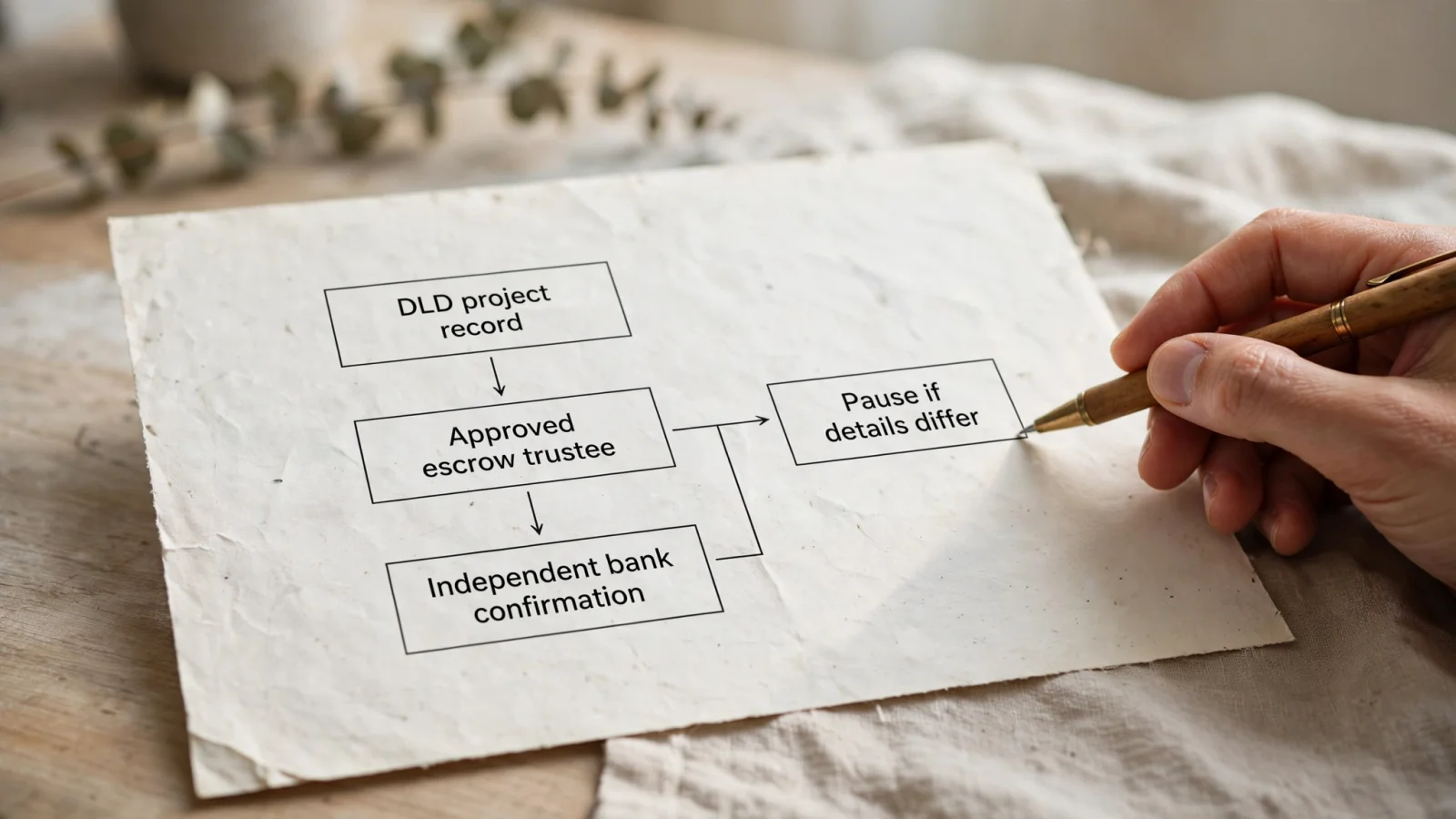
A mismatch between an invoice and the official DLD record is a reason to pause the transaction and investigate. It does not automatically prove fraud, but I require documented resolution before a transfer is authorised.
Discrepancies often stem from administrative changes, corporate restructuring, or simple human error at the developer's invoicing desk. However, sending funds before resolving the issue places the entire financial burden on the buyer. Until every legal name, project number, trustee bank, and account identifier aligns across all documents, I advise keeping the capital safely parked in the home bank account.
If the DLD search returns no matching record for the project, the developer cannot legally collect off-plan funds. DLD frequently answers queries regarding projects not yet visible on the public portal, noting that discretionary exceptions sometimes exist, particularly for older projects that were already significantly advanced before certain regulatory updates. I advise directing the inquiry to DLD for official clarification rather than accepting a salesperson's excuse about system lag.
I advise buyers not to send off-plan instalments to a project that cannot be identified within the DLD database. If a sales representative claims that the project is in a pre-launch phase and that full escrow registration will follow in several weeks, I recommend declining to pay. Legitimate developers in Dubai obtain their initial commercial approvals, plot ownership registrations, and escrow accounts before collecting off-plan capital from the public. Handing over funds during an unregistered pre-launch window circumvents statutory escrow protections entirely.
I advise buyers to be highly suspicious if the payment instructions name a different bank or a different account number from the DLD details. Sometimes developers change their trustee bank mid-construction, and DLD provides a formal escrow-account transfer-approval service for developers switching financial institutions. If the developer claims they recently changed banks, I ask them to produce the updated official DLD record reflecting the new trustee. I advise buyers not to send money to a new bank based on a letterhead announcement.
When a developer changes its escrow trustee, the transition requires formal regulatory clearance from the Dubai Land Department. The existing trustee must reconcile outstanding liabilities, transfer the retained statutory balances to the incoming financial institution, and secure formal discharge certificates. During this transitional period, DLD updates its internal registry and public portals to reflect the incoming bank. A developer cannot redirect buyer funds to a new bank based solely on an internal corporate notification. I ask buyers to wait until the DLD Project Status Enquiry portal officially displays the incoming institution as the certified escrow trustee.
I advise buyers to refuse any request to pay an individual's personal bank account, and to reject instructions directing funds to a broker's corporate account or a developer's general operating account. The law requires the money to land in the designated project escrow. Intermediaries offering to hold buyer funds in their own accounts violate the core protection of the escrow framework.
Sales agents occasionally ask international buyers to wire reservation deposits directly into an agency account, claiming this expedites unit allocation while the developer processes the formal paperwork. I consider this practice a serious operational risk for the buyer. Agency operating accounts are not regulated by project escrow rules, they carry no statutory protection against creditor claims, and they are not monitored by RERA technical auditors. I advise buyers to ensure every dirham of their purchase, including the initial booking deposit, flows straight into the project's DLD-approved escrow facility.
I advise buyers to exercise caution regarding last-minute payment changes. Business email compromise remains a severe threat in international real estate, as hackers monitor broker communications and send urgent emails with altered PDF invoices just as a buyer prepares to transfer funds. If a buyer receives a WhatsApp message or an email changing the bank details, I ask them to freeze the process. They should call the developer using a verified phone number and demand an explanation.
Cyber syndicates routinely infiltrate unencrypted email exchanges between real estate brokerages, buyers, and developers. They monitor transaction timelines quietly until the final Sales and Purchase Agreement is executed. The moment an instalment falls due, the attackers transmit an urgent message citing sudden banking maintenance or international clearing issues, directing the buyer to wire funds to an alternate offshore account. I advise treating any sudden modification to banking coordinates as an immediate compromise indicator. I ask buyers not to accept updated payment instructions without verbal confirmation through verified, landline corporate channels.
I ask buyers to keep escrow verification entirely distinct from the registration of their individual purchase. Checking the project's escrow entry confirms the developer's legal standing to receive funds, but it does not establish that a specific unit purchase is registered.
Dubai maintains an Interim Real Estate Register, commonly known as Oqood, for off-plan disposals. The developer must register the individual SPA in this interim register and provide the buyer with an official Oqood certificate. Sending money to the correct escrow account is the first step, while securing interim registration ensures the buyer's legal right to the specific apartment or villa.
The interim register protects the buyer's proprietary interest in the asset. If an unprincipled developer collects an escrow payment but fails to register the contract on Oqood, the unit remains vulnerable to administrative disputes or unauthorised secondary disposals. Under Dubai property regulations, the developer is legally obligated to initiate this registration process promptly upon receiving the contractual deposit. Once the payment clears into the verified escrow account, I advise buyers to demand their formal Oqood pre-registration certificate, which displays the unique property identification code issued directly by the Dubai Land Department.
I ask buyers to assess the property's suitability separately from its payment mechanics. A perfect DLD record merely clears the minimum legal hurdle for a transaction. Buyers must still evaluate their liquidity requirements, their tolerance for construction delays, and the verified future supply in that specific community. They can begin that deeper assessment by exploring the best off-plan projects in Dubai to understand market positioning and developer quality.
A pristine escrow account does not compensate for an overpriced asset or an unviable micro-location. Before signing contracts, I advise buyers to analyse the developer's balance sheet, previous delivery timelines, architectural finish standards, and past facility management practices. I also ask them to examine the broader urban master plan surrounding the site to determine whether infrastructure, road networks, schools, and retail nodes are funded and progressing, or whether the tower will sit isolated amidst empty desert plots for years after completion.
A buyer's holding period dictates the strategy. If the plan is to rent the unit upon completion, I advise calculating the true net yield after deducting service charges, management fees, and sinking fund contributions. Estimating these figures requires accurate baseline data, which is why I recommend using the RERA rental index Dubai calculator to test the developer's yield projections against actual, regulated market rates. Mapping out the total cost of flats in Dubai helps buyers plan for registration fees, handover payments, and furnishing costs.
Developer sales brochures routinely advertise gross yields between eight and ten percent, but these promotional estimates omit critical operational deductions. Annual service charges in prime high-rise communities can consume a measurable portion of top-line rental receipts. When buyers factor in letting fees, property management reserves, and periodic void periods between tenancies, their actual net return will sit well below developer marketing claims. I advise doing this calculation in advance to reduce the risk of capital shortfalls during handover.
Remote property investment requires discipline. I advise buyers not to let artificial urgency override their verification process. Demand the correct documents, use the Dubai Land Department portals systematically, secure direct bank confirmation, and retain every piece of evidence. If the records do not align perfectly, keep the capital in your home bank account until they do.
Book a no-obligation intro call with Ritu Kant Ojha Real Estate Advisory, where I personally work with every client.
Ask Ritu Kant
Have a question about your purchase? Ask me directly.
Tell me what you are considering. I read every message myself and reply within one working day.