
To verify a previous owner’s Dubai service-charge balance, you must compare the management company’s itemised ledger against the official Mollak payment notice. Under Law No. 6 of 2019, unresolved service charges block disposal of the property, meaning outstanding debts prevent the Dubai Land Department from issuing a clear title deed to an incoming buyer.
For a buyer making an acquisition decision in 2027, accepting an unverified ledger risks inheriting years of late penalties or developer-period arrears. Using the latest available reconciliation data from 2026, this article demonstrates how to sequence ownership dates, trace specific payment receipts, and record the exact financial settlement in your purchase contract before you sign.
The Legal Reality of a Previous-Owner Balance
When I review a Dubai resale file, I line up the Mollak statement with the ownership dates and payment evidence before deciding what an unexplained balance means. The governing framework for jointly owned property assigns specific obligations to the unit owner, and understanding these boundaries is the first step in protecting your acquisition.
I rely on Law No. (6) of 2019 Concerning Ownership of Jointly Owned Real Property in the Emirate of Dubai, which defines Service Charges as annual charges collected from Owners to cover the management, operation, maintenance and repair of Jointly Owned Real Property. I also note that, unless the Unit lease agreement provides otherwise, the Owner is liable for those charges and remains liable if the tenant fails to pay.
The 2019 law restricts a sale or transfer until the debt is resolved. It does not state that an incoming buyer assumes the seller’s personal pre-transfer debt upon taking the title. However, the restriction on disposal means an unexplained balance presents an immediate transfer risk and can block the issuance of a clear title deed. A buyer cannot ignore a historical balance or assume they owe it. The dates, the itemised account, the sale terms, the clearance records, and any ongoing legal action need strict verification.
Article 27 of the same law also places charging and collection under regulatory oversight. Management entities require Real Estate Regulatory Agency (RERA) approval before charging or collecting relevant amounts from owners. This regulatory requirement means any demand for payment must match a budget formally approved by the authorities. I provide a practical due diligence perspective for tracing these records and structuring your transaction safely, rather than acting as a substitute for qualified legal counsel. If a liability dispute reaches the point of litigation, the framework changes. Article 32(b) sets out a RERA-approved written notice process that includes a 30-day period before an unpaid claim can be enforced, while Article 42 gives the Rental Disputes Settlement Centre exclusive jurisdiction over disputes concerning rights and obligations under this law.
Gather the Records Before You Reconcile
To trace a historical balance, I begin by collecting the relevant documents. A seller’s verbal assurance or a screenshot showing a zero balance may leave important questions unresolved, so I request these records early in the negotiation, well before signing a binding Memorandum of Understanding.
The first document I request is the full, dated Mollak payment notice. Mollak is the official online system managed by the Dubai Land Department (DLD) that regulates owner associations and monitors service charge accounts. The payment notice generated by this system provides the official record of what is owed according to the regulator.
I also obtain the management company’s itemised statement of account. This internal ledger tracks every financial interaction between the unit and the building management. A proper statement of account shows invoice periods, opening and closing balances, itemised payments, applied credits, and manual adjustments. The management company issues this document directly to the current owner, who then shares it with your advisory team.
I ask the seller to provide payment receipts as well. These documents require exact transaction references, payment dates, and the specific bank accounts used. A common failure mode occurs when a seller makes a valid bank transfer but fails to include the unit number in the payment reference, leaving the funds unallocated in the management company's account while penalties accrue on the unit.
I also obtain the property's complete title history. This includes the initial handover notice from the developer and records of any subsequent title transfers. The timeline determines exactly when the current seller became legally responsible for the unit.
I prepare the draft purchase agreement to reflect the findings. The Form F, which serves as the standard real estate contract in Dubai, contains a section for special conditions. I use this section to document exactly how you and the seller will handle prepayments, outstanding balances, and invoice periods that cross the transfer date. If you are negotiating a transaction where the seller cannot afford to clear their arrears before transfer, refer to the latest available data in the 2026 playbook for negotiating distressed deals in Dubai for strategies on structuring the contract safely.
The regulatory framework supports this documentation. Circular No. 2021/03, issued by DLD and RERA, gives a direct reconciliation model for owner balances. It explicitly instructs auditors to compare the Mollak payment notice with the statement of account and the Mollak ledger, verifying the exact nature of outstanding sums and identifying amounts due from previous owners.
Step 1: Reconcile the Mollak Notice and the Statement of Account
I start by comparing the headline figure on the official Mollak notice against the detailed line items in the management company’s statement of account. This comparison reveals what makes up the outstanding balance and highlights discrepancies between the building manager's internal records and the government portal.
I record the statement date on both documents. A ledger pulled on the first of the month will differ from a Mollak notice generated on the fifteenth if new penalties have applied or a quarterly invoice has been raised. I ask for documents generated within the same week.
I ask the community manager to identify every line item on the statement of account. A standard Dubai service charge ledger contains multiple distinct categories, and treating them all as a single debt leads to incorrect allocations. Base service charges cover the general upkeep of the building, security, and cleaning. The sinking fund represents a mandatory reserve for future capital expenditures, such as replacing lifts or repairing the facade. Chiller charges relate to the district cooling provision, which may be billed by the management company or directly by a third-party utility provider. Usage charges apply to specific community facilities, while penalty fees accumulate automatically when previous invoices remain unpaid past their due date.
I ask the manager to state the period and provide the supporting invoice for each line item. I rely on the official Mollak process page, which confirms that invoices are issued every quarter based on the final approved budget. Because the page confirms quarterly billing, I ask the parties to agree the buyer-seller allocation separately if a transfer falls within a billed period.
I create a simple reconciliation worksheet. It lists each line item, the corresponding period, the specific charge type, any payment or credit applied, the evidence supporting that payment, and any outstanding question for the community manager. This structured approach helps prevent an incoming owner from absorbing unexplained penalties or paying for services delivered long before they took ownership.
Step 2: Match Each Charge to the Ownership Timeline
Once I have an itemised list of charges, I map them against the exact dates the property changed hands. A balance on a unit's ledger does not automatically belong to the person currently selling you the property. It may belong to the developer who delayed the initial handover, or to an earlier owner who sold the property before the current electronic clearance systems were fully implemented.
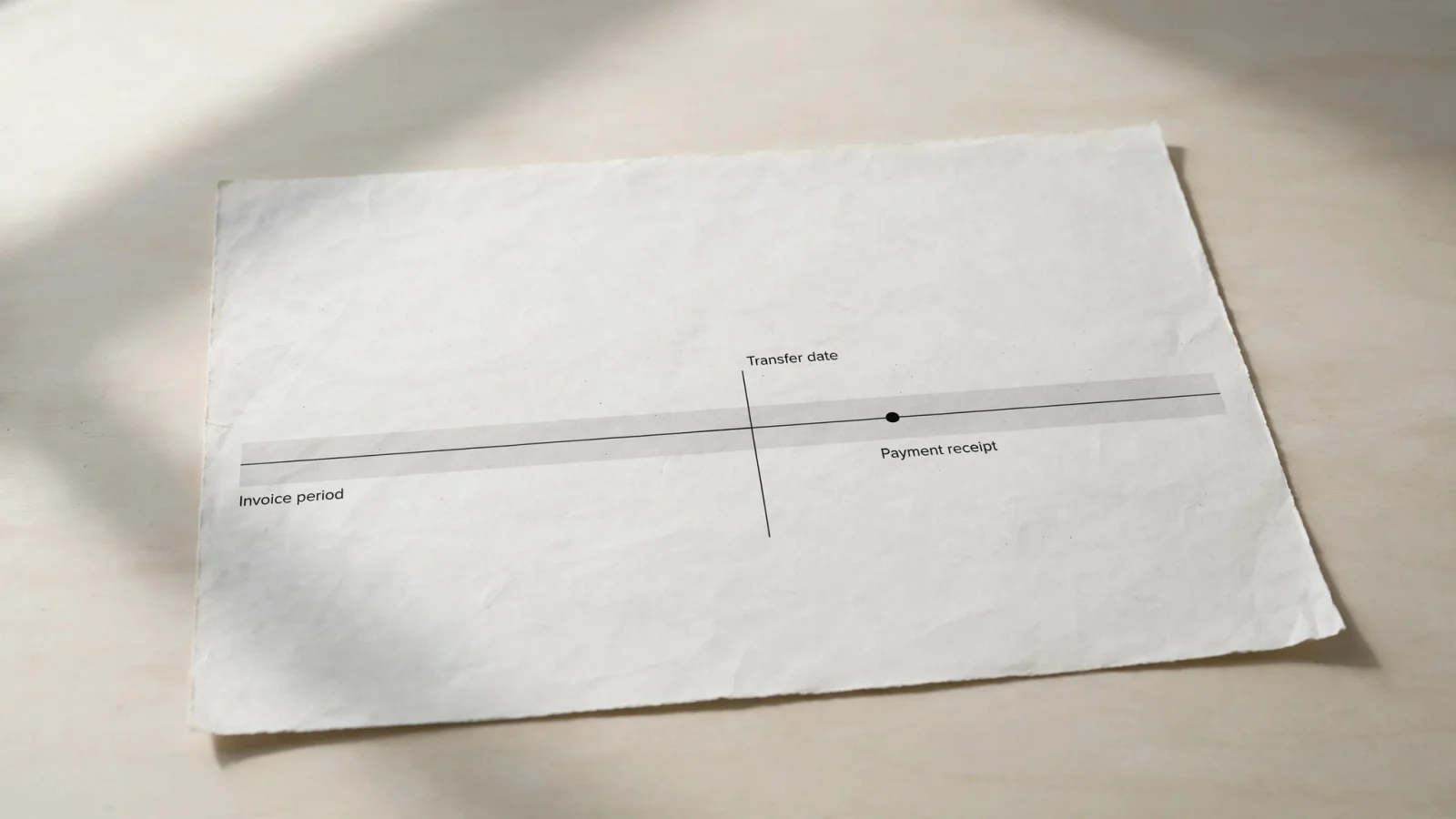
I build a complete date sequence for the property. I start with the initial handover notice issued by the developer, add every subsequent title-transfer date recorded on previous title deeds, and end with your proposed resale transfer date.
I compare this timeline against each charge period, invoice date, due date, and payment date on the statement of account. RERA Circular No. 2021/03 specifically directs auditors to verify the initial handover notice and later ownership-transfer dates, including amounts attributed to a previous owner or developer. I use the same checks when reviewing an acquisition.
When an invoice period precedes the current seller's ownership start date, I treat it as a previous-owner balance to investigate. An earlier-period or handover-related entry is not proof on its own of who is liable for the final bill. Developers sometimes hold a unit in their inventory for two years before selling it to the first investor, and the management company may incorrectly bill that first investor for the developer's holding period. If the first investor later sells the property to your current seller without resolving the ledger, the developer's original debt rolls forward into your transaction.
I map the current quarter's invoice against your proposed transfer date. If the quarter runs from October through December, and your transfer is scheduled for mid-November, the invoice spans two distinct ownership periods. Documenting this overlap helps protect you from paying the seller's share of the final quarter.
Step 3: Trace Payments and Check the Approved Charge
After matching the ownership timeline to the ledger, I confirm who should have paid each invoice, whether they paid it, and whether the charged amount matches the rate approved by the regulator.
I compare the seller’s payment receipts and transaction references directly against the Mollak notice and the statement of account. I look for the specific reason the arrears appeared. I ask the management company in writing about any partial payments, unidentified transfers, or uncredited amounts. A seller may have paid their base service charge but ignored the sinking fund contribution, resulting in a partial payment that triggers ongoing penalty fees.
I consider several possible explanations before assigning the balance to a cause. The arrears might stem from an unpaid earlier invoice that the current owner forgot. They could relate to a payment made from an international bank account that lacked the correct unit reference, leaving the funds stranded in the owner association's suspense account. The balance might consist entirely of accumulated penalties from a dispute the seller had with the developer three years ago. It might relate to a different charge category altogether, such as an unpaid chiller bill that the management company consolidated onto the main service charge ledger.
I check the relevant fiscal year and the approved budget. The law bases the owner’s mandatory share on the unit area recorded in the Real Property Register. You can cross-check the project's approved rate by fiscal year using the Frequently Asked Questions portal provided by the Dubai Land Department, which details the Service Charge Index. The index provides a comparison tool to ensure the rate charged per square foot matches the regulatory approval. It serves as a benchmark for the approved rate, rather than proof that a historical unit balance or a specific payment allocation on the ledger is correct. If you are calculating your expected net yield after clearing these verified charges, you can reference the RERA rental index calculator to model your projected gross income against the confirmed holding costs.
The ADVICEdge Framework in Due Diligence
I use the ADVICEdge framework to guide this reconciliation process. It defines trustworthy financial advice across five distinct qualities.
Alignment requires judging the cost of clearing a disputed balance against your intended holding period. A ten-thousand-dirham penalty might break the yield model for a short-term studio flip, but prove irrelevant to a high-net-worth family acquiring a signature villa for generational wealth preservation. If you are acquiring ready property through a corporate structure for portfolio diversification, ensure your acquisition plan aligns with the correct LLC formation in Dubai guidelines before executing the transfer.
Depth means tracing the dates, invoices, and ledger entries back to the original handover notice, rather than accepting a broker's summary of the debt. Voice requires explaining the exact nature of the uncertainty plainly, telling an overseas buyer exactly what risk they carry if a receipt cannot be verified. Integrity involves separating hard documentary evidence from assumptions, demanding written proof for every payment claim, and maintaining commercial transparency. Compassion means managing this complex paper trail for a remote buyer, executing the verification efficiently without making the investor feel naive for asking detailed questions about the billing cycle.
I invite buyers to use the free ADVICEdge Advisor Check tool on our homepage to frame questions for their broker and management company. The tool does not act as an automated ledger-verification system.
Step 4: Confirm Clearance and Record the Allocation in Writing
Once I have isolated the cause of the arrears and verified the correct charges, I confirm the transfer mechanics. This involves securing the correct government or developer clearance and recording the exact financial settlement in your purchase contract. Separating the property’s transfer-clearance status from the buyer-seller agreement is critical: one mechanism allows the sale to proceed, while the other decides who pays for it.
Confirm Which Transfer Approval Applies
Every property transfer in Dubai requires official clearance proving that the unit's financial obligations are settled. I ask the management company or developer which specific transfer approval or No Objection Certificate (NOC) applies to the property, and obtain written evidence of its status and validity.
The clearance mechanism depends on the status of the building and the management company. The Dubai Land Department operates an automated eNOC system that links directly with Mollak. The official Electronic No Objection Certification (eNOC): FAQs confirms that this service is for eligible ready properties managed by owners’ association management companies that issue invoices through Mollak.
The eNOC system accelerates the clearance process when the ledger is clean. The DLD document outlines a processing time of three to five working days for an eNOC request. This figure represents the stated request-processing time within the portal, not a guarantee of the overall sale-transfer timetable. The presence of unresolved previous owner arrears immediately blocks the automated eNOC issuance.
The eNOC does not replace every other required document. The DLD guide explicitly states that the eNOC is not a substitute for a developer NOC. Many master developers require their own separate clearance certificate, particularly if the property sits within a gated master community where the developer retains control over infrastructure fees, exterior modifications, or master community levies. If a previous owner owes master community charges that sit outside the standard Mollak ledger, the developer will withhold their NOC until the debt is cleared, regardless of the building manager's statement of account.
Record the Buyer-Seller Allocation in Writing
The regulatory framework establishes the legal obligations between the unit owner, the management company, and the government. The cited statutory provisions create a lien on the property and restrict disposal, but they do not provide a statutory resale-day apportionment formula for deciding how an incoming buyer and an outgoing seller split an invoice that spans the transfer date.
I advise the parties to record the allocation as an express contract point. They can set out how they will handle the charges in the Form F special conditions or a formal addendum, including periods before and after the transfer, any prepaid amounts, and any balance that remains in dispute.
If the current quarter's invoice is ten thousand dirhams, and the seller has already paid it in full, the contract must state whether you will reimburse the seller for the days you own the property during that quarter. If the seller has not paid the invoice, the contract must dictate that the seller clears the amount covering their ownership days prior to the issuance of the NOC.
Documenting this settlement helps prevent transfer-day failures. A seller who assumes a customary pro-rata split is a legal rule may refuse to clear a historical penalty, believing the buyer automatically absorbs it. Written clearance and an agreed split reduce the risk of a transfer surprise, while relying on one electronic approval or an unwritten handshake leaves critical financial questions unresolved. Once you have cleared the property and secured the title deed, you will need to formalise the transition of the unit to a rented state. You can use a standard tenancy agreement Dubai template to establish the new terms with your incoming tenant, ensuring they understand their own utility obligations distinct from your owner service charges.
What to Do If an Earlier Balance Appears After Transfer
Even with rigorous due diligence, administrative delays can cause historical balances to reappear on your ledger after the transfer completes. This typically happens when the management company runs a delayed reconciliation cycle or applies a retrospective penalty to a period before you took ownership. I handle this with a calm, documented follow-up.
After the management company updates its primary owner record with your new title deed details, I request a fresh, dated statement of account and a new Mollak payment notice. RERA’s auditor checklist calls for continuous owner correspondence, balance adjustments, and discrepancy reporting, rather than a single comparison of headline totals on transfer day.
If an earlier-period balance appears on your new ledger, I send the management company your new title-transfer document, the seller’s payment evidence gathered during step three, and the written settlement terms from your Form F addendum. I request an itemised reconciliation of the earlier-period balance and a written explanation of any manual adjustments made after the transfer date.
I keep the management company's written response with the sale file. This documentation helps show that you contested the charge promptly. If the issue escalates and the management company threatens to restrict your access to community facilities over the previous owner's debt, I refer back to the legal framework.
Article 32(b) of Law No. 6 of 2019 sets out a precise regulatory process for debt enforcement. It requires a RERA-approved written-notice process, including a formal thirty-day period before an unpaid claim can be enforced through the Rental Disputes Settlement Centre. This is a specific legal enforcement mechanism, not a general grace period or a rule that automatically decides resale allocations. Article 42 gives the RDSC exclusive jurisdiction over disputes concerning rights and obligations under the jointly owned property law.
If liability remains contested and the management company refuses to remove the previous owner's debt from your unit, I recommend seeking qualified Dubai legal counsel. I provide the strategic framework to identify these risks and structure your acquisition safely, ensuring you possess the necessary documentation if legal action becomes unavoidable. For an overseas investor, the immediate step is requesting a written reconciliation from the building manager so the discrepancy can be formally reviewed.
Ritu Kant Ojha Real Estate Advisory provides evidence-led property due diligence and acquisition strategy for overseas investors, non-resident Indians, and high-net-worth families buying in Dubai. Book a no-obligation intro call.
Ask Ritu Kant
Have a question about your purchase? Ask me directly.
Tell me what you are considering. I read every message myself and reply within one working day.