
I Check The Approved Cost Before I Discuss Rent
You can verify the exact operational cost of a Dubai property by searching the official Dubai Land Department (DLD) Service Charge Index. By entering the specific project, usage type, and budget year, the database provides the legally approved maintenance rate per square foot, giving you a verified baseline for your cash-flow model.
For a buyer making an acquisition decision in 2027, relying on projected yields without accounting for verified maintenance charges masks the true net return. While gross rental income attracts attention, this operating expense dictates how much cash you actually keep. This article outlines how to extract the correct figure from the DLD system, calculate your actual annual liability using the latest 2026 data, and protect your purchase from inherited building arrears.
What The Dubai Service Charge Index Shows
I use the official DLD Service Charge Index to search by project, usage and year, then check the calculation's listed management entity and start and end dates.
I treat the returned figure as the approved budget divided by the total chargeable area of the relevant usage type. It reflects the cost of operating the jointly owned property for that specific period. I use the index to identify the maintenance cost for a square foot of residential or commercial space during that year. I explain that an owner must request a separate statement to verify whether they hold a credit or owe arrears.
I use the budget years in the DLD search form dropdown menu to guide the search parameters. I do not assume that an entry is available for every project in the current year, nor that the displayed rate remains fixed in future years. The DLD FAQ clearly notes that charges vary according to the services provided, common area dimensions, and unit mix. I treat a rate approved for the current year as applicable only to that budget cycle. When service contracts adjust or reserve fund requirements change, I expect the management entity to submit a new budget for audit and RERA approval, which can alter the rate over a buyer’s holding period.
How I Find The Correct DLD Entry
I need an exact match across multiple fields to find the right figure. A similarly named project, a different usage category, or a previous year will return irrelevant data that skews an investment model. I account for the fact that a mixed-use building often carries entirely different rates for residential apartments and commercial spaces because they consume common resources differently. I walk buyers through two primary search routes, depending on whether they are assessing a prospective purchase or checking a property they already own.
Project Search For A Prospective Buyer
When I assess a unit for a buyer who does not yet hold a title deed, I use the project search function. I begin by selecting the main project, which often represents the broader master community or development phase. Next, I select the specific project name corresponding to the individual building or tower. I use the usage field to separate residential, commercial, and retail components. Finally, I select the budget year to ensure I am viewing the most recent approved figures rather than historical data.
After I enter these parameters, I run the search and review the returned card. I check the result against my selections to confirm that the management entity and rate period align with the current operational year. I export the result to keep the project details, rate period, and management entity visible. This exported record helps prevent a mismatched rate from entering the financial model weeks later. I also use the Dubai REST application’s manual or map-based project selection route to identify the correct building, which helps when a project uses a marketing name that differs from its legally registered DLD title.
Title-Deed Search For An Existing Owner
When I advise existing owners who hold their property documents, I explain that they can use the title-deed search route for a more direct lookup. This method bypasses the project selection menus by using the unique identifiers on the official registration document. The owner enters the certificate number and year alongside the property type and target budget year. I note that the system uses these details to pull the specific rate applicable to that registered unit.
I use this route to reduce the risk of selecting the wrong usage type or building phase in a complex master development. I explain that the certificate year corresponds to the date the title deed was issued, while the budget year refers to the period for which the owner wants to check the approved charge. I advise owners reviewing their portfolio before deciding to hold or sell to use this function to verify that the rate their management company is billing matches the RERA-approved figure for the current operating cycle.
How I Estimate The Unit's Annual Charge
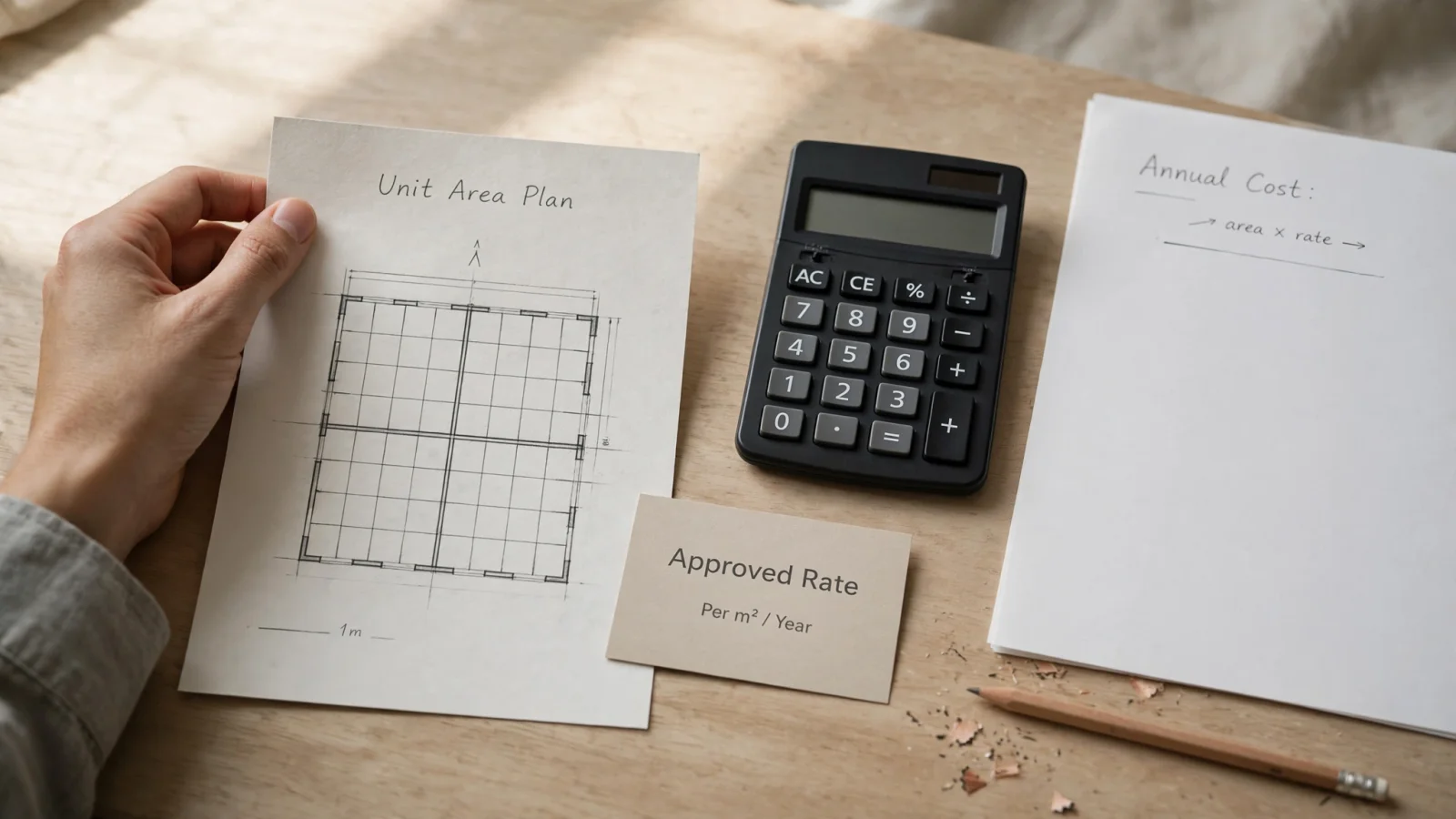
I turn the index rate into a usable financial figure with a straightforward calculation and precise inputs. I multiply the approved rate in AED per square foot by the relevant unit area in square feet to estimate the annual service charge. For example, I calculate a baseline annual cost of 15,000 AED when a rate of 15 AED applies to a 1,000-square-foot unit.
I take care to confirm the exact area used for this calculation. The DLD frequently asked questions state that an owner’s common-service-charge share relies on the unit area recorded in the title deed. However, I recognise that the exact treatment of balconies and exclusive-use areas can vary, and that the DLD platform’s wording regarding balcony areas remains unclear. I do not infer a universal balcony rule or assume the gross marketing area applies. Instead, I request the approved unit invoice or written confirmation from the management entity of the specific area used in the calculation.
For a ready property on the secondary market, I always compare my calculated estimate with the latest unit-level invoice or official account statement. This reconciliation helps me catch discrepancies between the index rate and the actual billed amount, which can occur if the unit carries specialised exclusive-use charges or master-community charges billed alongside the standard rate. For an off-plan unit without an issued title deed, I use a project rate only if the project, usage, and budget year match the development in question. If I rely on a developer’s projected estimate because the building lacks an approved budget, I label that figure separately in the model to highlight the risk of post-handover increases.
The Scope And Limits Of The Approved Rate
I use the approved index figure to verify a specific operational cost for a defined project and year. It establishes the legal baseline for billing while excluding the physical reality of the building and other secondary ownership costs. I map the exact limits of this charge to help overseas investors account for potential bills after the transfer completes.
Possible Services And Separate Usage Charges
I explain that an approved service-charge budget covers the day-to-day operation and long-term preservation of jointly owned property. These categories include security staffing, common-area cleaning, and facility maintenance contracts. The budget also covers shared utility consumption, administration, insurance, and reserve fund contributions. I also account for the portion of collected funds that must flow into a dedicated reserve account to cover major capital replacements, such as roof repairs or chiller upgrades, over the building's lifecycle.
I apply the distinction in Dubai Law No. 6 of 2019 Concerning Ownership of Jointly Owned Real Property. I read the law as defining Service Charges as annual charges collected from Owners to cover the management, operation, maintenance and repair of Jointly Owned Real Property, and Usage Charges as annual charges collected from Owners or Sub-developers for the management, operation, maintenance and repair of Common Facilities. I also note that the law defines Common Facilities as areas and spaces demarcated on a Master Plan for common use and service of a Master Project, including streets and gardens, and states that they are owned by the Developer subject to ownership limitations. I therefore check which category a quoted charge covers before adding it separately to a buyer’s cost plan.
Interpreting Building Quality From The Budget
I treat a service charge figure as a measure of the approved budget, separate from execution quality. I account for differences in the service package, common area ratios, and specific unit mix when assessing charges. A high rate does not prove that the building enjoys premium maintenance or superior management. I consider whether it might indicate an inefficient cooling system, an underfunded reserve account trying to catch up, or an architectural design demanding excessive exterior cleaning.
Conversely, I do not treat a low rate as a guarantee of a sound investment. An artificially suppressed budget often causes deferred maintenance, which can degrade the property's rental appeal and capital value. I use the index as a financial metric for cost verification, so I still recommend a physical condition check, a review of owner association meeting minutes, and an assessment of the management company's track record.

Pre-Purchase Document Verification
I keep in mind that the index explicitly excludes arrears. When I search a project and find a rate of 18 AED per square foot, the system makes no representation about whether the current owner of unit 402 has paid their 18,000 AED bill. For a secondary-market purchase, I request the unit’s current account statement and definitive evidence that all outstanding charges have been settled. If a buyer relies on an index search while ignoring the unit-level account, they remain exposed to inherited debt.
I also explain that Dubai Law No. 6 of 2019 provides a management entity with a legal lien on the unit for unpaid service charges. The law restricts the disposal of a property until those charges are cleared, meaning the Dubai Land Department will not issue a No Objection Certificate (NOC) to transfer the title until the management company confirms a zero balance. I advise overseas buyers to verify this clearance early in the due-diligence phase, rather than assume the transaction will proceed smoothly.
For remote service-charge payments, I direct clients to review invoice details and pay through the Mollak system, rather than rely on forwarded instructions. I do so because Mollak lets unit owners pay service charges directly to the system and monitors accounts related to those charges using financial accounts that operate under an escrow-account mechanism.
I also turn concerns about the building's condition into specific document requests. I ask for the current budget breakdown, reserve fund balances, and maintenance logs detailing unresolved building issues. I account for RERA’s separate audit and inspection powers over jointly owned property to enforce compliance, which operate separately from the index lookup. I reconcile the project rate with this unit-level evidence, flag missing documents, and explain the cash-flow implications to the buyer. This approach helps me close the remote due-diligence gap without misrepresenting the index as a legal clearance or an engineering inspection.
How I Handle Missing Entries And Off-Plan Budgets
When I run a search and receive a "No Data found" message, I treat it as a missing result that may indicate pending approval. I consider pending budget approval, a recent project handover, or a search parameter error as possible explanations for a missing entry. I recheck the project details, usage category, and budget year. If the details are correct and the system still returns no data, I ask the seller or management company whether an approved budget or a RERA-approved temporary budget is available.
I maintain a strict boundary between a developer’s marketing projection and a legally approved budget. I note that DLD approval requires audited budgets, external financial reviews, and formalised service contracts. While Dubai Law No. 6 of 2019 allows RERA to approve a temporary service-charge budget in specified circumstances, such as immediately following building completion, I do not treat a figure printed in a sales brochure as having regulatory weight.
When I underwrite off-plan property, I direct off-plan buyers to the Sale and Purchase Agreement (SPA), the reservation document, and master-community declarations. I use these documents to confirm exactly when the service charges commence and who bears responsibility for them. I note that the law states the developer pays the service-charge share for unsold units, preventing the entire operational cost of a half-empty building from being shifted onto the first wave of residents. Furthermore, developers must pay the charges for sold units where the sale or reservation agreement explicitly states the developer will cover them on the purchaser’s behalf for a defined period. Because Usage Charges remain distinct and can apply to under-construction developments or vacant plots, I review the contracts to identify any master-community charges that trigger before the physical keys are handed over.
Calculating Real Net Yield With Approved Rates
I include the annual service-charge estimate in the property’s financial model as one recurring line item when I assess an investment decision. I place it alongside owner-paid property management costs, vacancy allowances, and interior maintenance buffers. I also include landlord insurance premiums, financing costs, and separately billed cooling capacity charges.
I avoid double-counting items. If the approved service charge already includes chiller charges because the building operates on a centralised, unmetered system, I do not add a separate district cooling estimate, which would artificially depress the yield. Conversely, if the index rate covers only the building management, I add the master-community Usage Charge to find the true cost of ownership. I calculate the precise impact by examining the full cost of buying a Dubai flat, from acquisition costs to ongoing operational expenses.
I always present an upside base case alongside a realistic downside scenario. In the downside model, I test the impact of falling rents, extended vacancy periods, and rising service charges over a five-year hold. If I model a future rate increase, I label it as an investor assumption for stress-testing purposes rather than a DLD forecast. I use this analysis to see whether the property still meets the investor's minimum return threshold under pressure.
I tie this analysis directly to the buyer’s goals and holding period. When I advise an NRI family planning to hold a unit for ten years, I account for multiple budget cycles, making reserve-fund health and historical rate stability more critical than a temporary post-handover charge waiver. If the verified cost strips the net yield down to a level that no longer justifies the illiquidity of real estate, I revisit the unit selection, negotiate a lower purchase price, or advise the client to wait. I also direct clients to the RERA Rental Index Dubai Calculator guide to understand the income ceiling, while the service charge determines how much of that income they keep.
Procedural Questions Before A Dubai Property Purchase
I hear remote buyers ask the same procedural questions when we begin analysing operational costs. I answer them by matching the exact project, usage type, and budget year.
Locating The Approved Rate
I search the official DLD Service Charge Index using the project name, the specific building or phase, the usage type, and the target budget year. If I am advising someone who already owns the property, I bypass the project menus by entering the title deed certificate number, the certificate year, and the property type into the deed-search tab.
Calculating The Exact Unit Bill
I use the index’s approved rate per square foot and multiply it by the unit's relevant area to estimate the annual cost. I reconcile this estimate with the actual unit-level account statement. I also check whether specific exclusive-use charges, ambiguous balcony calculations, and separate master-community charges alter the final billed amount.
Identifying Unpaid Arrears
I bear in mind that the index explicitly excludes arrears. The published rate only shows the approved cost per square foot for the selected year. To confirm whether a specific seller owes money, I request the unit’s current account statement and verify that all balances are settled before proceeding with a transfer.
Distinguishing Service And Usage Charges
I treat Service Charges and Usage Charges as legally distinct under Dubai Law No. 6 of 2019. Service Charges fund the management of jointly owned property within a specific building, while Usage Charges fund common facilities across a broader master project. I also check for Usage Charges that may apply independently, including charges levied on vacant land or under-construction buildings.
Handling Missing Project Data
When I see a "No Data found" result, I understand that the system cannot locate an entry for those parameters. I recheck the spelling, the master project selection, and the usage category. If the details are correct, I ask whether the building is newly completed or awaiting budget approval, and I request the RERA-approved temporary budget from the management entity.
Evaluating Low Service Charges
I treat a low rate as an accounting metric rather than a building-condition score. Artificially low charges often signal an underfunded reserve account or deferred maintenance, which can degrade the building's appeal and force a sudden levy increase.
Treating Off-Plan Charges
I treat a developer’s off-plan projection as an estimate separate from a legally approved audited budget. I check the Sale and Purchase Agreement to confirm exactly when the buyer’s liability for these charges begins and whether the developer has committed to covering the costs for a specified post-handover period.
I advise overseas investors, non-resident Indians, and family offices acquiring Dubai property by building downside-aware models that verify real ownership costs. I align each transaction with the buyer’s long-term wealth strategy to ensure the asset meets their minimum return threshold under pressure.
At Ritu Kant Ojha Real Estate Advisory, I personally work with every client. Book a no-obligation intro call.
Ask Ritu Kant
Have a question about your purchase? Ask me directly.
Tell me what you are considering. I read every message myself and reply within one working day.