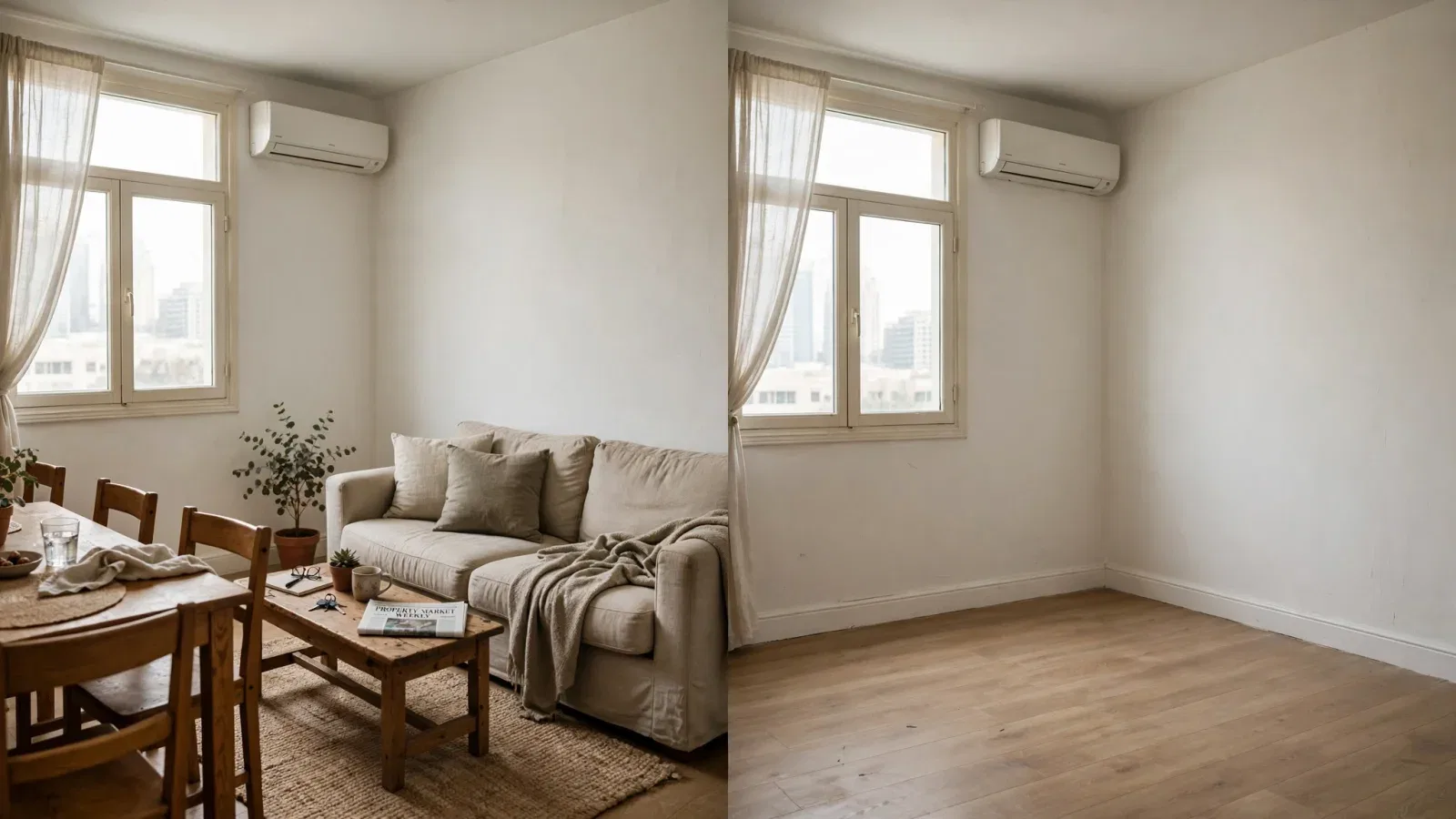
A furnished Dubai apartment only earns a better return if the rent premium recovers your setup capital. While a 2025 report in the Khaleej Times notes that 64 percent of renters searched for furnished options, a higher asking price is not profit. You must subtract higher management charges, maintenance, and replacement provisions to find the actual net yield.
For an overseas buyer making a property decision in 2027, trusting a developer's gross rent projection can trap capital in a depreciating furniture package. This article compares the real operating costs of furnished and unfurnished annual leases, showing you how to calculate the net cash uplift and determine whether outfitting an empty unit makes financial sense.
This assessment focuses on a furnished vs unfurnished Dubai rental on an annual lease. I exclude holiday homes and monthly billing arrangements, because this decision involves deploying capital to fit out a long-term residential property rather than switching to short-term letting. I examine signed contracts, physical condition records and the documented operating costs of remote management.
Define the Comparison Around Long-Term Leases
I describe a furnished property as one with a complete, functional setup that allows a tenant arriving with only a suitcase to live in the space immediately. I recommend that the inventory include beds, mattresses, dining furniture, seating, television units, major appliances, window coverings and basic kitchenware.
I describe an unfurnished property as one handed over with bare rooms. The landlord provides finished flooring, painted walls and fitted bathroom fixtures. The kitchen may include integrated appliances like an oven or hob, while the tenant brings their own freestanding furniture, soft furnishings and electronics.
I treat partly furnished as a middle option that can cause contractual confusion. A landlord might leave a dining table and a sofa but expect the tenant to provide beds. I recommend listing every included item on a signed contents schedule to prevent disputes at the end of the tenancy.
A functional, ready-to-use setup may suit expats moving to the UAE for the first time, as they often arrive without furniture and wish to avoid outfitting a new apartment. I treat this as a hypothesis about tenant fit, not a universal rule guaranteeing faster letting.
I find that an unfurnished home attracts a different demographic. Long-term Dubai residents, families upgrading to larger villas, or tenants who have accumulated their own belongings may prefer an empty space so they can control the interior design. If I were assessing a furnished family home in Jumeirah Village Circle or a large villa in Dubai Hills, I would check whether prospective tenants ask for the furniture to be removed before signing the lease.
Furnished: Convenience With More Capital at Risk
Furnishing a property demands immediate upfront capital. I account for the cost of items, delivery, assembly and staging before a single tenant views the apartment.
A standard setup for a one-bedroom apartment in Downtown Dubai requires a substantial budget. I would include a quality bed frame, a durable mattress, bedside tables, a wardrobe if the unit lacks built-in storage, a sofa, a coffee table, a dining set and a television console. Kitchens need a refrigerator, washing machine, microwave and basic cooking equipment, alongside curtains, rugs and lighting fixtures.
Once the tenant moves in, my operating exposure increases. The furniture belongs to the landlord, who pays to maintain it. A broken washing machine, malfunctioning television or damaged dining chair requires attention and money. I also account for additional cleaning costs between tenants, longer inspection times and the eventual cost of replacing worn items.
The upside of this investment depends on a documented rent uplift and capable local management. A well-furnished apartment in a high-demand area can secure a higher annual rent. If the property manager handles maintenance efficiently, that extra income can improve net yield.
The downside arises when the tenant does not value the setup. I might price the apartment higher only to find the market rejecting the premium, leaving the property vacant. I might eventually accept a lower offer from a tenant who tolerates the furniture but refuses to pay extra for it, leaving me to cover maintenance costs from ordinary rental income.
Unfurnished: Lower Furniture Spend, Different Tenant Fit
Leaving an apartment empty keeps the initial capital requirement low, as I avoid the cost of sourcing, shipping and installing furniture. This approach also removes a major layer of operating complexity.
With an unfurnished property, I avoid furniture-specific repair requests. When a tenant owns the television, they pay to fix it, so I avoid updating an inventory list, arguing over a stained sofa during handover or paying a cleaning company to wash a mattress.
This approach does not remove ordinary property maintenance. I remain responsible for the air conditioning, plumbing, electrical systems and structural integrity of the building. I also face vacancy costs if the property sits empty, and service charges remain payable regardless of occupancy.
The main trade-off involves tenant appeal and initial marketing. An empty apartment can look smaller and less inviting in listing photographs, and tenants arriving from the UK or India without belongings may skip the listing. I would need to rely on a pool of renters who already own furniture and plan to stay in the country for several years.
I recommend testing these tenant profiles against the specific building’s leasing history. A studio apartment in Dubai Marina serves a different demographic from a four-bedroom villa in Arabian Ranches. Experienced property managers can advise whether incoming tenants in a specific tower expect an empty unit or a turnkey solution.
Compare the Options on Operational Criteria
The choice between these setups determines financial exposure and management burden. I evaluate the options across five operational criteria.
| Feature | Furnished | Partly Furnished | Unfurnished |
|---|---|---|---|
| Initial capital required | High. Covers all furniture, appliances and window coverings. | Moderate. Covers only specific retained items like appliances. | Low. Covers only fitted fixtures and integrated kitchen units. |
| Target tenant profile | New arrivals, corporate relocations, temporary residents. | Tenants with some belongings seeking specific gaps filled. | Established residents, families, long-term renters. |
| Maintenance responsibility | Landlord repairs or replaces all included furniture and appliances. | Landlord repairs only the items explicitly listed in the contract. | Tenant repairs their own belongings; landlord handles the property and its systems. |
| Handover complexity | High. Requires detailed inventory, condition checks and appliance testing. | Moderate. Requires checking the specific included items. | Low. Requires structural and cosmetic condition checks only. |
| Remote management burden | Heavy. Overseas owners must coordinate itemised repairs and replacements. | Moderate. Overseas owners manage only the listed appliances or items. | Light. Overseas owners handle only building and system issues. |
The furnished option demands high capital and ongoing involvement, while the unfurnished route minimises the operational footprint. A partly furnished property requires strict contractual boundaries to prevent confusion over who fixes a broken refrigerator.
Compare Lease Evidence, Not Listing Labels
I base my decision on completed annual leases rather than asking prices. Property portals display what landlords hope to achieve, while signed contracts reveal what tenants pay.
A 2025 report in the Khaleej Times highlighted portal preference data, noting that 64 percent of renters opted for furnished apartments, compared with 45 percent the previous year. I treat this as a portal preference signal indicating that furnished options attract interest. The figure does not represent a share of signed annual leases, prove lower vacancy rates or guarantee that tenants paid more.
I also cite a separate Property Finder guide, which claims a 20 to 30 percent annual rent premium for furnished apartments over comparable unfurnished units and estimates one- to two-bedroom furniture setup costs at around AED 15,000 to AED 35,000. I treat these figures as unverified claims because the guide does not connect the premium to a matched set of signed leases or the setup estimate to an itemised supplier bill. I do not use them as Dubai-wide underwriting assumptions.
To find a verifiable premium, I match properties precisely using records from the same building. I compare apartments with the identical floor plan, bedroom count, size, view and condition. The leases must commence around the same date, cover the same term and feature similar payment structures, as a tenant paying in one cheque often secures a lower rent than a tenant paying in four cheques regardless of the furniture.
I record whether each rent figure is an asking price or a signed contract, and I describe the furniture and its quality in the comparison. A unit fitted with imported Italian furniture will perform differently from a unit filled with budget flat-pack items.
I ask the property manager for completed lease data, including the time between tenants and the furniture-related costs incurred during the last turnover. For rent benchmarks, I use the Dubai Land Department Rental Index. Its public form requests tenancy and property details, including contract end dates and areas, but has no field to distinguish furnished from unfurnished stock. I therefore cannot use it to prove a furnishing premium.

Model the Net Uplift and Payback
I use a strict financial model to calculate the return on a furniture investment. I do not treat a higher gross rent as proof of success. I isolate the additional cash generated by the furniture and measure it against the capital deployed.
I first calculate the gross revenue difference by subtracting the comparable unfurnished annual rent from the furnished annual rent. If an empty apartment rents for AED 100,000 and a matching furnished unit rents for AED 115,000, the gross uplift totals AED 15,000.
I then account for the costs of generating that extra revenue. Incremental annual net cash equals the rent uplift minus the difference in management costs, furniture repairs, replacement provisions, and any additional vacancy or cleaning costs.
Management costs usually scale with the rental amount. If a manager charges 5 percent of the gross lease, the charge is AED 5,000 to manage the empty unit and AED 5,750 to manage the furnished one, creating an incremental cost of AED 750.
I also provision for wear and tear, as furniture depreciates and a rental sofa may not last ten years. If I estimate needing to replace a AED 30,000 furniture package every five years, the annual replacement cost is AED 6,000. I might also spend an extra AED 1,000 on deep cleaning between tenants and AED 1,500 on minor repairs during the year.
Subtracting these costs from the gross uplift reveals the financial performance. An initial AED 15,000 gross uplift drops by AED 750 for management, AED 6,000 for replacement, AED 1,000 for cleaning and AED 1,500 for repairs, leaving incremental annual net cash of AED 5,750.
I then calculate how long it takes to recover the initial capital. Simple payback equals the installed furnishing cost divided by positive incremental annual net cash. If I spent AED 30,000 on the initial setup, I divide 30,000 by 5,750 to find a payback period of 5.2 years. If incremental annual net cash is zero or negative, the model shows no payback from the rental uplift.
I integrate these figures into the broader property assessment. The full yield model includes the property purchase price, acquisition costs, service charges, standard maintenance and baseline vacancy. I count the initial furnishing capital once at the beginning of the model, then forecast future replacement costs consistently across the intended holding period.
The Rental Property ROI Calculator is my primary calculation aid for these baseline metrics. Its visible fields handle purchase price, rent, service charges and management costs. Because the tool does not feature a dedicated furniture line, I add the furnishing capital to the initial investment total and include the repair provision in annual operating expenses. I also offer a free RERA rental index calculator for rent benchmarking, while recognising that the published index cannot distinguish furnished from unfurnished stock. I help clients assemble unit-specific lease evidence, test itemised supplier costs and calculate the verifiable rental yield rather than repeat a developer's broad projection.
Account for Wear, Handover and Remote Management
I account for the extra handover work furniture creates, because it turns a structural check into a detailed inventory audit.
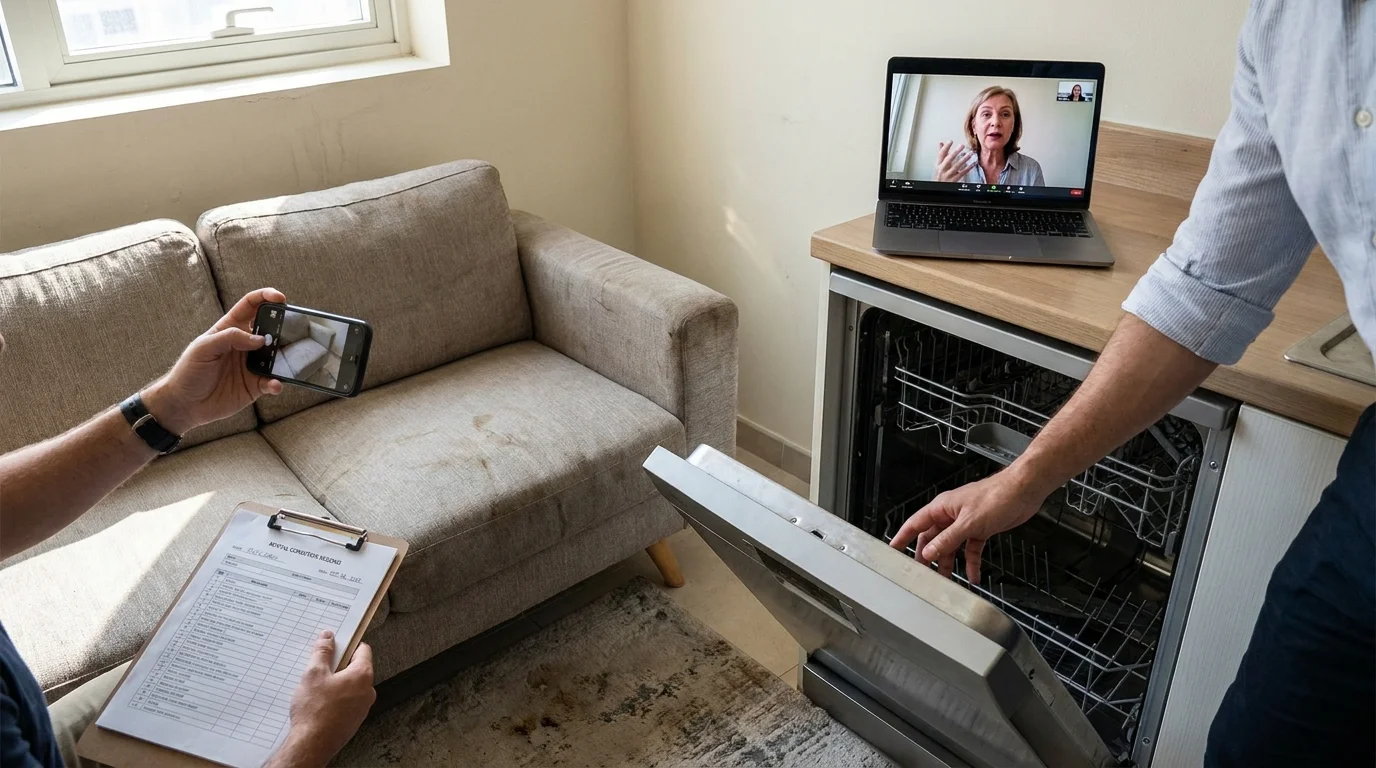
An unfurnished handover involves confirming that the walls are clean, the doors lock and the air conditioning runs. A furnished handover requires the manager to test the washing machine, inspect the mattress for stains, count the dining chairs and check the television remote.
For an overseas owner, this creates a substantial coordination burden. I cannot walk through the apartment myself, so I rely on a local representative to verify delivery when the furniture first arrives. I pay them to check the function and condition of every item during a tenant turnover. This can require me to make remote decisions about whether to repair a scratched table, store an unwanted bed or dispose of a broken microwave.
I protect the investment through rigorous documentation. I recommend obtaining a signed contents schedule from the tenant and asking the manager to create a dated condition record covering every item in the apartment. I ask the document to note existing defects, confirm appliance function, state agreed maintenance responsibilities and outline what happens if an item is damaged, removed or replaced.
I rely on Dubai Law No. 26 of 2007 for Dubai's landlord-tenant rules. It covers written leases, maintenance responsibilities, tenant obligations and security deposits, and requires tenants to return the property in the condition received, except for ordinary wear and tear or damage beyond their control.
These general provisions do not automatically assign every furniture repair to one party. I would not rely on a vague interpretation of the law to require a tenant to replace a washing machine that breaks down from old age. I recommend checking the current contract and drafting applicable amendments that assign specific repair liabilities. A well-drafted addendum states exactly who pays for a technician call-out and who replaces an appliance that cannot be fixed.
Managing Currency Sensitivity for NRI Buyers
Indian nationals and South Asian diaspora living in the US, UK or GCC evaluate Dubai property through a cross-border lens. When capital is held in Indian Rupees, US Dollars or British Pounds, currency sensitivity sits alongside local operating costs.
I keep the core yield model in UAE Dirhams. The property generates AED rental income, while service charges, management costs and maintenance bills are also paid in AED. Introducing an exchange rate into the middle of the calculation distorts the property's local performance.
I run a separate currency sensitivity analysis after determining the dirham yield. A strong US Dollar, to which the AED is pegged, means dirham income translates to more Rupees or Pounds, while a weakening dollar has the opposite effect.
This sensitivity directly affects the furnishing decision. If net cash flow is to be repatriated to India or the UK, a heavy local repair burden eats into the transferable funds. When a tenant damages a AED 4,000 sofa, the replacement must be paid for in dirhams from a local account, reducing the capital available for repatriation.
I find that minimising local operating friction helps preserve cross-border cash flow. An unfurnished property requires fewer local interventions, which can result in a more predictable net income stream for an overseas owner. If I recommend furnishing, I first check that the net uplift is large enough to absorb local repair costs and leave a surplus for repatriation.
Post-Purchase Maintenance and Manager Coordination
Many first-time investors assume property management remains a passive exercise where a management company handles everything quietly in the background. A furnished rental instead requires regular small decisions.
When a tenant reports a leaking refrigerator, the property manager does not buy a new one immediately. They send a technician to diagnose the fault, email a quotation for the repair and wait for the owner to review it against the cost of a new unit. Once the owner approves the expense, the manager coordinates the repair and deducts the cost from the next rental disbursement.
This process takes time, and if the owner lives in a different time zone, the delay can frustrate the tenant. A frustrated tenant may be less likely to renew their lease, increasing turnover and vacancy costs.
I advise investors to consider whether they have the capacity to manage this workflow. For someone who travels frequently for work or holds a demanding corporate role, a steady stream of minor repair requests can degrade the experience of owning Dubai real estate. Unfurnished properties remove these micro-decisions, leaving the owner to deal with major structural or systemic issues.
The Role of the Property Manager in Furnished Lettings
The success of a furnished rental depends on the quality of the local manager, as poor management can erode yield through negligence and inflated repair bills.
I look for a manager who conducts thorough inspections twice a year. They catch minor issues, like a slow leak under the kitchen sink, before it ruins the custom cabinets. They also enforce the inventory list at move-out, helping establish whether the tenant is responsible for torn upholstery through the security deposit.
An incompetent manager may rush the handover, miss the burn mark on the rug and fail to test the dishwasher. When the next tenant moves in and complains, the owner may bear the cost of replacing the items because the manager cannot prove the previous tenant caused the damage.
Before committing capital to furniture, I advise interviewing the management company. I would ask to see its standard inventory template and request a sample condition report from a recent handover. If it provides a one-page checklist without photographs, I would question whether it has the operational rigour to protect a furnished asset.
Choose for the Holding Period, Not a Rent Projection
The decision rests on verified evidence and the planned holding period. I apply the ADVICEdge framework, alignment, depth, voice, integrity and compassion, to ensure the recommendation fits the investor's capacity and financial goals. I align the physical setup with the target return, seek depth in the lease evidence and maintain the integrity to point out when a developer's projection ignores market data. I set out this framework for evaluating advisors in my 2026 book, The Only Difference.
I advise furnishing a property only when unit-specific lease evidence supports a positive net uplift. The additional rent must recover the capital cost and operating expenses within the planned holding period. The owner also needs a credible local plan to handle handovers, coordinate repairs and replace depreciating assets.
I advise leaving the unit unfurnished or partly furnished when the premium remains unverified. If the building’s leasing history shows that target tenants prefer bringing their own belongings, I would not force a furnished setup onto the market. Remote management and frequent turnover costs can rapidly erode theoretical returns, making an empty unit a more predictable investment for an overseas owner.
When comparable leases are unavailable, I use no uplift in the base case. I would wait for better evidence to emerge from the secondary market, as I do not recommend spending capital on furniture to validate a developer’s aggressive rent projection.
I consider both scenarios. The upside delivers a documented rent uplift managed by a reliable team, boosting annual yield. The downside occurs when the asking rent falls flat, the market rejects the premium, and the owner still faces repair and storage costs for unwanted furniture.
I assess whether the rental strategy can be sustained across multiple tenancies. I recommend fitting the property to verified data, accounting for remote management capacity and letting net yield guide capital deployment.
Book a no-obligation intro call with Ritu Kant Ojha Real Estate Advisory for a detailed net-yield assessment; Ritu Kant personally works with every client.
Ask Ritu Kant
Have a question about your purchase? Ask me directly.
Tell me what you are considering. I read every message myself and reply within one working day.