
A DIFC Foundation suits long-term Dubai property portfolios requiring multi-generational governance, but it rarely fits single-asset acquisitions. Under the Foundations Law DIFC Law No. 3 of 2018, the Foundation operates as a separate legal person with the capacity to acquire assets directly. It separates legal ownership from beneficiary rights, replacing individual probate with a continuous corporate Council.
For families planning allocations in 2027, treating a Foundation as an automatic tax shield or default property wrapper often leads to trapped capital. Dubai Land Department eligibility routes dictate whether the Foundation can hold title directly or requires a company layer. This guide compares ownership structures, maps the administrative drag on rental yield, and defines when formal governance aligns with your exit plan.
Start With the Family’s Objective, Not the Vehicle
I do not begin by asking whether a DIFC foundation is the ideal structure for your portfolio. I start with who should control the property and how decisions must proceed if the founder cannot act. A DIFC Foundation warrants assessment when a family requires durable governance for a long-held portfolio. It operates as a governance tool rather than a default property wrapper or a guaranteed tax-saving device.
I centre this planning on the distinction between legal ownership and governance, then consider who benefits from the asset. Under the Foundations Law DIFC Law No. 3 of 2018, consolidated in March 2024, the Foundation is a separate legal person. It holds the capacity of a natural person to acquire assets, meaning its property is not held on trust for another individual. Beneficiaries do not automatically own the underlying real estate, as founder rights depend on what the By-laws provide.
Many overseas buyers arrive at Proact Luxury Real Estate having heard that a Foundation resolves every succession question. I assess whether the intended holding period justifies formal governance. Buying a single unit to hold for five years rarely warrants the administrative weight of a Foundation. If I am advising a high-net-worth family allocating AED 20 million across multiple Dubai assets to fund grandchildren's education, the governance framework informs the decision. I also test any expected returns against the risks, rather than relying on a developer’s projections.
Establishing a Foundation means accepting a formal division of roles. The Founder establishes the entity to endow it with assets, while a Council administers the Foundation in pursuit of its objects. Beneficiaries receive distributions or use the assets according to the rules set out in the Charter and By-laws. This separation forces families to articulate their rules for succession and conflict resolution while the Founder remains capable of making decisions. I treat this as a private governance framework for a family’s wealth, which demands time and a defined understanding of its liquidity needs.
Confirm the Property’s Title Route Before Signing
I start with Law No. (7) of 2006 Concerning Real Property Registration in the Emirate of Dubai, which restricts ownership to UAE and GCC nationals, companies fully owned by them, and public joint stock companies. For non-UAE nationals, I note that the law permits freehold ownership without a time limit, or usufruct or leasehold for up to 99 years, in areas designated by the Ruler and with the Ruler's approval. I also note that the Dubai Land Department is the only entity authorised to register real property rights, and transactions creating or transferring those rights are not valid unless recorded in the Property Register. Since the law does not identify DIFC entities specifically, I check the exact property against the proposed ownership structure before drawing an eligibility conclusion.
A 2025 DIFC announcement described an agreement with DLD to use DIFC structures in real-estate ownership, aiming to enable families to consolidate wealth. The evidence gap remains clear in practice. DLD’s public FAQ lacks a Foundation-specific registration route for direct title. A DLD registration trustee lists Foundations and notes that supporting documents include a no-objection certificate. I treat this as procedural information from a service provider, not a universal guarantee of eligibility.
Before I recommend signing a Sales and Purchase Agreement (SPA), I ask buyers to confirm the exact property’s eligibility, the accepted title route, and all required approvals with DLD. Assuming the Foundation can hold direct title without checking can cause blocked transactions and tied-up capital.
The title route dictates the required documentation. When DLD accepts direct title, the Foundation itself appears on the title deed. If DLD or a developer requires a holding company, the Foundation owns shares in a separate property company that takes the title. Each route carries different approval timelines and compliance demands. Developers also impose their own compliance checks before issuing an SPA to a corporate entity, often requesting certified copies of the Charter alongside Council resolutions. I map these administrative friction points with buyers before they commit funds.
Compare Ownership, Control and Succession
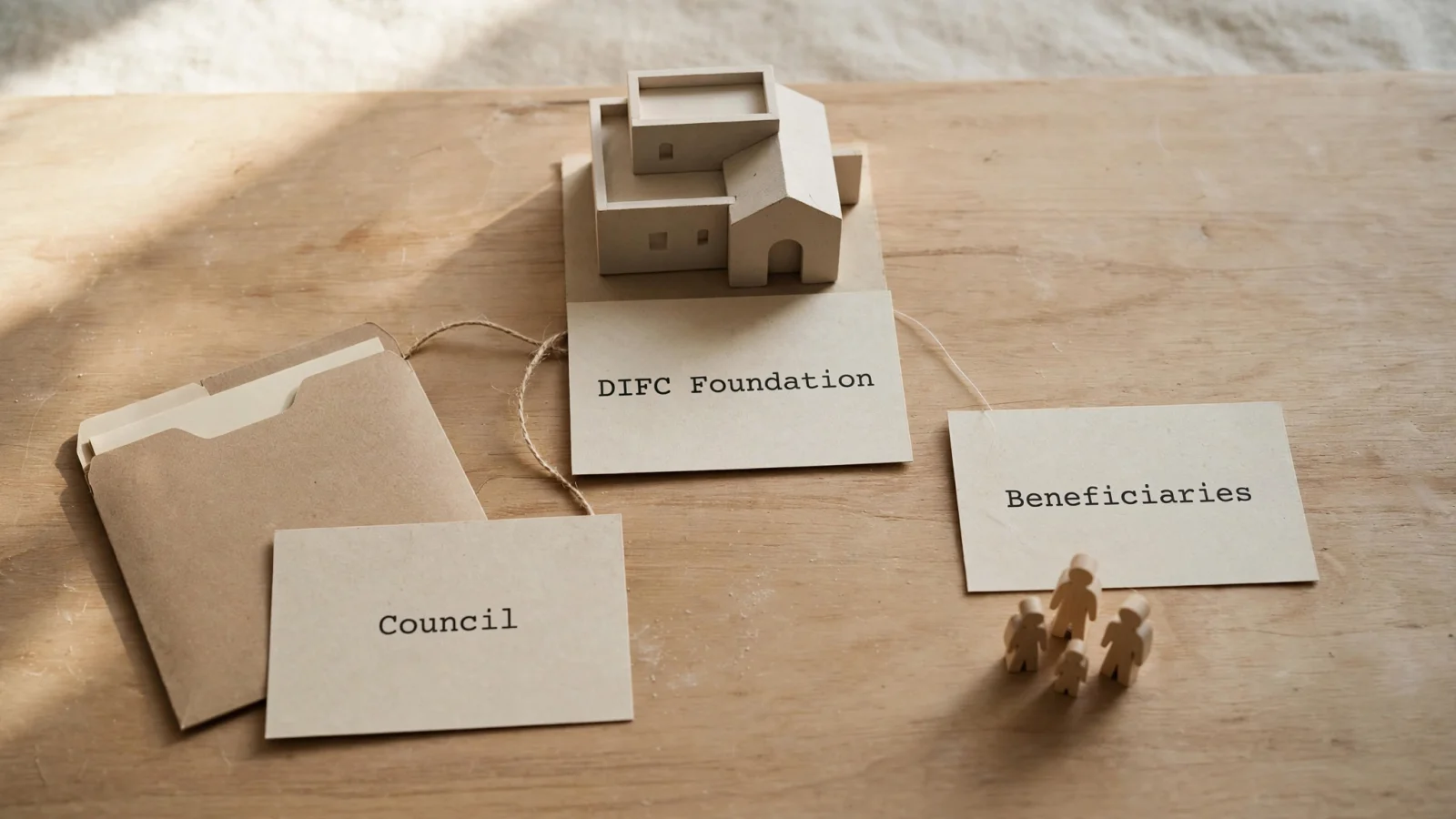
I compare the structural options using clear criteria: who holds the legal title, who makes the decisions, how succession functions, and what the administration involves. The right choice depends on the family's tolerance for ongoing compliance.
| Structure | Legal Title Holder and Decision Maker | Succession Continuity | Main Administration or Exit Trade-off |
|---|---|---|---|
| Personal ownership | The individual is the registered owner and makes all decisions directly. | On death, DLD guidance refers to inheritance procedures approved by Dubai Courts. | May be a poor fit for families needing a durable decision-making framework across several generations. |
| Company owns the property | A company holds title. Shareholders and governing documents dictate control and decisions. | Shares pass according to company rules and applicable probate, maintaining corporate continuity. | A change in shareholders’ equity is treated by DLD as a property transfer requiring notification and applicable fees. |
| Foundation holds title directly | The Foundation is the legal owner. The Council administers the asset under the Foundation’s documents. | The Foundation survives the Founder. Council governance continues based on specified rules for beneficiaries. | DLD eligibility must be confirmed for the specific property. The family must fund recurring Council and accounting administration. |
| Foundation owns a property company | The company holds title. The Foundation governs the company as shareholder. | Foundation governance remains intact, dictating how the company shares are managed over time. | Adds a company layer, creating dual compliance, cost and tax questions. Share transfers can also trigger DLD implications. |
Personal title offers a direct route for individual control. When a buyer wants to sell, they sign the forms, and leasing the property requires their signature on the tenancy contract. The limitation appears upon death or incapacity. DLD states that the transfer of a foreign individual’s property on death follows inheritance procedures approved by Dubai Courts. Managing international probate in Dubai can become complex for surviving families when the deceased held assets across several countries.
Company documents shape shareholder control. Many investors expect a company layer to bypass property transfer fees during succession. DLD investor guidance treats a change in shareholders’ equity within a property-owning company as a property transfer requiring notification and applicable fees. I ask buyers to confirm current treatment for their specific structure instead of assuming corporate share transfers occur without property-level costs.
A Foundation preserves continuity of ownership only if DLD accepts the proposed title route. It does not make the beneficiaries the property owners, and it leaves applicable succession rules governing the Founder's initial endowment of assets intact. If the Foundation holds title, the death of the Founder does not trigger a real estate transfer because the Foundation still owns the asset. The Council continues operating the property according to the By-laws.
The Government of Dubai’s 2025 family-business guidebook illustrates a Foundation owning a holding company, which in turn holds immovable property. These examples serve as a common architecture rather than a mandatory structure for every buyer.
Privacy often surfaces during planning. A Foundation lacks absolute anonymity. The Foundations Law allows public inspection of certain register information, although access to a certified Charter remains restricted to a person with sufficient interest. The 2025 Dubai family-business guidebook describes a private-register option. I recommend verifying exact disclosure requirements under the selected registration route with DIFC before proceeding.
Match the Structure to the Holding and Exit Plan
I test the structure against realistic scenarios to assess its practical value. These profiles act as decision illustrations for Dubai off-plan property investment and ready property acquisitions, serving as guidance rather than definitive legal conclusions.
Consider a first-time buyer acquiring one Dubai apartment for a defined five-year holding period. This buyer intends to rent the unit out and capture capital appreciation before selling. Personal ownership usually proves proportionate here. The administrative burden, setup fees, and annual accounting costs of a Foundation would erode the net yield. Setting up a Council to manage a single short-term asset introduces friction when the buyer intends to exit the market before succession concerns arise.
Compare that with a multi-generational family holding several properties intended to remain within the family. The family members reside in different jurisdictions and need formal rules on who controls the assets and how rental income is distributed. The governance case for a Foundation becomes strong. The Founder can draft By-laws establishing investment parameters, preventing a single beneficiary from forcing a sale of a legacy asset. The holding period justifies the governance costs.
For an active portfolio with frequent sales or short-term operations, I consider a different approach. The Foundations Law limits commercial activity to what is necessary for or incidental to the Foundation’s objects. Flipping properties or running an active holiday-home business may cross the line into prohibited commercial activity. A company layer becomes an option to test in this scenario. The company handles the commercial operations and holds the properties, while the Foundation sits above it as a passive shareholder providing broader family governance.
At Ritu Kant Ojha Real Estate Advisory, I map the family’s holding period and exit plans against liquidity constraints to define these title routes. I also define the intended use of the property. If the goal is long-term capital preservation and structured yield distribution, I consider the Foundation for further assessment. If the goal involves rapid acquisition and disposal, I identify the friction points of Foundation governance and suggest alternative corporate or personal routes. I then frame the exact questions buyers should take to DLD and their specialist legal advisors.
Budget for Setup and Ongoing Administration
A Foundation operates as a legal entity requiring annual funding. The DIFC Foundations Law mandates a licence, a registered office within DIFC, and the maintenance of proper accounting records. Annual accounts must be produced. After the Council approves these accounts, the Foundation must file them with the Registrar or provide them to its Registered Agent within 30 days.
The Council must have at least two members. Family members often serve on the Council, but bringing in professional members adds governance depth while incurring recurring fees. A Guardian acts to ensure the Council executes the Founder's intentions, which is required for charitable or specified non-charitable objects. For an object benefiting a person or class of persons, a Guardian remains optional. A Registered Agent is also optional under the Law but frequently appointed to handle DIFC compliance and registered office duties.
I ask buyers to compare cost categories to understand the drag on their rental property ROI. I recommend budgeting for:
- Foundation formation, including the bespoke drafting of the Charter and By-laws.
- DIFC licence fees, registered-office charges, and service-provider costs.
- Council, Guardian, or Registered Agent professional fees where applicable.
- Annual accounting preparation, auditing if required by the By-laws, and compliance filing.
- Formation and annual renewal costs for any underlying company layer.
- DLD registration or transfer costs, plus specific developer or community approval fees.
- The property’s own service charges, management fees, and maintenance costs.
I recommend consulting the current DIFC Handbooks & Fees portal for date-stamped official charges. Relying on historical forum posts or outdated advisory brochures leads to miscalculated yields.
When transferring an existing property into a newly formed Foundation, I recommend obtaining written DLD confirmation of the transaction classification and fees. I do not assume a reduced transfer fee. Some historical commentary described discretionary reductions for transferring personally owned property into a Foundation, yet I advise modelling the transfer based on written confirmation from the registration trustee and DLD for the specific transaction today. Paying a standard 4% transfer fee on a high-value portfolio to move it into a Foundation alters the breakeven timeline of the investment.
Separate UAE Tax Treatment From Home-Country Exposure
Forming a Foundation does not determine your tax treatment. I separate the ownership and governance decision from the tax classification of the entity and the personal tax exposure of the beneficiaries.
UAE Corporate Tax Treatment Is Conditional
The UAE Corporate Tax regime applies specific rules to Foundations. The Federal Tax Authority’s Taxation of Family Foundations | CTGFF1 guide, updated on 10 June 2026, describes the process for qualifying Family Foundations to be treated as fiscally transparent unincorporated partnerships. This treatment is not automatic. It requires an application to the FTA, and the Foundation must meet strict conditions regarding its objects and beneficiaries.
When the application is approved, the Foundation acts transparently for UAE Corporate Tax purposes. The beneficiaries are seen as holding the assets and deriving the income directly. Dubai Government tax-structure guidance notes that real-estate investment income earned by a natural person may fall outside UAE Corporate Tax where the activity operates without a commercial licence.
If the Foundation holds the property through an underlying company, the guidance details conditions under which entities within qualifying Foundation structures may seek transparent treatment. I recommend comparing the actual direct-title and company-layer arrangements under the current FTA guidelines. A company layer adds complexity to the transparency application. These are conditional classifications requiring precise structuring and specialist tax counsel to maintain.
NRI and Other Home-Country Questions
For Non-Resident Indians (NRIs) and diaspora buyers, UAE tax classification represents only half the equation. The Foundation structure does not isolate buyers from their home-country tax authorities. I separate these cross-border issues entirely from the Dubai property acquisition mechanics.
Indian tax residents and NRIs moving capital face stringent Foreign Exchange Management Act (FEMA) regulations. How a buyer funds the Foundation and how rent or sale proceeds return to India require specific compliance steps. Establishing a DIFC Foundation does not bypass the Liberalised Remittance Scheme (LRS) limits or the required disclosures for foreign assets.
I read the Income Tax Department’s Form 41 User Manual as guidance on the Form 41 process for non-residents claiming relief under a Double Taxation Avoidance Agreement. I do not treat it as a determination of a particular Foundation’s or beneficiary’s tax treatment.
I ask buyers to resolve distinct questions with their Indian tax advisor:
- Who is the Founder, who are the beneficiaries, and where is each person currently tax-resident?
- Will the Foundation own the property directly, or will it own shares in a company, altering the characterisation of distributions?
- How will rental income be retained within the Foundation or distributed to beneficiaries?
- Where did the acquisition funds originate, and what is the compliant path for repatriating sale proceeds?
I also ask buyers to clarify their residency aims. Foundation ownership of a property does not automatically grant the Founder or the beneficiaries a UAE Golden Visa or long-term residency. Visa eligibility tied to real estate investment usually requires the property to be held in the individual applicant's name. If selling property in Dubai or securing a retirement visa forms part of a buyer’s plan, I recommend verifying current immigration rules regarding corporate or foundation-owned assets before altering the title. I also recommend obtaining current advice on tax residence and the movement of funds before executing the transfer.
Apply the Decision Before an SPA or Transfer
The decision to use a DIFC Foundation requires testing your family’s governance needs against the administrative reality of maintaining a corporate structure. I use this checklist to apply the decision before a buyer signs an SPA or initiates a transfer.
First, I obtain written confirmation from DLD of the property’s eligibility and the proposed title route. I also establish whether the Foundation can hold the asset directly or whether the developer requires a company layer.
Second, I establish who will control the asset. I review the proposed Charter, By-laws, and Council arrangements with the family. I check that the governance structure reflects how the family makes decisions, rather than adopting a generic template that paralyses property management.
Third, I test the structure against the intended holding period and exit plan. A Foundation serves long-term, multi-generational wealth preservation. It introduces unnecessary friction for short-term, single-asset acquisitions or highly active trading portfolios.
Fourth, I price the formation and recurring administration alongside property and DLD costs. I build a ten-year cost model that includes licence renewals, registered agent fees, accounting preparation, and Council member remuneration. I compare this drag on yield against the cost of personal ownership and potential probate.
Fifth, I obtain UAE and home-country tax advice for each entity layer. I confirm the requirements for FTA transparent partnership treatment and map the cross-border implications for funding and capital repatriation according to the buyer’s tax residency.
A Foundation becomes practical when continuity of family governance holds enough value to justify its administration and the title route is accepted. Personal ownership offers a proportionate path for a simple, defined holding. A company layer supports operating needs while adding compliance and transfer considerations.
In the due-diligence context, I recommend evaluating structural advice using the ADVICEdge Advisor Check. The five-point ADVICEdge framework incorporates alignment, depth, voice, integrity, and compassion. It asks an advisor to weigh liquidity and downside risks instead of processing a registration. In The Only Difference (2026), I set out the ADVICEdge framework for evaluating advisors. My earlier book, Real Conversations In Digital Age (2019), is also available through my site. Proact Luxury Real Estate is my primary real-estate advisory route for defining the holding period and property economics, while legal structuring and tax execution remain with the relevant specialists. I ensure that my structural recommendations align with your defined investment horizon rather than available inventory.
Book a no-obligation intro call, as I personally work with every client.
Ask Ritu Kant
Have a question about your purchase? Ask me directly.
Tell me what you are considering. I read every message myself and reply within one working day.