
You verify Dubai off-plan construction progress by checking the Dubai Land Department (DLD) Project Status Enquiry portal, which logs official completion percentages and inspection dates. However, the DLD requires developers to supply a formal letter from a registered project consultant to legally trigger construction-linked payments under your sale and purchase agreement.
For overseas buyers managing payment schedules in 2027, relying solely on developer marketing updates risks premature cash transfers and misaligned yield projections. This article shows you how to establish a baseline using 2026 completion data as your latest available metric, obtain technical corroboration from licensed engineers, and use physical site evidence to protect your liquidity.
These procedures, digital portals, and statutory protections apply specifically to off-plan developments within the Emirate of Dubai. Other emirates, including Abu Dhabi, Sharjah, and Ras Al Khaimah, use their own municipal systems and regulatory bodies. Dubai’s integrated digital tracking framework makes regular status checks accessible to overseas owners who cannot visit project sites in person.
I frame property investment through a five-stage model: diagnose, align, prepare, execute, and steward. Monitoring construction progress belongs in the stewardship phase. It connects the developer’s evidence to your liquidity needs, expected holding period, and exit strategy rather than serving as a reason to shortlist another launch. Good stewardship means treating an acquisition as a long-term financial commitment that calls for ongoing oversight. By tracking construction milestones, you can make decisions based on progress rather than react to developer deadlines.
Before checking online portals or arranging site visits, gather the necessary documentation. You need your signed SPA, the registered project name and number, the specific building or phase identifier, the stated completion target, and the payment schedule. Identify whether each trigger in that schedule relies on a specific calendar date, a defined construction stage, or a mix of both. Keep your interim property registration documents, such as your initial reservation agreement and your Oqood certificate, organised alongside your main contract. Having these records at hand helps you check that the commercial name used by sales agents matches the registered legal entity recognised by the land registry. Keep recent payment notices and developer updates with these documents so you can compare them against the public record.
Step 1: Find the Correct DLD Project Record
The primary source for a Dubai project’s registered status is the DLD portal. Searching this database gives you the developer’s reported progress, the escrow account details, and the date the department last recorded an inspection. Public regulatory records cut through sales rhetoric by presenting the operational data logged directly with government authorities.
Work through to the DLD Project Status Enquiry service. There, you can search by project name or project number.
Check that the returned record matches the exact developer and building listed in your SPA. Master developments are typically divided into individual plots or phases, with each carrying its own distinct progress metric and escrow account. Applying the completion percentage of an entire master community to your specific building distorts your cash flow planning. A master community might reflect an aggregate completion rate of seventy percent because central infrastructure, landscaping, and earlier towers have been delivered, while your specific building plot remains at the foundation stage. Checking the exact sub-project number prevents you from relying on high-level master community figures that have no bearing on the physical reality of your unit.
Once you locate the correct entry, review the available status tabs and save the completion information, inspection details, fact sheet, and escrow information. The fact sheet details the registered project start date, the developer's officially submitted anticipated completion date, the registered master developer, and the licensed sub-developer executing the work. It also documents the designated escrow agent bank and the specific project escrow account number. Comparing the developer name on the portal against your contractual seller helps ensure that your agreement reflects the officially approved development entity rather than an unlicensed marketing intermediary.
If you use a mobile device, the department describes its Dubai REST application as giving off-plan project beneficiaries access to the completion percentage, actual project pictures, escrow account number, and payments due from owners in projects they invested in. The department describes these project details as real-time information.
Record a dated screenshot or download the fact sheet to your local files. Note the date of your search and the data source, as project statuses update periodically and previous percentages disappear from the live view once overwritten. Archiving these snapshots creates an objective audit trail of the project's progress over time.
Step 2: Check Dates and Request Technical Evidence
A high completion percentage on a portal provides comfort only if the data is fresh. Before acting on a project record, check the last inspection or update date shown on the fact sheet. A record indicating that a project is eighty percent complete offers little reassurance if the site audit occurred nine months ago and the site has remained dormant ever since.
According to its published guidance, RERA periodically reviews project records and asks developers to update technical information like expected completion dates and completion rates. When addressing late projects, DLD notes that a technical report expires three months after its date. This statement applies to late-project updates and does not offer a universal refresh guarantee for every project listing in the emirate. Routine projects that proceed according to their original timelines might show inspection dates spaced out over wider intervals depending on municipal engineering schedules. If the record appears stale, missing, or inconsistent with a payment notice you received, flag it for follow-up rather than assuming the database has failed.
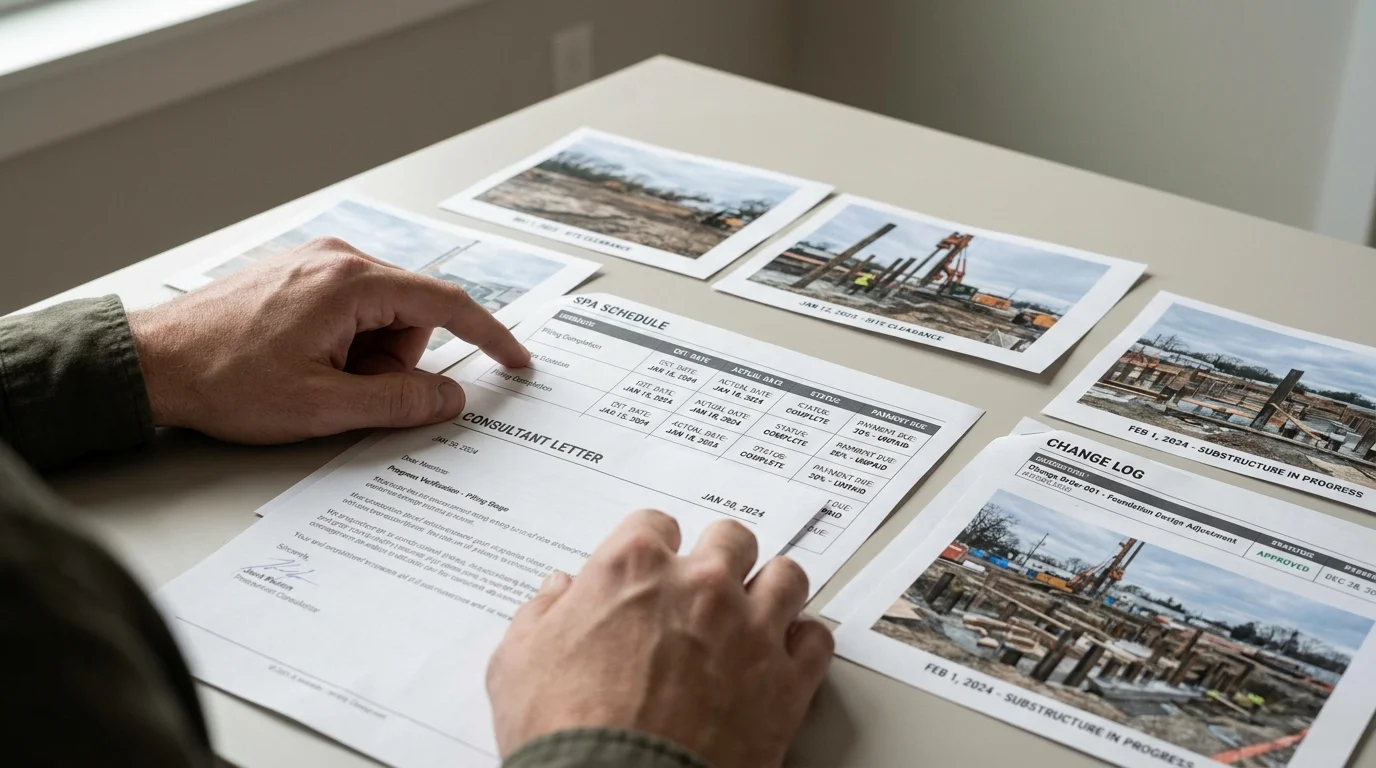
When your SPA payment schedule relies on completion rates, the developer’s demand for payment requires technical backing. A portal screenshot does not serve as the official trigger. The department explains that an investor may request the current completion percentage in a letter from the project consultant approved by DLD, which represents the formal technical evidence linking the physical construction stage to the agreed percentage. The project consultant is the licensed engineering and architectural firm responsible for supervising on-site execution, and their formal certifications carry statutory weight under regulatory supervision.
Compare the stage or percentage stated in the approved consultant’s letter with the exact trigger written in your SPA. Ensure the document explicitly references your project phase and carries a recent date. The letter should clearly detail the specific milestones achieved on site, including substructure works, concrete superstructure pouring, masonry, internal plastering, and mechanical installations. When a payment notice demands twenty percent of the property price based on the completion of the fifteenth structural floor, the consultant’s certification must expressly verify that the structural slab of that specific floor has been completed and formally approved by municipal building inspectors.
Distinguish this targeted consultant letter from the formal technical-report service. The department’s developer-facing service page details a process involving site visits and data collection to prepare an approved report. That structured service exists to allow developers to formally document project health and submit baseline data into the regulatory system. Separately, the DLD outlines routes for investors and other applicants to request information through service trustee centres or Customer Happiness channels. Confirm your eligibility, the appropriate channel, and any fee directly with the department before attempting to order a full technical report yourself. In most cases, requesting the consultant’s letter directly from the developer satisfies the evidence requirement for a payment milestone.
Step 3: Corroborate the Record With Site Evidence
Technical reports measure structural and internal progress that remains invisible from the street. Remote owners still need visual confirmation that the site reflects the reported stage. Comparing the consultant’s stated completion with physical site conditions helps identify major discrepancies before you transfer funds. An official document might attest to continuous activity, but physical site conditions show whether machinery is active, workers are present, and materials are being delivered to the plot.
For an overseas owner, the most practical approach involves requesting dated photographs from a reliable local representative. If you own off plan villas in Dubai, your representative should capture the specific plot or cluster instead of stopping at the master community entrance. Master community developers frequently pave the primary access boulevards and plant decorative palm trees near the sales pavilion long before breaking ground on the secondary residential enclaves. Instruct your proxy to take wide contextual shots establishing the building's height and facade, followed by tighter shots of the specific floor or section where your unit sits. For low-rise villas or townhouses, request clear photographs showing roof slab casting, external boundary walls, and utility connection points.
Arrange an appropriately authorised site visit if the developer permits access. When physical entry is restricted due to safety regulations, external photographs from public roads or adjacent completed towers provide sufficient corroboration. Dubai Municipality safety rules impose strict liability in active construction zones, so developers routinely restrict unescorted client access until the building reaches the official snagging stage. Elevated photographs taken from surrounding vantage points can clearly show whether rooftop cooling towers have been hoisted, whether external window glazing is progressing, and whether tower cranes remain operational.
Compare the same viewpoint across consecutive checks. Standardising the angle allows you to track the pace of cladding installation, crane movement, and floor additions over a six-month period. When you catalog images taken from identical cardinal directions every quarter, the rate of physical transformation becomes easier to assess. If three consecutive sets of quarterly photographs show the concrete skeleton paused at the identical floor with no exterior envelope progress, you have visual corroboration of an operational pause regardless of the marketing copy sent in developer newsletters. Record the exact date, the building or phase identifier, and the source of each image in your files.
Recognize the limits of visual corroboration. Visible changes support the DLD record and the consultant’s letter, but they cannot establish a specific completion percentage or prove a contractual milestone on their own. Internal mechanical, electrical, and plumbing installations heavily influence the official percentage despite showing no external changes. A high-rise tower might appear entirely static from the street for four months while internal trades install vertical piping, HVAC ductwork, fire suppression networks, and high-voltage electrical cabling across dozens of floors. The technical-report process includes dedicated site visits and data collection because a facade photograph cannot quantify internal readiness. Frame your images as supporting contextual evidence rather than a substitute for technical reporting.

Step 4: Match Payment Notices to the SPA
Developers issue payment notices when they believe a contractual milestone has been reached. Reconcile the notice against your signed agreement before authorising a bank transfer. Billing departments within large development companies operate automated invoicing schedules that sometimes release payment demands based on projected calendar dates rather than verified physical construction achievements. Treating every invoice as an undeniable obligation without independent verification can expose you to unnecessary financial risk.
Compare the date of the notice, the requested amount, and the precise milestone wording with the specific clause in your SPA. If the installment depends entirely on a calendar date, the construction progress check serves your portfolio planning rather than your payment obligation. Date-based payment schedules require you to settle payments on specific dates regardless of the structural progress achieved on site. Conversely, if the installment depends on construction progress, the notice must align with the physical reality. In a construction-linked plan, the developer's legal entitlement to call capital depends strictly on fulfilling the preceding physical condition established in the contract.
Ask your developer to provide dated confirmation from the DLD-approved project consultant outlining the current stage. Check whether the stated percentage in that letter matches the contractual trigger. A notice demanding payment for a "50% completion" milestone requires a consultant letter verifying that the project has crossed the 50% threshold. If the letter indicates 48% completion, the contractual trigger remains unmet, regardless of the invoice date. That two-point gap can still represent substantial construction work, engineering inspections, and administrative approvals. Paying before the threshold is formally crossed surrenders the financial leverage that your construction-linked contract was designed to preserve.
Clearly separate your contractual SPA payment trigger from the project’s escrow release mechanism. Under Dubai’s Law No. (8) of 2007, a developer wishing to sell units off-plan must apply to the Department to open an escrow account, and payments by purchasers or project financiers are deposited into it. The account is held in the project’s name and dedicated exclusively to construction of that project, with a separate account required for each project.
However, buyer deposits into escrow operate on a different schedule than contractor payouts from escrow. The escrow process requires the developer and the account trustee to agree on construction stages for disbursements. A trustee’s engineer then visits the site and checks the relevant construction phase before funds are released to project service providers. The bank acting as the escrow trustee protects the accumulated capital by releasing funds only in arrears after work is verified by its own engineering inspectors.
Matching the escrow account details on your payment notice to the DLD record confirms that your funds are routed correctly, but it does not establish construction progress, prove delivery timing, or confirm that your specific SPA milestone is due. Always confirm that the IBAN listed on the payment demand matches the project escrow IBAN shown on the official DLD fact sheet. Making a payment to a general corporate operational account rather than the legally mandated project escrow account strips away the statutory protections provided under Dubai law.
Organising these layers of evidence becomes complex for buyers holding multiple units. I provide post-purchase milestone monitoring to help owners arrange consultant evidence and payment records around their next cash commitment. This advisory support clarifies your schedule and protects your liquidity without acting as a substitute for technical certification or legal advice. Keeping the distinction clear between escrow routing and SPA triggers prevents premature payments.
Step 5: Log Changes and Resolve Conflicts
Maintaining a structured record over a three-year construction cycle prevents confusion when milestones cluster together or projects face delays. Relying on memory or a scattered inbox leaves you vulnerable to misinterpreting payment notices. Large off-plan projects inevitably encounter design revisions, structural adjustments, and regulatory inspections that alter the timing of cash calls. When you manage multiple off-plan properties simultaneously, the complexity multiplies, making a centralised record system necessary for capital preservation.
Create a dedicated investor change log. This operates as a practical portfolio management tool rather than a DLD-prescribed form. Structure your log with the following fields:
- Check date: Record the exact calendar day you conduct your review.
- Project number and phase: Note the official land registry identifier alongside the specific building or cluster name.
- DLD status and completion percentage: Document the official progress metric published on the government portal.
- Inspection or update date: Log the specific date the land department engineers conducted their last physical audit.
- Consultant-letter date and stated milestone: Record the issuance date of the engineering certification and the exact stage it validates.
- Site-evidence dates: Note when your latest contextual and physical photographs were taken.
- SPA trigger: Detail the contractual condition required before the next payment falls due.
- Payment notice date and amount: Enter the date of the developer's demand and the exact currency figure requested.
- Escrow details: Confirm the designated account title, the managing bank, and the verified IBAN.
- Change since the last check: Calculate the percentage gain and physical advancements recorded since your previous audit.
- Next action required: Identify the immediate task, such as authorising an installment, requesting missing technical letters, or scheduling the next review.
Updating this log takes fifteen minutes per property and gives you a clearer picture of your cash flow. If a project stalls, the "Change since the last check" column highlights the stagnation immediately. Tracking the mathematical progress rate across consecutive quarters allows you to calculate the true operational velocity of the build. If a project advances by only two percent per quarter while requiring thirty percent progress to hit its scheduled delivery date within nine months, the log reveals that the official handover date will inevitably shift outward.
For stale portal records or differences between the DLD entry, the site evidence, and the payment request, escalate the discrepancy formally. Advise the developer or project consultant of the conflict in writing and ask for a detailed explanation. Send a polite, structured email referencing the project registration number, the specific clause of your SPA, and the conflicting evidence points. Request an updated, DLD-approved project consultant certificate verifying that the physical threshold has been satisfied. Preserve your SPA, the payment notices, the portal screenshots, and all developer responses in a single secure folder. Maintaining a documented paper trail simplifies matters if you need to engage a lawyer later.
Treat a formal cancellation or a cancellation process as a severe, separate escalation rather than routine schedule slippage. If the DLD status updates to cancelled, the path forward shifts from milestone monitoring to recovery planning. The department notes that distributions for cancelled projects may depend on the funds available in the escrow account, meaning the liquidation period remains indefinite. The regulatory authorities refer cancelled projects to the Special Committee for Liquidating Cancelled Real Estate Projects, which assesses outstanding project liabilities, auctions off assets, and determines creditor payouts. A cancelled status does not promise an immediate or full refund, so securing appropriate legal counsel takes precedence over routine logging.
Working through a stalled project or seeking an exit before completion requires objective guidance. Whether you decide to hold a delayed asset, pay the next milestone, or explore how to capitalize on distressed off-plan assignments, base your decisions on verified facts rather than marketing timelines.
Use the Update to Revisit Your Investment Plan
A Dubai construction progress check completes the technical portion of your review, and the next step is to turn those verified changes into an updated financial plan. A shift in the construction schedule directly impacts your holding costs, your capital allocation, and your projected yields. Real estate performance depends not only on whether concrete is poured on schedule, but also on how effectively the asset fulfills the financial role assigned to it within your wider wealth portfolio.
Start by mapping the remaining cash commitments. If the consultant letter confirms a project is moving faster than anticipated, your future SPA milestones will trigger earlier. Review your available liquidity and ensure your funds are positioned to meet accelerated cash calls without incurring penalties or requiring high-interest bridge loans. Faster construction is generally desirable, but it compresses your payment timeline, requiring you to convert foreign currencies or draw on liquid reserves ahead of your original schedule. If the site evidence and the portal indicate a six-month delay, you have a longer window before the next payment. You can allocate that idle capital elsewhere rather than leaving it in a zero-yield checking account while waiting for a delayed invoice.
Adjust your expected rental start date next. Many investors time their off-plan purchases to supplement their income upon retirement or to coincide with a relocation to the UAE. A delayed handover pushes back your initial yield generation. If you plan to lease the property upon completion, check how the revised timeline aligns with market cycles. Handing over in the middle of summer often yields different leasing momentum than a peak-season winter handover. During the summer months, tenant movement typically slows across Dubai as residents travel, which can extend vacancy periods and require softer asking rents to secure immediate occupancy. Conversely, a completion date that lands between October and February positions the property to capture high corporate and family relocation activity. You can run updated yield scenarios using a RERA rental index calculator to stress-test your assumptions against the new timeline.
Review your holding period and exit assumptions based on the updated progress. A completion percentage provides a snapshot of the physical build without acting as a definitive promise of delivery. Snagging, authority approvals, and utility connections frequently add months to the timeline after a project reaches structural completion. Even after the developer receives the Building Completion Certificate from Dubai Municipality, individual unit handovers require final snagging inspections, clearance from the civil defense authority, utility energisation through the Dubai Electricity and Water Authority (DEWA), and title deed registration. If you are preparing to sell properties in Dubai Marina to fund this off-plan final payment, you need realistic handover buffers to avoid holding two properties simultaneously or finding yourself caught between transactions.
Record your next planned review date in your change log. Repeat this verification process when a new payment notice arrives, when the developer issues a quarterly update, or when you reach the next scheduled review date. Consistent quarterly reviews establish an early warning mechanism, alerting you to emerging delays long before the developer formally announces a revised completion target.
Close your review with a clear next step. If the DLD record, the consultant letter, and the site photographs align with your agreement, process the payment. If the records conflict, request further written evidence from the developer. Treating construction verification as an active portfolio management tool protects your capital from premature disbursement and keeps your holding strategy intact.
Book a no-obligation intro call with Ritu Kant Ojha Real Estate Advisory at https://ritukant.com.
Ask Ritu Kant
Have a question about your purchase? Ask me directly.
Tell me what you are considering. I read every message myself and reply within one working day.