
Choosing between Dubai rental income and capital growth depends entirely on whether you need spendable cash flow now or can lock away capital for five years. A headline 8.0 per cent gross yield often drops to 5.0 per cent net after deducting Dubai Land Department (DLD) approved service charges and vacancy buffers.
For buyers allocating capital in 2027, relying on marketing materials that blend immediate rental projections with speculative future price gains distorts the underlying risk. Off-plan properties generate zero rent during construction, while ready assets require active operational management. This article breaks down how to calculate realistic net returns and match the correct property strategy to your liquidity timeline.
Investors often struggle to weigh Dubai rental income vs capital growth because they rely on marketing materials that present both outcomes as guaranteed. Glossy sales presentations routinely show an eight per cent gross rental yield sitting alongside a projected thirty per cent capital appreciation curve over a three-year construction period. These projections combine two different risk profiles into a single fictional return. A gross rental yield calculated on an off-plan brochure overlooks service charges, maintenance costs, agency letting costs, property management costs, and the months of vacancy required to find a vetted tenant. At the same time, an appreciation projection treats future market liquidity as an absolute certainty, ignoring the possibility that capital gains can vanish if thousands of competing units hand over in the same micro-market simultaneously.
At Proact Luxury Real Estate, I approach this choice by examining what the investor needs from the asset. I start by asking how long the capital can stay invested without causing liquidity strain. I test whether the resulting rental income will be spent to cover personal liabilities or reinvested to compound returns. I also evaluate how credible the exit plan is, given the specific micro-market and property type. An Indian Non-Resident Indian (NRI) living in Singapore who needs predictable cash flow to fund educational commitments in London requires a different asset profile from a family office in Mumbai seeking a ten-year wealth preservation vehicle. This evidence-led process defines the strategy before I ever look at available inventory.
How I Calculate Net Rental Yield and Total Return
A gross yield figure on a sales brochure ignores the practical friction of owning property from 6,000 kilometres away. To estimate the cash a property will generate, I calculate the net rental yield before financing and investor-level tax. I define this as the underwritten annual rent minus a vacancy or collection allowance, annual service and usage charges, management and leasing costs, and all maintenance, insurance, and other landlord-paid costs. I divide that resulting net income by the total acquisition cost, which includes the purchase price, registration charges, and agency costs.
`` Net Rental Yield = (Underwritten Annual Rent − Vacancy Allowance − Annual Service Charges − Management and Leasing Costs − Maintenance and Insurance) ÷ Total Acquisition Cost ``
Gross yield is simply the top-line annual rent divided by the headline purchase price. It provides a quick marketing metric, but it tells me nothing about the actual money entering an investor’s bank account. If an apartment rents for AED 100,000 against an acquisition price of AED 1,250,000, the headline gross yield is 8.0 per cent. However, once I deduct AED 18,000 in annual building service charges, AED 8,000 for full-scope property management, AED 5,000 for a realistic vacancy buffer between tenancies, and AED 4,000 for routine maintenance and landlord insurance, the net operational income drops to AED 65,000. When I measure that figure against a total acquisition outlay that includes land registration charges and transaction charges, the net yield settles closer to 5.0 per cent. That difference alters the investment case.
For an unlet unit, I establish the underwritten rent using like-for-like registered rental records, and I state my vacancy and letting assumptions in the model. I keep portal asking rents separate from transacted lease records. For an occupied unit, I start with the existing lease terms and model what happens at expiry. I use the official DLD Rental Index as a market reference because it calculates average rent and rental increases using the tenancy contract expiry date, property type, region, number of rooms and current annual rent. I then model empty units and properties under construction with separate rent assumptions.
I use the index primarily to assess permitted rent increases for renewing tenancies, rather than as an open-market pricing tool. If an in-place tenant pays below the prevailing market rate, the RERA calculator restricts how quickly a landlord can raise that rent year-on-year. This creates a clear operational distinction: buying a tenanted unit provides immediate cash flow, but it may bind the owner to below-market rental rates for several years under local tenancy laws. Conversely, an empty unit allows the owner to capture the open-market rate immediately, but it exposes them to initial leasing delays and marketing costs. My RERA Rental Index Dubai Calculator guide explains how to use these index outputs as an underwriting baseline rather than a promise.
Operating costs require equal verification. The Dubai Land Department notes that approved service charges differ between projects and cover common-area management, operation, maintenance, and repairs. These charges are calculated on a per-square-foot basis, which means that an inefficient floor plan can erode an owner’s operating margin. I pull the specific rate from the DLD Service Charge Index for the relevant project and budget year. I then add unit-level costs, such as property management costs, letting agent costs, and annual maintenance contracts, as separate line items. I explain this structure in Calculating Rental Yield in Dubai and show how to test different scenarios in my Rental Property ROI Calculator guide.
Total return over the holding period combines these dated rental cash flows with the final sale proceeds, minus applicable exit costs. I set this total against the initial acquisition and ongoing holding outflows. If the buyer uses a mortgage, I model the debt service and the cash-on-cash return separately, showing how debt amplifies both the yield and the risk. I assess debt service coverage alongside cash-on-cash return because bank financing can enhance equity returns when interest rates fall and rents rise, but it can also create negative cash flow if mortgage rates climb or the property remains vacant for three consecutive months.
How Property Readiness Changes Cash Flow
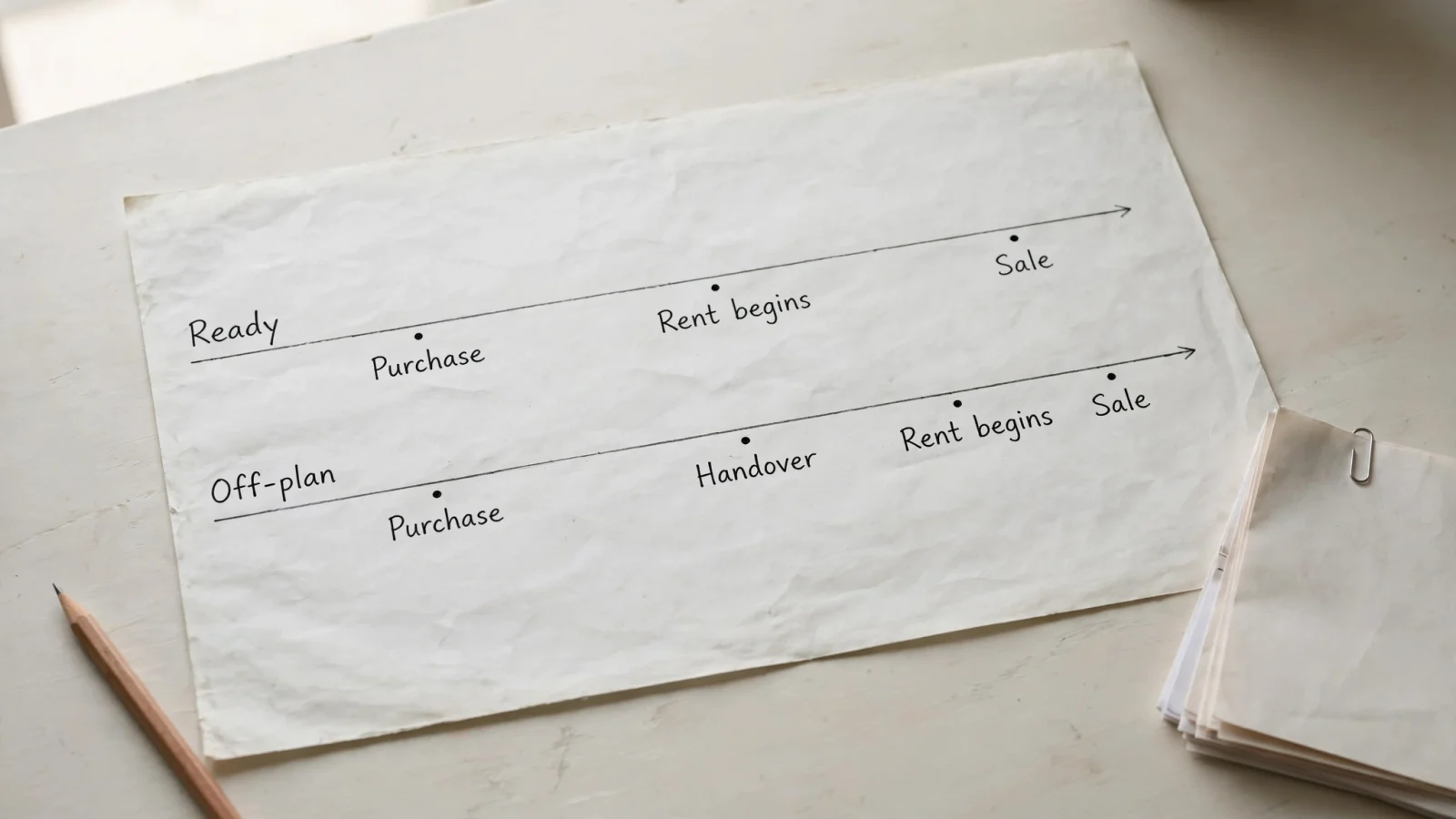
The timing of cash flow depends on the property’s status at purchase. A ready property produces rent only once it is usable, furnished if required, and successfully let to a tenant. An off-plan property produces zero rent before handover, but it still requires the investor to meet a strict payment schedule.
This structural difference alters the compounding potential of an investor’s capital. When I assess a completed property, I account for the fact that its capital can begin working almost immediately. The time between signing the sale agreement, registering the title, and securing a tenant usually spans thirty to ninety days. If a buyer purchases a tenanted unit, rent and deposit balances are generally apportioned between seller and buyer at legal completion. The rent attributable to the buyer can then offset debt service, cover service charge liabilities, or be deployed into liquid yield-bearing instruments.
Off-plan property purchases follow a different financial dynamic. An investor must commit capital across a multi-year construction timeframe, often paying ten to twenty per cent upon booking, followed by instalments tied to construction milestones or calendar dates. Throughout this entire period, the asset produces zero rental income. The investor’s capital suffers negative carry because it remains illiquid while earning no yield. If a buyer funds these off-plan instalments using domestic credit or liquidates interest-bearing deposits back home, the real cost of waiting expands rapidly.
When I model an off-plan purchase, I track purchase-payment dates alongside a probable handover delay and the subsequent letting period. DLD project records supply fields for the escrow account details, current project status, and completion percentage. I use these fields to verify available project information and audit the developer's progress. I never use them to promise an on-time completion, a specific capital growth trajectory, or an immediate resale opportunity. The cash-flow timeline must reflect the months a property will sit empty during snagging, handover, and the search for the first tenant.
Handover is rarely an overnight event. Once the developer issues the notice of completion, the buyer must conduct a professional snagging inspection, submit rectification requests, settle the final balance, pay advance service charges, register for utility connections with the Dubai Electricity and Water Authority (DEWA), and install furnishings if targeting the premium executive rental market. This operational runway frequently absorbs two to four months after structural completion. If an investor models rental cash flow starting on the exact date printed on the original sales agreement, their net return projections will be inaccurate from the outset.
When I Would Favour Income-First Exposure
Income-first exposure suits an investor who requires spendable cash flow to meet other obligations or who intends to systematically reinvest rent to compound their portfolio. This strategy also demands an investor who can accept the administrative work and periodic uncertainty of the leasing market. A ready, lettable property offers the potential to begin producing rent much sooner than an off-plan alternative, provided the investor verifies the current lease or pulls comparable DLD rental records.
Consider the needs of an NRI professional who plans to retire within five years. For this buyer, hypothetical capital appreciation in a master-planned community scheduled for delivery in 2029 offers little practical utility. They need consistent, tangible currency inflows that can replace their corporate salary or service financial obligations in their home country. Similarly, family offices often favour income-first assets because regular rental distributions support dividend payouts to family members without requiring the sale of core portfolio assets.
Earlier cash flow comes with operational friction. Rent is not a bond coupon. The potential for steady income sits alongside standard vacancy periods, collection delays, and lease turnover. Tenants leave, appliances break, and management companies charge renewal costs. These variables reduce net income below initial projections. The Rental Index provides a regulatory framework for rent increases, but it does not dictate what a new, prospective tenant will agree to pay in a shifting open market.
Lease management also involves strict legal frameworks under Dubai law. If an owner wishes to recover a residential property for personal use or to sell it vacant to achieve a higher exit price, Dubai tenancy legislation requires serving a formal twelve-month notarised notice through the public notary or registered mail. This statutory rule restricts an investor’s ability to pivot rapidly between an income strategy and a vacant-possession sale strategy. The property must be managed within these legal boundaries, which directly influences tenant negotiations and income continuity. I treat rent spent on personal liabilities and rent reinvested into other assets as separate investor paths, modelling the compounding effect only when the investor commits to reinvesting.
Comparing property types requires strict parameter controls. If I test a studio apartment against a one-bedroom apartment to see which delivers better income, I evaluate the exact same micro-market over the same time period. I include the total acquisition cost, evidenced rent, service charges, vacancy assumptions, fit-out costs, and relevant resale records for both asset classes. I do not rely on blanket assertions that one format yields more than another.
A studio unit often appears to offer a higher headline gross yield because its capital entry ticket is lower. Yet studios frequently suffer from higher tenant turnover, requiring more frequent repainting, minor repairs, and leasing agency costs. Furthermore, because service charges are levied on the total square footage of the apartment, smaller units with inefficient layouts or large terraces can end up paying disproportionately high service charges relative to their usable internal living area. Any community yield figure requires a defined property segment and a specified reporting period from the DLD data. Without that official backing, I mark any area yield claim as unverified and exclude it from the financial model.
When I Would Favour Appreciation-First Exposure
Appreciation-first exposure fits an investor who does not require near-term rent and possesses the liquidity to leave capital invested for a defined, multi-year holding period. This approach treats the property as a store of value and a vehicle for wealth preservation, rather than a monthly income generator.
A prime example is an investor with substantial operating cash flow from an existing business who wants to hedge against global currency debasement. This individual does not need monthly rental remittances. In fact, receiving small quarterly rental payments across borders may add administrative and accounting burdens. For this investor, deploying capital into an asset positioned in the path of major infrastructure expansion, waterfront redevelopment, or prime urban regeneration may generate a stronger total return over a seven- to ten-year holding horizon.
A higher eventual sale price may contribute more to total return than years of accumulated rent. If an asset appreciates by fifty per cent over a five-year period, that capital gain could exceed the net five per cent annual rental yields collected over the same timeframe, particularly when accounting for the timing of cash flows. I evaluate this potential by testing the entry price against registered sale transactions in the DLD Real Estate Data portal. I filter for the exact property type, bedroom count, specific project, and time period, then compare the investor's acquisition cost against these closed transactions, ignoring developer asking prices and speculative broker projections. This method grounds the capital growth expectation in recorded market history rather than future hopes.
The downside scenario must sit immediately alongside the upside potential. A strategy reliant on capital growth means the asset may produce little or no rent while the investor waits for the market to move. The property still incurs holding costs, including service charges, during this waiting period. The anticipated capital gain remains illiquid until a transaction closes, and there is no guarantee that a buyer will appear at the target price or on the investor's preferred timeline. A flat or declining market can trap capital, forcing the investor to either sell at a loss or hold the asset longer than intended.
Consider an investor who purchases a premium luxury villa off-plan, anticipating a rapid resale upon handover. If broader market liquidity tightens or bank lending criteria become more conservative during the construction cycle, the pool of end-user buyers capable of securing financing for high-value properties can contract. In that environment, the owner faces a difficult operational choice: hold the completed asset, furnish it, and attempt to let it at an unproven rental rate, or discount the asking price to liquidate the position. Because verified, long-term appreciation rates vary drastically by building and floor plan, I label any generic community-wide growth forecast as unverified and model the exit using conservative transaction evidence.

How I Test Exit Liquidity, Costs and Downside
Exit liquidity defines the success of any capital growth strategy. A high valuation on a property portal means nothing if no buyer is willing to wire the funds. I use comparable registered transactions to assess trading activity within the specific property type, project, and period. DLD transaction counts confirm that sales occurred in a building. They do not promise that a specific unit will sell in thirty days or achieve the building's record price per square foot.
Transaction volume serves as the first filter for assessing exit credibility. When examining DLD data, I look at the velocity of secondary-market sales over the preceding twelve to twenty-four months. A building that records fifty secondary transactions a year suggests regular price discovery and a more active resale market, though it does not establish institutional liquidity or guarantee a quick sale. A boutique development that logs only two transactions a year indicates a fragmented market where an owner may wait twelve to eighteen months to find an interested buyer. If an investor holds an appreciation-focused asset in an illiquid enclave, I allow for an extended marketing period in the financial projections.
I run a downside model for every acquisition to test what happens if the property commands lower rent, suffers longer vacancy periods, and incurs higher operating costs than expected. My exit analysis assumes a flat or lower sale price, paired with a slower selling process that adds months of holding costs. Presenting these as stress-test scenarios rather than predictions allows the investor to see if they can financially withstand a poor market cycle.
| Underwriting Variable | Base Case Assumption | Downside Stress-Test Scenario | Financial Impact on the Asset |
|---|---|---|---|
| Annual Market Rent | Evidenced registered rent | 15% reduction in lease rate | Directly lowers net operating income and debt coverage |
| Annual Vacancy Rate | 30 days between tenants | 90 days between tenants | Erodes operational cash flow and extends payback period |
| Building Service Charges | Current approved DLD rate | 10% increase in common charges | Increases fixed landlord outflows regardless of occupancy |
| Holding Period Exit Price | Transacted comparable value | Flat to 10% below entry pricing | Eliminates capital gain; shifts return burden entirely to net rent |
| Exit Marketing Timeline | 60 days to transfer | 180 days to transfer | Accrues ongoing service charges and opportunity cost of equity |
I also display returns in UAE Dirhams and separately in the overseas investor’s home currency to account for conversion spreads and transfer costs that degrade the final yield. While the UAE Dirham maintains a stable peg to the US Dollar, South Asian currencies, including the Indian Rupee, have historically experienced long-term currency depreciation against the Dollar. I ask overseas investors to assess whether a property’s return in Dirhams translates into an acceptable return after paying foreign exchange spreads, cross-border banking remittance costs, and local domestic conversion charges.
Acquisition and exit charges dictate the real friction of trading property. The DLD Property Sale Registration service page lists a 2% registration charge for the buyer and a separate 2% charge for the seller, alongside administrative charges for title deeds, maps, and service partners. I ask investors to verify these specific charges for their intended transaction route rather than relying on a generalised all-in closing cost estimate. Before calculating net return, I refer them to my guide on the overall Cost Of Flats In Dubai to ensure they have accounted for all transaction layers.
I consolidate comparable DLD rent and sale evidence, building costs, project information, and downside assumptions into a single decision review. I structure this work through the ADVICEdge framework, representing alignment, depth, voice, integrity, and compassion. I set out this framework for evaluating advisors in my book, The Only Difference (2026). Alignment ensures that the choice between income and capital growth matches the investor’s balance sheet rather than an agent's sales quota. Depth means verifying building-level service charges and registered transaction histories instead of relying on glossy marketing summaries. Voice ensures that I provide direct, unvarnished assessments of project delays and market liquidity. Integrity guides my refusal to present paper appreciation as guaranteed wealth. Compassion acknowledges that capital allocation involves real family stakes, personal sacrifices, and long-term security. Investors can review this methodology through my ADVICEdge framework and Advisor Check.
What I Ask Indian NRI Investors to Verify
Cross-border property ownership introduces complex tax and compliance requirements. Holding Non-Resident Indian (NRI) status does not automatically shield Dubai rental income or capital gains from scrutiny, nor does it guarantee a tax-free return. The legal framework depends heavily on the investor’s specific residency status during the tax year the income arises.
For tax years beginning on or after 1 April 2026, which represents the latest available data, India’s Income-tax Act, 2025 applies. Section 5 of this Act includes foreign-source income within the total income of a resident, subject to specific rules for an individual classified as "not ordinarily resident." For a non-resident, the scope of taxation generally covers income received or accruing in India. If an Indian citizen qualifies as a Resident and Ordinarily Resident (ROR) during a specific assessment year, their global income, including rental proceeds and capital gains derived from Dubai real estate, becomes subject to Indian income tax. Conversely, an individual who maintains non-resident status under the statutory day-count rules will generally face Indian tax scrutiny only on income that accrues, arises, or is received directly within India. Determining the investor’s precise physical presence and residential category under the tax code is essential before committing capital.
The published India–UAE treaty text states that income derived from immovable property may be taxed in the country where the property is situated. Article 6 of the Double Taxation Avoidance Agreement gives the UAE the right to tax income arising from real estate located within its territory. However, the treaty language does not state that this income is exclusively taxable in the UAE. If an investor is considered a resident of India under Indian tax law, India retains the right to include that foreign income in the individual's worldwide taxable base, granting foreign tax credits where applicable. Because the UAE does not currently levy personal income tax on property receipts, there may be no local UAE tax to credit against the Indian liability, leaving the income taxable in India at the applicable domestic slab rates.
On the UAE side, the UAE Federal Tax Authority FAQ, last updated on 22 May 2024, confirms that an individual’s income from a personal-capacity investment in UAE real estate is generally not subject to UAE corporate tax. However, neither the UAE exemption nor the treaty text alone settles the final tax liability in India or any other country of residence.
Funding the purchase and repatriating the returns involve separate regulatory systems. The RBI LRS FAQ, updated on 6 April 2023, addresses the outward funding of an overseas property purchase by a person resident in India under the Liberalised Remittance Scheme. This guidance covers the capital leaving India, allowing resident individuals to remit up to USD 250,000 per financial year for permissible capital account transactions, including property acquisitions.
However, the LRS framework addresses outward capital remittances. It does not establish a single, universal procedure for transferring UAE rental receipts back to Indian accounts. When an investor collects rent in a UAE dirham bank account, moving those funds to an Indian Non-Resident External (NRE) or Non-Resident Ordinary (NRO) account involves specific foreign exchange compliance standards, including documentary evidence such as lease agreements and chartered accountant certifications. The exact transfer route, compliance burden, and tax treatment for a specific banking setup remain unverified in this context. I advise investors to verify their position with qualified tax and foreign-exchange professionals. I also do not apply these Indian regulations to diaspora buyers in the US, UK, Canada, Singapore, or Australia, as their respective tax codes dictate different outcomes that remain unverified within this brief.
My Verdict: Match the Strategy to the Investor
The choice between a high-yield apartment and a capital-growth townhouse requires aligning the asset's financial mechanics with the investor's balance sheet.
| Decision Criteria | Income-First Exposure | Appreciation-First Exposure |
|---|---|---|
| Primary Investor Need | Spendable cash flow or regular income to reinvest systematically. | Time to hold the asset for five to ten years without relying on near-term rent. |
| Evidence to Verify | Existing lease agreements, registered comparable rents on DLD portal, service charges per square foot, and property management costs. | Entry price relative to closed registered sales, developer completion history, escrow status, and realistic secondary buyer demand. |
| Cash-Flow Timing | Rent begins shortly after legal completion, furnishing, and successful tenant placement. | Asset produces zero cash flow during multi-year construction; may sit unlet post-handover. |
| Downside Risk | Extended vacancy intervals, tenant turnover costs, rising common-area service charges, and maintenance outlays. | Softening secondary market prevents profitable exit; ongoing service charges drain liquidity while waiting. |
| Exit Credibility | Asset can be sold to another income-focused investor based on a verifiable, audited rent roll. | Asset requires an end-user buyer willing to pay a premium for layout, location, architectural scarcity, or interior upgrades. |
I favour income-first exposure when the net rent, calculated after all service charges and a realistic vacancy allowance, directly serves the investor’s defined cash-flow objective. This works for owners who treat real estate as a dividend-producing utility. An executive apartment in an established central district with an active tenant base provides tangible, ongoing yields that protect capital and generate liquidity. The trade-off is limited capital appreciation upside, as mature communities with established pricing rarely experience sudden, speculative valuation spikes.
I favour appreciation-first exposure when the investor’s capital can remain locked in the asset for five to ten years, and their personal liquidity allows them to withstand periods of zero rent and an uncertain sale timeline. This suits family offices and wealth-preservation buyers focused on long-term inflation hedging. Purchasing prime land, high-end townhouses, or waterfront properties in expanding master developments can create substantial generational wealth, provided the buyer enters at a justifiable price per square foot verified by historical DLD transaction records.
A hybrid allocation, buying a property that promises both moderate rent and moderate growth, frequently results in an asset that delivers unexceptional net yields and muted capital gains. For buyers entering the market in 2027, splitting capital into two distinct allocations usually achieves a cleaner risk-adjusted result than searching for a single compromise property. Setting strict decision thresholds before reviewing floor plans ensures the choice rests on confirmed transaction evidence rather than projected future gains.
Book a no-obligation intro call at Ritu Kant Ojha Real Estate Advisory; Ritu Kant personally works with every client.
Ask Ritu Kant
Have a question about your purchase? Ask me directly.
Tell me what you are considering. I read every message myself and reply within one working day.