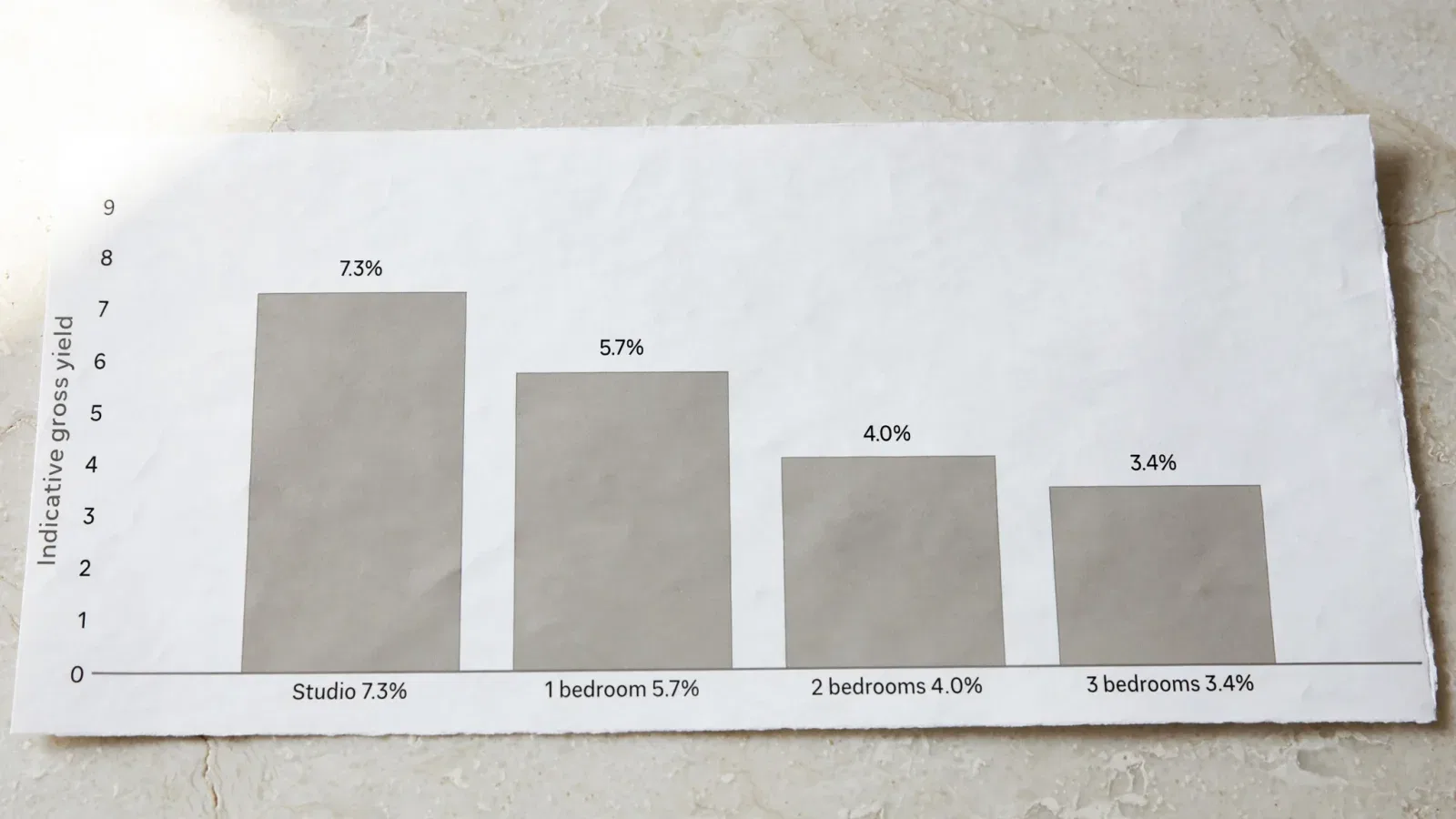
Studios generate the highest indicative gross yield in Dubai at 7.3%, according to Q3 2026 lease and ready-sale data from Prop971 Research. However, this metric divides a median AED 41,000 rent by a median AED 560,000 price. It does not measure your actual net return after factoring in recurring service charges, vacancy periods, and complete acquisition costs.
For overseas buyers allocating capital in 2027, relying on the latest available 2026 gross yields can mask the true holding expenses of different apartment sizes. A high percentage on a small unit leaves little margin if maintenance escalates. This article compares registered rents, ready-sale prices, and capital requirements across studios to three-bedroom apartments to help you build a realistic net-return model.
What the 2026 bedroom figures measure
I use available Dubai-wide lease and transaction data as a baseline for comparing apartments by bedroom count. The Q3 2026 Prop971 Research comparison tracks registered lease contracts starting in the 12 months to 30 September 2026 alongside median ready-sale prices for the same period. Because the figures draw on official Ejari and transaction records, I use them to compare median annual rent with ready-sale prices by bedroom count.
| Apartment type | Median ready-sale price | Median annual rent | Registered lease records | Indicative gross yield | Price plus DLD buyer registration |
|---|---|---|---|---|---|
| Studio | AED 560,000 | AED 41,000 | 118,878 | 7.3% | ~AED 571,200 |
| 1 bedroom | AED 1,047,382 | AED 59,999 | 233,851 | 5.7% | ~AED 1,068,330 |
| 2 bedrooms | AED 1,950,000 | AED 78,000 | 183,421 | 4.0% | ~AED 1,989,000 |
| 3 bedrooms | AED 3,500,000 | AED 120,000 | 37,169 | 3.4% | ~AED 3,570,000 |
These citywide figures measure separate sets of properties. The median rent does not necessarily belong to the apartment that sold at the median price. Gross yield in this context is a simple mathematical ratio: the median annual rent divided by the median ready-sale price for that bedroom category. This metric represents neither a matched-unit yield nor a complete total return over the holding period.
The lease records column counts the number of registered rental contracts for that property type during the 12-month window. High record counts indicate recorded rental activity, but they do not represent unique individual tenants or measure how long a unit sat vacant before letting.
The final column adds only the standard buyer-side sale-registration cost to the median price. That figure excludes required service-partner charges, financing costs and initial furnishing expenses. I treat these indicators as starting points for due diligence, rather than final forecasts for an individual acquisition.
Studios offer the lowest entry price and highest indicative gross yield
Studios display the highest indicative gross yield in the citywide comparison at 7.3%. This ratio is driven by a median ready-sale price of AED 560,000 and a median annual rent of AED 41,000. For an NRI or overseas buyer with a tight capital allocation, I can see why this profile appears attractive. The absolute purchase price is the lowest among the four primary apartment types, while the relative rental revenue appears strong.
I use a differently defined dataset to check the pricing pattern. The Dubai Real Estate Data rent figures were updated on 19 October 2026 and track new apartment contracts over the trailing 12 months, grouped by floor-area bands that serve as proxies for bedroom count. In the band up to 40 square metres, I find a median annual rent of AED 44,000 and a median rent of AED 121 per square foot per year. The 110 to 160 square metre band reports AED 83 per square foot per year, so its per-square-foot rent is lower than the smaller band’s.
This high density of revenue comes with specific operational demands. High gross yields on small apartments leave little margin for error if building maintenance costs escalate. Because service charges are levied per square foot, I check that the approved rate leaves enough of the AED 41,000 rent intact. An inexpensive studio with a disproportionately high service charge will see its net yield collapse, regardless of the citywide 7.3% gross ratio.
Tenant fit remains a property-level variable. While studios attract single professionals, I assess the specific layout and furnishing quality against recent leases in the same building. I do not assume that a high indicative yield proves a unit will let quickly or resell easily. Instead, I check local lease evidence to confirm whether a specific studio aligns with the rent used in the buyer’s calculations. For context on how this fits into a broader wealth strategy, I recommend reviewing how to maximise ROI on property investments in Dubai to align the unit choice with the buyer’s timeline.
One-bedrooms dominate the registered lease records
Moving from a studio to a one-bedroom apartment requires a substantial increase in capital. The median ready-sale price reaches AED 1,047,382, requiring about AED 1,068,330 once the buyer’s registration cost is added. The median annual rent rises to AED 59,999, which drops the resulting indicative gross yield to 5.7%.
I compare the one-bedroom medians directly against the studio medians to assess the cost of that extra space. The difference is approximately AED 487,382 in purchase capital for AED 18,999 more in annual median rent. These are separate market medians, but the relationship is clear: adding capital to a property purchase rarely scales rental revenue at the same rate.
The one-bedroom category generated 233,851 registered lease records in the Q3 2026 window, the highest count among the four types. This shows high recorded rental activity for this size. However, volume does not equal efficiency. High contract turnover can indicate tenant churn as easily as strong demand, so I do not treat a large number of citywide leases as a guarantee of zero vacancy for a specific apartment.
For an overseas buyer, I assess whether the specific building justifies the extra half-million dirhams in capital. I ask the seller or agent for same-building rent and ready-sale comparables. Any claim about attracting more stable couples or long-term corporate tenants remains a marketing hypothesis until I verify it locally. I review Ejari records for the exact tower to see whether one-bedrooms command a premium that justifies the higher purchase price, or whether nearby studios offer better capital efficiency.
Two-bedrooms require testing the rent premium against the capital allocation
The two-bedroom category shifts the investment profile firmly towards higher absolute values and lower relative yields. The median ready-sale price hits AED 1,950,000 while the median annual rent sits at AED 78,000, producing an indicative gross yield of 4.0%. Meanwhile, the lease record count drops to 183,421.
Against the one-bedroom medians, acquiring a two-bedroom demands about AED 902,618 more purchase capital for AED 18,001 more in annual rent. This puts capital efficiency under pressure, so I look for a clear buyer-specific reason to deploy nearly two million dirhams into a single asset with a 4.0% gross yield.
Location often overrides bedroom count when determining returns. Area-level data shows how widely performance varies regardless of size. The DLD-derived area-level yields report 9.3% across apartments in International City compared to 4.9% in Dubai Marina. A smaller flat in a high-yield community can outperform a larger flat in a premium waterfront district on a percentage basis.
When I assess a property priced at AED 1.95 million, I account for significant holding costs. The actual unit area dictates the recurring service charge liability. If a developer has built an unusually large two-bedroom layout, the revenue per square foot drops further while the service charge bill rises. I treat family suitability or shared-household appeal as another hypothesis to test. I check whether the building provides the amenities, such as covered parking and community space, that a tenant paying AED 78,000 annually will demand.
Three-bedrooms deliver the highest rent and lowest indicative gross yield
Three-bedroom apartments record the highest absolute median rent in AED but the lowest indicative gross yield and the largest median ticket. With a median ready-sale price of AED 3,500,000 and a median annual rent of AED 120,000, the resulting gross yield sits at 3.4%. The category generated 37,169 lease records during the 12-month period.
Compared with a two-bedroom apartment, the median price is AED 1.55 million higher, while the median annual rent is AED 42,000 higher. At this level, the investment arithmetic changes. For most investors, deploying AED 3.5 million into a single asset with a 3.4% gross yield before costs is difficult to justify on rental income alone.
I assess this category against the buyer’s primary objective. If a buyer needs a larger home for personal use during visits or plans to relocate their family to Dubai, the utility of the space may justify the capital. If the primary goal is rental income, deploying the same AED 3.5 million across multiple smaller units in carefully chosen communities will likely produce a higher blended net return and spread vacancy risk.
The lower lease-record count reflects the smaller inventory of three-bedroom apartments and the different nature of this tenant pool. While it does not automatically prove weak demand, comparable evidence remains thinner when evaluating a specific building. I look for recent, verifiable lease contracts in the target tower before advising a buyer to commit. The higher the capital allocation, the stronger the evidence required to support the exit assumption. For context on broader market stability at these price points, I recommend examining why Dubai real estate historically outperforms global crises as part of a long-term hold strategy.
Replace the headline yield with a net-return model

Comparing apartment sizes using gross yield is only the first step. To make a defensible acquisition decision, I build a net-return model that reflects the buyer’s holding costs. Through the ADVICEdge framework of alignment, depth, voice, integrity and compassion, I help remote buyers distinguish revenue from profit.
I define three distinct measures:
- Gross yield: Annual rent divided by the purchase price.
- Net operating yield: Collected rent minus operating costs, divided by the complete acquisition-cost basis. This denominator includes purchase costs and initial repairs.
- Total return over the holding period: All rental cashflows plus the eventual resale gain or loss, after subtracting transaction and maintenance costs. Projected appreciation is not guaranteed income and should never be used to inflate day-one yield calculations.
To calculate the true acquisition cost, I start with the purchase price and add the exact costs. The Dubai Land Department mandates a standard buyer sale-registration cost. For properties valued at AED 500,000 or more, a separate service-partner charge of AED 4,000 plus 5% VAT applies. I also account for agency costs, mortgage arrangement costs and any required furnishings. A AED 1,047,382 one-bedroom median price will require well over AED 1.1 million in total cash to close once all transaction costs are settled.
Operating costs shape my net-yield estimate, so I model service charges, management costs, maintenance and owner-paid utilities using actual property records. I avoid invented Dubai-wide percentage allowances. The DLD Service Charge Index lets me check approved service charges by project, use and year.
Running the stress test on rental income
I always apply a downside scenario to test an investment’s resilience. I test the assumption that a unit will command the median AED 59,999, then calculate what happens if the market softens.
I model a 10% fall in market rents below the headline assumption, lowering the achievable rate to AED 53,999. I also assume the property sits vacant for one month while a new tenant is secured. Under this scenario, the buyer collects rent for eleven months at the reduced rate. Multiplying 0.90 by 11/12 means the buyer collects 82.5% of the original full-year rent expectation before paying a single service charge or management cost. This is a stress assumption, not a forecast, but a property that still covers its costs under these conditions is a defensible asset.
When I forecast rental increases or check current market rates, I use the official DLD Rental Index. The tool asks for the tenancy expiry date, property type, region, number of rooms and current annual rent, then calculates a rental increase and the average rent in the market. I use it as a cross-check on rent increases, not as a prediction of what a new tenant will pay.
We use the ADVICEdge Cash Needed and Net Yield tool as the primary buyer-specific model. We input the exact negotiated price alongside verified rent comparables and project-specific service charges to examine day-one cash requirements against the yield after costs. This keeps downside risks visible. To test different income scenarios based on exact property values, I recommend using our rental property ROI calculator framework.
Treat resale depth as an evidence question

No single bedroom type possesses guaranteed resale liquidity. The sources reviewed for this comparison do not establish which apartment size has the strongest citywide resale depth or which sells fastest. I do not advise clients that studios are more liquid or that three-bedroom apartments have a deeper pool of end-user buyers, because the transaction data does not provide time-on-market metrics.
For a defensible comparison of resale potential, I examine the exact transaction history of the target building. The Dubai Land Department Real Estate Data portal publishes fields covering room count, property size and registered transaction amounts.
When evaluating an exit strategy, I extract the ready-sale transactions for the same 12-month period in the chosen locality. I review the count and distribution of comparable sales by bedroom type. If a building shows twenty studio sales and zero two-bedroom sales over a year, the smaller units demonstrate recorded activity. However, transaction counts indicate past registration volume; they do not reveal listing prices, seller concessions or days on the market.
Separating ready properties from off-plan launches
I keep ready-property prices and rents completely separate from off-plan launch pricing. The Q3 2026 indicative yields apply exclusively to ready properties generating immediate rent.
For an off-plan studio or one-bedroom, I do not apply the 7.3% or 5.7% gross yield to the buyer’s current capital. Off-plan registered prices embed payment terms alongside delayed capital deployment and completion risk. I model the payment schedule, delivery timing and the time required to secure an initial tenant once the building opens. I do not treat a ready-property yield as income that begins when a buyer signs an off-plan sale and purchase agreement. Accurate market-data methodology isolates off-plan activity because the economics of a future delivery differ from those of a ready asset. For buyers considering a purchase before completion, I recommend evaluating opinion why Dubai's real estate isn't flinching for context on how structural market changes affect long-term delivery risk.
Match the unit to the holding period
There is no universal winner among apartment sizes. A studio offers the lowest median entry price at AED 560,000 and the highest indicative gross yield at 7.3%, making it highly accessible, provided I check building-level rent and service charges. A one-bedroom flat brings higher absolute rent in AED and generates the largest lease-record count, but I check whether the extra AED 487,000 in purchase capital improves the net return. Two- and three-bedroom apartments produce higher absolute rent but require heavy capital deployment, up to AED 3.5 million for the largest units, and show lower indicative gross yields. This makes them better suited to personal use or long-term capital preservation than to pursuing high rental yields.
I base my recommendation on the intended holding period, available capital and a credible exit case supported by local transaction evidence.
For an NRI or overseas buyer managing this process remotely, I evaluate cashflows in United Arab Emirates Dirhams (AED) first. I advise buyers converting returns into their home currency to account for exchange-rate risk and track it over time. I do not base an acquisition on unsupported claims regarding home-country tax exemptions or automatic repatriation rules; I recommend consulting a qualified tax professional in the buyer’s tax residence regarding foreign rental income.
I recommend checking the following before allocating capital to any bedroom type:
- Calculate the complete purchase cash: I add the DLD buyer registration cost, the service-partner charge and all advisory or mortgage costs to the negotiated price.
- Verify comparable rents: I review recent Ejari registrations for the exact building and layout, rather than relying on citywide medians.
- Confirm the approved service charge: I use the DLD index and the title-deed square footage to calculate the exact recurring liability.
- Apply the stress test: I deduct 10% from the rent and allow for one month of vacancy to see whether the asset remains cash-flow positive.
- Check ready-sale evidence: I search recent transaction records for the same unit type in the same building to assess whether an exit path exists.
Thorough verification reduces the risk of costly errors when purchasing property from thousands of kilometres away. I use the ADVICEdge Cash Needed and Net Yield tool to base your decision on net operating reality rather than developer projections, ensuring the chosen asset aligns perfectly with your required holding period and liquidity needs.
Book a no-obligation intro call with Ritu Kant Ojha Real Estate Advisory; I personally work with every client.
Ask Ritu Kant
Have a question about your purchase? Ask me directly.
Tell me what you are considering. I read every message myself and reply within one working day.