
Branded residences in Dubai carry an average purchase premium of 64 percent over conventional homes, according to CBRE's latest available 2026 data. While a luxury hospitality flag offers design consistency and defined service standards, the primary risks involve strict letting restrictions, mandatory furniture replacement funds, and complex resale transfer requirements that can significantly erode net yields.
For a buyer allocating capital in 2027, this premium dictates the required holding period. If your strategy relies on unrestricted personal occupation or maximizing net rental returns, paying upfront for hospitality infrastructure directly challenges those financial goals. Evaluating the asset requires examining the specific legal structures, the complete ownership costs, and the contractual usage limits behind the brand.
At Ritu Kant Ojha Real Estate Advisory, I help buyers think through an asset rather than repeat a developer’s projections. I set out the ADVICEdge framework in my book, The Only Difference (2026), and offer the free ADVICEdge Advisor Check for buyers assessing advice. My guidance is evidence-first and downside-aware, so the decision remains tied to your goals and holding period.
The branded residence segment in Dubai attracts substantial international capital because buyers associate luxury hospitality flags with effortless execution and steady appreciation. The marketing narrative suggests that a five-star hotel brand acts as an insurance policy against poor construction, weak property management, or secondary-market illiquidity. That narrative is flawed because it confuses licensing with asset governance. A global hotel chain rarely finances or builds the tower that bears its crest. The brand provides a style guide, inspects fit-outs, and licenses its trademark in exchange for substantial ongoing royalties. The actual performance of your investment depends on the contractual framework beneath the marketing layer.
When evaluating Dubai branded residence risks, I weigh the clear advantages against the contractual constraints. An iconic luxury brand can establish exceptional interior finishes, secure consistent concierge and security operations, and attract affluent tenants willing to pay higher nightly rates. Those advantages carry real trade-offs: rigid restrictions on how you let the property, mandatory capital reserves for brand-standard refurbishments, higher initial purchase pricing, and complex transfer requirements on resale. If your holding strategy requires unrestricted owner occupation or low carrying costs, paying a heavy upfront markup for hospitality infrastructure works directly against your financial goals.
Legal Distinctions Behind the Brand Promise
Marketing materials often blur the lines between who builds the property, who manages the services, and who licenses the name. The legal structure in Dubai is precise. I distinguish the legal status of the building from the marketing collateral used to sell it.
I read Dubai Law No. 6 of 2019 as defining a Hotel Project as real property whose units are intended for joint ownership. The property must be licensed by the Competent Authority for use as a hotel establishment. If a development meets that definition, the developer must outsource management of its Common Parts to a Hotel Project Management Company under the relevant rules approved by the Director General. If the company expresses a wish for an owners’ committee, the Hotel Project will have one with members selected by RERA. The committee cannot participate in managing the Hotel Project or its Common Parts.
This statutory governance creates an operational reality that many buyers misunderstand. In a conventional residential building governed by Law No. 6 of 2019, the owners' committee holds statutory advisory rights regarding building operations, service contracts, and maintenance standards. In a classified Hotel Project, that governance model shifts entirely. The Hotel Project Management Company manages vendor appointments, common-area modifications, security protocols, and shared-facility upkeep. If a buyer disagrees with how the building is maintained, or believes certain facilities are operated inefficiently, individual unit ownership does not provide a direct vote to overturn management decisions.
This legal treatment does not automatically apply to every development marketed as a branded residence. Some branded projects are conventional residential buildings with a licensing agreement for the brand name and a separate service-level agreement for amenities. I check the project’s authorised use and governing documents rather than infer its status from promotional materials. I also establish whether the municipality classifies the asset as a residential building, a hotel apartment, or a hybrid structure. A hybrid tower might designate the lower twenty floors as hotel suites and the upper thirty floors as branded private residences. Each section may follow distinct regulatory categories, separate escrow accounts, and divergent service-charge schedules.
The documentation requires close reading. Administrative Resolution No. 1 of 2020 provides implementing bylaws for holiday homes, explicitly stating that the Arabic text prevails in the event of a conflict with the English version. I do not rely exclusively on the English translation provided by a developer sales team. I verify the official Arabic wording before advising a buyer to sign, so we can identify what the brand promises to deliver and how long that obligation lasts. Discrepancies between translated marketing brochures and binding Arabic filings frequently surface around operational definitions, especially concerning whether a unit can be let as a private holiday home or must remain bound to an internal operator programme.
Understanding the legal baseline also means examining the precise title deed issued by the Dubai Land Department upon handover. A title deed registered for a serviced apartment or hotel apartment may carry distinct municipal zoning obligations compared to a freehold residential title. These zoning differences influence local utility tariffs, licensing fees for letting, and your legal rights should you choose to occupy the property permanently as a primary residence. I review the authorised land use registered on the title documentation to check that the asset classification matches your intended use.
Valuing the Brand Premium Against Comparable Homes
Developers charge more for a branded property. I quantify that premium before deciding whether the amenities justify the extra capital. Published estimates offer market context, with a recent CBRE UAE Branded Residences Report pricing the average premium at about 64 percent over non-branded units. A separate Knight Frank market review for Q3 2026 reports a premium of around 115 percent against standard residential properties. In another study, Morgan’s International Realty’s H1 2026 insights report an average premium of about 56 percent against the non-branded properties in its comparison group.
These reports use different comparator definitions to establish market benchmarks. One report measures headline listing prices across luxury master communities, while another compares sales transaction data across prime water-facing developments. I cannot combine these separate figures into a single generic 56 to 115 percent market range or apply a broad multiplier to an individual unit and consider it a valuation. A citywide average fails to reflect the specific building you want to buy in Business Bay, Downtown Dubai, or Palm Jumeirah.
To make an informed decision, I compare the branded unit with conventional homes in the same micro-market. I adjust the figures for view, floor, size, condition, furnishing, completion status, permitted use, and transaction timing. If you are examining the cost of flats in Dubai, I isolate the cost of the brand from the underlying real estate. If a branded two-bedroom unit on a high floor in Business Bay is priced at AED 4,500 per square foot, while an equivalent high-spec conventional apartment in an adjacent building trades at AED 2,800 per square foot, you are paying a 60 percent brand markup.
I map the potential value of the branded services against the downside scenario. The upside is a defined service standard and a premium lifestyle when you occupy the home. You may also achieve higher nightly rates if the hotel operator runs an efficient booking engine with global customer reach. You might pay a 60 percent premium at launch, while the secondary market supports a 20 percent premium five years later. Modeling this depreciation of the brand value into your return calculations prevents unexpected losses.
When I assess a brand premium, I consider whether the markup generates enough incremental cash flow to amortise the initial capital outlay over your planned holding period. If the branded unit costs an extra AED 2,000,000 to purchase, that capital must produce either a substantial rental premium or superior capital appreciation to justify its allocation. If higher operational charges, operator cuts, and vacancy losses erode that gross rental premium, the net yield will fall below that of a premium conventional apartment in the identical neighbourhood.
| Issue | What I would compare | Downside case to model |
|---|---|---|
| Purchase premium | Like-for-like price difference against conventional homes in the same micro-market; what services or owner-use value the buyer actually expects | The buyer pays a premium at purchase but the resale price reflects the physical home and location rather than the brand |
| Brand and operator | Who contracts with the owner; which services are promised; the brand or operator term; what happens if it changes or ends | A service or branding promise is weaker, shorter, or less enforceable than the buyer assumed |
| Annual cost | RERA-approved service and usage charges, plus any separate operator, rental, furnishing, maintenance, or optional-service costs | Net rent is reduced by obligations that were absent from the initial yield calculation |
| Rental flexibility | Owner-use rules, annual letting, holiday-home permission, rental-pool participation, deductions, and exit terms | The owner cannot use the rental channel or personal-use dates expected when buying |
| Resale | Any transfer documents, buyer accession requirements, unpaid charges, and actual comparable secondary transactions | The next buyer will not pay the original brand premium, or will price in the same operating obligations |
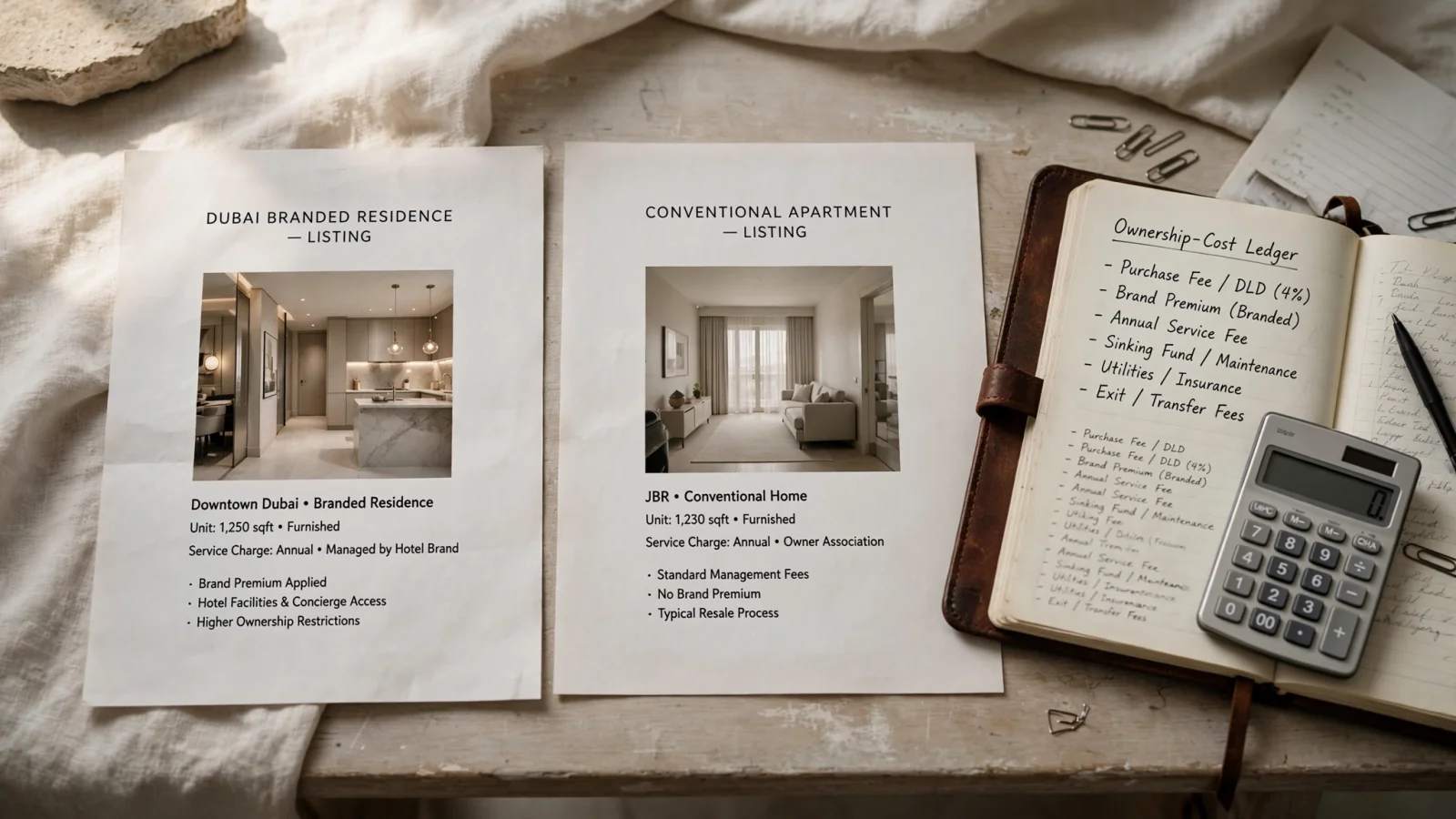
Examining Operator Terms and Deflagging Risks
The brand name on the building indicates a licensing arrangement, while the developer builds the property. The brand operator handles the services, and a separate entity might manage the rental pool. A brand may review sales documents or request a buyer acknowledgement describing the operator’s limited role, which protects the hospitality company from construction liabilities. When a buyer signs a purchase agreement, the hospitality brand does not guarantee delivery timelines or cover defects in the concrete superstructure.
I map out the responsibilities for each element of the project. The developer holds the construction risk, while the licensor grants the right to use the name. The hotel operator manages hospitality services, the building manager handles common area maintenance, and the rental manager runs the letting programme. Identifying which entity owes you a contractual obligation for each promise clarifies your legal standing. If the concierge desk fails to provide adequate staffing, I advise you to direct your grievance to the operator agreement rather than the developer's sales entity.
I review the operator agreement for its term length, renewal conditions, and termination rights, as a brand management contract typically runs for ten to twenty years. I also check what happens if the developer and the operator enter a dispute. A termination leads to a deflagging event where the brand removes its name, booking systems, and service personnel. Deflagging strips away the global reservation network, removes the branded signage, and eliminates the distinctive amenity protocols that supported the building's prestige.
Provisions covering a change of brand warrant close attention. The contract might allow the developer to substitute a similar-tier operator, permitting a replacement with a lesser-known company if the initial luxury brand exits. The definition of a similar-tier operator in legal agreements is often elastic. A contract negotiated with an ultra-luxury hospitality brand might allow the developer to replace it with an upscale business-hotel operator without granting owners a cancellation right or price adjustment. These contracts provide a legally defined service standard, yet they introduce the risk of a weaker obligation than you anticipated when paying the premium. The property also remains subject to conventional building and community rules alongside the brand requirements.
I also check how dispute resolution operates between the management company and individual owners. Many operator agreements require arbitration in specific jurisdictions rather than settling disputes through local court channels, which can make legal challenges prohibitively expensive for an overseas owner. If an operator imposes unilateral changes to common-area access or increases ancillary hospitality fees, your ability to contest those decisions depends on the dispute clauses negotiated into the master management agreement.
Calculating the Complete Ownership Cost
The headline service charge covers a fraction of the total ownership cost. Dubai Law No. 6 of 2019 dictates that owners pay their share of service and usage charges, which can leave them liable even if a tenant defaults. The Real Estate Regulatory Agency approves the service-charge budgets annually.
I treat the Dubai Land Department Service Charge Index as a baseline for service charges by project, use and year; the index states that service charges exclude arrears.
I ask developers for a complete breakdown of every recurring charge. The approved service charge covers building maintenance, security, and common area cooling, while a separate operator fee funds branded amenities like valet parking and concierge services. Placing the property in a rental programme triggers a management fee and a mandatory Furniture, Fixtures, and Equipment (FF&E) reserve fund. This fund extracts a percentage of gross revenue each year, often between 3 and 5 percent, to replace worn carpets, repolish stone surfaces, and replace outdated appliances to maintain the required brand standard.
Unit-level maintenance and pay-per-use services like housekeeping add to the ledger, so I identify the legal document governing each item to prevent unexpected billing. When an owner joins an operator's rental pool, the operator may require that all in-unit maintenance be performed exclusively by the hotel’s internal engineering staff. This internal staff typically bills for minor repairs, plumbing checks, and paint touch-ups at luxury hospitality rates rather than local market contractor pricing.
Calculating the incremental cost involves adding the purchase premium to the recurring operational and unit-level expenses. I compare this total with the incremental net rent and the expected personal-use value. Developers often project a gross rental yield to market the investment. A brochure might advertise an attractive 8 percent gross return based on peak winter room rates. I find the net yield by subtracting vacancy periods, management deductions, service charges, usage fees, FF&E contributions, and maintenance costs.
In a realistic operational scenario, that advertised 8 percent gross return can compress to an actual net yield of 3.5 to 4.2 percent once you deduct the operator’s 25 to 35 percent revenue share, the base service charges, the reserve funds, and the local utility overheads. A prime conventional apartment purchased at a 50 percent lower entry valuation might easily achieve a net rental yield of 6 percent on a stable annual lease.
At Ritu Kant Ojha Real Estate Advisory, I build branded-versus-conventional financial scenarios tied directly to your holding period. I present the downside case using conservative occupancy rates and maximum operational deductions, so you can base your decision on verifiable maths rather than a marketing brochure.
Assessing Rental Flexibility and Usage Limits
I remind buyers that owning a property does not guarantee the right to live in it or rent it out on their own terms. Branded residences govern owner occupation, long-term letting, and short-term holiday use through strict contractual clauses.
Rental arrangements vary by project, so I also review Trowers & Hamlins' analysis. It says rental-pool participation is usually discretionary, while owners who opt out face restrictions on short-term lettings.
I treat these as specific contract options rather than universal Dubai rules. I review the rental pool agreement to check the formula used for distributions. Identifying the deductions taken before payout, the timing of payouts, and the termination rights clarifies the financial picture. I also examine the exit costs if you decide to withdraw your unit from the programme. Some agreements require a six-month notice period and impose a substantial decoupling penalty if you pull the property out of the pool to occupy it permanently.
I check whether the contract limits owner use to two to four weeks per year. The contract will likely enforce booking blackouts during peak seasons like December, the New Year holidays, or major regional exhibitions. If you exceed your allocated time, or want to visit during a blackout period, you will pay the standard hotel rate for your own property. Furthermore, personal stays may require advance booking windows of up to ninety days, removing any spontaneous travel flexibility for your family.
For buyers planning to rent the property themselves as a short-term let, I assess the regulatory hurdles. Dubai Decree No. 41 of 2013 requires a licence to conduct holiday-home activities. The associated 2020 Resolution makes a unit permit subject to strict conditions. You must prove the permitted location, meet technical standards, provide proof of your right to use the unit, and ensure there is no explicit clause in your Sales and Purchase Agreement prohibiting holiday-home use.
Operators often ban independent short-term letting to protect their monopoly on nightly rates, preventing owners from listing the property on a booking platform like Airbnb or using a third-party local holiday-home company. If you bypass the operator to lease the unit directly, the building management can revoke access credentials for your guests or refuse concierge services to unapproved visitors.
If you plan a long-term let, the RERA rental index Dubai calculator helps verify baseline market rents for conventional tenancies. I offer this free tool to check conventional rental assumptions, but it cannot project hotel-pool payouts, short-term holiday rates, or the net yield for a branded asset. The RERA index reflects conventional residential leases registered through Ejari, which follow statutory rental caps and lease renewal protections under Dubai tenancy law. Those metrics do not govern hotel-pool distributions or nightly guest room revenues.
I find that managed letting can simplify operations for an overseas buyer by eliminating tenant complaints and maintenance emergencies. The downside is losing control over the nightly rate, the rental channels, and personal access to the home.

Stress-Testing Resale Potential by Holding Period
Selling a branded residence requires finding a buyer willing to accept the same operational restrictions you assumed. I treat resale potential as an evidence-based question specific to the project rather than a guaranteed exit strategy.
I examine the transfer documents and the buyer accession requirements. On resale, the new buyer usually has to sign a deed of adherence, legally binding them to the original operator terms, the rental pool agreement, and the FF&E reserve contributions. Any unpaid service charges or usage fees must be settled before the Dubai Land Department will issue the No Objection Certificate required for the transfer. If an incoming purchaser wants to live in the home full-time, but the unit is locked into a five-year irrevocable rental-pool commitment, that buyer will walk away.
I analyze comparable sales in the secondary market. If a building is only two years old, data may lack the depth to prove the brand premium persists upon resale. I model a downside scenario where the property trades at the price of a conventional home in the same neighbourhood, stripping out the original brand premium. I consider the investment more solid if the numbers still hold up under these conditions. I would treat a strategy that depends on a substantial brand premium at exit as high risk.
I have no reliable Dubai-wide measure proving that branded residences have a narrower buyer pool, take longer to sell, or retain more value than conventional homes. I make no general claim on those points. Every building performs differently based on the strength of the operator and the quality of the maintenance. I check whether a future buyer might value the specific services offered, but I require transaction evidence before treating that assumption as resale support.
Liquidity dynamics also change across different market cycles. In a surging secondary market, speculative capital may bid up branded and unbranded properties indiscriminately. During consolidation phases, secondary buyers scrutinize recurring carrying costs far more aggressively. An incoming owner looking at two comparable luxury penthouses will calculate that an annual service obligation of AED 60 per square foot represents an ongoing financial drag compared to an adjacent unbranded penthouse billing AED 22 per square foot. That carrying-cost difference gets discounted directly from the resale price.
I tie this stress test to your intended holding period. If you plan to find genuine motivated sellers and flip the property in two years, a branded residence with high transfer fees and strict assignment clauses will hurt your yield. Short-term flippers frequently find their exit margins erased by developer assignment administrative fees, resale no-objection costs, and a smaller secondary buyer pool willing to pay an elevated premium for an off-plan contract. If you are securing a generational wealth asset for a twenty-year hold, the operational stability of a global brand might outweigh the lack of short-term liquidity. Over two decades, an institutional hospitality operator may maintain the building facade, mechanical plant, and interior common areas to a standard that a fragmented homeowners association cannot achieve.
Framing the Decision for Cross-Border Buyers
I see distance amplify Dubai branded residence risks for overseas clients. An NRI buyer in Singapore or an expat in London cannot easily visit the site to check construction progress or dispute a maintenance charge.
For overseas buyers, I separate the developer checks from the brand checks. A famous hotel name on the hoarding does not guarantee the developer has the cash flow to finish the building. I advise clients to verify the developer’s track record, the project’s escrow account status, and the delivery obligations in the SPA, separate from the brand’s reputation. The brand will not refund your deposit if the developer defaults. In the off-plan phase, your primary counterparty is the developer corporation, which remains subject to the standard provisions of Dubai off-plan real estate legislation, project registration through RERA, and statutory escrow accounts.
When advising Indian families, I ask them to account for their home country's regulations. Dubai property income and capital appreciation look attractive, yet these buyers must account for cross-border requirements. The research provided for this advisory process does not verify Indian tax treatment of UAE rental income, FEMA-compliant funding mechanisms, repatriation rules, or current UAE residency eligibility against the relevant authorities.
I do not promise that Dubai income is tax-free for an Indian family. I do not guarantee that proceeds can be freely repatriated, or that a specific branded residence automatically qualifies the buyer for a UAE Golden Visa. I help build the property strategy and direct readers to separately researched guidance or a qualified tax advisor in their home jurisdiction to handle cross-border compliance. You might also consider exploring LLC formation in Dubai to structure the holding properly, which requires its own specialized legal counsel. I ask cross-border buyers to coordinate their local corporate structure with their domestic tax obligations under the Liberalised Remittance Scheme or relevant corporate overseas direct investment rules.
I also ask clients to consider their perspective on market stability. Many ask why Dubai real estate historically outperforms global crises. Part of the answer lies in the city's structured regulatory environment and cash-heavy transaction base, but past performance in the broader market does not insulate an over-leveraged buyer in a restrictive branded rental pool. If market conditions soften, fixed operating costs and rigid rental structures can magnify cash flow strain, turning a luxury lifestyle acquisition into an expensive capital sink.
Verifying Documentation Before Commitment
I base my final advice on verified paperwork rather than verbal assurances, and request a complete document package before advising any client to proceed.
My document review covers the Sales and Purchase Agreement alongside its schedules, the building management regulations, and the master-community documents. I verify the authorised project use and ownership records with the Dubai Land Department, mapping out the parties responsible for construction, brand standards, building management, and rental management.
After reviewing the operator terms and change provisions, I cross-reference the approved service-charge information with a separate schedule of operator, rental, optional-service, and unit-maintenance costs. I run the full rental-programme calculations to factor in deductions, pool sharing formulas, payout timing, owner-use rules, termination rights, and exit costs. I also review the specific clauses dictating holiday-home use, private letting, and resale transfer requirements.
Before signing, I ask clients to verify each of the following elements:
- The complete Sales and Purchase Agreement, including all disclosure statements, building management regulations, and master-community declarations.
- The project's authorised land-use classification and unit ownership category registered with the Dubai Land Department.
- A complete contractual counterpart map that isolates the specific entities responsible for construction completion, brand licensing, on-site building management, and rental pool operations.
- The operator agreement term, renewal conditions, termination triggers, and the explicit contractual procedures governing an operator replacement or deflagging event.
- The latest approved RERA service-charge schedule, accompanied by an itemised budget of non-indexed operator fees, mandatory FF&E reserve deductions, and optional service pricing.
- The detailed rental-pool contract, including gross-to-net distribution formulas, expense deductions, payout schedules, owner-usage limits, blackout periods, and exit fees.
- Every restrictive covenant concerning private letting, independent holiday-home permitting under Decree No. 41 of 2013, and mandatory buyer accession terms on resale.
Documented services and personal-use value may justify the premium for a family seeking a hassle-free vacation home with five-star amenities. Price discipline or letting flexibility may favour a conventional home, subject to its own rules.
Evaluating a branded residence requires projecting the long-term financial outcomes, verifying the binding contracts, and stress-testing the downside scenarios. I help you align the property's operational reality with your portfolio strategy, so you acquire an asset that genuinely supports your holding period.
Ask Ritu Kant
Have a question about your purchase? Ask me directly.
Tell me what you are considering. I read every message myself and reply within one working day.