No, a jointly owned property worth AED 2 million does not automatically qualify every co-owner for a Dubai Golden Visa. The General Directorate of Residency and Foreigners Affairs (GDRFA) requires your specific registered share to be worth at least AED 2 million independently. A shared deed divides this value, leaving equal partners on an AED 2 million asset ineligible.
As you make property decisions in 2027, assuming the gross purchase price covers everyone on the deed traps capital in an illiquid asset without the expected residency benefits. This article explains how to calculate your eligible share accurately, structure the title before signing the sales contract, and verify official valuations so your family relocation plans succeed.
Many co-purchasers discover this issue only after transferring funds and registering the sale with the land registry. By that point, the contract has closed, the title deed reflects the fractional division, and any correction requires a formal re-registration or an internal buyout that triggers additional fees. Structuring the ownership correctly before signing the sale and purchase agreement remains the safest way to avoid finding yourself with a valuable property asset that provides no residency status.
Dubai Golden Visa Joint Ownership Requirements
Property buyers frequently encounter mixed terminology when researching residency rules. The Dubai Land Department (DLD) outlines a renewable 10-year property-investor visa route, stating a purchase value threshold of at least AED 2 million. This broad language focuses on the asset itself, leading many co-owners to believe that hitting that figure secures visas for everyone on the title. Because public summaries often highlight the headline asset figure rather than the exact share mechanics, buyers frequently interpret marketing materials as official legal clearance for shared applications.
The General Directorate of Residency and Foreigners Affairs (GDRFA) in Dubai sets a specific rule for joint ownership. Its GDRFA Dubai investor service states that if a property is jointly owned, the applicant’s share must be worth at least AED 2 million, so the property’s total value alone does not meet the threshold when the applicant’s share falls below that amount.
Understanding this distinction clarifies the difference between Dubai Golden Visa joint ownership and other regional schemes. The Federal Authority for Identity, Citizenship, Customs & Port Security (ICP) also references properties registered in the applicant’s name. Overseas buyers relying on this federal language need to confirm exactly how the specific emirate applies that guidance to their exact title structure, because a purchase never functions as an automatic guarantee. Each government portal serves a distinct stage of the process: ICP sets federal entry standards, DLD certifies the legal status of the land holding, and GDRFA makes the ultimate determination on the residence permit inside Dubai.
This inter-agency dynamic means that general federal guidance cannot override specific local processing terms. When GDRFA screens an investor file, it looks for the specific applicant's name and confirms that the portion assigned to that individual meets the published threshold. If two business partners purchase a commercial floor or a residential villa for AED 3.8 million under an equal split, neither partner satisfies the baseline criteria. Even though the aggregate investment reflects significant economic contribution, the administrative mandate requires that each applicant show an individual holding of AED 2 million or more.
Avoid confusing this 10-year pathway with DLD’s separate Taskeen service. The Taskeen route offers a two-year residence permit and explicitly allows a joint owner to apply if their registered share reaches AED 400,000. Mixing the criteria from these two separate services often causes buyers to assume an AED 400,000 share grants access to a decade of residency. The threshold for the long-term visa remains AED 2 million per applicant share. The Taskeen pathway has different guidelines, renewal intervals, and fee structures, and conflating the two can misalign an investor’s expectations with their actual legal rights.
Calculating the Applicant’s Share
Initial screening for a joint ownership application relies on a straightforward calculation. Multiply the applicant’s registered ownership percentage by the official property value accepted by the authority. This formula gives a working estimate of the eligible share, providing a necessary reality check before committing capital. If a title deed assigns a 60 percent share to one party and 40 percent to another, both individuals must calculate their position separately using the authority-accepted baseline rather than an arbitrary blended average.
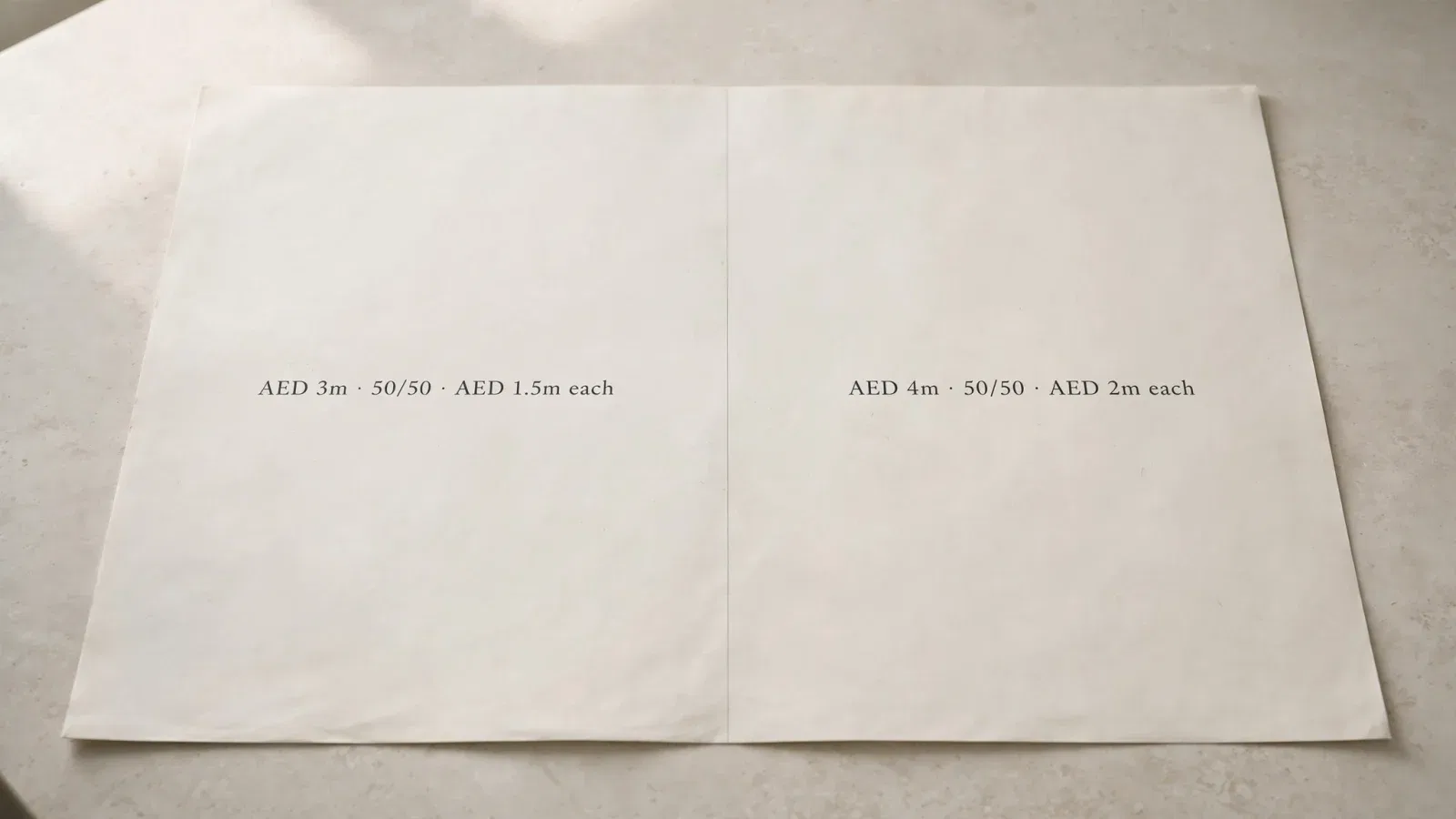
Consider an arithmetic illustration based on the published GDRFA conditions. If two investors purchase a property valued at AED 3 million and split the title 50/50, each individual recorded share is AED 1.5 million. While the entire asset sits well above the headline threshold, neither applicant meets the published joint-share floor. If those same investors purchase a property valued at AED 4 million with the same equal split, each 50 percent share equals AED 2 million. This second scenario reaches the numerical floor, though approval remains subject to accepted valuation and required evidence.
Unequal equity allocations follow the same mathematical discipline. Suppose three investors purchase a luxury townhouse for AED 6 million, dividing the title into shares of 50 percent, 30 percent, and 20 percent. The investor holding the 50 percent stake controls an asset value of AED 3 million, comfortably satisfying the published joint-share minimum. The investor holding 30 percent accounts for AED 1.8 million, falling just short of the floor, while the 20 percent stakeholder controls AED 1.2 million. In that scenario, only the primary partner meets the baseline requirement for the 10-year residence permit, leaving the other two co-owners ineligible despite their participation in a multi-million dirham transaction.
Treat this calculation as a planning tool rather than an official eligibility decision. The valuation multiplier needs to reflect an official figure instead of market sentiment. Buyers often substitute an optimistic listing price, an informal broker estimate, or a combined household net worth for their recorded property share, but the authority relies on the recorded figure from official land department documentation. If a co-owner claims that recent neighborhood transactions indicate their unit has appreciated by 20 percent, that verbal assertion carries zero weight during visa screening.
Reviewing apartment pricing data helps investors project whether a targeted neighborhood supports the required valuation for a fractional share. Investors need to target assets where their specific fraction comfortably clears the AED 2 million mark under conservative valuation models, since a half-share in a property valued at AED 3 million would represent AED 1.5 million, below the threshold. When evaluating units in master-planned districts, co-investors must calculate their share against documented transaction values rather than peak asking rates from property portals.
Market fluctuations complicate this math further. If a buyer purchases a 50 percent share in a property for AED 1.8 million, hoping that short-term appreciation will push their share past AED 2 million, they take on immense approval risk. The authorities base their decisions on proven, documented value instead of projected returns. If the market cools or an official valuation reflects historical transaction data rather than premium expectations, the recorded share remains below the qualification line. I insist on mapping these valuation gaps during the preparation stage, ensuring clients understand how the calculation affects their specific residency timeline.
Combining Spousal Shares and Multiple Properties
Understanding these rules demands separating legal asset rights from immigration sponsorship privileges. Investors frequently ask whether they can pool fractional shares or aggregate multiple properties to reach the threshold. The published regulations address these scenarios differently, and relying on assumed flexibility often leads to rejected applications. Working through these rules demands an understanding of how local processing centers interpret individual title records alongside family dependency allowances.
Family sponsorship is separate from share pooling
A clear distinction exists between the person who qualifies as the property investor and the family members they subsequently sponsor. The DLD Golden Visa application specifies that a qualifying investor may sponsor a husband or wife, children, and parents. Earning the primary visa grants the holder the right to attach dependents to their status. That privilege allows a primary resident to establish long-term legal status for their immediate household without requiring each dependent to purchase an independent property holding.
That sponsorship right does not mean a husband and wife can automatically pool their fractional title shares to qualify as the principal applicant, as the DLD public service page lacks an exception allowing a married couple holding equal shares in an AED 2.5 million property to combine those shares for eligibility purposes. One applicant needs to independently meet the property value requirement. If a married couple registers an apartment jointly with a 50/50 allocation on an AED 2.5 million acquisition, each partner legally holds an asset share worth AED 1.25 million. Because neither individual share reaches the AED 2 million mark, the file fails the published screening criteria at the principal applicant stage.
To sponsor a spouse, the principal applicant then presents a certified marriage contract during the family residency application. Avoid building a purchase strategy around an assumed spouse-pooling exception without securing written authority confirmation for the exact title structure. When couples intend to reside in Dubai using a single acquisition below AED 4 million, title structuring becomes paramount. In many cases, titling the entire asset under one spouse's name enables that individual to clear the AED 2 million threshold, after which they sponsor the other spouse through standard family dependency procedures. Splitting the deed down the middle on an asset valued between AED 2 million and AED 4 million frequently invalidates both partners from qualifying directly.
Couples who already hold an equally divided title deed face a practical decision. They can either purchase additional qualifying real estate to elevate one partner's personal holding, or they can restructure the existing title deed through an official transfer at the land department. Restructuring incurs transfer fees and administrative procedures, but it solves the core statutory hurdle by placing an eligible share size in the name of the prospective principal applicant.
Aggregating portfolios and indirect ownership
Aggregating multiple properties presents another layer of interpretation. DLD and ICP language refers to "one or more properties," confirming that an applicant can combine several wholly owned assets to reach the AED 2 million figure. Checking a sole-owned portfolio across different communities is standard practice. An investor who acquires two studio apartments at AED 1 million each under sole ownership meets the published portfolio threshold, provided the registered deeds reflect the individual's full legal holding across both units.
The public wording leaves unresolved how authorities treat a mix of sole-owned property and jointly owned property in the same application, and it does not explicitly detail how to aggregate several fractional shares. A buyer owning a sole asset worth AED 1.5 million and a 50 percent share in an AED 1 million asset might appear to hit the threshold mathematically, but processing centers may view the combined structures differently. The operational regulations do not guarantee that fractional percentages scattered across different master developments can be stacked together to meet the single investor threshold.
Corporate ownership adds similar friction. While forming corporate structures provides privacy and succession benefits, the public immigration pages do not explain whether company-held or trust-held property is transparently attributed to an individual beneficial owner for residency purposes. Immigration systems screen personal identity records and title deeds issued directly to natural persons, whereas corporate vehicles hold assets under separate commercial legal personalities.
Federal ICP service terms expressly reference ownership registered directly in the applicant’s name. If an investor owns 100 percent of the shares in a holding company that purchases an AED 5 million luxury villa, that property deed lists the commercial entity as the registered owner. Published guidelines do not confirm that an immigration screener will look through the entity to qualify the ultimate shareholder for a real-estate Golden Visa. We recommend treating all portfolio aggregation, mixed-share combinations, and entity-held properties as unresolved edge cases. Asking DLD or GDRFA for a written determination on the exact title arrangement provides clarity before acquiring properties specifically for visa eligibility.

Verifying Valuation and Ownership Documents
Securing approval requires two distinct categories of evidence: proof of ownership and proof of value. A title document proves who owns the asset and dictates the recorded shares, while authority-accepted valuation evidence dictates the specific monetary figure used for the application screening. Presenting sales brochures, private transaction receipts, or preliminary booking forms will not satisfy the verification requirements.
DLD lists an electronic title deed or certificate among its mandatory application documents. This record confirms the applicant's name and percentage of ownership. For valuation, GDRFA identifies a DLD property-status statement as the accepted evidence of Dubai property value, though they also note that a valuation certificate from a DLD-licensed office may be accepted. DLD service descriptions separately mention the purchase value at the time of purchase. That dual standard means applicants must understand which metric governs their specific file before lodging paperwork.
This overlap requires careful handling for older holdings, appreciated assets, or portfolios. If an investor bought a property five years ago for AED 1.5 million and it now carries a market value of AED 2.2 million, they must ask DLD which specific document will establish the accepted value for their application. An informal appraisal won't establish the accepted value, so the applicant needs to secure the specific DLD property-status statement or licensed valuation certificate required by the processing center. Historical purchase contracts showing sub-threshold acquisition costs cannot establish present qualification without an official property-status certificate confirming that current registry records validate the AED 2 million standing.
A preliminary evidence check prevents delays later. Gather these specific documents before submitting the file:
- An electronic certificate of title or title deed showing exact ownership percentages, verifying that the applicant's name is recorded accurately and matches their passport.
- Official value evidence, preferably the DLD property-status statement showing the certified valuation accepted by the land department.
- A certified valuation certificate from a DLD-licensed valuation office if the application relies on post-purchase capital appreciation to clear the threshold.
- The applicant’s passport, which must remain valid for at least six months from the date of submission.
- A recent high-resolution photograph meeting official identity standards and passport formatting guidelines.
- An Emirates ID if the applicant already holds UAE residency under another visa category.
- A current residence permit or entry stamp if the applicant is already physically present within the country.
- A certified marriage contract, properly legalized and translated into Arabic, if the principal applicant plans to sponsor a spouse after their own approval.
Route-specific requirements also apply. The federal ICP Golden Residency Guide lists valid UAE health insurance and a letter from the real-estate registration department confirming qualifying ownership. Local health insurance policies must satisfy regulatory coverage levels before the residency permit is stamped. Since processing centers update their procedural requirements without public announcements, always check the current application checklist directly with the authority. Missing a single verification stamp on a foreign civil document can delay the entire filing by weeks.
I handle this documentation review during the preparation stage of an engagement. I review title and valuation records and prepare focused questions for DLD or GDRFA, mapping the exact UAE residency pathways against the buyer's actual portfolio. While I do not promise an outcome, I ensure the client approaches the authorities with accurate data and clear ownership structures. Aligning these technical records early prevents administrative rejections and protects the buyer from repeating costly document attestation steps.
Working through Mortgages, Off-Plan Sales, and Overseas Applications
A property’s gross stated price alone never settles eligibility when the purchase involves financing, future delivery, or cross-border processing. Mortgages, off-plan contracts, and overseas applications introduce distinct evidence requirements that alter the standard joint-ownership calculation. Each of these transaction types involves third parties, such as lending banks, master developers, or federal immigration channels, that impose their own compliance layers on top of the baseline real estate criteria.
Requirements for mortgaged properties
Financing a property purchase adds a bank to the ownership equation. DLD states that mortgaged property may be used for an application, but requires a bank no-objection letter showing the amount paid and the outstanding balance. The DLD service summary specifically refers to AED 2 million paid. That equity requirement fundamentally changes how financed buyers must calculate their financial readiness.
GDRFA similarly notes that mortgaged property may be accepted, referring to placing a lien to ensure continued ownership, while federal ICP guidance states that financing is an option when it originates from an approved local bank. Foreign bank loans secured against overseas assets do not qualify under this framework; the financing must link directly to the UAE asset through an accredited local lender recognized by regulatory authorities.
These published terms do not settle every mortgage scenario. If a buyer purchases a property for AED 4 million, pays a 20 percent down payment of AED 800,000, and finances the rest, they hold an asset worth over the threshold but fall short of the specific AED 2 million paid condition referenced by DLD. Because the public wording leaves room for interpretation across different processing centers, applicants need to confirm the exact paid-amount condition for their specific case. If two co-owners buy a property for AED 5 million with an AED 2.5 million mortgage, their combined equity equals AED 2.5 million, meaning each co-owner's paid equity sits at AED 1.25 million under a 50/50 ownership structure.
Before signing a mortgage agreement, have the bank confirm they can issue the no-objection letter in the precise format DLD requires. Ask DLD whether the paid-equity requirement applies to your specific loan-to-value ratio. Some commercial lenders take weeks to issue official letters, and minor variations in bank wording can cause processing delays at the land department. Assuming the gross purchase price resolves the mortgage condition frequently leaves buyers holding a financed property without the expected residency benefit.
Processing off-plan and overseas applications
Purchasing property before construction finishes introduces a different set of approval variables. The federal ICP guide states that purchased off-plan units may meet the visa route when their total value is at least AED 2 million and they are bought from a locally approved real-estate company. Buying off-plan allows investors to secure modern assets with phased cash flows, but it adds structural dependency on project registration records.
That federal guidance does not settle which specific Dubai registration record, Oqood certificate, or payment milestone a local processing center will demand. Since a developer’s sales brochure claiming a project is eligible carries no weight with immigration authorities, confirm the project’s specific approval status and the required evidence with DLD before committing capital. Some administrative desks require that a designated percentage of the purchase price be paid into the project's escrow account before issuing the real-estate eligibility certificate, while others demand that construction reach a certified completion benchmark.
Overseas investors face a sequential challenge because DLD’s Dubai route states that the applicant must be inside the UAE to process the application. To bridge this gap, the ICP offers an entry-permit service designed specifically for real-estate investors completing Golden Residency procedures. This entry visa provides a multi-entry window allowing buyers to enter the country, complete medical fitness tests, obtain their Emirates ID biometrics, and collect the required property verification certificates from the land registry.
Investors must confirm their specific application route and travel sequence with the responsible center before booking flights around a property closing. Arriving on a standard tourist visa expecting to convert an off-plan purchase into a 10-year residency without the proper developer letters or escrow confirmations leads to unnecessary administrative complications. Coordinating the closing timetable with the entry permit window ensures that every document is stamped in the proper sequence without risking visa expiration.

Confirming Approval and Exit Terms Before Committing
Residency rules carry long-term financial implications that extend far beyond the initial application. GDRFA’s published terms explicitly refer to placing a lien on the property to ensure continued ownership. Furthermore, their service information states that the property may not be disposed of during the 10-year residency period. This condition means that securing long-term residency fundamentally changes how an investor can manage the underlying real estate asset.
These constraints turn a real estate purchase into an illiquid asset. If an investor needs to sell a jointly owned apartment in year four to free up capital, they face a conflict between their liquidity needs and their visa status, since a sale, transfer, refinance, or co-owner buyout directly affects the registered lien. A co-owner who wishes to liquidate their 50 percent share cannot simply transfer their title to an outside party without clearing the residency status tied to that deed. If the remaining partner depends on that shared asset value for their own visa, dissolving the partnership can trigger visa cancellation for both investors and their sponsored dependents.
Take a short set of specific questions to DLD or GDRFA before signing a reservation agreement or transferring funds:
- For this exact title deed and ownership percentage, what value will be used for the applicant’s share?
- Is the relevant evidence the original purchase value, a DLD property-status statement, or a specific valuation certificate?
- Can this applicant aggregate these specific properties or fractional shares across multiple assets?
- Can a spouse’s share count toward the principal applicant’s threshold under any circumstances?
- What exact mortgage paid-amount, bank-letter, and lien conditions apply to this financing structure?
- Which off-plan records, escrow payment receipts, and payment milestones are accepted for this specific developer?
- How does a future sale, refinance, or co-owner buyout affect the visa status and the property lien registered on title?
Encourage processing centers to explain how those terms apply to your exact category instead of treating general promotional summaries as universal rules. Asking these questions in advance clarifies whether the proposed transaction satisfies current processing standards or introduces unverified assumptions that could stall an application.
A disciplined decision rule protects capital: if the investment case depends on unconfirmed share pooling, an unverified valuation, a questionable financing treatment, or an undefined exit treatment, do not build the purchase decision around an assumed residency outcome. If making the numbers work depends on acquiring properties from motivated owners, the investment likely lacks the necessary liquidity without the visa attached. Sound real estate fundamentals must stand on their own merit, including rental yields, capital stability, location quality, and exit flexibility.
I structure engagements around this reality using a disciplined five-stage advisory model. In the Diagnose phase, I identify the prospective applicant, the proposed co-owners, the family sponsorship objectives, and the planned holding period. During the Align stage, I examine the registered share sizes, accepted valuation baselines, bank financing structures, and exit routes before creating a shortlist of prospective assets. In the Prepare stage, my team reviews title deeds, sales contracts, bank letters, and developer escrow filings, securing formal pre-checks from DLD or GDRFA whenever official guidance leaves room for interpretation.
In the Execute phase, I proceed with acquisition only after you understand which elements are confirmed and which remain subject to final agency approval. During the Steward phase, I monitor title changes, property liens, refinancing adjustments, and planned asset disposals to keep them synchronized with your long-term residency status. Using 2026 market projections as the latest available data, I model the downside risk to ensure you understand the implications if property values shift during your 2027 holding period.
If the proposed ownership structure fails the initial stress test or the required exit terms lock up your needed liquidity, I recommend waiting or walking away entirely.
Book a no-obligation intro call with Ritu Kant Ojha Real Estate Advisory; I personally work with every client.
Ask Ritu Kant
Have a question about your purchase? Ask me directly.
Tell me what you are considering. I read every message myself and reply within one working day.