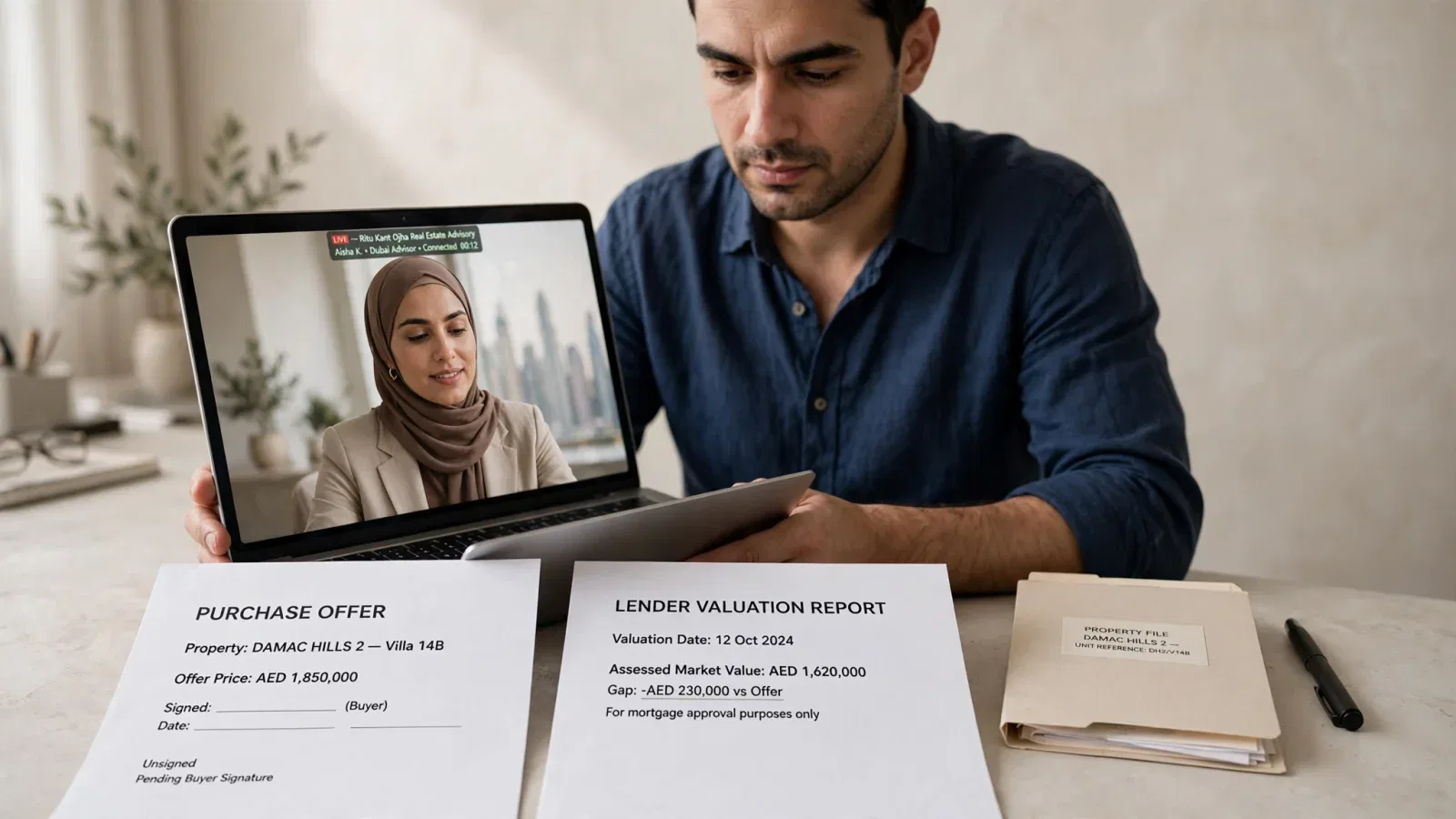
When a lender values a Dubai property below your agreed purchase price, the bank applies its loan-to-value limit to that lower assessment. This immediately reduces your approved loan amount. You must fund the difference in cash, because the Dubai Land Department defines Contract F as a binding agreement that does not automatically adjust to match bank valuations.
For buyers making decisions in 2027, this gap tests your cross-border liquidity just weeks before completion. Using the latest available Central Bank of the UAE regulations from 2026, this article models the exact cash impact of a lower valuation on non-resident mortgage limits. It sets out how to calculate the extra equity required, review the appraisal data, and draft protective contract clauses before risking a deposit.
What a Dubai Mortgage Valuation Gap Means
I advise overseas buyers to separate the bank's assessment of risk from the market value of the property. Lenders mandate valuations to protect their capital exposure. They need to know what the asset will sell for in a distressed scenario. To find this baseline, lenders rely on valuation firms regulated by the Real Estate Regulatory Agency. These valuers analyse recent transfer data recorded by the Dubai Land Department. They look backward at closed transactions over the previous three to six months. When property prices rise quickly, this trailing data lags behind current asking prices. A seller might demand a premium for custom upgrades, but a valuer often discounts these modifications because a bank lends against the generic value of the unit. The resulting gap is the mathematical difference between your negotiated contract and the bank's conservative risk assessment.
Valuers visit the property to conduct an on-site physical inspection, observing internal layout changes, finishes, structural defects, and view obstructions. If an owner renovated a two-bedroom apartment in Dubai Marina with imported marble and smart home automation, the valuer still benchmarks the asset against standard units in the same building. Banks instruct these panels to determine liquidation value within an accelerated sale window, rather than what an enthusiastic private buyer might pay after prolonged marketing. When the appraiser finds no recorded transactions supporting a new price high in a specific cluster, they default to documented historical transfers.
This divergence frequently catches buyers off guard during active market phases. In established districts like Downtown Dubai, Palm Jumeirah, or Arabian Ranches, sellers price their homes according to real-time sentiment and current portal listings. Panel valuers ignore unverified listing prices because those figures represent seller aspirations, not executed contracts. They rely on cleared title transfers from the Dubai Land Department registry. By the time a transaction completes and registers on the official portal, weeks or months have elapsed since the initial memorandum of understanding was signed. Trailing valuation metrics fail to capture sudden upward shifts, producing a gap between your agreed price and the formal assessment.
I test this downside scenario before you sign any binding document. A valuation shortfall forces you to contribute more personal equity, testing your liquidity and cross-border funding arrangements. This scenario reveals whether the property remains a sound investment when your loan size decreases. The additional equity you provide is a percentage of the valuation gap, determined by your loan-to-value limit. I quantify that additional requirement early to prevent surprises weeks into the transaction.
How a Lower Valuation Changes the Cash Calculation
Understanding the financial consequence of a low valuation requires a precise numerical illustration. Consider a scenario where you sign a contract to buy a property for AED 2,000,000. You submit your mortgage application, and the bank instructs a valuer. The valuer returns an accepted value of AED 1,900,000. The price-to-valuation difference stands at AED 100,000.
This gap does not automatically require AED 100,000 in additional cash. The exact requirement depends on the loan-to-value limit the lender applies to the accepted valuation. This assumes the bank approves the maximum limit and no lower income or product cap restricts the loan.
| Illustrative LTV | Loan ceiling on AED 1.9m valuation | Buyer’s cash toward AED 2m price | Extra cash caused by the lower valuation* |
|---|---|---|---|
| 50% | AED 950,000 | AED 1,050,000 | AED 50,000 |
| 60% | AED 1,140,000 | AED 860,000 | AED 60,000 |
\*Compared with the cash required at the same LTV if the valuation had matched the AED 2 million price. The 50% and 60% examples reflect individual non-resident bank products, not promises of eligibility or approval.
If your approved product provides a 50 percent loan-to-value ceiling, the lender calculates 50 percent of the AED 1,900,000 valuation, making your maximum loan AED 950,000. To complete the purchase, your cash contribution toward the price rises to AED 1,050,000. If the valuer had matched the AED 2,000,000 contract price, a 50 percent loan would have provided AED 1,000,000, requiring AED 1,000,000 in cash. The lower valuation creates AED 50,000 of extra equity you must fund.
An approved product offering a 60 percent limit sets a loan ceiling of AED 1,140,000 on the lower valuation. Your cash contribution toward the AED 2,000,000 price becomes AED 860,000. At full valuation, a 60 percent loan yields AED 1,200,000, requiring AED 800,000 in cash. The AED 100,000 valuation difference therefore creates AED 60,000 of additional equity.
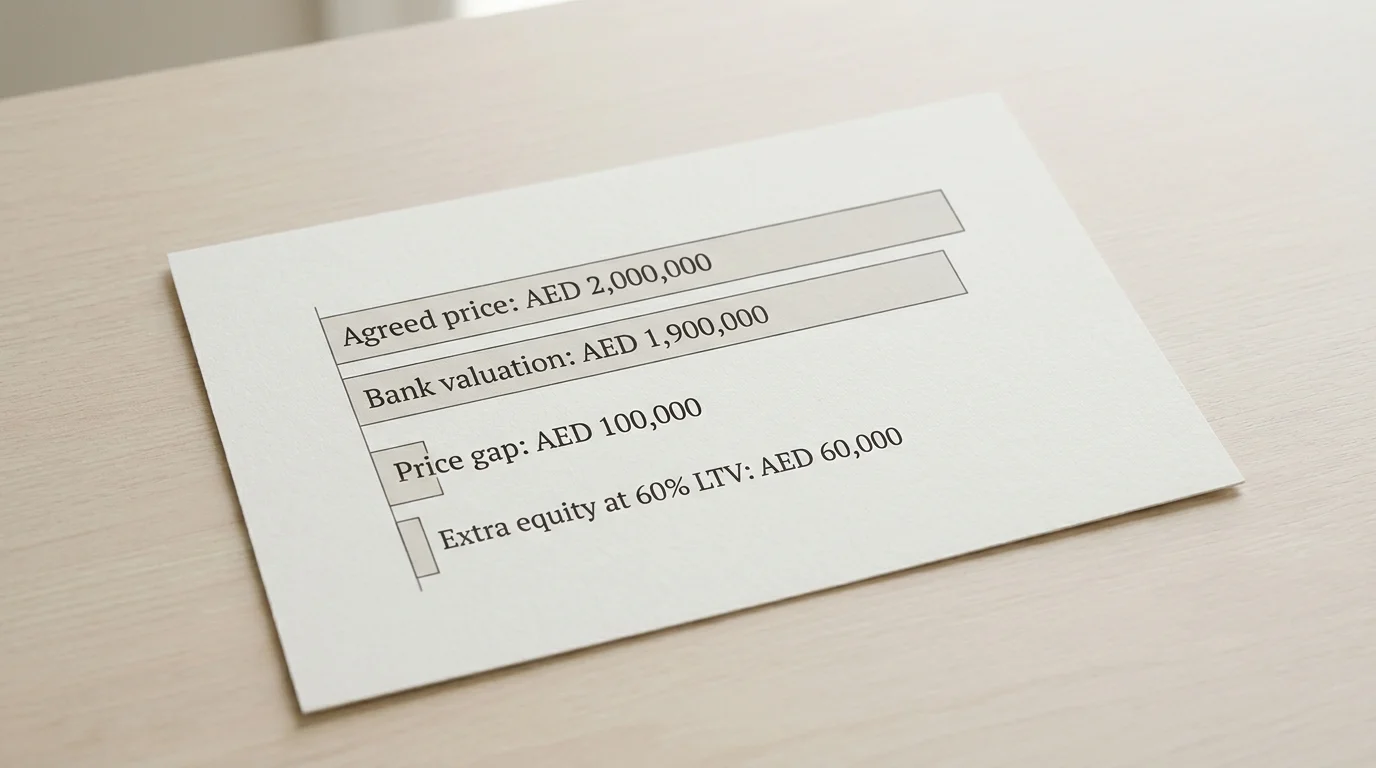
The calculation follows a clear formula. Your illustrative loan ceiling equals the lender's limit multiplied by the accepted valuation. The cash needed toward the price equals the agreed price minus the actual approved loan. If the valuation falls below the price and no other limit applies, the extra equity attributable to the valuation equals your loan limit multiplied by the difference between the price and the valuation.
At a 60 percent financing ratio, every dirham of valuation deficit deprives you of 60 fils of debt capital, forcing 60 fils of unbudgeted personal capital into the settlement. Many buyers incorrectly believe they must write a cheque for the entire AED 100,000 deficit on top of their original down payment. That mistake can create unnecessary panic, while underestimating the gap can leave you unable to complete the purchase. The actual shortfall directly mirrors your contracted leverage ratio.
I exclude purchase costs from this equity calculation, so I advise buyers to budget for them separately. For an ordinary mortgage with an ordinary or usufruct title deed, the Dubai Land Department lists a 0.25 per cent charge on the mortgage value. The cost schedule also lists AED 250 per title deed and AED 10 each for knowledge and innovation per drawing. It also lists an AED 4,000 service-partner charge, with VAT on that charge. On the AED 1,140,000 loan, the 0.25 per cent charge is AED 2,850. The Government of Dubai Law No. 14 of 2008 also states that the mortgagor is liable for mortgage contract registration costs unless the parties agree otherwise. I keep these expenses outside the basic price-equity calculation.
When you add the 4 percent Dubai Land Department transfer charge, trustee registration charges of AED 4,000 plus VAT for properties priced above AED 500,000, title deed issuance costs, and mandatory broker charges, incidental expenses add roughly 6 to 7 percent to your capital outlay. When your bank lowers the financing ceiling by AED 60,000, that unexpected cash demand competes directly with these statutory closing costs. If your available capital was already apportioned to cover the deposit and statutory charges, a sudden AED 60,000 shortfall forces immediate reallocation or secondary liquidity sourcing.
The timing of these cash disbursements compounds the pressure. Bank processing charges and valuation costs must be paid upfront before the appraiser steps onto the property. Trustee charges and Land Department transfer charges fall due at the registration trustee office on completion day, payable via official manager's cheques drawn on a local bank. For an overseas purchaser, coordinating these simultaneous cash demands from an international account can be difficult if the exact Dirham totals are not finalised days in advance.
Why Non-Resident Mortgage Limits Are Product-Specific
I separate the Central Bank's regulatory ceilings from an individual lender's offer, because the CBUAE mortgage regulations set maximum LTVs and say lenders should use more conservative limits where risks are higher. For expatriates, the maximum is 80 per cent for a first owner-occupied property valued below AED 5 million and 70 per cent for one valued above AED 5 million. A second or subsequent home or an investment property has a 60 per cent cap for expatriates, regardless of value. For off-plan purchases, the cap is 50 per cent for all purchaser categories.
These figures dictate the absolute ceiling a bank can offer, rather than a directive compelling the lender to provide that exact percentage. The Central Bank mandates an on-site valuation by a qualified third party before any irrevocable commitment to lend. You cannot rely on the 80 percent owner-occupier limit when residing abroad and intending to lease the unit. Lenders assess your income jurisdiction, currency, and home-country liabilities before setting your limit.
Under Central Bank circulars, banks must retain documented underwriting evidence demonstrating that expatriate and foreign borrowers possess the verifiable capacity to service their debt. The 80 percent threshold is explicitly reserved for primary residences where the applicant resides in the United Arab Emirates under a valid residency visa. If an overseas national residing in Singapore, London, or New York purchases an apartment in Jumeirah Lake Towers, local retail banks categorise that asset as an investment property. That classification can bring the maximum permissible regulatory ceiling down to 60 percent.
I treat the 60 per cent figure as a product ceiling, because HSBC UAE advertises non-resident financing of up to 60 per cent of the property's value and sets account eligibility conditions. Applicants must be HSBC Premier or Private Bank customers, or eligible for an account, and HSBC says the borrower must sign the loan document in person during mortgage registration. Since the page does not specify where that signature must be provided, I cannot conclude that an overseas buyer has to travel to Dubai.
If an investor fails to review the small print, they might arrange remote legal representation through a local power of attorney, only to learn that their lender rejects third-party execution for mortgage deeds. Certain banks require the borrower to physically present their original passport and biometric verification at a local retail branch before release of the final offer letter. Discovering this requirement forty-eight hours before contractual completion can expose the buyer to contractual default penalties under standard conveyancing terms.
I compare Mashreq's headline with its FAQ before setting a financing plan. The Mashreq non-resident home-loan page advertises up to 60 per cent of the property's value, while its FAQ states that Mashreq finances non-UAE residents up to 50 per cent of the property's fair market value, as determined by a Mashreq-approved valuation agency. I base my non-resident estimate on the FAQ's explicit 50 per cent figure.
These published discrepancies highlight the internal segmentation within major regional lenders. A 65 percent ceiling might apply strictly to salaried non-residents employed by recognised multinational firms within select corporate jurisdictions, while self-employed applicants or buyers purchasing villas rather than apartments face lower internal thresholds. Other lenders adjust the loan-to-value ceiling based on the age of the building, restricting older communities to 50 percent regardless of the applicant's wealth profile.
Lenders apply another restriction known as the debt-burden ratio by assessing your global income and existing liabilities. Banks often discount foreign-sourced income, particularly rental income or self-employment earnings. A bank might recognise only 50 percent of a foreign salary when calculating repayment capacity. This invisible cap lowers the approved loan amount even if the valuation matches the purchase price. I treat a pre-approval letter as a preliminary check on borrowing capacity, confirming the bank accepts an income profile up to a stated limit. It never guarantees final approval for a specific apartment or villa, a sequence I explain thoroughly in my guide on buying property in Dubai for foreigners.
When lenders evaluate international tax returns and foreign bank accounts, currency risk enters their underwriting calculations. If your earnings are denominated in British Pounds, Euros, or Indian Rupees, the underwriting desk applies an internal foreign exchange stress haircut. This discount protects the bank against currency devaluations relative to the UAE Dirham, which is pegged to the US Dollar. A borrower whose home currency depreciates sharply could struggle to service a Dirham-denominated debt. This internal haircut reduces your qualifying disposable income, which directly lowers the final Dirham loan amount irrespective of the property appraiser's report.
What I Test Before Signing Form F
Before committing capital and risking a deposit, I test how the lender operates. An off-plan or ready property purchase requires precise timing, leaving little room for late surprises. I treat pre-approval as a borrower-capacity check, not the final loan amount for a selected unit.
I ask the mortgage advisor which non-resident product applies to the application and request written confirmation of the maximum loan-to-value limit. I also ask whether the bank calculates this percentage against its own valuation, the purchase price, or another defined basis. The bank should list any income or property caps that restrict the loan regardless of the valuation outcome.
Many non-resident purchasers assume their pre-approval letter functions like a certified cheque. That assumption can cause problems because pre-approval merely verifies that their personal credit profile, foreign earnings, and verified global debt obligations qualify them to service a loan of a given size. The bank has not yet evaluated the physical real estate. If the building maintenance is deteriorating, or if the owners association is embroiled in legal disputes, the credit committee can reject the property outright.
I check the eligibility of the selected building and unit, because lenders maintain lists of approved developments and strict exposure limits for individual towers. A bank might refuse financing entirely if it holds too many mortgages in a chosen building. I ask when the bank orders its valuation and what the service costs. I also ask how long the final offer remains valid, because a 30-day validity provides little security for a transaction requiring 45 days to complete. For remote purchases, I establish the signing arrangements early to find out whether a flight to Dubai is necessary.
Exposure caps can become deal breakers in popular master communities like Downtown Dubai, Dubai Marina, or Dubai Hills Estate. When a financial institution reaches its internal concentration threshold for a specific residential tower, its underwriting platform halts further mortgage originations for that building. Your broker may have secured your pre-approval, but if the building quota is filled, the bank refuses to instruct a valuer. I check these building-specific restrictions before executing Form F and delivering the 10 percent security deposit to the escrow agent.
When dealing with off-plan assignments or newly handed-over properties, the valuation risk increases. Lenders typically conduct their final valuation shortly before the project completes. If the wider market softens after the original purchase agreement, the valuer records the lower market price. The bank bases its loan on this lower figure, requiring you to fund the shortfall just weeks before handover. I establish when the chosen lender conducts its valuation for new builds so I can plan cash buffers accordingly.
Under Central Bank regulations, off-plan property financing carries a strict 50 percent regulatory ceiling. If an investor purchased an off-plan property two years ago on a post-handover payment plan and seeks to transition the final handover installment into a conventional mortgage, the lender orders an inspection near completion. If supply additions in that submarket moderate current pricing, the appraisal might fall short of the original developer sales price. The buyer must then absorb both the required 50 percent down payment and the entire valuation deficit to secure the title deed.
I stress-test downside cases before presenting an offer by running scenarios where the valuation falls 5 percent and 10 percent below the agreed price. No reliable market-wide data establishes a standard frequency for low valuations, so these tests map exact liquidity requirements in Dirhams. I check whether a small market fluctuation breaks the funding strategy. After quantifying the potential shortfall and transaction costs, I verify capital logistics. Cross-border remittances face daily limits, compliance checks, and currency conversion delays. I verify when additional funds can clear into a Dubai account.
I treat this funding check as vital for Indian and South Asian buyers. Non-Resident Indians transferring funds from domestic Indian accounts must operate within the Reserve Bank of India’s regulatory frameworks. International capital movements require proper documentation through authorised dealer banks. If an unforeseen valuation gap forces you to remit an additional AED 100,000 within ten business days, bank compliance clearances and tax paperwork can disrupt the schedule. Moving funds from the UK, Europe, or the United States involves source-of-wealth scrutiny, wire limits, and clearing house timelines. If your additional capital is locked in fixed deposits, mutual funds, or foreign equities, liquidating and transferring those assets takes valuable days.
The Dubai Land Department identifies Contract F, commonly called Form F, as the binding agreement to sell between buyer and seller. You secure downside protection within this document. I ask a UAE conveyancing lawyer to draft a specific clause governing a low valuation or an insufficient final mortgage. This clause dictates the threshold that triggers your right to act, the required notice period, the mechanism for cancelling the contract, and the guaranteed treatment of the deposit. A standard mortgage-approval condition rarely covers a valuation shortfall. If a bank formally offers a loan but the amount forces excessive equity contribution, a poorly written contract leaves no legal right to recover a deposit.
Standard boilerplate clauses generated by brokerage templates often state merely that the transaction is "subject to bank mortgage approval." Sellers and their listing brokers interpret that clause strictly: if the bank issues a final offer letter, mortgage approval has legally occurred, even if the approved sum is AED 150,000 less than anticipated due to a low valuation. If you cannot produce the unexpected cash difference, you cannot complete. The seller may then claim you breached the contract and seek to forfeit your 10 percent deposit cheque under standard DLD provisions.
For a more solid finance clause, I ask a qualified conveyancer to define exact metrics. I recommend specifying the minimum mortgage loan amount required by the buyer, the maximum acceptable interest margin, and an explicit timeline for valuation completion. I also ask the conveyancer to state that if the valuation conducted by a RERA-licensed firm appointed by the lender falls below the purchase price by more than a specified percentage, the buyer has the unilateral option to renegotiate or terminate the agreement. The clause should set out how the security deposit cheque will be returned in full within three business days without deduction upon such termination.
This thorough testing aligns with the ADVICEdge framework, which includes alignment, depth, voice, integrity, and compassion, guiding my practice. I align contractual commitments with real liquidity and explore the depth of specific product terms. I maintain integrity by exposing downside risks before commitment, preparing you to instruct a lawyer effectively. This approach prioritises financial safety over closing the transaction.
Compassion in my framework means protecting clients from high-stress scenarios that drain their peace of mind. I examine worst-case valuation outcomes early so that you do not face a contractual completion deadline without the necessary cash in place. My voice remains objective, steering clear of market hype and focusing on defensible financial assumptions.
What to Do If the Valuation Comes in Low
When a valuer returns a figure below the agreed price, I recommend a disciplined sequence. The outcome depends on factual accuracy, contract terms, and available capital.
First, I review the valuation report for errors, because valuers inspect thousands of units and mistakes occur. I compare the recorded square footage against the title deed, then check the unit condition, floor level, and specific view. If the valuer missed a major structural upgrade or recorded the wrong layout, I consider that a concrete basis for requesting an amendment.
I also examine the appraiser’s baseline data. Valuers sometimes mistakenly identify a unit as having a community view when it faces an open waterfront, or they fail to account for allocated parking bays detailed on the title deed. If the valuer recorded an incorrect built-up area by relying on older master community marketing brochures instead of the official DLD title document, that error skews the total value. I ask my mortgage broker for a copy of the valuation report, then examine every parameter against the actual physical property and conveyance documents.
Next, I ask the lender to explain its review process, including whether the valuation agency accepts relevant comparable sales data or other material evidence. Firms often reconsider their figures when presented with verified transfer data for identical units in the exact same building.
I build any valuation appeal around verifiable data rather than subjective opinions. I gather official transfer certificates and title deeds from identical layouts within the same tower completed over the previous 60 to 90 days. If the transaction involves an upgraded unit, I provide detailed contractor invoices, municipal completion permits, and photographic records showing the scope of the architectural work. I submit these documents to my mortgage loan officer alongside a formal appeal letter. Some lenders permit a desktop review by a senior appraiser, while others allow a second physical inspection by an alternative agency on their approved panel for an additional cost.
While the bank processes the review, I recalculate the likely loan and extra equity against the hard cash ceiling. I compare this revised figure with the buyer's reserves, then discuss a revised price with the seller if appropriate. A low bank valuation provides objective evidence that the property exceeds current market metrics. Sellers prioritising a fast, secure completion often lower the price to bridge the gap. If the seller refuses to negotiate, I explore another lender while checking the timing, product eligibility, and valuation costs of a new application. A second valuation takes time, so I allow sufficient days in Form F for the delay.
When presenting a valuation shortfall to a seller, I approach the discussion methodically. The seller’s agent might assert that other cash buyers are waiting. However, remarketing a property consumes time, risks missing seasonal demand cycles, and raises questions among future buyers regarding why the previous transaction collapsed. If the seller understands that any incoming buyer financing through a bank will encounter the exact same panel valuer and historical DLD data, they are often willing to split the gap or adjust the sale price downward to ensure a successful closing.
If I consider applying to a second lending institution, I review the calendar carefully. A new bank requires a fresh application, another non-refundable valuation charge of AED 2,500 to AED 3,500, and five to seven working days for the new valuer's report. If the Form F completion date is set within fourteen days, switching lenders without a written contractual extension from the seller places the deposit in severe jeopardy. I pursue a second valuation only if the seller signs a formal addendum extending the completion date.
I consider walking away only if the signed contract and a conveyancing lawyer confirm that route is legally protected. The bank's valuation alone is not an automatic exit. A lower valuation forces a useful renegotiation, protecting you from overpaying. Alternatively, finding the extra equity might consume emergency reserves or put completion at risk. I treat proceeding, renegotiating, or cancelling as contractual choices, not automatic outcomes.

Evaluating the Purchase After an Equity Increase
I evaluate every property decision against your intended holding period and liquidity limits, rather than developer appreciation projections. I assess whether the purchase remains viable when borrowing power decreases.
More equity results in smaller loans, reducing the monthly interest burden and potentially improving cash flow over a ten-year holding period. You can model this impact using the ADVICEdge Net Yield Calculator after estimating the final loan and cash contribution. However, this extra equity ties up capital. I assess whether reserves remain adequate after funding the price contribution, transaction costs, and required renovations. I also consider whether this purchase fits your wider wealth-preservation strategy or leaves your portfolio exposed.
When you contribute an unbudgeted AED 60,000 or AED 100,000 in equity, your financial structure shifts. A lower loan balance reduces total interest charges paid across the mortgage term. For an investor planning to hold the asset for eight to ten years, lower monthly debt servicing reduces break-even rental thresholds, shielding you during tenant turnover or minor rental market corrections. Conversely, that additional equity is trapped inside physical brick and mortar. If you planned to use those funds for home improvements, commercial investments, or unforeseen business expenses, locking that liquidity into the property may weaken your broader financial position.
For an overseas buyer, the available-cash test requires practical verification. I ask buyers to confirm their remittance logistics with an authorised dealer bank or tax adviser in their home jurisdiction. Moving capital from the United Kingdom, Singapore, or North America involves strict compliance documentation. Funds held in a foreign brokerage account do not function as immediately available liquidity. I account for settlement times, currency conversion, and international transfer processing.
I assess international banking mechanics before committing extra capital. Central banks and commercial clearing networks enforce anti-money laundering checks on high-value transfers directed toward property transactions. Transferring funds from an offshore account requires verified proof of funds, certified identity records, and tax clearance certificates. If your bank requires five business days to liquidate investment holdings, three days to clear international wires, and another forty-eight hours for compliance review at the receiving UAE bank, I advise allowing at least two full weeks. Assuming you can transfer funds instantly through a mobile app often leads to missed deadlines and legal defaults.
A larger cash requirement alters the risk profile of the investment. If you are evaluating the broader implications of reducing your loan size, review my verified guide on how to invest in Dubai real estate.
When calculating your return on investment, I account for all initial capital outlays. If an investor injects AED 860,000 in down payment capital instead of the planned AED 800,000 on an AED 2,000,000 acquisition, the cash-on-cash yield calculation changes immediately. I incorporate the expanded equity denominator alongside service charges, property management costs, sinking fund allocations, and maintenance provisions. If the revised cash yield falls short of the risk-free return of investment-grade sovereign bonds or the buyer's baseline portfolio hurdle rate, I reassess whether proceeding still makes sense.
I examine the property through the lens of your defined investment timeline. If your objective is a short-term holding period of two to three years, paying an equity premium above the bank’s certified asset valuation elevates your investment risk. You are essentially purchasing the property at a premium that the institutional lending market does not yet validate. Should you need to liquidate the asset quickly during your holding period, the secondary market might reflect the valuer's conservative assessment rather than the premium you paid. For long-term investors with a holding window of seven to ten years, short-term valuation gaps matter less, provided the asset generates sustainable rental cash flow and sits in an established community with enduring infrastructure demand.
FAQs About Dubai Mortgage Valuation Gaps
Does a Low Valuation Change the Agreed Sale Price?
A lender valuation operates as a risk-assessment input for the bank and does not amend the sale agreement. The agreed price changes only if you and the seller renegotiate the contract. The seller holds no obligation to reduce the price to match the bank's figure, and you remain contractually bound by the signed terms.
The bank conducts its valuation solely to determine its safe lending margin under regulatory guidelines. The seller is contractually entitled to insist on the full purchase price specified in the executed Form F. If you refuse to proceed without a legally binding valuation clause, the seller can declare you in breach, forfeit your security deposit, and seek enforcement through the competent legal channels. The valuation report serves merely as a commercial tool during bilateral discussions.
Can I Cancel Form F If the Valuation Is Low?
The right to cancel the contract and recover a deposit depends entirely on the written clauses within Form F, supported by legal advice. The valuation itself grants no automatic cancellation right. If the contract lacks a specific protective clause detailing the required loan amount or a minimum accepted valuation, you risk forfeiting the deposit upon failing to complete the purchase. I recommend instructing a UAE conveyancing lawyer to draft protective clauses before signing.
A standard template contract contains no implicit finance contingency that protects the buyer's down payment. If you sign Form F without customised finance conditions, the law views your mortgage application as an internal financing arrangement that does not impact your primary obligation to pay the purchase price. To preserve your deposit, I recommend asking your legal adviser to insert clear, unambiguous conditions precedent that state precisely when and how the agreement terminates if the bank's formal valuation falls short of the contract price.
Is Pre-Approval the Final Mortgage Amount?
Pre-approval does not finalise the mortgage amount. It confirms the lender considers you a qualified borrower up to a specific limit based on income and liabilities. The final loan amount depends on the property valuation, the product terms, and the bank's final asset approval. The lender assesses the physical property and verifies product eligibility before issuing a binding commitment.
A pre-approval certificate reflects your creditworthiness as a borrower, not the acceptability of the real estate. The bank issues a binding offer letter detailing the exact Dirham amount it will disburse only after its credit committee approves both your application and the property valuer's report.
Book a no-obligation intro call with Ritu Kant Ojha Real Estate Advisory; Ritu Kant personally works with every client.
Ask Ritu Kant
Have a question about your purchase? Ask me directly.
Tell me what you are considering. I read every message myself and reply within one working day.