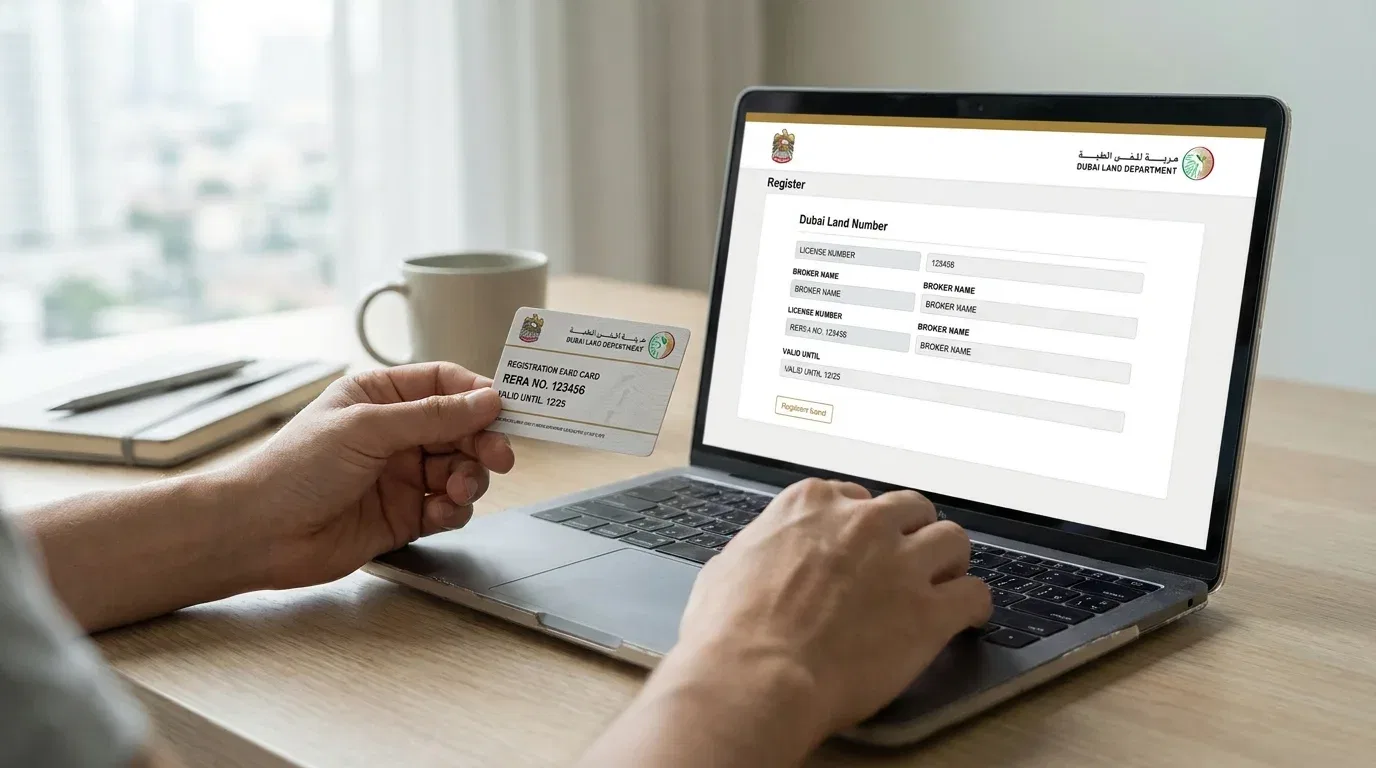
To verify a Dubai real estate broker, you must check their individual Broker Registration Number (BRN) and the company's Office Registration Number (ORN) directly against the Dubai Land Department (DLD) live registry. A static image of an ID card is insufficient, as the DLD requires active verification through the Dubai REST application or its web portal.
For overseas investors making decisions in 2027, validating an agent's regulatory standing prevents capital loss when buying remotely. Distance makes buyers vulnerable to altered documents and unregistered operators making speculative claims on social media. This article outlines the exact steps to validate the broker card, check the company licence, and inspect the underlying project permissions before you transfer a single dirham.
These checks establish regulatory standing. They confirm that the person holds the legal right to market Dubai property under the oversight of the authorities. What they do not confirm is whether that person acts in the buyer’s financial interest, nor do they guarantee that a specific unit fits the buyer’s wealth-preservation strategy or liquidity horizon. I establish the legal facts first through government databases, then test the commercial quality and alignment of the advice itself.
What I gather before a Dubai RERA broker check
Before I open a registry, I gather the correct identifiers. Brokers in Dubai operate under a specific regulatory framework managed by the Real Estate Regulatory Agency (RERA), which serves as the regulatory arm of the Dubai Land Department (DLD). An individual broker and the brokerage company hold separate credentials under Dubai law, so I check both.
I ask the person contacting me for these exact details in writing:
- Their full legal name as registered with DLD.
- Their individual Broker Registration Number (BRN) or broker card number.
- The legal name of the brokerage company they represent.
- The company’s Office Registration Number (ORN).
- The company’s DLD trade licence number.
- The specific property advert link and its associated Madmoun QR code.
I do not treat a generic business card, a social media profile, or an email signature as a substitute for these numbers. I use the raw identifiers to run queries across state databases. DLD provides its verification tools online and through the Dubai REST mobile application. A critical operational detail for international clients is that the residency status on the official broker service is listed as "All". An Indian national sitting in Mumbai, an expat professional in Saudi Arabia, or an institutional buyer in Zurich can perform these exact checks directly without needing a UAE residence visa or a local Emirates ID login.
I also pay close attention to how the advisor responds to my request. In my experience, a legitimate, licensed professional who values compliance should be able to supply their BRN and the firm's ORN. An unregistered operator or an unaccredited lead generator will often deflect, offering excuses about corporate restructuring or claiming that their manager holds the primary registration. I check the individual credentials of the person guiding the transaction, supported by the corporate credentials of the firm holding the deposit documents.
I also distinguish the administrative functions of each number. The ORN identifies the corporate brokerage registered with DLD, whereas the trade licence number reflects the commercial entity registered with the relevant licensing authority. The BRN belongs exclusively to the individual practitioner. Confusing an office number with an individual licence is one of the most frequent administrative mistakes I see overseas investors make. Once I have every identifier recorded in writing, I run the checks in sequence as part of a structured Dubai property due-diligence process.
Step 1: I check the individual broker in DLD records
I first use the DLD Licensed Real Estate Brokers service to check whether the individual contacting me appears on its list of brokers licensed by RERA in Dubai.
Open the service page on the DLD website. The interface provides a direct lookup tool that does not require a login or any administrative charge. You can search using the broker’s registered name, their mobile number, their registered office, the target area, or their specific BRN. The search field asks you to enter at least two characters or numbers to generate a result. I prefer using the specific BRN or the exact registered name to eliminate false positives, as common names return multiple results that can create confusion.
Enter the details and run the query. The system provides sale and lease filters to narrow down the specialisation if necessary. This filter is practical because RERA issues licences tailored to specific activities. An individual registered strictly for leasing activities does not hold the statutory authority to execute commercial or residential sales transactions. When the record appears, compare every displayed detail with the person who pitched you the property. The names must match exactly, and the mobile number registered on the DLD record should correspond with the number they use to communicate with you over official channels.
Watch for transliteration discrepancies when evaluating search results. Official names in the UAE are recorded in Arabic script first and transliterated into Latin characters for English records. A surname like "Choudhury" might appear as "Chowdhury" or "Choudhary" in the departmental registry. If an initial search by name fails, switch immediately to the numeric BRN. The numeric identifier bypasses spelling variations and queries the exact digital record associated with that broker.
A positive match confirms that the individual holds an active registration on the DLD broker list. It verifies that RERA authorises them to conduct real estate brokerage in Dubai, but it does not mean DLD endorses their specific investment recommendation. If an agent tells you a studio in Jumeirah Village Circle will deliver a 9% net yield, their presence on this registry does not make that projection true. It proves they are licensed to sell the unit. I remind buyers that they still need to stress-test the agent’s financial claims.
Steps 2 and 3: I verify the card and brokerage separately
A common mistake remote buyers make is assuming that a verified individual automatically means a verified corporate entity. An individual broker card relates to the person, whereas the ORN and trade licence relate to the company. I check both.
Under Dubai property regulations, individual brokers cannot operate as free-floating agents. They must be registered under an active, licensed brokerage firm that takes institutional responsibility for their contracts, client accounts, and regulatory compliance. If a broker holds a valid qualification but the firm they represent is suspended or operates outside its commercial remit, your purchase agreements and deposit payments are placed at severe legal risk.
How I validate the E-Card in Dubai REST
Every registered broker carries an electronic identification card issued by RERA. Rather than looking at a static image or a screenshot of this card sent over messaging apps, I validate it live through the sovereign digital infrastructure.
Download the Dubai REST application to your smartphone, which serves as the official smart application for real estate in Dubai. Open the app and select the "Validate E-Card" service. The system asks you to select the specific type of broker card you are checking. You then enter the card number manually or use your phone camera to scan the card details.
The application queries the live DLD database and returns the current status of that specific card. A DLD FAQ page explains that a broker card's validity remains associated with the underlying licence. If a broker leaves a company, if their commercial sponsorship lapses, or if the firm’s trade licence expires, the broker card status updates immediately to reflect that change. A saved PDF or a photograph taken three months ago carries no weight. I perform the E-Card validation on the day I decide to proceed with an engagement.
During the validation, check the card expiry date alongside the broker's current sponsoring company. If an agent presents a card branded with Brokerage A, but the Dubai REST database indicates their active registration sits under Brokerage B, stop the conversation. Brokers who switch agencies often continue using marketing materials from their previous employers while their paperwork transfers. Engaging an agent whose legal registration does not match their current contracting entity leaves you without institutional recourse if a dispute arises.
How I check the brokerage’s DLD trade licence
After validating the individual, turn your attention to the corporate entity handling your funds and contracts. You need to know that the company holds a valid commercial licence for real estate brokerage.
I use the DLD Trade License Search to check the validity of trade licence numbers registered with DLD. DLD says users enter the required data and view the information on screen; it lists the service time as immediate and gives the DLD website and Dubai REST app as access channels. I note that the DLD site footer lists 3 November 2026 as its last update.
Compare the returned legal entity with the company named on any proposed contract, Form B, or booking form. The names must align perfectly. If an agent pitches you under a global franchise brand yet asks you to sign a document with an entirely different local LLC name, you pause the transaction until you understand the corporate relationship. A franchise agreement may exist, but the legal entity named on your contract is the only entity liable for your money under UAE civil law.
Examine the licensed business activities listed on the departmental portal. A legitimate property advisory or brokerage must hold explicit permissions such as "Real Estate Buying and Selling Brokerage" or "Leasing Brokerage". If the licence lists generic consultancy, public relations, or commercial information services, the firm is not authorized to act as an intermediary in real estate transactions. Intermediaries operating under generic commercial licences skirt RERA oversight, leaving buyers unprotected by statutory real estate regulations.
I apply this standard to my own firm. When clients engage my advisory practice, they deal with Proact Luxury Real Estate LLC. Our public identifiers are ORN 43533 and BRN 71195, updated 18 November 2025. I instruct every buyer to take those numbers and run them through the DLD Trade License Search themselves before signing our terms. You verify the issue dates, confirm the future expiry, and check that the licensed activities match the service offered. Transparency must come first, and buyers must demand that proof from every practitioner they encounter.
Step 4: I check the advert and off-plan project separately
Confirming the broker and the company leaves one mechanical check remaining. Broker registration does not authenticate an advert, and an advert permit does not guarantee the investment quality of a project.
The property sector in Dubai operates under strict advertising guidelines designed to prevent misleading marketing, phantom listings, and unauthorised price claims. Unregistered operators often scrape images from legitimate luxury developments in Downtown Dubai or Palm Jumeirah, republishing them on social channels to attract foreign capital. Validating the individual advertisement ensures you are reviewing a genuine property authorized for sale at an approved price.
I verify the Madmoun QR against the property advert
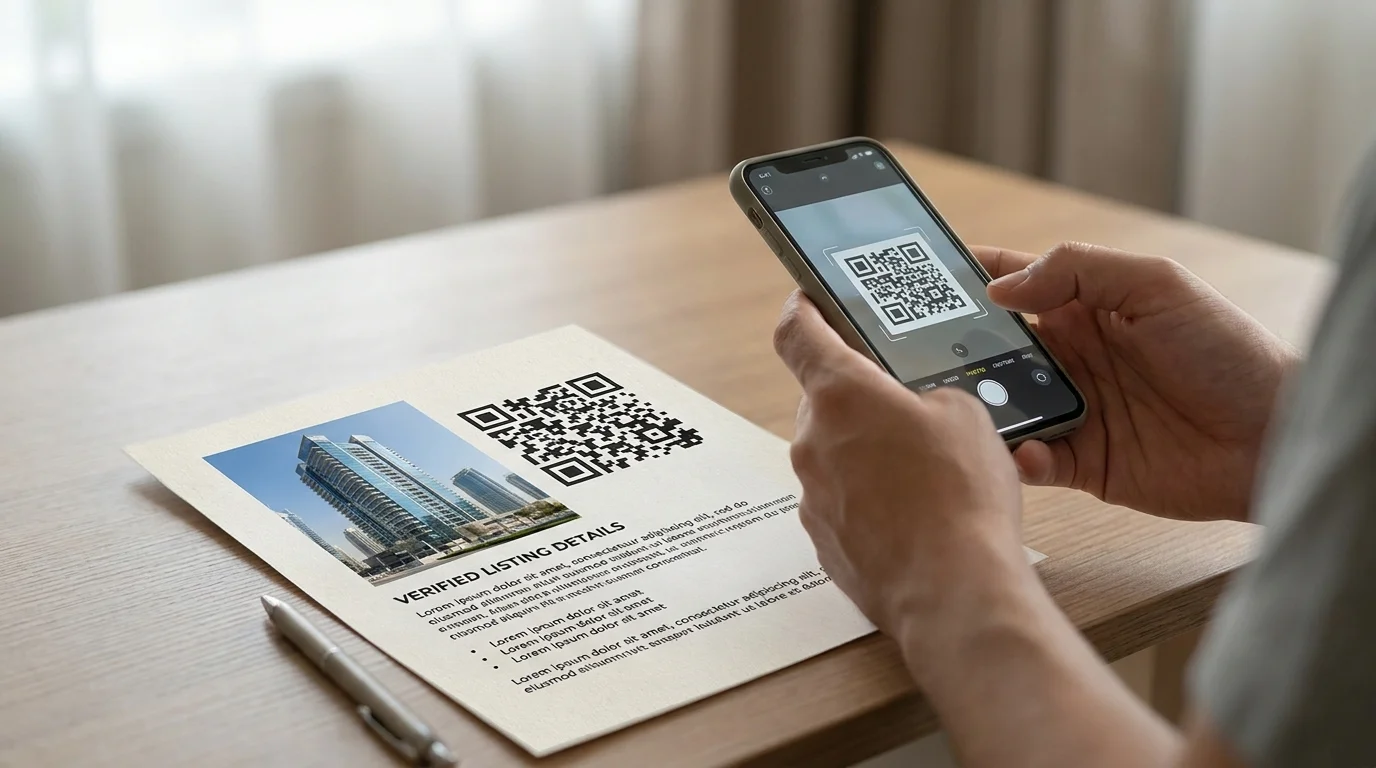
Dubai requires real estate adverts across print, digital, and social channels to carry a formal permit, represented by a digital QR code. When you receive a property brochure, an email proposal, or a digital listing, look for the Madmoun QR code.
I scan the QR code to check the advert’s authenticity and validity, as described in the DLD release. I then compare the details DLD makes available on its website, including the advertising company and the property’s condition and specifications, with the marketing material I received.
This scan protects you from fake listings designed to harvest your contact details or promote units that have already been sold. When you scan the Madmoun code, check that the issuing broker named on the DLD portal matches the company you are dealing with. If the QR code redirects to an external corporate website instead of the official DLD domain, or if it describes a residential plot in Dubailand when the brochure claims to sell a penthouse in Dubai Marina, you discard the advert immediately.
For off-plan, I check project status and the payment route
Off-plan purchases require project-level verification. A broker's registration tells you nothing about a developer's track record or a project's completion timeline.
When an agent pitches an unbuilt property, ask for the specific DLD project registration number and the escrow account details. Dubai’s Executive Council Resolution No. 6 of 2010 regulates off-plan project marketing. Articles 10 through 12 stipulate that a broker engaged to market an off-plan project must hold a formal marketing agreement with the developer and must deposit the sale price directly into the official project escrow account rather than the broker's or developer's corporate operating account.
You never pay an off-plan booking amount into a broker's personal bank account, nor do you wire funds to a generic company account that does not match the DLD-registered escrow details. Unscrupulous intermediaries sometimes request direct transfers to corporate accounts under the guise of an administrative holding charge. When assessing distressed off-plan assignments in Dubai, I see buyers lose capital because they handed cash to an intermediary instead of routing it through the regulated escrow framework.
To verify an off-plan project, access DLD’s project status tracking tools through the Dubai REST application or the departmental web portal. Enter the developer’s name and the project name to inspect the development file. The portal confirms whether the project holds an active status, records the official escrow account bank and account number, and displays the certified construction completion percentage verified by DLD site inspectors.
Check these metrics against the sales claims made by the agent. If an agent promises that a tower will hand over within twelve months, but the departmental inspection records construction progress at only 15%, you are dealing with an unrealistic handover projection. You can identify similar structural issues by reviewing common red flags in Dubai off-plan sales pitches before submitting an expression of interest. Verify the project status independently, confirm the escrow account title with the custodial bank, and execute your payments through secure banking channels.
Why I treat registration as the first test
At this point, you have confirmed the individual BRN and validated the E-Card. You have checked the company trade licence and scanned the Madmoun QR code. The records are clear. The broker holds an active registration.
Many remote investors stop here. They assume a clean DLD record means the agent will protect their capital and steer them away from bad assets. That conclusion goes beyond what the registry can establish.
I use Dubai Law No. 4 of 2019 to identify RERA’s statutory role: it regulates and licenses real estate activities, monitors those conducting them for compliance, maintains registers of such persons, and considers and investigates complaints against them. I treat that oversight as the legal baseline, then assess an asset against each buyer’s goals and holding period, weighing the intended return against the downside if it does not fit.
A successful lookup confirms that the broker met the training and licensing requirements to operate a commercial business. It provides no evidence to support the broker's appreciation claims. The registry will not show whether the broker represents your interests or the seller's interests, nor will it confirm whether a recommended off-plan launch fits your specific five-year holding period.
This gap between legal registration and investment suitability explains why my advisory practice exists. I operate as a second-stage review for international families and NRI investors. Once the legal credentials are clear, we evaluate the advice using the ADVICEdge framework and Advisor Check, assessing the five core dimensions of advisory practice: alignment, depth, voice, integrity, and compassion.
Alignment tests whose goals drive the conversation. An aligned advisor starts by interrogating your balance sheet, your risk tolerance, your currency exposure, and your planned exit date. They do not start by sending you a glossy brochure for a project that recently launched in an unproven peripheral community. If the advice centers on available inventory or developer inventory incentives rather than your liquidity needs and investment horizon, the alignment fails.
Depth tests the analytical evidence. When a broker promises a 10% capital gain in two years or a double-digit rental return, depth demands the historical transaction data and cost schedules that make this plausible. Buyers want to understand the Dubai real estate price drop forecast and market resilience, requiring an advisor to model the downside scenario alongside the upside case. I run the numbers on prolonged vacancy, realistic service charges, maintenance allowances, and a forced early sale. If your broker presents an optimistic projection without testing the downside risks, their advice lacks depth.
Voice tests openness to challenge. I expect buyers to be able to question a recommendation without the agent becoming defensive, dismissive, or manufacturing fake urgency through claims of expiring inventory. A sound advisor welcomes scrutiny. They present objective counter-arguments and will actively supply reasons to walk away from a deal if the pricing or legal terms shift against your interests.
Integrity requires absolute transparency about the commercial structure of the deal. You need to know exactly what arrangements govern the transaction. My advisory model is fully disclosed on our Dubai real estate advisory portal. Laying the structural facts flat on the table removes hidden incentives and allows us to focus entirely on asset quality.
Compassion accounts for the reality of buying from abroad. It means understanding the anxiety of managing foreign exchange regulations, working through unfamiliar legal frameworks, and committing large sums of family capital without walking through the physical front door. A compassionate advisor slows the process down, builds defensive structures, and ensures every question receives a clear answer, whereas a transactional broker speeds it up to hit an internal sales target.
What I ask about advice, representation and compensation
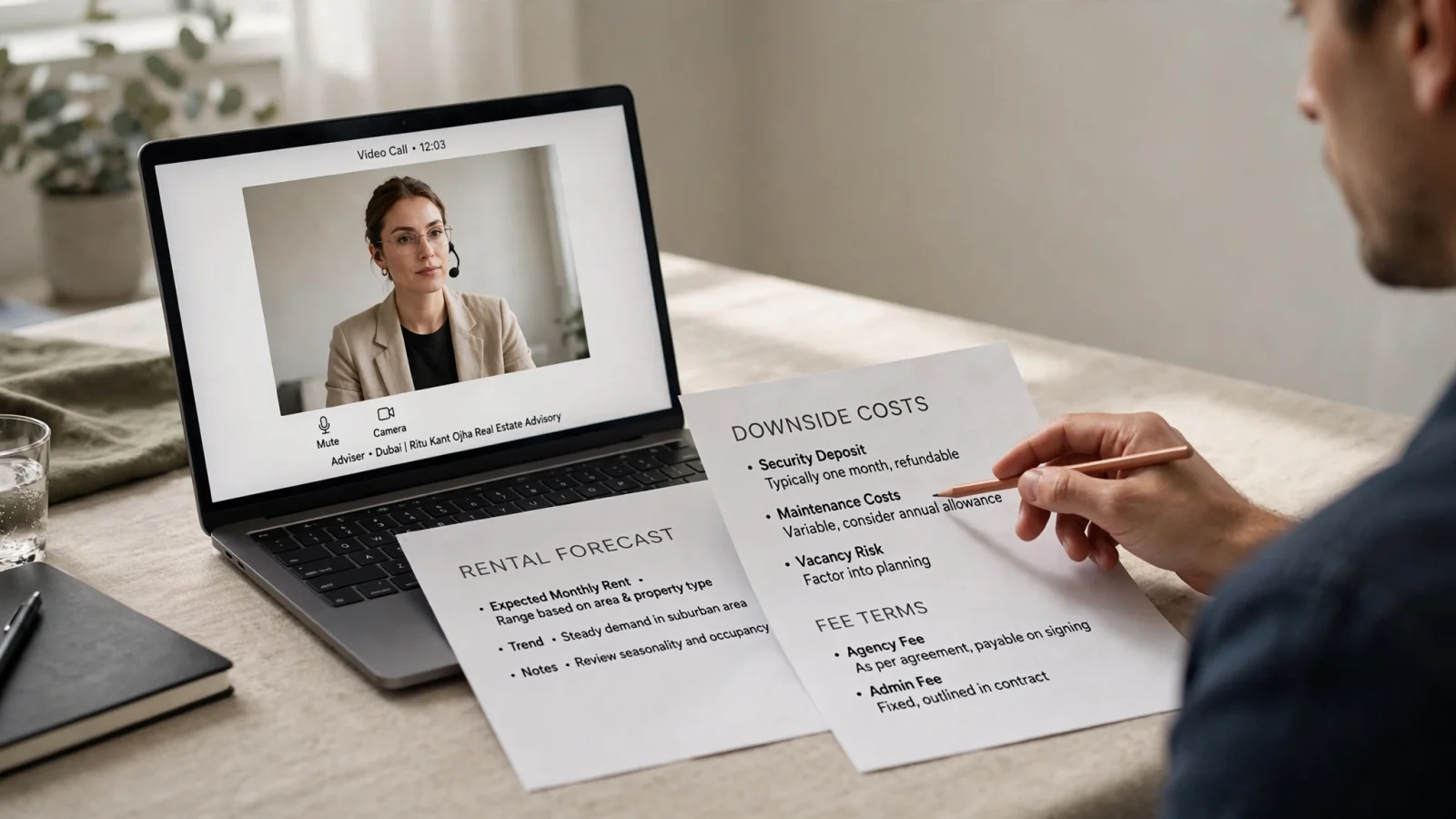
To assess an advisor against these standards, you ask direct questions and require written answers. Verbal assurances evaporate when a dispute arises. Send this specific script to the person handling your transaction before you sign a Form B or an engagement letter:
- Which specific legal entity am I engaging, and which individual broker will handle my transaction?
- Whom do you represent in this transaction? Are you working for me, the seller, the developer, or multiple parties?
- Who compensates you if I buy this property? Do you receive an incentive from a developer or seller?
- What exact compensation could I owe you, how is it calculated, and what specific event triggers the payment?
- What concrete market evidence supports your rent or resale projection?
- Under what specific circumstances would you advise me to wait or walk away from this deal?
- If this is an off-plan project, provide the DLD project record and the escrow account details.
The answers you receive dictate whether you proceed. If the broker evades the compensation question or gives vague answers about compensation, you stop. The DLD FAQ notes that a brokerage contract must identify the contracting parties, describe the property, record the agreed amount, and define the remuneration rate. Under Dubai law, remuneration is set by agreement; if it is left unspecified, prevailing custom is adopted. Never assume that silence on compensation means nothing is due. Establish the commercial basis, the payer, and the payment milestone clearly in your own written engagement documents.
The regulatory framework under Bylaw No. 85 of 2006 also sets strict standards regarding representation and professional conduct. DLD’s guidance indicates that a broker may lose the right to claim compensation if they act in a manner inconsistent with the interests of the party they represent, or if they operate without an active licence. If an agent claims to represent you as a buyer's agent while secretly pocketing an undisclosed incentive from the seller, their commercial alignment is fractured. You resolve this upfront by requiring written disclosure of all compensation streams.
When evaluating the market evidence they provide, use independent data to cross-check their claims. If an agent projects aggressive rental yields to justify an inflated purchase price, consult the RERA Rental Index Dubai Calculator to understand the current regulatory baseline for rental renewals in that specific community. Use the index for regulatory rent context rather than treating it as a complete net-yield calculation. You must still deduct service charges, property management costs, sinking funds, and vacancy buffers to calculate your true return.
Assessing a secondary market purchase and identifying genuine motivated sellers in Dubai requires more than a registry check. You need a broker who knows how to inspect title deeds, verify mortgage release documents, read the unified Form F contract, and negotiate without compromising your commercial position. The registry proves they can legally negotiate, while their answers to your written questions prove whether they possess the skill and integrity to represent your capital.
If the details do not match, I pause and clarify
Sometimes a search returns a blank page. You enter the BRN, run the query, and the DLD system reports no results. When this happens, you do not immediately accuse the person of fraud, but you halt the transaction.
First, retry the search with deliberate care. Technical errors happen frequently when querying databases from abroad. Ensure you have the exact spelling of the registered name, as a slight variation in Arabic-to-English transliteration can cause a mismatch. Confirm the exact broker card number and the specific office ORN. Compare each identifier separately with its own dedicated DLD record. This ensures you have not typed a trade licence number into the ORN field or entered a company number into an individual broker field.
If the mismatch remains after careful re-entry, the person may be operating with an expired card, working under a different administrative entity, or attempting to use another broker's credentials. Unregistered individuals sometimes borrow the registration number of a licensed colleague to generate client trust while marketing properties independently.
There are narrow legal exceptions within the Dubai regulatory code. Article 3 of Bylaw No. 85 of 2006 establishes that a person may not conduct brokerage activities in Dubai unless licensed by a competent authority and registered in the brokers register. However, Article 5 of that same bylaw sets out a Category A exception for experienced persons approved by the Chairman who are exempt from the standard register requirement.
As an overseas buyer, you are in no position to interpret complex regulatory exceptions, evaluate historical administrative dispensations, or verify special ministerial approvals from abroad. I would not expect a buyer to do so. I recommend relying on the standard, publicly accessible databases designed to protect consumer transactions.
If the public records do not validate the broker, pause before authorising any payment, providing passport copies, or signing any legally binding document. Seek clarification directly from the regulator. DLD lists its direct support number as +971 8004488 on the broker service page. Call them during UAE working hours. Explain that you are an overseas buyer attempting to verify an agent and request that DLD customer service clarify the status of the individual, the brokerage licence, or the advert permit.
Resolve the record mismatch first. Once the regulator confirms the credentials are valid and active, you return to the ADVICEdge framework to assess the written terms, the financial models, and the quality of the advice.
A thorough Dubai RERA broker check forms the first stage of due diligence. You verify the individual, the company, and the advert through official DLD systems, then test the advice against evidence and downside scenarios. This process identifies unregistered operators and ensures an investment genuinely fits your goals and holding period.
Book a no-obligation intro call with Ritu Kant Ojha Real Estate Advisory.
Ask Ritu Kant
Have a question about your purchase? Ask me directly.
Tell me what you are considering. I read every message myself and reply within one working day.