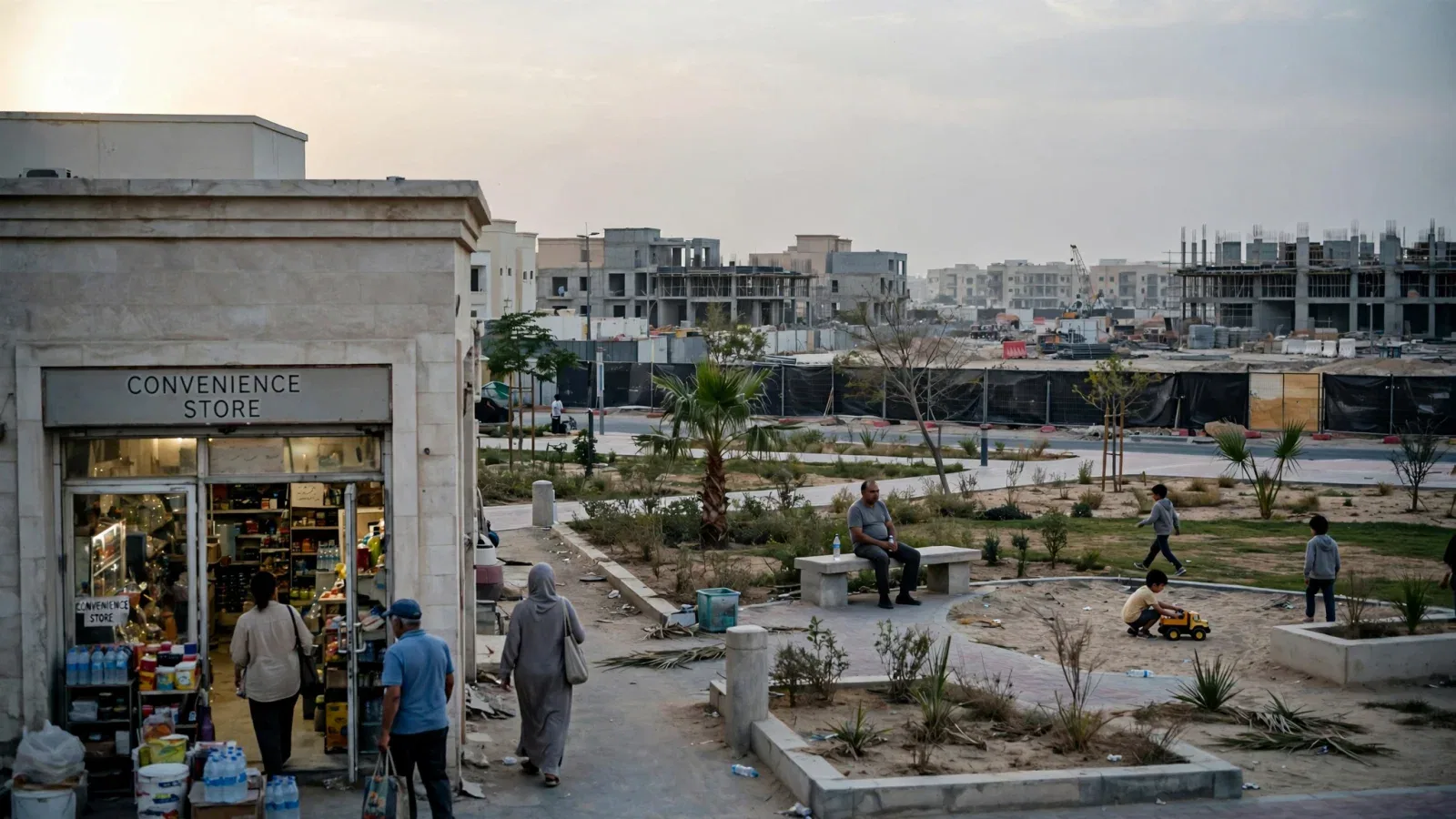
I measure new Dubai community risk by comparing scheduled project supply against verified tenant absorption rather than relying on developer renderings. While the DLD Annual Report for 2024 showed established areas like Business Bay generating AED 3.54 billion in aggregate rental value, emerging masterplans lack this proven cash flow. Auditing usable amenities and registered leases determines your real yield.
For overseas buyers making property decisions in 2027, this evidence separates a performing asset from an empty unit draining your capital through service charges. I am Ritu Kant Ojha, a Dubai-based real estate advisor, author, and CEO of Proact Luxury Real Estate. This article shows you how to grade project claims, test local tenant demand, and build a downside scenario for your holding period.
Broad market statistics provide context, but they do not answer community-level questions. The Dubai Land Department Dubai Real Estate Market, Annual Data Review 2025, published 12 October 2026, highlights transaction volumes across the city. In a separate market update on the rental sector, the DLD reported 1.38 million registered tenancy contracts alongside 937 projects under construction. Those figures confirm a highly active emirate-wide market, yet they do not prove that one specific emerging neighbourhood has enough tenant demand to absorb its incoming supply. I use local, project-specific data to determine whether a masterplan functions as a residential market.
I verify occupancy and usable amenities
A completed building is not necessarily an occupied building. Similarly, an amenity listed in a glossy brochure is not necessarily usable by residents today. When I evaluate an emerging neighbourhood, I separate physical construction progress from human absorption. The public tables available through the DLD Open Data portal display transaction amounts and property types, but they do not provide a ready-made community occupancy percentage. A developer's sold-out launch announcement tells me about investor appetite, rather than end-user presence.
I measure occupancy against delivered lettable homes
To determine verified absorption, I require a dated numerator and denominator. The denominator is the total number of delivered, lettable units in the specific phase or building. The numerator is the count of currently occupied units. A high volume of registered leases tells me little without the total available supply. If a broker claims an 80 percent occupancy rate, I ask for the calculation date and the specific unit denominator. Claims without that mathematical foundation remain unverified and stay out of my base-case scenario.
Completed project counts can mislead remote buyers. A developer handing over 500 units adds to the denominator immediately. If only 50 of those units secure tenants in the first three months, the building holds a 10 percent occupancy rate despite being classified as completed. Empty buildings face physical degradation risks because air conditioning systems and plumbing require continuous use and funding through service charges to remain in good condition. A high vacancy rate strains the owners' association budget, which can lead to reduced maintenance and a subsequent drop in the building's appeal to future tenants.
I track lease registrations over time to measure the rate of absorption. I look for the pace of new move-ins following a handover. If a building reaches 70 percent occupancy within six months of completion, that may indicate a functioning local rental market. If it stalls at 30 percent occupancy after a year, tenant demand may be failing to match supply. I include service charges and mortgage interest in your holding-cost model during any extended vacancy.
I check which amenities are open and maintained
In my experience, tenants weigh convenience and lifestyle, so I do not assign a premium to a future retail promenade that remains behind a construction hoarding. I check whether services such as supermarkets and schools are open, accessible, and maintained now. I assign no current rental value to a proposed metro station for a tenant moving in next week.
I assess amenity quality through in-person checks. The DLD Smart Rental Index 2025 evaluates buildings using technical and structural characteristics, the quality of finishes and maintenance, strategic location and spatial value, and available services and facilities, including cleanliness and parking management. I use those building-quality factors as a reference, then inspect the community itself. I check parks for maintained landscaping and functioning irrigation, and I look for operating businesses in retail centres. I also assess whether access roads are paved and clear of heavy construction traffic.
Living next to an active construction site creates noise and traffic disruptions that deter premium tenants. When I inspect an emerging area, I map the proximity of your specific building to ongoing works. A completed tower situated between two empty plots carries the implicit risk of future construction noise. For overseas buyers, I request independent video walkthroughs showing the condition of the entrance, lobby, and immediate streetscape. This physical evidence takes precedence over any rendering or promise of future development.
I count future supply against the holding period
I assess incoming supply against your planned investment horizon. If you intend to hold a property for five years, I identify every comparable unit scheduled for delivery within that exact timeframe. Ignoring competing supply exposes you to a sudden spike in local vacancy rates when multiple buildings hand over at the same time.

I map comparable homes by community, phase, and property type. A one-bedroom apartment competes primarily with other one-bedroom apartments of similar size and quality in the same immediate area. Townhouses compete with townhouses. I extract project records to find the total number of comparable units under construction and their scheduled handover dates.
For a specific off-plan project, I check the developer's claims against the Mashrooi Project Status Enquiry, which displays project status and completion information. I compare those details with the developer's handover timeline and adjust my financial model if they do not align.
The Mashrooi system also details the project's escrow account. According to Dubai Land Department regulations, this regulated bank account holds purchaser payments and project financing, releasing funds only against verified construction milestones. While escrow protects your capital from being diverted to other developer projects, it does not guarantee your investment return. Escrow compliance provides evidence that construction funding is secure, but it does not establish future rental demand or resale liquidity.
I integrate these registered supply figures into your risk scenarios. The base case includes only operating infrastructure and delivered units. I put registered projects under construction into a scheduled supply model based on their official Mashrooi timeline, not the sales brochure. Unverified project announcements and proposed transport links remain in the upside scenario. I detail the common hazards of ignoring these distinctions in my guide to spotting red flags in Dubai off-plan sales pitches.
Matching this supply to your holding period changes the decision matrix. If you buy an off-plan unit completing in 2028 and plan to sell in 2030, you face a two-year operational window. If the community expects 4,000 competing units to hand over in 2029, your exit liquidity may suffer as buyers choose brand-new developer inventory over your two-year-old secondary unit. Understanding this timeline is a core principle I outline when advising clients on buying off-plan property in Dubai.
I test tenant demand and resale depth separately
Tenant demand and resale demand represent two different market forces. Strong rental yields do not automatically translate into a liquid resale market, and rapid off-plan sales do not guarantee that tenants want to live in the area. I test these buyer pools independently using different datasets.
I test rental depth with comparable leases
To model expected rental income, I compare leases for the exact same property type, bedroom count, and building quality. I restrict the data period to the last 90 days to capture current market conditions. Advertised asking rents on property portals show what landlords hope to achieve. Registered contract values show what tenants are willing to pay. I base all financial modelling on the registered figures.
Where the data source allows, I distinguish between new leases and renewals. Renewals often sit lower than open-market rates due to RERA index caps, while new leases reflect current willingness to pay. However, gross rent is not your final return. I subtract the anticipated vacancy period, the property management fee, and the annual service charges to calculate net yield. A projected 8 percent gross yield can compress to a 5.5 percent net yield once you account for the costs of remote ownership.
The DLD Rental Index calculates average rent and allowable rental increases for selected areas. New buildings enter this index only after their initial registration period. Because the index lags behind immediate new deliveries, I use it as a sanity check for broader area trends, rather than as a precise forecasting tool for an unregistered, newly launched tower. For a more structured approach to modelling these yields, buyers can use my RERA rental index Dubai calculator to test different scenarios before committing capital.
I check resale liquidity with ready-home transactions
I define exit liquidity as the ability to sell quickly without taking a heavy discount, then assess it by examining ready-home transactions for comparable units in the area. A high volume of secondary market sales indicates a deep pool of end-users and investors willing to purchase established stock.
A fast off-plan sell-out reflects developer marketing efficiency, rather than secondary market depth. Many initial buyers are speculative investors planning to flip their contracts before completion. When a building hands over, this concentrated group of investors may try to exit at the same time, adding identical units to the market. If the community lacks end-user demand, prices can compress as sellers undercut each other to secure a buyer.
I track the price stability and transaction volume of comparable ready homes. A healthy community shows steady secondary sales occurring close to original asking prices. A distressed community shows low transaction volumes and wide gaps between asking and achieved prices.
I compare emerging and established communities fairly
I compare a new masterplan against a fully matured neighbourhood using matching data periods and property types. A direct comparison highlights the distinct risk profiles and trade-offs in each choice. Neither label guarantees capital growth, and neither guarantees lower risk.
Emerging communities offer potential upside if the area successfully transitions from a construction site to a functioning neighbourhood. If the promised amenities open on schedule and tenants absorb the new supply, property values may adjust upward to reflect the reduced risk. The entry price is typically lower, compensating you for the uncertainty of living in a developing zone.
The downside of an emerging community materialises when the developer's timeline slips. Similar homes may complete and flood the market before tenant demand catches up. Roads may remain unpaved, and retail operators may delay opening until population density increases. This mismatch can leave you holding an empty asset with mounting service charges and facing a thin resale market.
Established communities offer a verifiable operating history. You can stand on the street, observe local traffic, and review years of registered sales data. This visibility reduces delivery and absorption risk. You know what you are buying, and you can model net yield based on historical service charge data and established tenant turnover rates.
The trade-off is the entry price. The market has already priced in the maturity and stability of the area, leaving less room for speculative capital appreciation. Furthermore, older stock introduces building-specific risks. A ten-year-old tower requires thorough checks on its maintenance history and current facility management quality. An established community address does not protect you from a poorly maintained building.
To illustrate the scale of mature area performance, the DLD Annual Report for 2024 recorded aggregate community rental values. Business Bay reached AED 3.54 billion, marking a 23.44 percent increase over the previous year, while Marsa Dubai (Dubai Marina) recorded AED 3.40 billion, up 2.15 percent. These explicitly dated figures represent total aggregate area value, rather than per-unit rent or individual occupancy rates. They demonstrate the volume of capital flowing through fully established tenant markets.
| Assessment Area | Emerging Community Profile | Established Community Profile |
|---|---|---|
| Potential upside | Value may improve as homes fill and local demand deepens over time. | Existing transaction and operating history provides clear evidence to underwrite. |
| Downside to model | Competing supply may arrive before tenants do; resale market may be highly illiquid. | Higher entry prices reflect the area's maturity; older buildings carry hidden maintenance and service charge risks. |
| Best fit for buyer | Investors whose holding period and liquidity needs can absorb a longer build-out, with pricing that compensates for the uncertainty. | Investors who value visible rental and ready-sale evidence, provided they conduct rigorous building-level checks. |
These are underwriting distinctions, not universal performance claims. "Established" does not mean risk-free, and "emerging" does not automatically mean higher growth. Your decision depends on your capacity to absorb a delayed return.
I build a remote-buyer evidence pack
For overseas NRI and diaspora buyers living in the US, UK, Canada, Singapore, or the GCC, remote due diligence is a primary concern. From 6,000 kilometres away, I use a structured, evidence-based approach to filter out sales hype. I account for the risk that a broker's primary goal is moving developer inventory, rather than relying on that broker's account alone. I build a specific evidence pack to bridge this geographic gap, and at Ritu Kant Ojha Real Estate Advisory I explain the basis for each recommendation to buyers.

I start with a dated, independent site walkthrough. I do not accept developer-led virtual tours, which are carefully staged to avoid showing negative aspects of the site. I look for unedited footage showing the condition of the building entrances and immediate neighbouring plots, whether the promised retail shops are operating, and whether the landscaping is maintained. I check the area at different times of the day to gauge real traffic and noise levels.
I pair this with a verified project and phase record. For any off-plan recommendation, I extract the official Mashrooi data detailing the exact completion percentage and the date of the last government inspection. This provides a factual baseline for the developer's delivery capability.
I test occupancy claims by asking for the calculation date and the specific unit denominator behind any stated percentage. If a broker cannot provide the calculation showing how many lettable units exist versus how many are currently occupied, I classify the evidence as incomplete and disregard the claim.
I then compare rental evidence for matching unit types, sizes, and building quality. I strip out advertised asking rents and rely solely on registered contracts. I build a full net-yield calculation, separating gross rent from anticipated vacancy periods and operating expenses.
I map future supply against your specific holding period, listing every comparable unit expected to complete during your intended ownership window. I separate operational stock from registered construction, and I exclude unverified future announcements from the supply model.
I also build a severe downside scenario. This model shows what happens to your cash flow if lease-up takes six months longer than expected or the achieved rent drops by 15 percent.
For NRI families whose capital originates in Indian Rupees or British Pounds, I include currency exposure in the downside model. The UAE Dirham is pegged to the US Dollar. If you are funding a payment plan with Rupees, depreciation of the Rupee against the Dollar increases your acquisition cost in your home currency. I model this FX risk separately from the property's base performance to show your total capital exposure.
This rigorous approach demonstrates my ADVICEdge framework. It ensures alignment with your financial goals and demands depth in the underlying evidence. I use a clear voice to explain uncertainty, maintain integrity by separating operating facts from developer promises, and bring compassion to the anxiety involved in remote purchasing. My book, The Only Difference (2026), sets out the ADVICEdge framework for evaluating advisors. I also wrote Real Conversations In Digital Age (2019). I detail the mechanics of my framework in my advisory process, where I explain how I stress-test a property before recommending a transaction. Buyers can also use my free ADVICEdge Advisor Check to assess the advice they receive against the framework.
I decide whether to buy, wait or choose established stock
My final recommendation is always conditional. I do not issue universal verdicts declaring an area "good" or "bad." The decision depends on how the community's specific evidence aligns with your risk tolerance and exit strategy.
I consider an emerging community viable only when the entry price compensates for delivery uncertainty, the holding period can absorb slower lease-up and a potentially thin resale market, and the buyer can withstand the downside without relying on future infrastructure to support the investment.
I favour an established area when a buyer prioritises immediate cash flow, visible tenant demand, and ready resale liquidity. For that choice, I shift due diligence towards building age and service charge inflation. A poorly managed building in a prime established area may perform worse than a well-managed building in an emerging zone.
I advise clients to wait or walk away under four specific conditions. First, if the broker's occupancy claim lacks a defensible mathematical denominator. Second, if local registered rental or ready-resale evidence is missing. Third, if the projected downside case conflicts with the buyer's liquidity needs. Fourth, if the entire investment thesis relies on a proposed transport link or amenity that is not currently operating.
I prioritise capital preservation by maintaining strict requirements for evidence-led, downside-aware underwriting. Tracking verified data ensures you do not absorb unnecessary risk when evaluating new developments. I help you calculate realistic net yields and build an exit plan based on your exact holding period.
Explore my advisory page and book a no-obligation intro call with Ritu Kant Ojha Real Estate Advisory; I personally work with every client.
Ask Ritu Kant
Have a question about your purchase? Ask me directly.
Tell me what you are considering. I read every message myself and reply within one working day.