
Transferring Dubai rental income to India requires routing the funds to either a Non-Resident External (NRE) or Non-Resident Ordinary (NRO) account. The Reserve Bank of India’s Accounts in India by Non-residents FAQ, updated in January 2025, permits eligible inward remittances to both account types without imposing the USD 1 million limit, which strictly applies to outbound transfers.
For non-resident Indian buyers acquiring property in 2027, understanding this remittance structure prevents foreign rental income from becoming trapped in domestic accounts. Based on the latest available banking data from 2026, hidden currency spreads and intermediary fees routinely erode expected yields before the money arrives. This article explains how to separate gross contract rent from cleared transferrable cash, select the correct receiving account, calculate the real cross-border transaction costs, and prepare the evidence trail required by the Indian tax authorities.
I Start With the Dubai Tenancy and Cleared Rent
I start the evidence trail with the signed tenancy agreement, then check it against the Ejari registration certificate, title deed and, where an agent collects rent, the property management agreement. I use the Dubai Land Department guidance, which lists service centres, Ejari and Dubai REST as registration channels and requires a representative applying through a trustee centre to hold an official power of attorney. For a jointly held property, I recommend keeping the ownership records alongside the rent receipts and transfer documents.
I treat the contracted rent schedule as the next layer of evidence. The UAE government confirms that rent can be paid in one payment or multiple payments as agreed with the broker or landlord, so I reconcile that schedule against copies of the rent cheques, payment receipts and the property manager’s remittance statements.
I distinguish rent due from rent cleared. If a tenant signs a lease for AED 120,000, I do not treat that figure as cash available in a UAE account. Cheques can bounce and tenants can delay payment. The contract records rent due, while a cleared UAE bank credit shows cash received. I match the bank statement showing the rent credit against the property manager’s ledger to confirm the exact amount collected.
Once the rent clears, I account for operating costs in the UAE. Property managers deduct their management fees directly from the collected rent before issuing your statement. Service charges levied by the Owners Association are required to maintain the building, and I also allow for emergency repairs, landlord insurance and any local mortgage obligations. I treat only the net operating income as available to transfer. If you own an apartment, the cost of flats in Dubai includes these recurring holding expenses, which reduce the transferable cash. I advise owners to keep a standing AED reserve in their local account. An unexpected air conditioning failure or a two-month vacancy between tenants can wipe out a quarter’s cash flow. If I send every dirham to India, a Dubai maintenance invoice could leave me needing to wire money back to the UAE and incur a second round of currency conversion fees.
I keep these documents together as a practical record pack. If the receiving bank queries a transfer, the Ejari, property manager’s statement and UAE bank credit advice can help explain its source.
I Confirm the Indian Account Route With the Bank
Choosing the correct receiving account helps avoid funds becoming trapped in a non-repatriable structure. The RBI framework provides specific uses for Non-Resident External (NRE) and Non-Resident Ordinary (NRO) accounts. Eligible inward remittances can be credited to either account type, but the rules for taking funds out differ.
An NRE account holds foreign earnings sent into India. The RBI guidance explicitly lists current income, such as rent from overseas properties, as a permissible credit to an NRE account. The primary advantage of this route is that NRE balances remain freely repatriable. If you decide later to move those funds to a brokerage in Singapore or pay a university tuition fee in the United Kingdom, you can transfer the money out of the NRE account without seeking special tax clearances or eating into your outward remittance limits. The funds stay in INR while parked in the account, but they retain their foreign-origin status.
An NRO account serves a different function. It primarily holds domestic Indian income earned by a non-resident, such as rent from a property in Mumbai or dividends from an Indian mutual fund. While an NRO account can receive inward remittances from Dubai, the balances inside it are not freely repatriable. Eligible outward transfers from an NRO account fall under the RBI’s USD 1 million-per-financial-year facility, and moving money out requires specific chartered accountant certifications regarding the taxes paid.
The correct choice depends on your FEMA eligibility, your property ownership structure, and your intended use for the money. If you plan to use the Dubai rent to pay an Indian life insurance premium, service a local loan, or support family members in Kerala, routing the transfer into an NRO account serves that purpose. If you want the option to move the money out of India again, the NRE account preserves that flexibility. I advise owners to instruct their Indian bank on exactly how to classify the incoming Dubai rental receipt before authorising the first wire. I do not treat NRE as an automatic choice, because the right route depends on how you intend to use the cash once it lands.
I Reconcile AED Debited With INR Credited
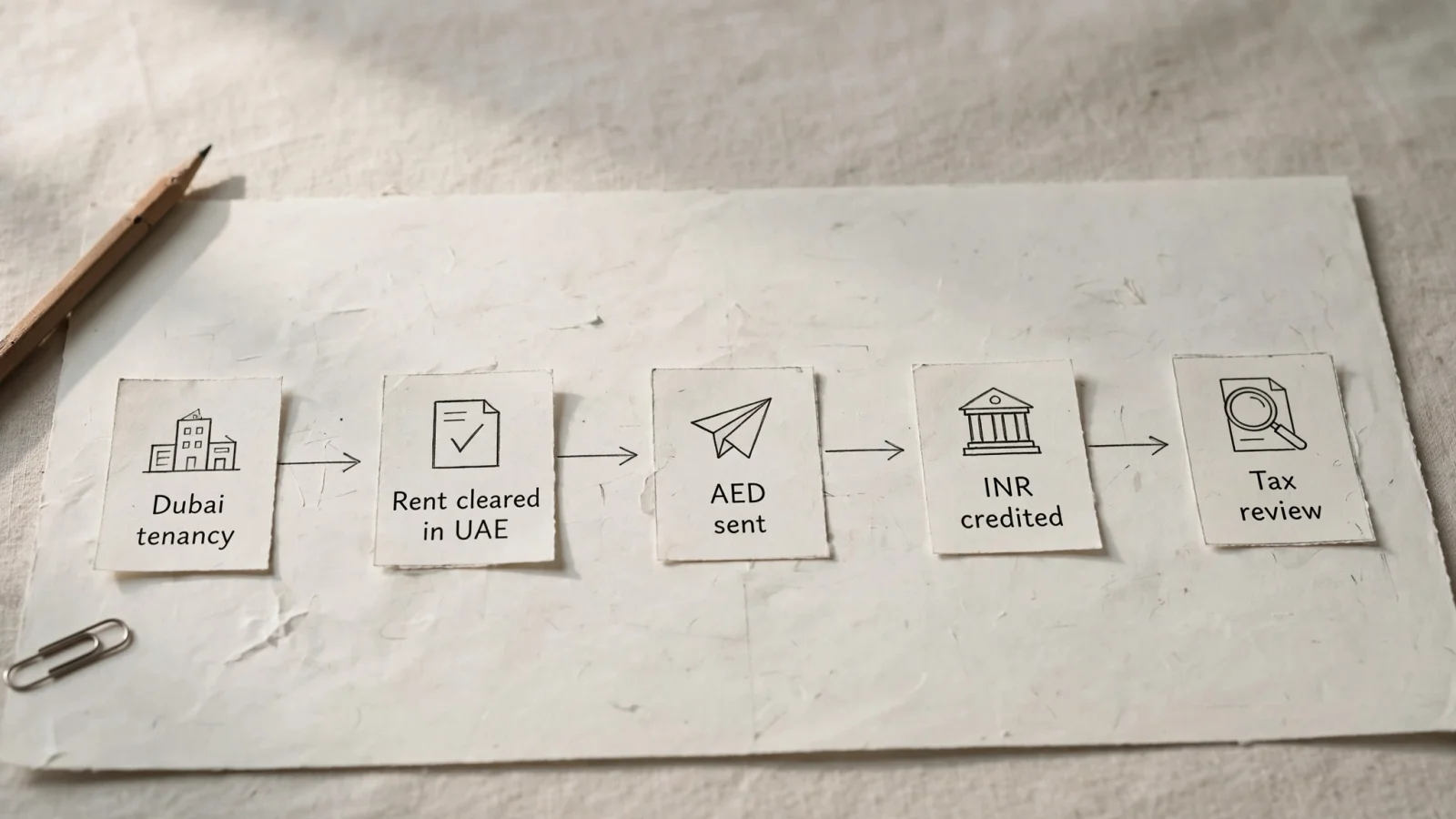
Gross rent never reaches your Indian account intact. I keep the rent due, the rent collected, the costs retained in the UAE, the AED debited, and the INR credited strictly separated on the ledger. Confusing the gross contract rent with the final cash available to transfer leads to severe miscalculations in portfolio yield.
When you initiate a SWIFT transfer from a UAE bank, the money rarely moves in a single direct line. As it passes through correspondent banking networks, the sending bank in Dubai may charge an outbound wire fee, an intermediary bank may deduct a correspondent fee from the principal amount, and the receiving bank in India may apply an inward remittance fee. By the time the dirhams convert to rupees, the principal may have absorbed three separate layers of friction.
The conversion rate itself can contain the largest hidden cost. Banks quote a headline exchange rate, but they apply a spread, which is the difference between the interbank market rate and the rate they offer retail customers. An attractive headline rate that comes with a wide spread and heavy intermediary fees produces a lower net credit.
I track the effective AED-to-INR result using a simple formula: the net INR credited to the Indian account divided by the total AED debited from the UAE account. This reveals the true cost of the transfer. I recommend asking currency providers for a live quote on the same AED amount on the same day. Request the sending fee, the expected intermediary charges, the exact exchange rate, and the anticipated receiving fee. Generic percentage estimates published on comparison websites can be misleading because costs depend on bank-specific correspondent relationships.
This financial reconciliation forms a core part of how my firm tests a property’s viability. We evaluate the collected rent, the operating costs, the vacancy risk, and the currency friction to model your holding-period returns. When an owner decides to buy properties in Dubai Marina, we map the difference between the developer’s projected gross yield and the realistic net INR credited after all cross-border costs. We do not execute the currency transfers, and we do not act as your tax agent. We provide the hard mathematical baseline that helps you decide whether to hold the property, adjust the rent, or exit the asset entirely.
I Separate Indian Tax From the Transfer Itself
The physical movement of money across a border does not dictate the tax liability. Income tax depends on the source of the income and the residential status of the earner during the specific financial year. I separate the banking mechanics from the statutory tax obligations.
I Check Tax Residence for the Year the Rent Was Earned
Indian tax law underwent a structural change with the enactment of the Income-tax Act, 2025. This new legislation applies to tax years beginning on or after 1 April 2026. For income earned in earlier periods, the Income-tax Act, 1961 continues to govern the assessment. I check the exact financial year the rent was earned to apply the correct statutory framework.
Under the 2025 Act, your tax residency status determines your exposure to Indian tax on foreign income. A resident is generally within scope for worldwide income, meaning Dubai rent is taxable in India regardless of whether you leave it in a UAE bank or transfer it to Mumbai. A resident but not ordinarily resident (RNOR) receives different treatment, typically remaining outside the scope for foreign income unless it derives from a business controlled in India or a profession set up there. A non-resident is generally only taxed on income received or deemed received in India, or income accruing or arising within India.
Determining that residency status requires a precise day count. The Income Tax Department’s Non Resident FAQs outline the basic tests: you are considered a resident if you spend 182 days or more in India during the tax year, or if you spend 60 days in the current year alongside 365 days across the preceding four tax years, subject to statutory exceptions for certain returning citizens.
A specific checkpoint exists for Indian citizens based in the UAE. A tighter 120-day test applies to visiting Indian citizens or people of Indian origin whose total Indian-sourced income (excluding foreign sources) exceeds ₹15 lakh. Furthermore, a separate deemed-residency provision can apply to an Indian citizen with more than ₹15 lakh of such domestic income who is not liable to tax in any other country by reason of domicile or residence. Because the UAE does not levy personal income tax, this deemed-residency clause requires careful review by a chartered accountant.
Living in Dubai, holding an Emirates ID, or possessing an NRE account does not automatically settle your Indian tax residence. The day count and the ₹15 lakh domestic income threshold help determine your status. I do not assume an owner is a non-resident without running the statutory calculation for the year the rent accrued.
I Trace Where the Rent Was First Received
For a confirmed non-resident, the taxation of foreign income often turns on where the money was first received. The principle distinguishes between income accruing abroad and income physically received in India.
When a Dubai tenant transfers rent into your UAE bank account, the income is received outside India. If you subsequently decide to transfer that cleared balance to your Indian NRE account, that second movement of funds is a remittance, not a new receipt of income. I explain this distinction by referring to the Delhi bench of the Income Tax Appellate Tribunal’s 22 January 2003 decision in Deputy Commissioner of Income Tax v. Finlay Corporation Ltd., which held that remitting income already received abroad did not count as receiving it again in India.
This remains a fact-dependent analysis requiring evidence rather than a blanket exemption. If you instruct your Dubai tenant or property manager to wire the rent directly into your Indian bank account, bypassing a UAE account entirely, the first receipt of that income occurs in India. That direct routing can change the tax analysis. I advise owners to keep explicit documentary evidence of the first credit hitting a UAE account. I give this collection trail to the Indian tax adviser, who can assess whether the owner's circumstances support this distinction. Corporate ownership of the property introduces further complexities regarding controlled foreign companies and corporate tax residency, requiring an entirely different layer of professional advice.
I Keep UAE Tax and Indian Remittance Forms Separate
The absence of personal income tax in Dubai does not guarantee an exemption in India. UAE and Indian tax treatments answer distinct jurisdictional questions, and the rules governing one do not override the other.
I Check UAE Tax Treatment Against the Ownership Structure
The UAE government states that individuals do not pay personal income tax on their earnings. Furthermore, the Federal Tax Authority (FTA) provides specific guidance for natural persons investing in property. The FTA’s Corporate Tax Guide: Real Estate Investment for Natural Persons published in 2024 explains that an individual’s income derived from investing in UAE property in a personal capacity will generally not be subject to UAE corporate tax, provided the activity is not conducted, or required to be conducted, through a commercial licence.
This exclusion covers standard residential buy-to-let investments held in your own name. If you own an apartment and rent it out on an annual Ejari contract, the rental income falls outside the UAE corporate tax net. However, this protection is not universal, as property held through a corporate structure or short-term holiday homes operated under a specific commercial licence require a separate tax assessment. When reviewing Dubai luxury rentals managed as active hospitality businesses, the corporate tax obligations look very different from those for a passive long-term lease. I check that the ownership structure matches the natural person criteria before ruling out the UAE tax question.
I Treat Inbound Transfers Separately From Outbound Forms
Remote owners frequently ask if they must file Form 15CA and Form 15CB to receive their rental income. This confusion stems from reading partial guidance about foreign remittances.
The Income Tax Department’s Income Tax Forms FAQ describes Form 15CA as information furnished by a remitter making a payment to a non-resident. It acts as a tracking mechanism for money leaving the Indian tax net. For India-originating payments on or after 1 April 2026, the department has designated Forms 145 and 146 under the new 2025 Act to serve this corresponding function.
Because transferring Dubai rent to India is an inbound remittance, the money is moving in the opposite direction. You do not file an outbound tax clearance form solely because you are receiving an inward international wire. I do not tell owners to submit Form 15CA or its successor forms for a standard rent repatriation. The receiving bank in India may still request its own source-of-funds declaration or a copy of the tenancy agreement to satisfy internal anti-money laundering protocols, but this banking compliance step is separate from the statutory outbound tax filings.
My First-Transfer File and Adviser Checks
Before executing the first transfer from a new tenancy, I assemble a complete document file. A missing document can delay a transfer if the bank requests it. The file includes the signed tenancy agreement, the active Ejari certificate, the title deed, and the property management contract. I attach the agreed rent schedule, the receipts for collected payments, and the UAE bank statements proving the rent cleared locally. I document the property costs retained in Dubai to explain why the transferred amount is lower than the gross contract rent. I record the transfer confirmation, the exact AED amount debited, the quoted exchange rate, the itemised bank charges, the SWIFT reference, and the final INR bank credit advice. Finally, I append the tax-year residence calculation and the proof of where the rent was first received.
I treat this as a preparation file rather than a rigid statutory mandate. Before sending a wire, I contact the receiving Indian bank for its current inward remittance checklist, account classification and expected charges. I also ask the chartered accountant to verify the relevant tax year, the residence status under the applicable law, and the ownership structure.
Common problems include attempts to transfer rent before it clears the UAE banking system and transfers from bank accounts whose names do not match those on the title deed. Some owners also omit exchange-rate conversion costs, making it harder to calculate the true net yield, while others misinterpret the RBI’s USD 1 million NRO outward facility as an inward restriction.
Evaluating a Dubai property manager from 4,000 kilometres away requires verifying that their incentives align with your holding period and that they understand the difference between gross yield and net repatriable cash. They must provide exact ledger breakdowns of service charges rather than broadcasting market projections. A RERA rental index calculator helps verify a renewal limit locally, while demanding accurate ledger statements ensures you have the documentation necessary for cross-border transfers. Assembling this file does not replace formal tax advice, but it creates the exact administrative record your Indian bank will require.
Book a no-obligation intro call with Ritu Kant Ojha Real Estate Advisory at ritukant.com to review your portfolio; I personally work with every client to verify property cash flows and build an evidence-led holding strategy.
Ask Ritu Kant
Have a question about your purchase? Ask me directly.
Tell me what you are considering. I read every message myself and reply within one working day.