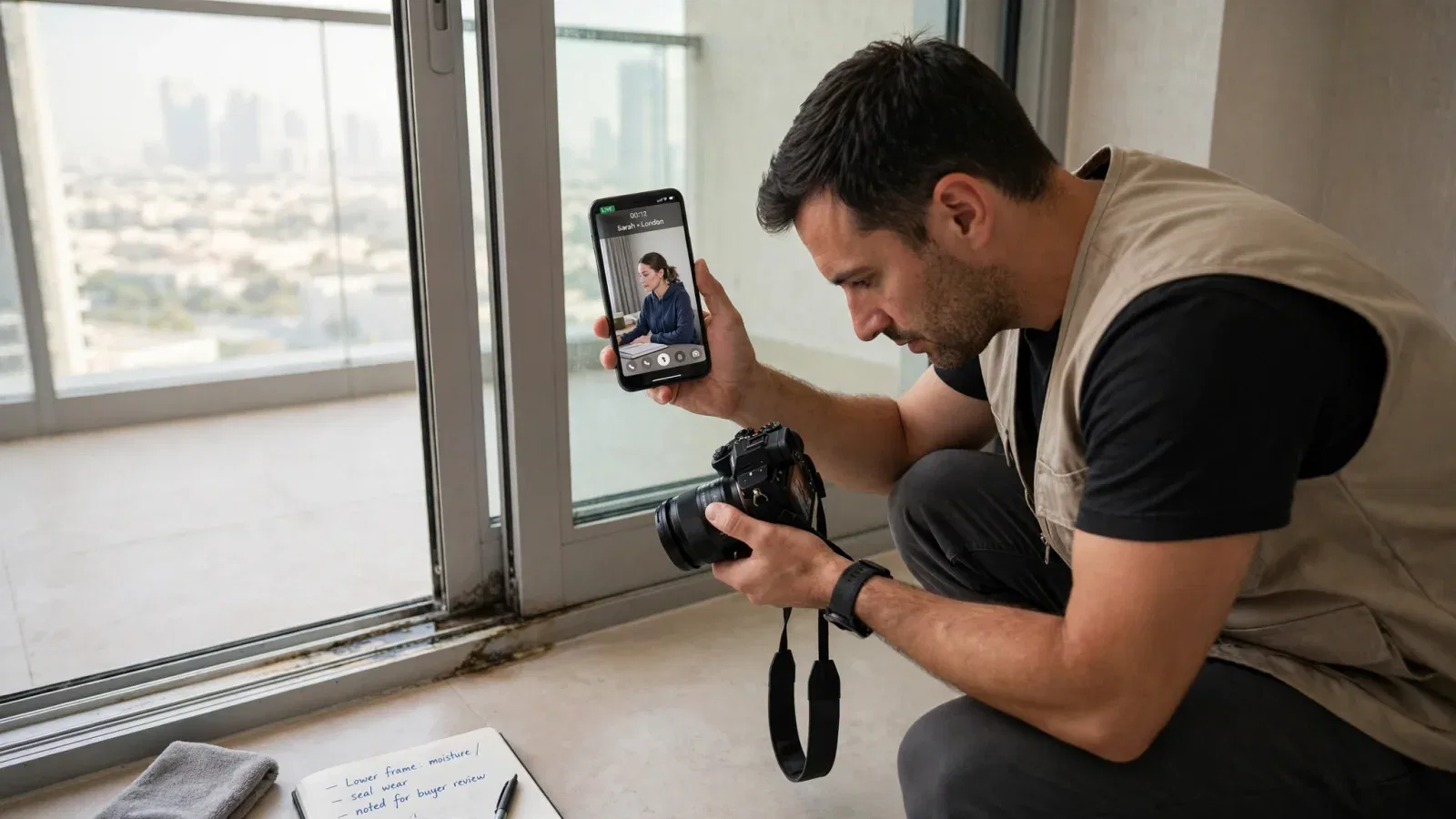
Inspecting a completed Dubai apartment before signing the contract is necessary to protect your capital. The Dubai Land Department's investor guide explicitly recommends buyers inspect resale properties before executing the standard Form F sale agreement. Unlike off-plan handovers backed by developer warranties, secondary market properties are sold as-is, leaving buyers liable for existing mechanical faults.
For a buyer allocating capital in 2027, an aesthetic walk-through offers no protection against hidden maintenance deficits or failing infrastructure. As Dubai's early freehold towers cross the twenty-year mark, assessing the building's financial health and structural baseline dictates your real net yield. This article details how to structure a technical inspection, review communal maintenance records, and verify occupancy before transferring funds.
A thorough Dubai apartment inspection before buying helps protect your net yield. Discovering a failing air-conditioning unit or a facade repair bill after transfer can erode your first-year returns. I therefore separate the aesthetic presentation from the structural and mechanical baseline. When you acquire an apartment in established districts such as Dubai Marina, Downtown Dubai, or Palm Jumeirah, you are buying into an operating asset that has endured years of Gulf weather, tenant turnover, and shared mechanical wear. Relying on an agent's smartphone video or a quick afternoon walk-through may leave your capital exposed to liabilities that could otherwise inform the purchase price.
Every secondary transaction involves a balance between the condition inside the private boundary walls and the financial health of the communal systems outside them. An owner can re-tile a bathroom to hide persistent damp, just as a building management team can defer critical elevator overhauls to keep headline service charges artificially low before an annual general meeting. As an offshore investor, you need to understand these issues before your funds have cleared through the Dubai Land Department transfer desk. Effective due diligence brings together technical testing, statutory checks, and financial modeling into an integrated purchase decision.
Inspect A Completed Apartment Before Signing
The sequence of your due diligence shapes your negotiating position. The Dubai Land Department provides a detailed investor guide on buyer rights, recommending buyers inspect a completed property before signing the sale and purchase contract. Many buyers reverse this order by signing the standard Form F contract, paying a deposit, and then sending an inspector. Unless your Dubai legal counsel has drafted conditional clauses into an addendum, discovering a defect after signing leaves you with little power to demand repairs or withdraw.
Once you sign a standard Form F, also known as the Unified Sale Contract, you enter into a legally binding commitment governed by the specific terms on that document. In typical secondary market transactions, the buyer lodges a 10% deposit cheque, made out to the seller or held by the broker, as a guarantee of performance. If your inspection subsequently reveals that the fan coil units are rusted through or that the primary balcony drainage is choked with construction debris, the seller can simply refuse to renegotiate. If you then decide to cancel the transaction without an explicit contractual right to do so, you risk forfeiting that 10% deposit.
This process applies strictly to ready or resale properties. Assessing a ten-year-old lived-in apartment presents different challenges than buying off-plan property in Dubai and conducting a handover snagging check. A handover inspection forces a developer to correct finishing errors before you accept the keys, whereas a secondary-market inspection uncovers mechanical degradation that the seller holds no legal obligation to fix. Handover inspections rely on statutory developer warranties, including a one-year defect liability period for general fittings and decennial liability for structural integrity. In the secondary market, properties are sold on an as-is basis unless you alter that presumption by contract. This makes inspection before signing especially important.
You can protect yourself by inserting clear condition-precedent clauses into the Form F addendum. DLD guidance explicitly confirms that buyers and sellers may add custom terms to the unified contract, provided those clauses do not contradict the baseline regulations. I recommend asking your legal counsel to draft a clause stating that the sale remains subject to a satisfactory technical inspection conducted within a specified window, typically three to five working days. The clause should clearly state what happens if material defects exceeding an agreed rectification value are found, providing you with the contractual mechanism to either request repair, renegotiate the net purchase price, or retrieve your deposit cheque without dispute.
Keep your condition report distinct from your title checks. Verifying that the seller holds clear title, checking for registered mortgages, and ensuring the property is free of liens or Dubai Municipality charges remain separate legal tasks. An engineering inspector will not flag a legal encumbrance. A clean title deed does not mean the apartment is free of unauthorised structural changes, just as a clean engineering report does not tell you if the seller owes three quarters of unpaid utility bills to the district cooling provider. I recommend verifying the specific transfer requirements for your building through a licensed conveyancer while the physical inspection takes place.
Define The Inspection Scope And Access
Because Dubai does not enforce a statutory or RERA-prescribed checklist for residential resale condition reports, I agree a defined visual scope with the buyer and inspector. I set out exactly what the inspector will examine. Without a detailed brief, an inexperienced inspector might spend two hours testing cosmetic door catches while completely overlooking a failing condensate tray inside the ceiling plenum.
In my brief, I ask the inspector to evaluate all accessible finishes, from flooring and wall plaster to ceiling panels. The scope includes the operation of all windows and internal joinery, alongside a specific check for visible signs of water ingress or blistered paintwork around wet rooms. In high-rise towers, window seals are subjected to intense solar radiation and high ambient dust, which degrades rubber gaskets over five to seven years. When these seals perish, they permit air infiltration, placing a heavy thermal load on your air conditioning and allowing humidity to condense on internal walls.
Plumbing fixtures, drainage flow, and visible electrical distribution boards also need thorough testing. I ask the inspector to check water pressure across all outlets simultaneously to identify supply bottlenecks, examine angle valves beneath basins for early corrosion, and verify that all water heaters mounted in false ceilings possess functional pressure-relief valves and overflow pipes. On the electrical side, I ask the inspector to check the distribution board for signs of scorched wiring, assess whether residual current devices (RCDs) trip under simulated earth faults, and ensure that circuits have not been overloaded by unauthorized domestic modifications.
Air conditioning demands the deepest scrutiny, given the climatic demands of the region. I ask the inspector to check air-conditioning controls, measure output temperatures across every supply grille, and examine accessible cooling equipment in ceiling voids, as well as test any kitchen appliances included in the sale contract. In apartments served by fan coil units linked to a central chiller, the inspector should evaluate the actuator valves, the cleanliness of the cooling coils, and the physical condition of the primary and secondary condensation drip trays. A cracked drain tray hidden behind gypsum board will eventually leak dirty water into the ceiling, creating hidden mould colonies that degrade indoor air quality and cost thousands of dirhams to remediate.
I agree the inspection scope, any acceptable exclusions, and authorised access times in writing with the seller or their tenant. Once access is clear, I request a time-stamped, room-by-room report containing labelled photographs of every defect. A professional report separates observed defects from their possible causes and recommends specific follow-up actions. For example, the report should distinguish between minor hairline shrinkage cracks in superficial plaster and diagonal step-cracking across masonry that suggests sub-frame settlement or excessive building deflection.
A visual inspection carries distinct limits. No inspector can confirm the condition of concealed pipework, internal wall insulation, or hidden ventilation ducting without invasive testing. The report should identify any inaccessible areas and state which tests were omitted. If a ceiling hatch is locked or a balcony door is blocked by heavy furniture, the report needs to document that restriction. If the electrical supply has been disconnected by the Dubai Electricity and Water Authority (DEWA) prior to transfer, the inspector cannot test the HVAC compressors, water heaters, kitchen appliances, or socket circuits. In that event, I ask for the inspection scope to record that all electrical and mechanical tests were impossible, so you can arrange an energized re-test before completing the transaction.
Buying property in Dubai for foreigners often involves managing this process from London, Mumbai, or Singapore. I use a live video call to bridge the distance, allowing you to walk through the apartment virtually with the inspector and see the layout and natural light. I treat this call as a supplement to the site visit. The camera will miss a slow shower drain or a vibrating air-conditioning compressor. A wide-angle smartphone lens cannot register the damp smell that indicates moisture trapped beneath wooden parquet flooring, nor can it register subtle ceiling deflections that point to a slow leak from the apartment above.
I advise buyers to match an inspector’s experience to the asset’s complexity. For an engineering or structural opinion on a previous owner’s alterations, I recommend checking the firm’s credentials, with particular attention to penthouses or ground-floor units with changes to internal walls or balcony balustrades. I recommend checking the Dubai Municipality’s database of registered engineering consultancy offices for registration; the page states that consulting engineering offices must be licensed by the Department of Economic Development and authorised by the Registration and Licensing Committee to practise in Dubai. I would confirm the firm’s relevant experience separately.
I help remote buyers define this brief. We coordinate access with the seller, the tenant, and your chosen inspector, ensuring they answer your specific questions about the asset. While we do not conduct or certify the technical inspection ourselves, we translate the technical findings into financial consequences. We sit between the raw engineering data and your investment balance sheet, converting notes about corroded isolator switches or blocked condensate lines into actionable negotiating deductions.
Read Building Maintenance Evidence Alongside The Unit Report
An apartment does not exist in isolation. A flawless interior condition report means little if the building itself suffers from chronic mismanagement, failing infrastructure, or severe underfunding. A unit-level inspection cannot establish how the common areas, financial reserves, or recurring capital works are managed. I review the building’s operational records alongside the inspector’s photographs.
Service Charges Reflect Operational Expenses
I recommend reviewing a building’s available service-charge information before assessing its ongoing costs, and recording missing details as a due-diligence gap.
I do not treat a high service charge as a guarantee of excellent maintenance; a rate serves as cost evidence rather than a maintenance rating. A building might charge a premium rate because its chiller system operates inefficiently or its management company overspends on administrative overheads. Conversely, an unusually low service charge in an aging tower can point to deferred maintenance. When an owners' committee or management entity deliberately suppresses the approved rate to appease investor-owners, they often skip preventative elevator servicing, defer facade washing, and ignore waterproofing maintenance. That deferred bill eventually arrives as an emergency special assessment that falls on the current title holder.
I check the approved rate for the exact project and fiscal year using the DLD Service Charge Index or the Mollak system, and compare that approved figure against the seller’s actual account statement and payment history. To secure a clear transfer, the seller must clear all outstanding charges. The DLD investor guide notes that obtaining a developer No Objection Certificate (NOC) is one way to verify payment clearance where no active owners’ association exists. I recommend confirming current practice for your specific building.
The clearance process involves practical administrative checks. When the seller applies for the developer NOC, the developer or the licensed owners' association management company reviews the unit's financial ledger. They verify whether all quarterly service-charge tranches have been settled, check for outstanding penalties, and confirm that there are no unapproved architectural modifications registered against the apartment. If the previous owner carried out internal alterations without developer approval or municipal permits, the NOC can be withheld until the seller either legalizes the works or restores the unit to its approved layout. I advise against agreeing to pay these clearance costs on the seller's behalf unless the expense was explicitly factored into a discounted purchase price.
I review the documents required for Dubai Land Department’s service-fee approval application, including a detailed annual budget, copies of service contracts and maintenance, management and insurance records, and an external financial audit report from a financial auditor accredited by RERA. I also ask the seller for any available budget and reserve-fund information, because these records help me assess planned expenditure. If the seller does not supply them, I treat the reserve allocation as unverified rather than assume it exists.
I ask the building manager about recurring leaks or unresolved maintenance requests, and about frequent elevator faults and upcoming facade replacements. If the unit inspector did not cover the lobby, corridors, and parking levels, I arrange a separate common-area walk-through. I also observe the condition of the basement car parks. Visible efflorescence on concrete ceilings, water stains below expansion joints, or temporary drip pans hanging beneath overhead drainage pipes in the parking bays reveal chronic waterproofing failures that standard apartment viewings never disclose.
Check The Building’s Quality And Safety Certificate
Dubai overhauled its regulatory framework for aging buildings by passing Law No. (3) of 2026, which mandates a formal Quality and Safety Certificate for older structures. This legislation came into force on 11 May 2026 and imposes a one-year compliance period running until 11 May 2027 unless the authorities grant an extension.
The requirement triggers when a building reaches 20 years from the date its completion certificate was issued. For jointly owned buildings, the appointed management entity must carry out the owner duties to secure this certification. The law prescribes a rigorous technical assessment covering structural integrity, exterior cladding, and electrical or mechanical systems located in external and common areas.
The authorities issue the resulting certificate with a 10-year validity for buildings whose completion certificates are less than 40 years old. Buildings aged 40 years or more receive a certificate valid for five years.
This statute has direct implications for buyers considering early freehold developments. Buildings completed during the early expansion of Dubai's freehold sector, including the initial towers handed over in Dubai Marina, Jumeirah Lakes Towers, or older areas of Bur Dubai and Deira, are crossing or approaching the 20-year operational mark. When a property reaches this milestone, the management entity must commission a licensed engineering consultant to conduct an exhaustive structural and life-safety audit.
When evaluating an apartment in a building constructed before 2006, I ask the seller or the management company whether the certification process has started, and request the technical report if one exists. A report that identifies severe structural degradation or non-compliant cladding signals upcoming capital calls that will fall on the owners. If the engineering audit identifies that the facade cladding panels require replacement to comply with current fire safety standards, or that the primary chiller risers suffer from advanced galvanic corrosion, the cost of those massive works will be distributed among the unit owners according to their unit area. If the reserve fund holds insufficient capital, the management entity will levy a special assessment.
I read the law’s description of the Quality and Safety Certificate as a building-level assessment: it requires an assessment of a building’s structural condition and lists electrical and mechanical installations in external and common areas among the inspection items. The cited provisions do not expressly require an inspection of each flat’s interior, so I treat the certificate as a building assessment rather than proof that the unit itself has been inspected. I recommend inspecting the flat separately and recording any relevant documents the seller has not supplied.

Verify The Tenancy Before Assuming Vacant Possession
A completed apartment frequently transfers with a sitting tenant, and I advise overseas buyers not to assume they can demand the tenant leave after the transfer. That assumption can lead to legal and financial complications, so I verify occupancy, rent levels, and inspection access against formal documents rather than relying on informal assurances from the seller or broker.
Confirm The Lease And Current Occupancy
Dubai law heavily protects residential tenants. Under Article 28 of Law No. (26) of 2007, the transfer of property ownership does not affect a tenant’s right to remain in the property under their fixed-term lease. The new owner inherits the tenant, the lease terms, and the current rental rate until that contract expires. Securing eviction for personal use or resale requires serving a 12-month notarised notice, regulated by the Rent Dispute Settlement Centre.
If you purchase an apartment with the intention of moving in or placing an end-user family member into the property, you cannot simply serve an informal eviction email upon receiving your title deed. The law requires formal notification sent via the Notary Public or by registered post, giving the tenant a full 12 months from the date of receipt. Even then, legal interpretations around whether a notice served by a previous owner transfers automatically to a new buyer can vary at the dispute tribunal. I advise evaluating the asset on the assumption that the occupant will remain in place for at least a full annual cycle, and perhaps longer if the eviction paperwork contains procedural errors.
Article 4 of the same law dictates that the lease should be written and registered with RERA. I ask the seller for the current lease agreement alongside the official Ejari registration certificate, and review the exact lease dates, the rental amount, and the payment schedule. I also request proof of recent rent payments and verify the security deposit information, as that deposit must transfer to you upon completion. At the transfer table, the remaining rental income covering the unexpired portion of the lease, paid by post-dated cheques, must be formally adjusted on the completion statement, along with the cash transfer of the tenant's original security deposit.
I review any renewal correspondence, formal eviction notices already served, side agreements, or unresolved repair requests filed by the tenant. We often review a tenancy agreement Dubai template alongside the actual signed contract to spot unusual clauses regarding maintenance liabilities. Some non-standard contracts alter the default statutory maintenance threshold, pushing the burden of minor repairs onto the landlord or requiring the tenant to pay for major equipment overhauls. Discovering that a sitting tenant has an agreement making the landlord liable for all repairs down to the smallest light bulb can alter your net cash flow expectations.
I confirm inspection access directly with the occupant or their authorised representative well in advance. Tenants who know the landlord is selling the property can be uncooperative, as frequent viewings cause disruption. If the tenant denies access to your technical inspector, forcing access can trigger legal disputes. If your business plan requires vacant possession immediately upon transfer, I recommend making that a specific, binding contractual issue for your Dubai legal counsel to draft into the sale agreement. I recommend asking the seller to secure a signed, notarised undertaking to vacate, or conditioning the final payment on the unit being physically empty and handed over with keys at the Land Department trustee office. I do not rely on a seller’s verbal promise that a tenant will vacate.
Use The Rental Index As A Cross-Check
Sellers often inflate the projected rental yield of an occupied apartment by quoting current market rates rather than the actual passing rent. I model returns on the documented tenancy in place. If an apartment is rented for AED 95,000 per year, but the broker claims open-market rents for comparable units have reached AED 130,000, you cannot immediately adjust the contract upward to bridge that gap.
The Dubai Land Department provides a Rental Index calculator that uses inputs like contract expiry, property type, area, number of rooms, and current rent to calculate average rents and permitted rental increases. I use this official data to cross-check the seller's claims about future rent hikes. The Rental Index sets statutory limits on rent increases, structured around how far the current rent sits below the official benchmark average for that specific community.
The index limits how much you can increase the rent upon renewal. If the current tenant is paying significantly below the open market rate, the index will cap your increase, meaning your yield will remain suppressed until the tenant eventually vacates. For instance, if the current rent is between 11% and 20% below the average market rent for that property category, the maximum allowable increase is capped at 5%. If it sits between 21% and 30% below, the cap is 10%. To achieve a 20% increase, the rent must be more than 40% below the benchmark.
I use our Rera rental index Dubai calculator to test these renewal scenarios. I model yields based on defensible comparable evidence and the legal limits on the existing contract rather than optimistic forecasts. If you buy a tenanted unit where the passing rent is suppressed, you need to account for the multi-year timeline required to adjust that yield upward to open-market levels. Factoring this yield drag into your initial offer price helps prevent unexpected income shortfalls during your early ownership years.
Use The Evidence To Decide Whether To Proceed
Due diligence creates value when it informs a decision. I bring the inspection report, the building maintenance records, the tenancy documents, and your occupancy plan into one clear view, setting decision thresholds before you submit a binding offer. An inspection report should not sit as an unread PDF in your inbox; I use it to assess whether you advance, renegotiate, pause, or withdraw.
The evidence will shape your next steps. You might proceed confidently if the unit condition and building finances fit your holding period, or request specialist investigations to renegotiate the purchase price if the inspection reveals documented defects requiring immediate capital. You could also pause the transaction if the seller refuses to provide the Ejari certificate or building records. I recommend walking away if a material risk remains unresolved, such as an undocumented tenancy or a major structural defect flagged in a 2026 Quality Certificate.
| Inspection & Document Finding | Investment Consequence | Recommended Action |
|---|---|---|
| Accessible FCU actuators failing; minor cosmetic plaster cracks | Rectification cost estimated at AED 3,000 to AED 6,000; no systemic structural risk | Request seller to rectify before transfer or credit the estimated cost against purchase price |
| Unpaid service charges spanning multiple fiscal quarters | Developer will refuse NOC; transfer cannot proceed cleanly at DLD Trustee office | Make full settlement and official clearance a contractual condition precedent in Form F addendum |
| Building reaches 20-year mark without Law No. (3) of 2026 technical audit initiated | Risk of unquantified special assessments for fire safety or MEP overhaul before May 2027 | Request management entity's compliance status; hold back contingency funds or negotiate discount |
| Live Ejari shows rent 35% below open market; tenant holds no formal eviction notice | Yield capped by RERA Rental Index bands; vacant possession unattainable for minimum 12 months | Model multi-year yield drag into financial baseline; discard inflated open-market yield projections |
| Significant active moisture detected behind bathroom tiles and adjoining bedroom wall | Concealed pipe rupture or failed waterproof tanking; repairs require tile removal | Require intrusive specialist testing by plumbing contractor or walk away if seller refuses access |
Both sides of the equation matter. A highly sought-after, well-maintained building can still contain an apartment ruined by an overflowing bathtub and neglected AC servicing. Conversely, a freshly renovated, immaculately presented flat can sit inside a building facing a massive special levy for non-compliant cladding replacement. High aesthetic quality inside the private unit never shields you from shared communal expenses. I give equal weight to what is visible within the four walls and what is recorded in the building management accounts.
DLD’s investor guide confirms that buyers and sellers may add bespoke terms to the standard Form F contract, provided those terms do not conflict with mandatory regulations. I strongly advise retaining Dubai legal counsel to draft specific wording regarding repair obligations, inspection access, and vacant possession guarantees. A technical inspection does not replace title checks, and no visual survey guarantees that every hidden defect will surface before transfer. I ask counsel to ensure the contract establishes who pays for repairs identified during the inspection window, sets explicit deadlines for completion, and specifies the proof required, such as licensed contractor invoices and municipal sign-offs, before final funds are released.
I update the financial model with verified findings, as accurate data regarding the cost of flats in Dubai requires more than the purchase price. I input the verified service-charge rate alongside separately billed district cooling charges or chiller charges. Many buildings in Business Bay, Downtown Dubai, and Jumeirah Lake Towers separate chilled-water capacity fees from regular electrical consumption. These capacity charges represent a fixed monthly overhead, whether the apartment is occupied or vacant, and failing to factor them into your ownership model will artificially inflate your net yield projections.
I estimate your annual maintenance allowance, management charges, and a realistic vacancy period between tenancies. For an older apartment, I set aside 1% to 1.5% of the property value annually as a repair reserve, whereas a newer building might require only 0.5%. I include standard property management costs, which typically run between 5% and 8% of the annual rent for non-resident owners who need full agency oversight. I label undocumented costs as estimates to avoid making a weak net yield appear stronger through unsupported rent projections.
I apply the five-point ADVICEdge framework to this process. I ensure alignment with your long-term plan, measuring the property against your liquidity needs rather than available inventory. If your objective is reliable capital preservation with steady cash flow, I will steer you away from older, uncertified buildings carrying heavy deferred maintenance. I provide depth by reviewing the building records alongside the visual finishes, scrutinizing the Mollak approved budgets, developer NOC ledgers, and structural condition reports rather than relying on staging decor. I use a clear voice to separate verified facts from seller optimism. I act with integrity by advising clients to wait or walk away from flawed assets when the evidence fails my standards. Finally, I operate with compassion, understanding the anxiety of wiring large sums across borders and conducting remote acquisitions. A solid inspection and verification process helps address that anxiety through documented findings, allowing you to build a Dubai real estate portfolio backed by hard evidence.
Book a no-obligation intro call with Ritu Kant Ojha Real Estate Advisory; I personally work with every client.
Ask Ritu Kant
Have a question about your purchase? Ask me directly.
Tell me what you are considering. I read every message myself and reply within one working day.