
Paying cash for a Dubai property eliminates interest and mortgage registration costs, lowering your total acquisition expense. Financing preserves your liquidity but introduces strict borrowing constraints. For overseas buyers, standard non-resident mortgage products, such as those from Abu Dhabi Commercial Bank, cap financing at 50% of the property value over 15 years.
If you are deciding how to fund a Dubai acquisition in 2027, this choice dictates your daily cash flow and exposure to market corrections. I use the latest 2026 interest rate data to model baseline financing costs, but headline rates rarely reveal the full financial burden. This article compares the total capital deployed, mandatory transaction costs, and downside risks.
The Core Trade-Offs
Choosing how to fund a property shapes your risk profile and daily cash flow for years. The decision relies on comparing the total cost of capital against the opportunity cost of locking up your funds.
| Criterion | Cash Purchase | Mortgage Purchase |
|---|---|---|
| Capital Locked Up | 100% of purchase price plus closing costs | Down payment plus closing costs (typically 20% to 50% of price) |
| Financing Costs | AED 0 | Interest payments, valuation fees, bank processing charges, and mandatory insurance |
| DLD Registration Fees | 4% sale-contract registration charge | 4% sale charge plus 0.25% mortgage registration fee and a AED 4,000 service-partner fee |
| Downside Risk | Asset value decline; no risk of lender foreclosure from missed loan payments | Debt magnifies equity loss; missed payments risk foreclosure |
| Cash Flow Impact | Monthly income absorbs only service charges, management, and maintenance | Monthly income must cover operating expenses plus strict principal and interest obligations |
| Alternative Capital Uses | None for the deployed funds until the property is sold or equity is extracted | Retained funds remain available for portfolio diversification, business expansion, or reserves |
Buying With Cash: Lower Costs, Less Liquidity
A direct acquisition removes the bank from your ownership experience. You avoid mortgage interest, which lowers the total lifetime cost of the asset. You also bypass bank processing charges, property valuation fees, life insurance premiums mandated by lenders, and the specific Dubai Land Department (DLD) fees attached to registering a mortgage. Because you carry no scheduled debt service, your monthly cash outflows drop. This lower break-even point allows you to absorb a sudden tenant vacancy, a major maintenance bill, or a spike in community service charges without scrambling to cover a loan payment out of your own pocket.
Operating a property without a lender also simplifies the acquisition and exit. You do not need bank pre-approval, you bypass lender-mandated stress testing, and you can close a transaction as quickly as the conveyancing process allows. This speed often gives a cash buyer in Dubai an advantage when negotiating with genuine motivated sellers who prioritize a fast transfer over the highest asking price. When you eventually decide to sell, you transfer the title deed without waiting for a bank to issue liability letters or process early settlement penalties.
Funding an entire acquisition out of pocket carries a distinct opportunity cost. Real estate lacks liquidity. Tying up millions of dirhams in a single apartment or villa reduces your ability to deploy that capital elsewhere. If your business requires sudden liquidity, or a high-yield investment opportunity appears in another asset class, extracting cash from a fully owned property takes time and incurs refinancing costs. Committing too much of your total wealth to one physical asset also creates concentration risk. A neighborhood dispute, a poorly managed building, or localized oversupply directly impacts a larger percentage of your net worth when you hold the asset without financing.
A cash purchase is not a cost-free transaction. Ongoing ownership expenses apply to every property. You still pay annual service charges, property management fees, sinking fund contributions, and routine maintenance costs. The property remains exposed to market cycles, meaning your principal investment can still lose value. Avoiding a bank does not exempt you from government transaction costs. The DLD mandates a 4% sale-contract registration charge on every property transfer. A review of the official Dubai real estate investor guide confirms that this 4% fee is normally shared equally by the buyer and seller unless the parties explicitly agree otherwise in their contract. A cash buyer still budgets for this upfront expense.
Buying With a Mortgage: Liquidity at a Price
Financing a property leaves a substantial portion of your capital in your bank account. That retained liquidity serves as a buffer against personal financial shocks or acts as dry powder for other investments. If you use the borrowed funds to acquire an asset that appreciates, borrowing amplifies your return on equity. A 10% increase in the value of an AED 2 million property delivers an AED 200,000 gain. If you deployed AED 1 million of your own capital as a down payment, your return on invested cash reaches 20% before accounting for costs.
Retaining liquidity requires paying for it. A mortgage introduces interest charges that accumulate over decades, heavily impacting the total cost of the asset. Lenders also require monthly principal repayments. While paying down principal builds your equity in the property rather than disappearing as an interest expense, it remains a hard cash obligation that leaves your account every month. You need enough rental income, or sufficient external income, to cover both the interest and the principal portion of the payment without fail.
Borrowing against an asset introduces strict repayment risk. Tenants move out, rental indices fluctuate, and properties require unexpected repairs. The bank expects its payment regardless of your property's occupancy status. If your tenant leaves and the unit sits empty for three months, your rental income drops to zero while your debt obligations remain constant. Managing this risk requires holding adequate cash reserves, which partially offsets the liquidity benefit of taking the mortgage in the first place.
Borrowing works in both directions. It amplifies gains, but it also magnifies losses if the property value declines. If you buy an AED 2 million asset with an AED 1 million mortgage and the market price drops by 10%, the property is worth AED 1.8 million. Your loan balance remains AED 1 million, meaning your initial AED 1 million equity has shrunk to AED 800,000. You have lost 20% of your invested capital before accounting for interest, fees, or selling costs.
As a reference point, the CBUAE lists EIBOR rates for overnight, one-week, one-month, three-month, six-month, and one-year tenors.
Dubai Mortgage Rules and Upfront Costs
Lending in the UAE operates under strict regulatory frameworks designed to maintain financial stability. Assuming you will automatically qualify for an 80% loan because you have the income is a mistake. The Central Bank sets firm maximums, and individual banks apply their own tighter credit policies based on your residency status, income source, and the specific property you intend to buy.
LTV Limits and Borrower Capacity
The CBUAE publishes consolidated Regulations Regarding Mortgage Loans, which dictate the absolute maximum Loan-to-Value (LTV) ratios banks can offer. For expatriate borrowers, the maximum LTV is 80% only for a first owner-occupied home valued at less than AED 5 million. If that first home exceeds AED 5 million, the maximum LTV drops to 70%.
Investment properties face stricter limits. For an expatriate purchasing a second or subsequent home, or an investment property, the regulatory maximum LTV is 60%. Off-plan purchases carry an even lower ceiling, capped at a maximum of 50% LTV across all borrower categories. The regulations also cap the maximum loan tenor at 25 years. Lenders enforce these limits strictly, and they require the down payment to come entirely from the borrower’s own resources, prohibiting the use of personal loans or credit cards to fund the deposit.
These CBUAE limits represent regulatory ceilings rather than guaranteed offers. If you are an overseas investor living outside the UAE, banks classify you as a non-resident and apply tighter lending criteria. A non-resident cannot access the 80% financing reserved for resident owner-occupiers. For instance, Abu Dhabi Commercial Bank's publicly advertised standard non-resident mortgage product offers financing up to 50% of the property value, with a maximum tenor of 15 years. This specific offer demonstrates how a lender's internal risk policy shapes the actual terms available to an international buyer.
Your borrowing capacity also depends on a regulated debt-burden ratio (DBR). For expatriates, the CBUAE mandates a maximum DBR of 50%. This means your total monthly debt obligations, including the new mortgage, personal loans, auto loans, and credit card limits, cannot exceed half of your verified monthly income. Banks evaluate your capacity beyond the initial introductory rate. The CBUAE requires lenders to stress-test your application at an interest rate 2 to 4 percentage points higher than the current offer. If your income cannot support the monthly payment at that stressed rate, the bank will reduce your maximum loan amount. When assessing an investment mortgage, lenders deduct at least two months of projected rental income from their calculations to ensure you can survive a realistic vacancy period.
Costs That Differ by Financing Route
Comparing the two routes requires separating the expenses common to every transaction from the fees exclusive to borrowing. The standard 4% DLD sale-contract registration charge applies whether you pay cash or use a bank. As noted, the contract dictates how this fee is shared, though buyers often bear the full cost in secondary market transactions.
Introducing a bank triggers a secondary set of government and administrative fees. To secure the lender's interest in the property, you register the mortgage against the title deed. The Dubai Land Department mortgage registration portal lists a fee of 0.25% of the mortgage value for an ordinary mortgage where an ordinary or usufruct title deed exists. The portal also lists service-partner fees of AED 4,000 plus VAT, rising to AED 5,000 plus VAT for a provisional Oqood registration.
Beyond government charges, the lender will impose a loan processing fee, typically ranging from 0.5% to 1% of the loan amount. You also pay a valuation company, chosen from the bank's approved panel, to assess the property before the loan is approved. Finally, UAE lenders require you to hold a life insurance policy assigned to the bank for the duration of the loan, ensuring the debt is cleared if you die. These monthly or annual premiums factor into your long-term financing costs.
Compare the Numbers on Equal Terms
A rigorous comparison requires testing both options against the same asset under identical market conditions. Pitting the cash yield of a studio apartment against the financed return of a luxury villa creates a false equivalence. Building an accurate model involves holding the property, the holding period, and the expected rental income constant.
Build an Apples-to-Apples Model
Begin by establishing the gross rental income for your specific unit. Use current market data and check baseline rental index estimates to set a realistic ceiling on your expected revenue. Deduct a strict vacancy allowance, standard service charges, property management fees, and a maintenance budget to arrive at your Net Operating Income (NOI). This NOI figure represents the cash the property generates before any financing costs.
For the cash model, compare this NOI directly against your total deployed capital, which includes the purchase price, the DLD sale-registration charge, and all conveyancing fees. This gives you a clear cash-on-cash return metric.
For the mortgage model, deduct your annual financing costs from the NOI. Separate your loan payment into interest and principal. The interest is a true expense that reduces your return. The principal repayment is a forced savings mechanism that builds equity, but you treat it as a hard cash outflow when modeling your monthly liquidity. Your total deployed capital in this scenario includes the down payment, the DLD sale charge, the DLD mortgage registration fee, bank processing fees, valuation costs, and the present value of your required life insurance premiums.
The final step is the retained-capital test. Deciding what to do with the cash you did not put into the property shapes the financial outcome. If you leave AED 1 million sitting in a zero-interest checking account, the mortgage interest you pay represents a pure loss. Investing that retained capital into a diversified portfolio involves comparing the expected risk-adjusted, after-tax return of that portfolio against the all-in cost of your mortgage over the exact same holding period. Overseas buyers also factor currency exposure into this calculation, as holding AED-denominated debt while generating returns in a home currency introduces exchange rate risk.
AED 2 Million Illustration
Consider a ready property priced at AED 2 million. You plan to hold the asset for 15 years. You negotiate a contract where you bear the entire 4% DLD sale-registration charge, amounting to AED 80,000.
If you pay cash, your initial capital outlay is AED 2,080,000, plus minor agency or conveyancing fees. You own the asset outright, and your ongoing obligations are limited to service charges and maintenance.
If you finance the purchase using a 50% LTV non-resident mortgage, you borrow AED 1 million and provide AED 1 million as a down payment. Your initial capital outlay includes the AED 1 million deposit and the AED 80,000 DLD sale charge. You also pay the 0.25% DLD mortgage registration fee on the loan amount, which equals AED 2,500, plus the AED 4,000 service-partner fee and VAT. Add an estimated 1% bank processing fee (AED 10,000) and an AED 3,000 valuation fee. Your total initial cash outlay is approximately AED 1,100,000. You preserve nearly AED 1 million in liquidity compared to the cash route.
Assume the bank offers an illustrative 5% fixed interest rate for the full 15-year term. A standard amortizing loan profile requires a monthly payment of approximately AED 7,900. Over the 15-year lifespan of the loan, you will pay back the AED 1 million principal and approximately AED 423,000 in total interest. This interest figure excludes the cost of mandatory life insurance and assumes the rate remains fixed; if the loan reverted to a variable rate tied to EIBOR after three years, your total interest cost would fluctuate with the broader economy.
To justify this path, the AED 1 million in liquidity you preserved must generate a risk-adjusted return greater than the AED 423,000 in interest and the AED 19,500 in upfront mortgage fees over the 15-year period. It must also generate enough liquid returns to help cover the AED 7,900 monthly payment during periods of tenant vacancy.
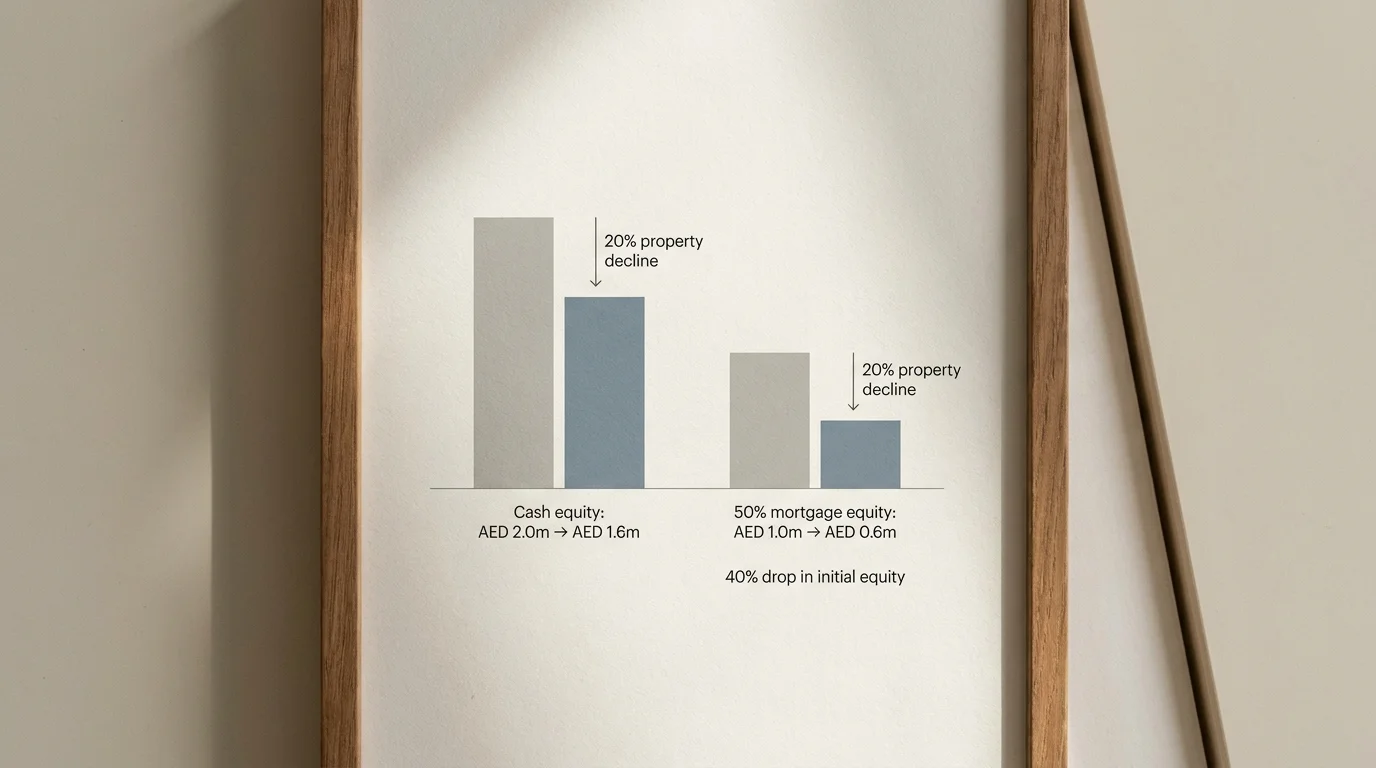
Applying a stress test to both scenarios exposes the risks of borrowing. Assume you complete the purchase, and six months later, macroeconomic headwinds drive property prices down by 20%. The market value of your asset falls from AED 2 million to AED 1.6 million.
If you paid cash, your equity drops from AED 2 million to AED 1.6 million. You have experienced a 20% paper loss on your invested capital, but your daily cash flow remains unaffected. You can continue renting the property and wait for the market to recover without facing any pressure from a lender.
If you took the 50% mortgage, the asset is still worth AED 1.6 million. However, your loan balance remains roughly AED 980,000. Your remaining equity in the property is now AED 620,000. Your initial AED 1 million investment has suffered nearly a 40% loss in value. Despite this severe drop in your personal equity, the bank still requires its AED 7,900 payment every single month. If the market downturn also depresses rental rates, you may find yourself subsidizing the mortgage payment out of your retained reserves.
These calculations highlight why I rely on a structured, five-stage approach to evaluate property investments: Diagnose, Align, Prepare, Execute, and Steward. I begin by diagnosing your specific liquidity needs, risk tolerance, and time horizon before looking at inventory. I align those goals with downside pricing models to ensure you can survive a market correction. I prepare a detailed financial model that incorporates the exact lender terms available to you, rather than theoretical averages. I execute the transaction with clear exit parameters, and I steward the asset post-purchase to monitor yields and financing efficiencies over time.
Applying the ADVICEdge framework ensures I evaluate these metrics objectively, placing your liquidity and holding parameters ahead of available inventory.
Which Route Fits Your Situation?
Your decision ultimately rests on your capacity to handle rigid monthly obligations and your ability to generate returns on retained capital.
A cash purchase fits an investor who values freedom from scheduled loan payments and lower monthly fixed costs. If you lack a compelling alternative use for your capital, paying cash avoids the contractual expense of mortgage interest. It suits buyers who prioritize a high net operating income over maximizing their return on equity. It is also the necessary path for investors who cannot secure favorable loan terms due to their residency status, age, or income structure. However, this route only works if you can deploy the full purchase price while still maintaining adequate emergency reserves in your broader portfolio. Draining your global liquidity to buy an apartment outright can leave you exposed to personal financial shocks.
A mortgage fits an investor who has a defined, credible use for their retained capital. If you run a business that generates a 15% return on working capital, liquidating those funds to avoid a 5% mortgage rate destroys value. Financing also suits investors seeking to diversify. Using AED 4 million to acquire two AED 4 million properties at 50% LTV spreads your risk across different neighborhoods and tenant pools, whereas paying cash forces you to concentrate the entire AED 4 million in a single asset.
This financed approach requires solid downside capacity. You need the cash flow to service the debt uninterrupted during a three-month vacancy, and the psychological tolerance to watch your equity shrink rapidly during a market correction. If you already hold a property-heavy portfolio, taking on another mortgage increases your overall concentration risk. In that scenario, paying cash might provide necessary stability to your broader asset allocation.
If neither option looks comfortable, perhaps because a cash purchase drains your reserves while a mortgage payment relies on uninterrupted premium rent, the correct decision is often to wait or reconsider the size of the investment.
Questions to Resolve Before Signing
Before committing a deposit to a seller or a developer, establish the exact terms a lender is prepared to offer. Regulatory ceilings alone won't tell you how much financing you'll receive.
Your LTV, down payment, and tenor depend on your specific passport, residency status, and property type, so the regulatory ceiling may not apply to your application. The offer should also specify the interest rate structure, including the length of the fixed period, the EIBOR tenor used for the variable phase, and the margin the bank adds to that baseline. A payment calculation using the lender's mandated stress-test rate can show whether your income supports the higher figure.
A complete schedule of bank processing fees, mandatory valuation charges, and life insurance premiums will clarify the total cost of the loan. The early-settlement terms also matter, particularly if you plan to sell the property or refinance in five years, because they set out the penalty for ending the loan early.
Your closing-cost budget should account for how the sale contract allocates the 4% property registration fee, along with the 0.25% mortgage registration fee and associated service-partner charges.
If you are acquiring properties in Dubai Marina on the secondary market, the process is straightforward: the bank values the existing unit and disburses funds upon transfer. Off-plan acquisitions require a different analysis. Comparing the developer's Sales and Purchase Agreement (SPA) payment schedule against the bank's disbursement timeline is necessary. Lenders typically step in to fund construction milestones after you have paid a substantial portion of the price from your own funds. Testing whether your cash flow can cover the developer's early payment demands before bank financing begins, along with loan interest during construction before rental income starts, helps prevent funding shortfalls.
Comparing a direct cash acquisition against a documented mortgage offer allows you to structure an investment that aligns with your risk tolerance. Testing these financing models against your own liquidity needs ensures the asset serves your long-term portfolio rather than straining your monthly reserves.
Book a no-obligation intro call with Ritu Kant Ojha Real Estate Advisory, and note that I personally work with every client.
Ask Ritu Kant
Have a question about your purchase? Ask me directly.
Tell me what you are considering. I read every message myself and reply within one working day.