
Completing a Dubai property transfer requires securing two distinct clearances before booking a registration trustee. The seller must obtain a developer or management No Objection Certificate (NOC) and a bank liability letter to release any existing mortgage. Under Executive Council Resolution No. 30 of 2013, the final sale registration fee is 4% of the contract value.
For overseas buyers executing transactions in 2027, treating these clearances as a single administrative step often leads to expired bank letters, delayed transfers, and wasted trips to the UAE. This article outlines how to run the property clearance and mortgage settlement tracks in parallel, preventing third-party delays from unravelling your cross-border acquisition.
Secure Property and Mortgage Clearances Before Booking a Trustee
Overseas buyers often treat the property transfer as a single administrative hurdle. I have seen investors sitting in London, Singapore, or Mumbai assume that once the seller secures a No Objection Certificate, the transfer is ready to book. That assumption can lead to stalled transactions, expired bank liability letters, and wasted trips to the UAE. The property clearance confirms that the developer or the building’s management company has no financial claims against the unit, and the mortgage clearance confirms that the mortgage has been settled and the bank is ready to release its legal security over the title. Neither document substitutes for the other.
I see transactions delayed for weeks because a buyer focused entirely on the developer clearance while ignoring the seller’s unreleased mortgage. I coordinate a transfer by aligning the validity period of the property clearance certificate with the bank’s settlement terms. A trustee office cannot proceed with a blocked title deed simply because one of the two clearances is ready. By planning these dependencies from the start, I help a remote buyer avoid transferring large sums of currency prematurely or missing the closing window.
Confirm the NOC Route for This Building
I do not assume that one clearance process applies to every Dubai resale. The issuing authority depends on the property type, the specific community, and how the building is managed. The Dubai Land Department sale-registration page lists an e-NOC from the developer for freehold areas. This developer-issued document confirms that the master developer has no outstanding claims, penalties, or unapproved alterations registered against the property.
Many ready properties managed by owners’ association management companies follow a different path. For units where owners receive service-charge invoices through the government’s Mollak system, the Dubai Land Department maintains an electronic alternative. The Electronic No Objection Certification (eNOC) FAQs describe a narrower electronic route for these eligible requests. I do not treat that specific route as a general substitute for a developer NOC. If a building falls outside the Mollak-integrated electronic system, the seller must apply directly to the developer or the management company using their specific portal, application forms, and procedures.
I advise the parties to confirm the exact route in writing before signing the contract. The seller needs to establish who issues the clearance, which application portal applies, what supporting documents are required, and the exact fee structure. The certificate will carry a strict expiry date, often 15 to 30 days from issuance, meaning the seller must apply and pay for a new certificate if the transfer is delayed. I ask remote buyers to establish the building's specific process well before a planned transfer, rather than discover it two days beforehand. If a developer requires the seller to settle a district cooling account before issuing the clearance, that creates a new third-party dependency. I check the exact issuer for the specific tower or villa community immediately to establish the correct timeline.
The published timeframe for an eligible eNOC request sits at three to five working days. This figure applies only to the specific electronic service detailed in the undated DLD document accessed on 23 October 2026, which represents the latest available data. It does not represent an end-to-end transfer estimate for the entire transaction. A manual request in a non-integrated community can take considerably longer, particularly if the management company requires physical property inspections or separate utility clearances before approving the application.
Settle Service Charges and Reconcile Credits
I cite Dubai Law No. 6 of 2019 for its stated scope: it applies to all Master Projects and Jointly Owned Real Property in Dubai and defines service charges as annual charges collected from owners to cover the cost of management, operation, maintenance and repair of jointly owned real property.
I recommend obtaining a current, itemised statement directly from the relevant management entity. A seller might present an old payment receipt or offer a verbal assurance that their account is clear, but neither is sufficient for a buyer planning a remote acquisition. An itemised statement shows the exact balance on the day the clearance is requested, including any late payment penalties or special levies approved by the owners’ committee.
I treat service-charge arrears as distinct from separately billed utility, cooling, or community master charges. A clear statement from the building management does not mean the district cooling account is settled. Buyers must identify each invoice issuer and the basis of the charged amount. A separate bill for chilled water capacity creates a distinct liability. A final electricity bill from DEWA does not serve as proof that the building management has cleared the property for transfer.
I also check whether a seller has prepaid service charges for a period extending beyond the transfer date. These prepaid amounts require a contractual reconciliation between the buyer and the seller. The seller will want a credit for the days they have paid for but will no longer own the property. I recommend agreeing on the cut-off date and the exact calculation method in writing within the initial agreement. There is no universal Dubai Land Department apportionment formula that automatically calculates this credit at the trustee office.
An early itemised statement shows whether the account is clear and allows the transaction to move forward. Stale evidence or outstanding charges will delay or prevent the disposal where the jointly owned property rules apply. If the seller disputes a late fee with the management company, the application will stall until the dispute is resolved or the fee is paid.
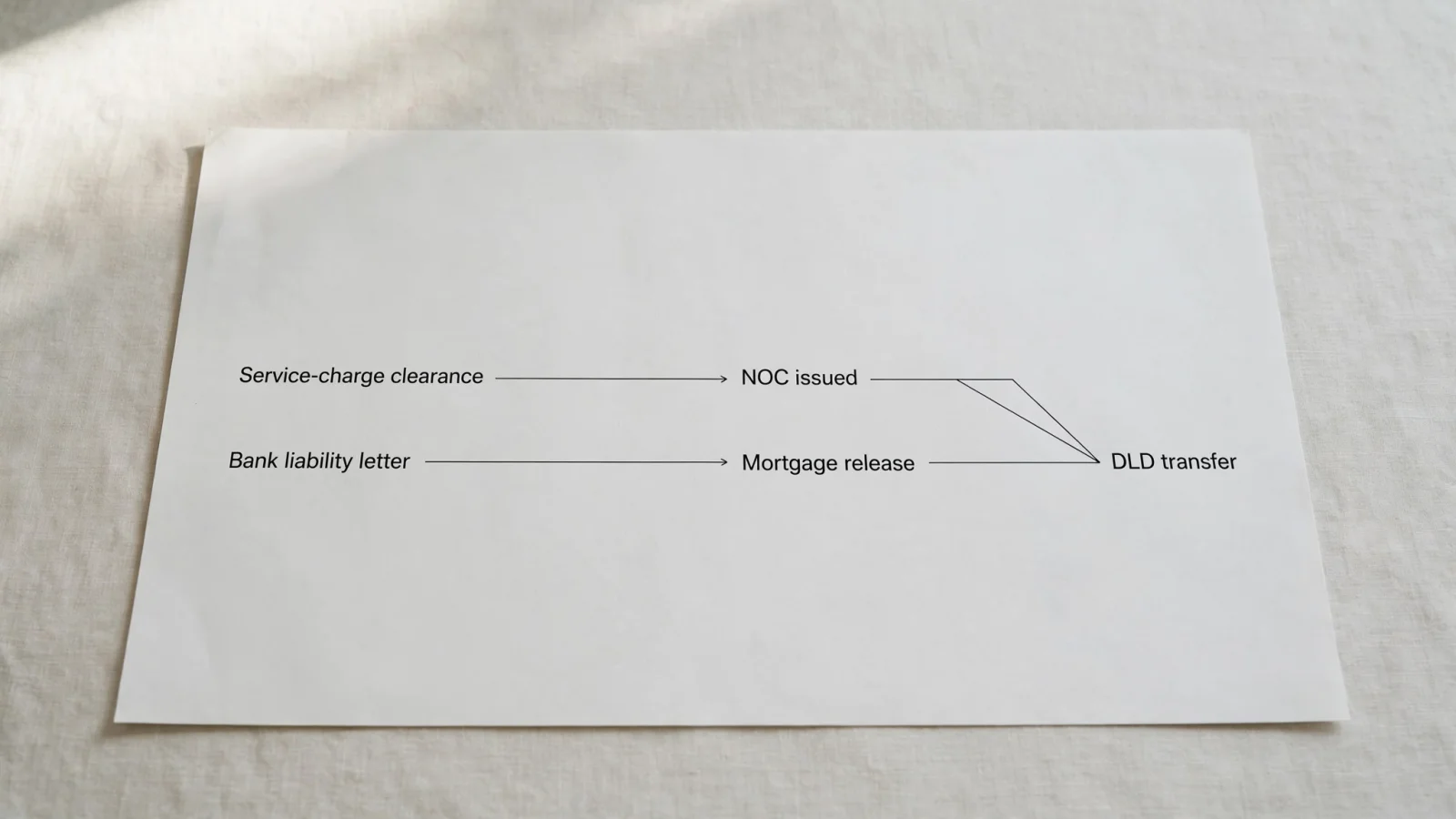
Process Mortgage Releases as a Separate Registration Track
I treat a resale involving a mortgaged property as a coordinated settlement sequence. A developer clearance approval does not release the lender’s security over the title deed. The seller’s bank holds a legal block on the property. The registration trustee will not record a new owner until that block is formally removed.
The official sequence requires the seller to obtain a bank liability letter. This document states the exact amount required to settle the mortgage, calculated up to a specific validity date. The buyer then prepares the manager’s cheques listed for the debt, any remaining seller proceeds, and the required registration fees. In the published DLD sequence, the bank-indebtedness cheque is delivered to the seller after the initial audit at the trustee office.
The mortgage-release letter is then submitted before the department completes the release, registers the sale, and records any new buyer mortgage. The specific mechanics of handing over the settlement cheque and receiving the release letter vary by lender. Some banks send a representative to the trustee office to exchange the release letter for the manager’s cheque in person. Others require the cheque to be deposited at a specific branch, after which they process the release electronically through the government system over several days.
I instruct buyers to confirm the specific lender and trustee instructions before agreeing on a completion date. The reviewed regulatory material provides no universal bank-release lead time. A bank might take two weeks to issue a liability letter and another week to process the final release. If a buyer is financing the acquisition with their own mortgage, the two lenders must coordinate the settlement and the new security registration. I establish this communication early to prevent a late change to the proposed transfer date. An expired liability letter forces the seller to request a new one, which restarts the timeline and may require the buyer to cancel and reissue their manager’s cheques at an additional cost.
Set a Completion Date Around Verified Dependencies
I set the completion date only after checking the title status, the correct clearance issuer, a dated service-charge statement, the seller’s mortgage status, and written requirements from the relevant bank. The earliest available trustee slot remains irrelevant if the bank settlement is not ready. A realistic date requires mapping these dependencies before signing the contract.
| Milestone | What I would verify | Why it affects the date |
|---|---|---|
| Before agreeing a completion date | Confirm the property is completed and title-deeded. Identify the NOC issuer and route. Check whether the title is mortgaged. Request a current service-charge statement. | The parties need to know which clearances apply before they promise a date. |
| When signing Form F | Record who will obtain the NOC, who pays its fee, who settles outstanding charges, how a seller mortgage will be cleared, how prepaid service charges will be apportioned, and what happens if a bank or management company is delayed. | A target date without a delay mechanism can leave a remote buyer exposed to a preventable dispute. |
| After signing, when the required documents are available | Start the NOC request and bank-liability-letter process in parallel. Ask the management company or developer for its current application checklist and an itemised account statement. | The NOC and bank are separate dependencies; waiting for one before asking about the other can waste time. |
| Before booking the final transfer | Confirm the NOC or eNOC is issued and valid for the proposed appointment. Confirm the lender’s settlement instructions and release sequence. Check that buyer funds, identification and any POA are ready. | A booking is useful only if the documents and payment route will still be valid on that date. |
| At transfer and handover | Complete the relevant DLD/trustee process. Record any agreed credit for service charges paid in advance and settle utilities or other final accounts separately. | Dues needed for transfer are different from an agreed adjustment for a future period already paid by the seller. |
I start the clearance and bank-liability-letter requests in parallel to save time, provided the seller understands both tracks. An unverified dependency will force the date to move. This delay frustrates buyers who have arranged travel, currency transfers, or moving companies.
Document Responsibility and Delay Terms in Form F
The standard Memorandum of Understanding, known as Form F, governs the transaction timeline. I advise buyers to document the exact responsibilities for every dependency in the contract or a bespoke addendum. The agreement must state who applies for the clearance certificate and who pays the associated fee. It must specify who is responsible for clearing confirmed property amounts, such as district cooling arrears or master community levies.
For a mortgaged property, I recommend that the contract outline the seller’s mortgage settlement and release steps. If the buyer is also using a mortgage, the agreement requires a clear buyer-mortgage condition detailing the timeline for final approval and property valuation.
I also ask the parties to address how prepaid service charges will be apportioned. Without a written agreement on the calculation cut-off date, the seller may refuse to transfer the property unless the buyer reimburses them for the remaining months of the year at the trustee office.
I ensure the contract includes an extension or long-stop mechanism if a bank or management company causes a delay. A third party’s processing time sits outside the buyer’s control. If the seller’s bank takes three weeks to issue a liability letter, a rigid 30-day completion clause will expire before the transfer can happen. A mutual extension clause prevents the contract from lapsing due to administrative friction.
Read Published Timings and Fees Narrowly
I caution buyers against reading published processing times as an end-to-end estimate. The DLD service page lists a 25-minute sale-registration service time. This refers exclusively to the final appointment at the registration trustee office, where the pre-approved documents are processed and the new title deed is issued. It does not measure the full transaction.
The stated eNOC figure of three to five working days applies only to eligible electronic requests submitted through the integrated system. It does not cover the time required to settle arrears, coordinate a bank liability letter, or resolve a blocked title. The reviewed regulatory pages give no combined NOC-to-transfer estimate. Every transaction runs on its own critical path based on the specific encumbrances attached to the property.
I use the schedule and Article 3(1) of Executive Council Resolution No. 30 of 2013 together: the sale registration fee is 4% of the sale contract value and, unless the parties agree otherwise, the seller and purchaser share it equally. I advise recording any different allocation in the contract, as Article 3(1) recognises an agreed alternative.
At Proact Luxury Real Estate, where I am CEO, I work on managing this entire sequence. I diagnose the title deed, verify the outstanding dues, identify the exact clearance route, and confirm the lender requirements. I then align on a completion window. I map these dependencies into a documented critical path and a clear responsibility list for the buyer, building the completion date around verified facts rather than optimistic assumptions.
This methodical approach reflects the ADVICEdge framework: alignment, depth, voice, integrity, and compassion. I provide the depth necessary to see a blocked mortgage before it stalls the transfer. I maintain the integrity to tell an overseas buyer when a proposed date is unrealistic. I offer the ADVICEdge Advisor Check for readers seeking an objective evaluation of their transaction plan and a way to measure their current representation.
I prioritise the buyer’s long-term portfolio health. I represent your interests, and my Trust & Disclosures framework dictates that I map downside scenarios alongside projected yields. I cannot control a third party’s processing time, but I ensure my clients never face a delayed transfer without a contractual remedy.
I often see NRI families assume that their local broker will handle the bank clearance. Real estate agents are not authorised to negotiate with a seller's bank. The seller must initiate the liability letter request personally. I diagnose the debt status on day one and require the seller to prove they have initiated the bank request before I let my buyers transfer the deposit. I steward the process by monitoring the validity dates of both the bank letter and the clearance certificate, ensuring they overlap on the day of transfer. I examine how these timelines affect portfolio exit strategies in my analysis on selling property in Dubai.

Confirm Scope and Attendance Before Booking
I verify the property type and the parties’ ability to attend the trustee office before making the final booking, as these dictate which transfer route applies and which documents are mandatory. I check both the legal nature of the property and the physical location of the buyer and seller. A remote transaction introduces strict documentation rules that I clear well before the target completion date.
Manage Off-Plan Assignments Through a Separate Process
Ready, title-deeded resales dictate the timeline discussed above. I treat selling a property under construction as a different legal transaction entirely. The official framework describes the off-plan resale before transfer to the land register as a separate process. This transaction requires a distinct developer clearance and follows the Interim Property Register route established under Dubai Law No. 13 of 2008.
An off-plan resale depends heavily on the developer’s specific sales and purchase agreement. I do not apply a universal minimum payment percentage required before a developer permits a resale. That threshold remains contract-specific. Some developers require 30% of the property value to be paid, while others demand 40% or more.
When addressing transfer charges for an off-plan assignment, I rely on the legislation’s specific wording. The published text of Article 7 in Law No. 13 of 2008 permits developers to charge only DLD-approved administrative costs on the sale or resale of completed or off-plan units. I advise verifying the approved administrative amount for the specific case with the developer rather than relying on generic online estimates. The clearance process for an off-plan unit often takes longer than a ready-property transfer because the developer must draft a new sales and purchase agreement for the incoming buyer and verify the source of funds for the assigned payments.
Confirm Passport and Power of Attorney Requirements
Overseas NRI buyers often ask if they must fly to the UAE to sign the final transfer papers. The official sale-registration page confirms that a valid passport is accepted for a non-resident foreigner. The department’s FAQ states that an owner may act through a duly legalised power of attorney.
I advise clients to confirm the exact wording, authentication steps, and document format with the selected trustee before signing Form F, sending original documents across borders, or arranging funds. A power of attorney drafted in London, Toronto, or Singapore must be notarised locally, attested by the UAE embassy in the country of origin, translated into Arabic, and finally attested by the Ministry of Foreign Affairs (MOFA) in the UAE. This attestation chain can take weeks. If the power of attorney lacks specific clauses granting the representative the right to sign the transfer forms and receive manager’s cheques, the trustee will reject it.
Digital transfer options exist, but they have strict limitations. The Dubai Now sale service offers a digital execution route limited to individuals holding a valid UAE ID. Properties with mortgages or other legal restrictions are excluded from this digital service. An overseas party cannot always complete a transaction digitally from a smartphone. A buyer sitting in California without a UAE residency visa cannot use the Dubai Now app to buy a mortgaged villa in Dubai. They must rely on a fully legalised power of attorney or travel to attend the trustee office in person.
For remote buyers, I use accurate data to calculate realistic net yield and assess the holding period. For investors deciding whether a specific community aligns with long-term rental demand, I recommend cross-referencing area data in my RERA Rental Index Dubai calculator guide. A yield analysis means little if the initial acquisition is delayed by months due to poor document planning.
I structure the remote-party checklist around these critical verifications:
- Confirm the property type and identify the exact clearance issuer.
- Obtain a dated service-charge balance and verify what has actually been paid.
- Map the exact mortgage sequence if a bank holds the title.
- Verify the manager’s cheque requirements with the designated trustee.
- Confirm the attendance format and initiate the power of attorney attestation immediately.
- Agree on the contractual remedy if a third-party clearance is late.
I manage a cross-border acquisition by controlling the variables I can see and building contractual protection against the ones I cannot. Indian tax implications, FEMA compliance, and repatriation rules dictate how an NRI buyer structures their funds, but they do not alter the Dubai Land Department’s sequence. The property must clear its local debts, the bank must release its hold, and the documents must meet the trustee’s standard.
Planning the completion date around these verified dependencies ensures the transfer executes as a planned financial transaction rather than a logistical crisis. I personally work with every client at Ritu Kant Ojha Real Estate Advisory to verify these legal dependencies and manage the acquisition process on your behalf. Book a no-obligation intro call.
Ask Ritu Kant
Have a question about your purchase? Ask me directly.
Tell me what you are considering. I read every message myself and reply within one working day.