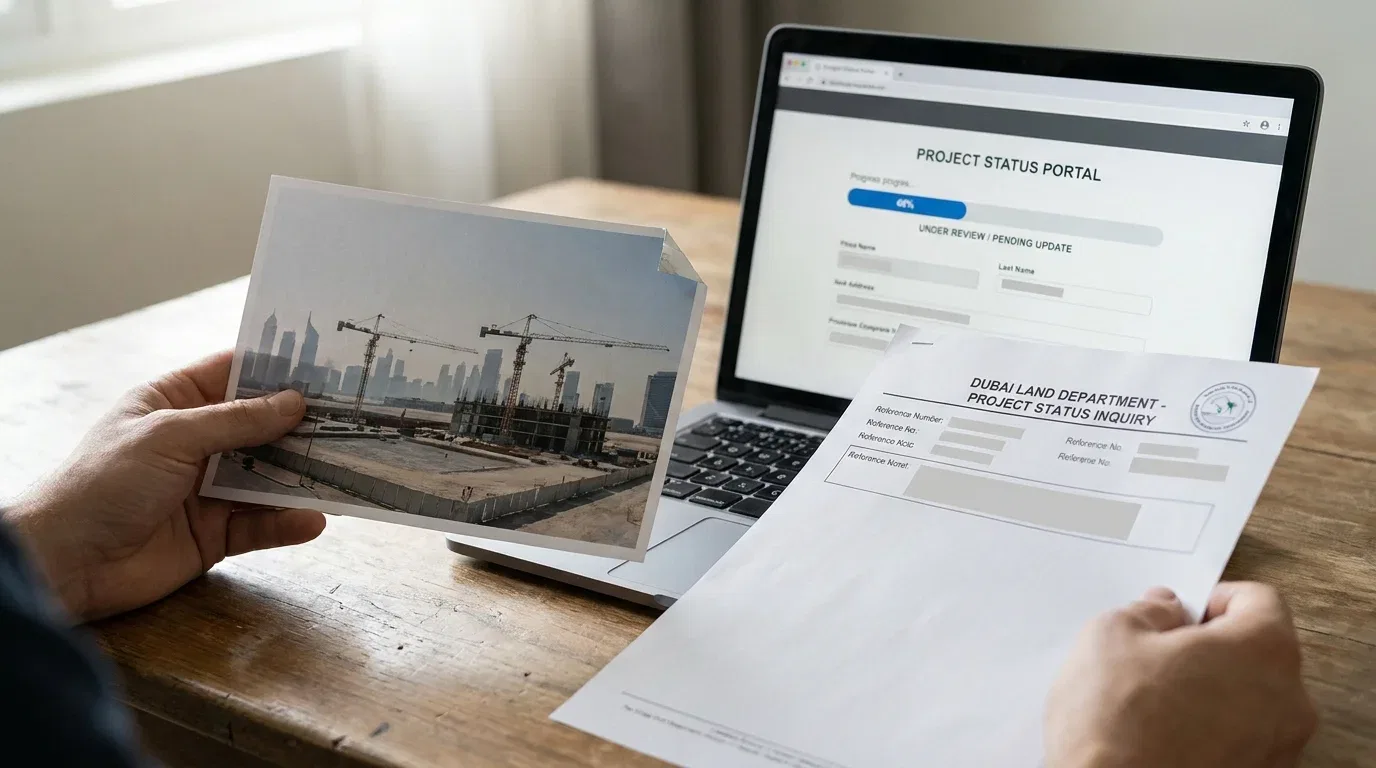
A quiet Dubai construction site does not guarantee a refund. Under Decree No. 33 of 2020, an unfinished development remains legally active until the Real Estate Regulatory Agency (RERA) issues a formal cancellation decision. Only after publishing this reasoned decision does the Dubai Land Department initiate the statutory liquidation process to return verified escrow funds.
For overseas buyers allocating capital in 2027, distinguishing between an operational delay and a formal cancellation prevents costly legal missteps. Assuming a stalled project automatically voids your Sales and Purchase Agreement can trigger default penalties and capital forfeiture. This article shows how to verify a development's official regulatory status, compile the required payment evidence, and work through the statutory recovery paths.
I Do Not Equate a Stalled Site with Cancellation
A quiet construction site does not, by itself, legally end a buyer’s Sales and Purchase Agreement. I begin by distinguishing a delayed schedule from a formal termination, since the agreement remains binding until the regulator formally intervenes and changes the project’s status.
Developers experience disruptions for diverse operational reasons, including supply chain bottlenecks, disputes with main contractors, municipal permitting revisions, or unexpected infrastructure adjustments. While such difficulties cause severe project delays, they do not automatically trigger the legal demise of the development. If a buyer acts rashly by terminating payments without regulatory approval, they risk placing themselves in contractual breach under Law No. 13 of 2008 and its subsequent amendments, which can lead to statutory default notices and the lawful forfeiture of invested capital.
I help buyers distinguish an operational halt from a formal cancellation, because each category of distressed asset carries different legal implications and administrative routes.
Stalled or Unfinished
Decree No. 33 of 2020 defines an unfinished project as one where construction commenced and subsequently stopped, meaning it retains a distinct legal standing from a formally cancelled development. The Dubai Land Department, through RERA, monitors sites displaying low progress and contacts the developer to establish the reason for the stoppage. If the developer fails to provide an adequate explanation, RERA then begins administrative procedures that might eventually lead to cancellation. During this monitoring phase, the Special Tribunal can consider assigning the completion of the structure to another developer. An unfinished designation means the regulator is managing the asset, which does not automatically result in returning capital to buyers.
RERA maintains dedicated technical inspection units that assess the physical status of building sites across Dubai. When inspectors register a lack of progress over consecutive cycles, the regulatory authority issues formal inquiries requiring the developer to show cause for the disruption. The developer might be granted a structured timeframe to resolve contractor disputes, refinance their construction obligations, or submit revised architectural plans. During this interim window, the master contract and the individual unit agreements remain intact.
If the developer fails to rectify the default, the file may be referred to the Special Tribunal established under Decree No. 33 of 2020. This judicial body holds broad authority to evaluate the commercial viability of the building. The tribunal can decide that the project is structurally viable and financial restructuring is possible, subsequently transferring the master title and development rights to a rescue developer or an institutional asset manager. Under this scenario, the buyer’s initial contract is preserved, the building moves forward toward physical completion, and the prospect of a cash refund ceases to be the active outcome.
Under Cancellation and Formal Decisions
The public portal often labels a distressed project as being under cancellation, which is a pre-final procedural stage that does not allow an individual buyer to terminate their contract on their own. The DLD states clearly that it cannot terminate an SPA at the buyer’s request while a project remains uncancelled. A final reasoned RERA decision changes the legal standing of the development entirely. Until the department publishes that final decision, the buyer remains bound by their contract unless a competent court rules otherwise. An investor facing severe liquidity pressure during this interim stage occupies a difficult position, since attempting to walk away from an active contract risks default penalties.
During the under-cancellation stage, the Dubai Land Department conducts internal administrative and financial evaluations. This review period allows the developer an opportunity to submit formal objections, present emergency financing facilities, or conclude consensual settlements with aggrieved purchasers. It also permits the authorities to determine whether the developer holds enough unencumbered assets to meet their winding-up obligations.
Because the project has not formally transitioned to a cancelled state, the escrow accounts remain managed under restrictive protocols rather than active liquidation mode. A buyer who contacts their bank or submits complaints to overseas consumer forums during this phase often finds that no administrative body can issue a refund order until the final decree is issued. At this stage, I recommend checking the official portal weekly and waiting for the final decision before taking steps that assume a refund is available.
Developer-Requested Cancellation
Sometimes a developer chooses to abandon a launch before heavy construction begins, prompting them to use a specific DLD service called Project Cancellation Upon Request. The developer must settle all investor claims and submit a comprehensive financial report to the department. The rules require at least 15 days to pass since the developer's last cancellation announcement before they can file the request. When the DLD accepts this filing, the department issues a project deregistration certificate. That certificate proves the developer closed the project legally, but it does not serve as proof that any individual overseas buyer has received their funds in their home bank account.
This procedure typically arises in cases where off-plan sales fail to reach commercial thresholds, or where master developers alter the master plan of an entire precinct, rendering a proposed tower obsolete. The developer must follow strict advertising and notification guidelines. They must notify all registered buyers in writing and publish public announcements in local newspapers to give interested parties an opportunity to record their claims.
Even when the developer presents proof of settled accounts to the DLD, administrative discrepancies can occur. An overseas buyer who relocated, changed email addresses, or failed to update their international telephone numbers might miss the initial notification period. Therefore, seeing that a developer has applied for voluntary deregistration should prompt the purchaser to present their original payment receipts and request formal written confirmation of their settlement status from both the developer and RERA.
How I Verify Dubai’s Official Project Status
My first action is to verify the official DLD record, because I prefer regulatory facts to broker updates or developer emails. In Dubai REST, I open the Mashrooi project status service and search by project name or project number. I then export the result. Through the Dubai Land Department's Project Status Enquiry, I check the project status, completion details, remarks, and the date comments were last updated. I note that the site itself was last updated on 10 November 2026, which represents the latest available data, so I ask remote buyers to check the live record and date their own printout to keep a dated record of what they reviewed.
The Mashrooi interface acts as an objective baseline for all future communications. It strips away promotional rhetoric and reveals the unvarnished engineering record compiled by RERA’s site inspectors. When I inspect this page for a client, I examine the inspection notes carefully. If the report records that foundation work stopped at twelve percent and that three consecutive inspections recorded zero progress, I have empirical evidence of a stalled project, giving my advisory team a firm platform for regulatory engagement.
The public page lists developer details alongside the escrow bank and account fields. I remind clients that this public display obscures the current escrow balance. Seeing a named bank fails to establish how much cash remains available for distribution, so I follow the public record check with private verification. I request the final RERA decision number, the decision date, the current procedural stage, and the audit status. I need to know the exact recorded claim amount associated with the buyer's unit, checking whether the file carries a specific tribunal or liquidation reference. Formulating any request for capital requires building an unassailable picture of the regulatory position first.
A buyer who relies solely on public search tools must understand their limits. Mashrooi provides transparency regarding completion percentages and municipal compliance, but it does not reveal the developer’s private debt obligations, pending subcontractor liens, or internal account reconciliations. To gain actionable clarity, I guide the client through submitting a formal enquiry via the DLD’s official communication channels.
In this submission, we state the registered unit number, the title registration identifier, and the exact project code, asking RERA to clarify whether the project has been referred to the liquidation committee or the Special Tribunal. This multi-layered approach ensures that our advisory assessments rely on documented facts rather than speculative commentary.
Statutory Refund Rules Following Formal Cancellation
The statutory route to recovering capital follows a reasoned RERA cancellation decision. A desire to leave an active SPA because of personal financial pressure does not trigger these specific legal protections. A buyer facing a household liquidity crisis while a project is active faces a different challenge entirely, often requiring an analysis of distressed off-plan assignments in Dubai to find a replacement buyer. For formally cancelled projects, the law outlines a distinct recovery path.
The UAE legal structure governing off-plan real estate has evolved systematically over the past two decades. What once involved ambiguous civil dispute resolution is now anchored in codified statutes that define the responsibilities of the master regulator, the developer, and the financial institutions hosting escrow accounts. When a formal cancellation order is signed by RERA leadership, it activates a defined legal sequence designed to protect consumer deposits.
RERA Cancellation and Statutory Refund Duties
Law No. 19 of 2017 amends the earlier interim property register framework and stipulates that when RERA cancels a project by a reasoned decision, the developer must refund purchaser payments. These procedures follow the rules established in Law No. 8 of 2007. I explain the exact sequence laid out in Articles 25 through 27 of the Executive Council Resolution No. (6) of 2010. First, RERA prepares a technical report explaining the cancellation and notifies the developer. The regulator then appoints a certified auditor to verify the amounts paid to the developer or deposited directly into escrow, alongside checking the legitimate project expenditure.
The auditor forensically examines the entire project ledger to reconcile the total deposits in the escrow account against the certified construction progress. If the developer claimed 30 percent completion and withdrew funds accordingly, the auditor verifies that 30 percent of the physical structure exists. Article 25 states that RERA must request the escrow agent or the developer to refund the verified amounts within 14 days of the cancellation decision.
Should the escrow funds fall short of covering the total owed to purchasers, Article 26 shifts the burden, requiring the developer to pay the outstanding amounts within 60 days of the cancellation decision, subject to approved extensions. If the developer fails to pay within the mandated timeframe, Article 27 allows authorities to take steps to protect purchaser rights, including referring the matter to competent judicial authorities. I outline these laws to show that the system relies on built-in escalating mechanisms.
The appointment of an external accounting firm under Article 25 is a critical procedural safeguard. This financial audit prevents developers from fabricating overhead costs or manipulating ledger entries to avoid their obligations. The auditor cross-references every payment voucher against bank statements from the designated escrow institution.
If discrepancies emerge between the cash received from buyers and the funds actually deposited into the project escrow account, the auditor highlights these irregularities in their official report to RERA. Such findings can expose the developer to direct personal or corporate liabilities under UAE commercial laws, giving the authorities clear justification to pursue escalating remedies under Article 27.
Special Tribunal Referrals
Moving beyond RERA's administrative processes, Decree No. 33 of 2020 grants the Special Tribunal jurisdiction over claims concerning unfinished and cancelled projects, allowing them to appoint an auditor to verify purchaser payments and project expenditure. The tribunal can subsequently order refunds of amounts paid into escrow or directly to the developer, although this jurisdiction excludes projects located within the Dubai International Financial Centre. Because referral to the Special Tribunal requires formal transfer, requesting the exact liquidation or tribunal reference number remains a mandatory part of my verification process.
The Special Tribunal operates with comprehensive judicial authority across mainland Dubai and the non-DIFC free zones. It replaced the previous judicial committee established under Decree No. 21 of 2013, expanding regulatory oversight and streamlining the adjudication of complex real estate insolvencies. The tribunal holds the authority to freeze developer assets, order the auction of the underlying land plot, and direct the distribution of liquidation proceeds directly to registered investors.
When a project enters the tribunal framework, standard civil litigation concerning the project is suspended, centralising all claims within a single specialised forum. This consolidation prevents individual creditors from seizing assets to the detriment of general buyers. For an overseas investor, learning that a project has been transferred to the Special Tribunal means their claim is part of a collective judicial settlement. It guarantees an orderly legal process, but it also signals that the final resolution will follow court-supervised timelines rather than rapid administrative payouts.
I Separate Refund Duties from Payment Dates
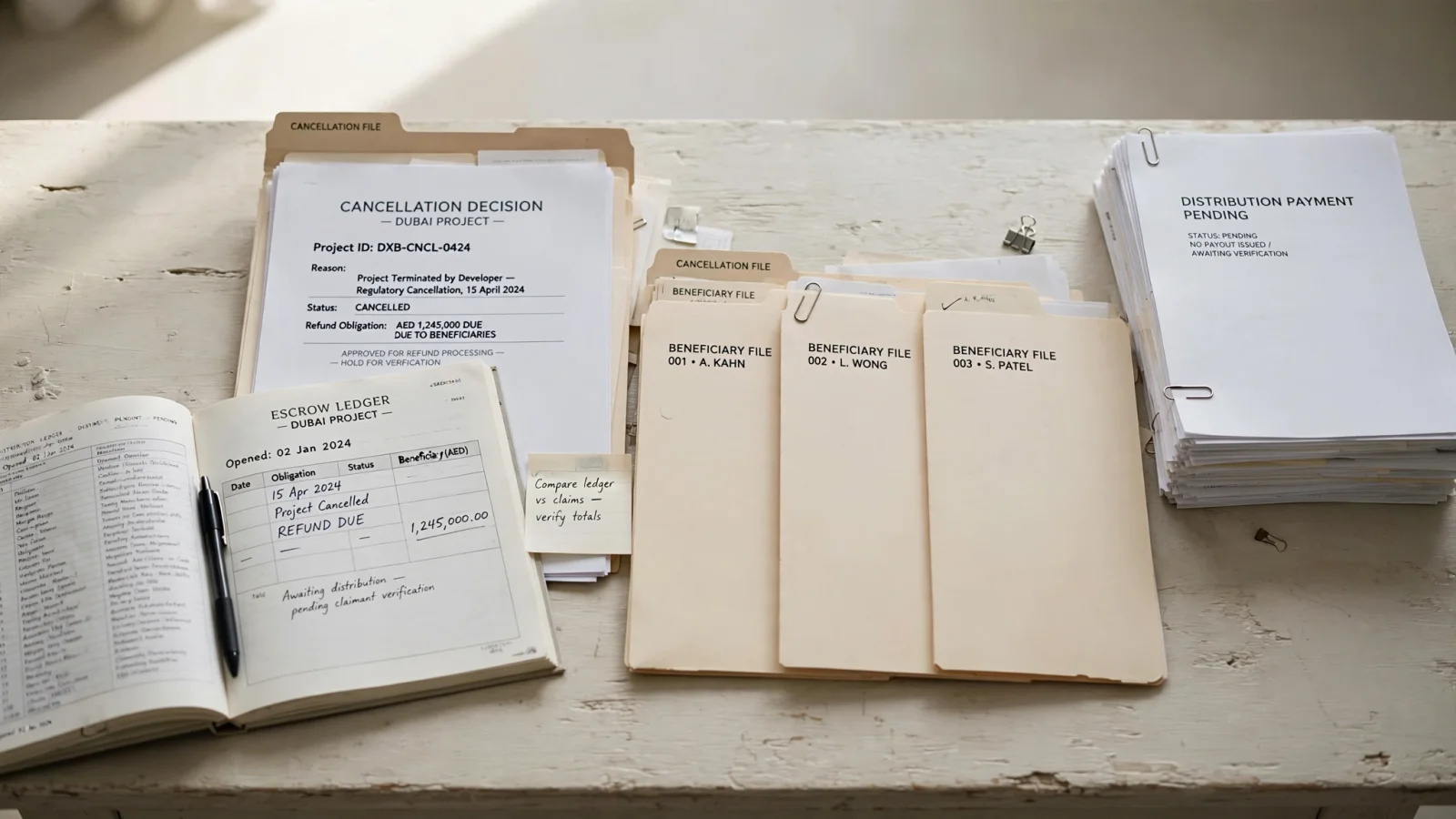
I distinguish the developer's return period from the time a buyer's bank credit takes to clear. I rely on the Dubai Land Department Frequently Asked Questions, which states that after a project is cancelled, the liquidation department requests that the developer return payments to investors within 60 days of the cancellation decision. I note that this period is extended if RERA deems there are reasons to postpone, and I find no bank-clearing timeline in that guidance. I also use the FAQ's liquidation sequence: when a project's status is cancelled, the liquidation section retrieves the amounts from the project escrow account and deposits them in DLD's trust account. I explain that DLD distributes these funds to beneficiaries in full or proportionately, depending on the amount available.
Because the DLD provides no fixed overall timeframe for this liquidation process, projects take their turn, and a legal duty to refund a buyer cannot conjure cash already spent on deep excavation or foundation pouring. The amount owed acts as a fixed legal figure, but the cash available for distribution relies on the physical recovery of assets and the developer's corporate liquidity.
Many buyers misunderstand the role of statutory deadlines. When Article 26 of Executive Council Resolution No. (6) of 2010 mentions a 60-day period for a developer to repay shortfall amounts, it establishes a formal timeline for compliance, not a guarantee of an automated refund. If the developer lacks immediate liquid capital or refuses to comply, RERA cannot instantly generate cash; it must pursue enforcement actions, which take time.
If the developer’s accounts are depleted, the recovery process relies on the liquidation of real assets, including the real estate plot itself, unfinished concrete superstructures, or corporate assets held by the development entity. The sale of large commercial plots in Dubai requires valuation reports, regulatory approvals, and public auction processes managed through official auction portals. Consequently, months or even years can elapse before physical real estate is converted into liquid cash ready for distribution.
Project-specific escrow rules offer a powerful safeguard because Dubai's Escrow Account Law prevents the developer's general creditors from attaching the funds deposited for a specific building. While this ring-fencing ensures that construction capital cannot be drained to cover unrelated corporate debts, escrow alone never guarantees full recovery. If the developer spent 40 percent of the escrow balance on legitimate construction before the project failed, the remaining 60 percent is what moves to the trust account. I avoid promising a date, an exact recovery amount, or a flawless outcome. My role is to clarify the distribution timeline so the buyer can adjust their own household or family office cash flow.
In cases where available capital is insufficient to cover all registered claims, the distribution is executed on a pro-rata basis. Each registered investor receives a proportion of the recovered funds corresponding to their verified contribution to the project.
For instance, if total validated buyer claims reach 100 million Dirhams but the liquidation of the escrow account and the land auction yields only 60 million Dirhams net of administrative costs, each investor receives 60 percent of their validated claim. Preparing a client for this haircut scenario represents honest advisory practice. I encourage buyers to build financial resilience into their plans rather than banking on full recoveries that market conditions cannot support.
What I Ask Overseas Buyers to Collect
Once I understand the public record, I build two parallel evidence tracks covering the project’s official file and the buyer’s specific payment history. I treat this as a practical evidence pack designed to survive rigorous audit, rather than a basic DLD upload checklist.
Auditors appointed by RERA or the Special Tribunal work strictly from documentary evidence. They do not accept informal assertions or unverified debit memos. If an overseas purchaser fails to substantiate an instalment with formal documentation, that specific payment risks being omitted from the auditor’s final reconciliation. Omitting a payment lowers the verified claim figure, permanently reducing the payout amount in a pro-rata distribution.
Official Project and Escrow Records
The first folder contains the dated Mashrooi project-status record and the final cancellation decision, provided RERA has issued one. We add the audit or payment reconciliation document, the buyer’s recorded claim amount, and any active referral or liquidation reference. Law No. (8) of 2007 grants depositors or their representatives the right to access their own accounting records and request copies. Accessing your personal deposit record involves a separate process from demanding to see the project's full public escrow balance. We request the buyer-level ledger from the escrow agent to prove that the funds arrived in the regulated account.
Securing the buyer-level ledger from the escrow bank provides definitive confirmation that the capital reached its designated destination. In some past instances involving distressed developers, rogue sales agents instructed unsuspecting buyers to wire deposits to corporate operating accounts rather than the statutory project escrow account.
Funds deposited outside the regulated escrow account bypass the primary protections of Law No. 8 of 2007, making recovery far more complicated. If the auditor discovers that an instalment went to an unapproved operating account, that sum might be excluded from the escrow liquidation pool, forcing the buyer to pursue a separate civil action against the developer. Confirming that every dirham is reflected in the escrow bank’s internal ledger is an essential due diligence step.
Buyer-Specific Payment and Identity Records
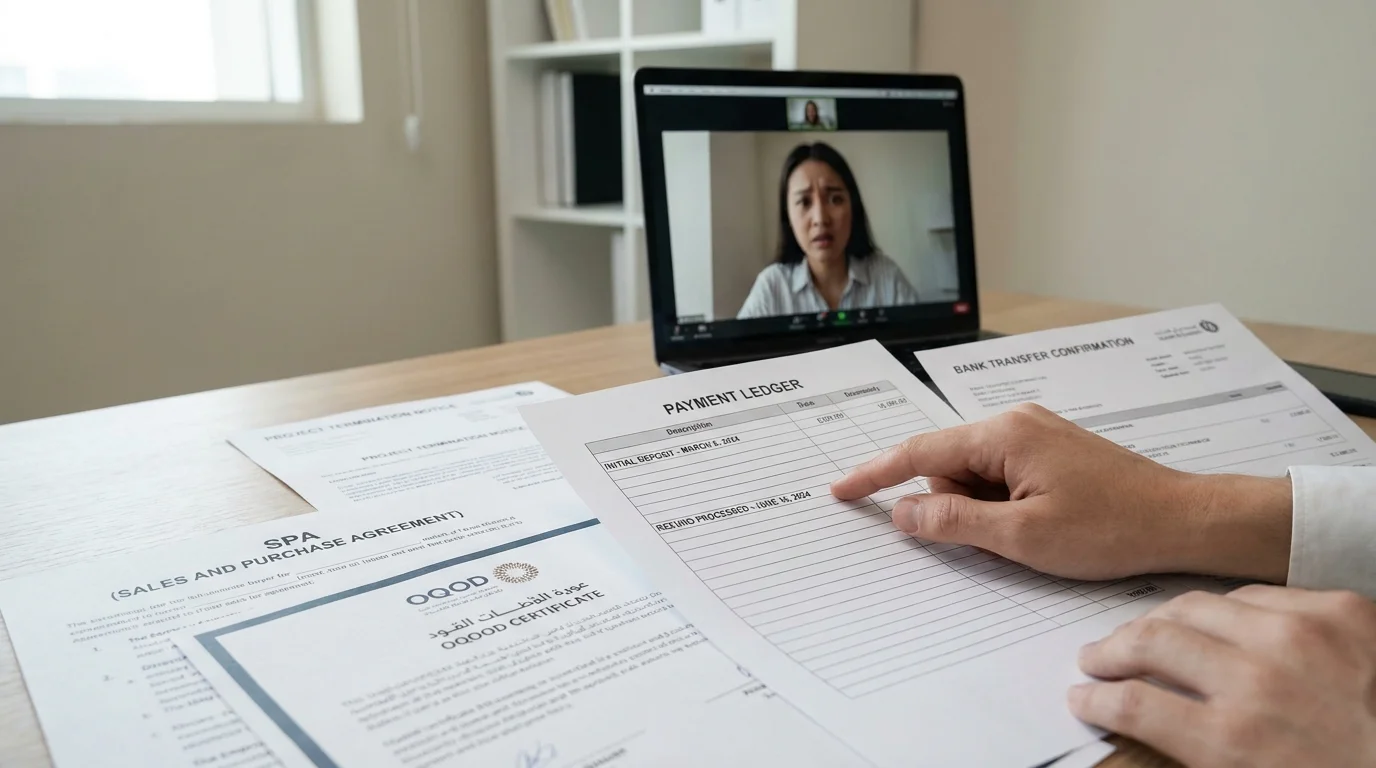
For the second folder containing the contract and financial trail, I instruct the buyer to scan the signed SPA, note the exact unit details, and collate the developer ledger alongside all corresponding receipts. I ask overseas buyers to retain bank and SWIFT transfer records. An international transfer carries specific UTR and SWIFT codes that prove the capital crossed borders and entered the correct account. If the buyer holds an Oqood registration certificate, we include it.
I ask the buyer to build a reconciliation spreadsheet listing every payment date, the transferred amount in the home currency, the cleared amount in UAE Dirhams, the receiving account, and the matching receipt number. The DLD committee guide displays fields for the purchase date, purchase price, and amount paid. The guide lists the SPA and receipts among the required uploads, marking the Oqood certificate as optional. Because app requirements update frequently, I instruct buyers to check the live system requirements before submitting their final file.
Currency exchange rates introduce hidden accounting discrepancies that must be reconciled early. When an overseas purchaser remits funds in US Dollars, British Pounds, Euros, or Indian Rupees, the originating bank converts the capital into Dirhams using retail exchange spreads. If an investor wires 50,000 US Dollars, the developer's bank might credit 183,250 Dirhams after deducting intermediary wire charges.
The buyer's ledger must document these intermediary deductions and establish the exact Dirham figure credited to the developer's account. Failing to reconcile exchange differentials creates minor balance disputes with the auditor, delaying the formal validation of the investor’s profile.
Non-Resident Indians face a compounded problem when a project fails, as they manage a cross-border capital allocation subject to strict domestic oversight. If an Indian national used the Liberalised Remittance Scheme to send funds, the original outgoing transfer carried a specific purpose code. When those funds return years later, the receiving Indian bank will require documentation to explain the incoming foreign exchange. The bank asks for the original SPA, the cancellation decree, and the DLD trust account transfer receipt to verify the capital as a legitimate refund. If a buyer fails to collect the exact SWIFT traces and the RERA audit confirmation, they might secure the payout in Dubai only to have the funds frozen by their home bank pending compliance checks.
Indian exchange regulations under the Foreign Exchange Management Act demand meticulous record-keeping. Under LRS guidelines, remittances sent abroad for property acquisition must be matched against formal capital assets or returned through banking channels if the transaction aborts.
If an NRI receives a cancellation refund into an overseas account and neglects to notify their Authorised Dealer bank in India, they risk regulatory scrutiny regarding foreign asset disclosures and reporting schedules. Having a complete evidence pack showing that the returned capital represents an unearned property deposit rather than fresh foreign income simplifies tax reporting and satisfies banking compliance officers.
High-net-worth families often purchase through corporate structures. If you used an LLC formation in Dubai to hold the off-plan asset, the returned capital must flow back to the corporate bank account, bypassing your personal account. If the family office has since closed that specific corporate account or let the trade license lapse due to the project stalling, they face a severe administrative bottleneck. The DLD distributes liquidation funds exclusively to the registered beneficiary. Reactivating a corporate structure merely to receive a stalled payout adds unexpected costs and delays. I ask my portfolio clients to maintain their holding structures and corporate accounts exactly for this reason, as losing your receiving capability just as the liquidation trust prepares a distribution creates avoidable friction.
Maintaining corporate good standing requires renewing trade licences, filing annual economic substance notifications, and paying registered agent retainers. When an off-plan project stalls for several years, corporate owners frequently question the value of paying annual renewal charges for an entity holding a single distressed asset.
Allowing the trade licence to expire results in frozen corporate bank accounts under UAE Central Bank compliance mandates. If the DLD liquidation trust issues a distribution cheque or initiates an electronic credit to a dormant entity, the transaction is rejected, sending the funds back to the regulatory trust account. The investor is then forced to pay accumulated municipal penalties, reactivate their corporate registration, and re-apply for distribution clearance, consuming both time and capital.
Overseas buyers must directly ask the DLD what identity, contact, bank-detail, and representative-authorisation documents are required for a remote submission. Managing these formalities from abroad requires precision. For Indian nationals, I avoid making broad promises about tax-free treatment or unrestricted repatriation. I direct all remittance and compliance questions to current Indian guidance, the buyer’s authorised dealer bank, or a qualified tax adviser.
Cross-border legal representation introduces another layer of administrative protocol. If an overseas buyer cannot travel to Dubai to sign distribution paperwork, they must issue a formal Power of Attorney.
Under UAE legal standards, a Power of Attorney executed outside the country must be notarised in the buyer's country of residence, attested by the Ministry of Foreign Affairs, certified by the UAE Embassy in that jurisdiction, and subsequently attested by the UAE Ministry of Foreign Affairs before receiving legal translation into Arabic. Attempting to work through this attestation chain at the final hour creates needless panic. Establishing authorised representation early prevents administrative blockages when the liquidation committee begins processing distribution files.
Our advisory practice organises the records and frames the exact questions for the official channels. We avoid claiming private access to regulators, providing legal representation, or guaranteeing a specific financial result. This meticulous approach reflects the ADVICEdge framework. Alignment means matching our work to the buyer's immediate liquidity needs rather than offering false hope. Depth requires building a reconciliation sheet that an auditor cannot reject. Voice means speaking plainly about the difference between a statutory duty and cash in the bank. Integrity ensures we never promise an outcome we cannot control. Compassion drives us to treat the buyer's anxiety with respect, offering honest treatment of uncertainty rather than sales-driven reassurance.
How I Match the Next Step to the Recorded Status
I match the buyer's action directly to the confirmed official status. I refrain from sending aggressive legal demands if the file is marked as unfinished, and I avoid waiting passively for an email if the project is formally cancelled.
Every phase of project distress demands a measured, proportionate response. Taking actions outside the appropriate regulatory sequence wastes money on legal retainers and distracts the investor from tracking practical milestones. I encourage clients to treat the recovery journey as an administrative workflow requiring methodical verification, meticulous record production, and steady communication with the authorities.
If the project is stalled or unfinished, I suggest asking the DLD for the current inspection remarks and inquiring whether the file has been referred for review. I wait for official confirmation before assuming a payout route has begun. For a project marked as under cancellation, I advise the buyer to confirm the exact procedural stage. We ask the department if a final decision is pending. I remind the buyer that they cannot use this interim status to demand the DLD terminate their specific contract.
Premature legal challenges during the under-cancellation stage frequently prove counterproductive. Some litigation attorneys encourage buyers to file immediate civil lawsuits before RERA has finalised its administrative audit.
Filing separate lawsuits while a project is transitioning toward formal cancellation creates conflicting jurisdictional claims and racks up unnecessary court fees. If the project is subsequently transferred to the Special Tribunal, separate civil proceedings are stayed anyway. I advise buyers to reserve their legal budget until the regulatory authorities complete their technical and financial assessments, then seek targeted representation if needed.
For a formally cancelled project, the buyer must confirm the decision date, the completion of the audit, the recorded payment amount, and the liquidation reference. If the developer initiated the cancellation request, I separate the accepted request from the individual distribution process.
I provide buyers with precise, focused questions to submit to the authorities. We ask whether the auditor included direct developer payments alongside the escrow deposits, and if the buyer's paid amount is recorded correctly down to the last dirham. We check whether the liquidated funds have moved to a DLD trust account yet, and identify what specific identity and bank documents remain outstanding for the distribution file.
I understand the personal strain a stalled investment can cause, so I keep enquiries concise and centred on verifiable information. This helps the case handler identify and assess the file.
Our advisory practice sets out the project registration number, the interim title deed reference, the date of the cancellation decree, and the precise banking coordinates for capital repatriation. Presenting an organised file facilitates faster verification by the case handler.
If the DLD record conflicts with the buyer's payment evidence, or if a severe contract dispute arises regarding the SPA terms, I recommend retaining an appropriate Dubai property lawyer or contacting the competent judicial authority. We provide strategic due diligence, portfolio monitoring, and record organisation. We abstain from providing legal representation.
A core component of our advisory work is post-purchase monitoring, addressing the common misconception among first-time investors that the advisory role ends at the signing table. Purchasing off-plan requires active monitoring until the keys are handed over. We track construction milestones against escrow drawdowns, alerting the buyer to any deviation from the baseline schedule. Weighing liquidity as heavily as appreciation, we acknowledge that an off-plan delay destroys the net yield for a buyer whose holding period spans only three years. Therefore, we set strict decision thresholds before shortlisting any project, avoiding developers with a history of stalled sites.
Capital protection begins long before concrete is poured. When evaluating new off-plan opportunities for our private clients, we look beyond glamorous architectural renders and celebrity marketing campaigns. We evaluate the developer’s track record of delivery, balance sheet strength, infrastructure commitments, and historical escrow compliance. If a master developer takes eighteen months to break ground on a simple mid-rise structure, that lag signals operational fragility, prompting us to advise clients against deploying fresh capital.
For buyers looking to re-enter the market after recovering capital, we run a rigorous downside-scenario model. We test developer projections instead of accepting them at face value. We use tools like the RERA rental index calculator to project realistic yields for ready properties, allowing the buyer to compare the safety of a tangible asset against the risks of a new off-plan contract. Whether evaluating a secondary market entry or analyzing how to find bank repossessed properties Dubai for sale, we ensure the next allocation aligns with the buyer's revised risk tolerance.
Ready properties eliminate construction risk, providing immediate rental cash flow that offsets previous off-plan losses. When a client transitions from a cancelled off-plan asset to a tenanted apartment in an established community like Downtown Dubai or Dubai Marina, their capital shifts from an illiquid legal claim into an income-producing asset. We stress-test rental yield models using official DLD transaction registers rather than optimistic agency listings, ensuring our clients build their wealth on actual market data.
When a development halts, protecting your legal standing requires verifying the official Dubai REST records and compiling a meticulous payment ledger that satisfies statutory auditors under Decree No. 33 of 2020. Because recovering capital depends entirely on documented claims and available escrow funds, your next steps must align with the regulatory reality rather than informal developer updates.
At Ritu Kant Ojha Real Estate Advisory, Ritu Kant personally works with every client to verify official records, manage portfolio risks, and work through regulatory requirements. Book a no-obligation intro call.
Ask Ritu Kant
Have a question about your purchase? Ask me directly.
Tell me what you are considering. I read every message myself and reply within one working day.