Oqood vs Title Deed in Dubai: What an Off-Plan Buyer Owns at Each Stage
Buying property before construction is complete raises an important question: Oqood vs Title Deed in Dubai - what does a buyer actually own at each stage of the purchase? The distinction matters because an Oqood registration and a Title Deed serve different purposes in Dubai's property registration system. Understanding when each document applies helps buyers verify their legal position, assess resale conditions, and avoid assuming that a signed Sales and Purchase Agreement (SPA) alone completes
Updated 23 October 2026
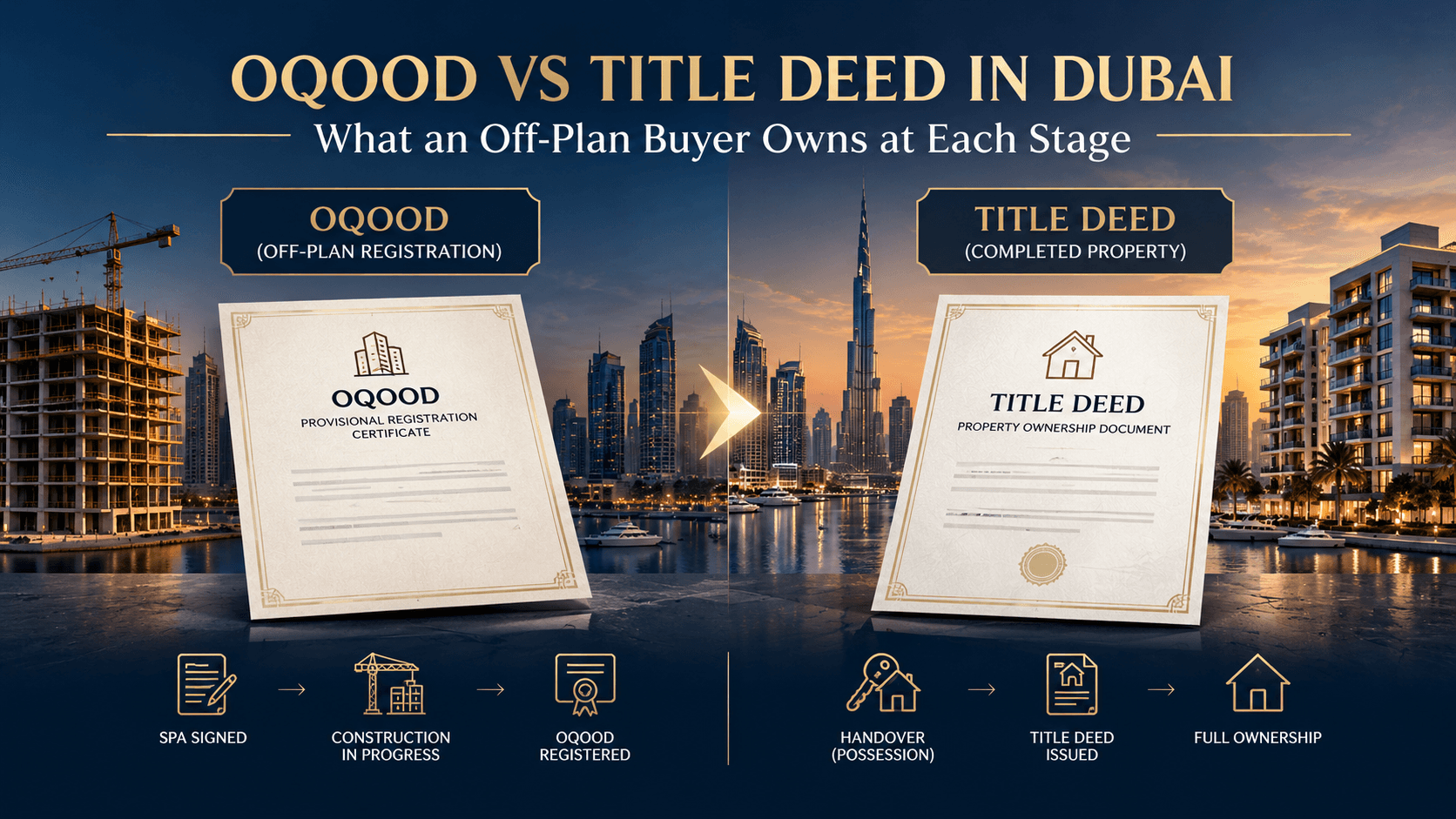
Buying property before construction is complete raises an important question: Oqood vs Title Deed in Dubai - what does a buyer actually own at each stage of the purchase? The distinction matters because an Oqood registration and a Title Deed serve different purposes in Dubai's property registration system. Understanding when each document applies helps buyers verify their legal position, assess resale conditions, and avoid assuming that a signed Sales and Purchase Agreement (SPA) alone completes every registration requirement.
Dubai's legal framework distinguishes between the Interim Property Register used for off-plan transactions and the main Property Register used for completed property registrations. Dubai Law No. 13 of 2008 establishes the interim registration framework, while the Dubai Land Department (DLD) provides services for registering off-plan sales and issuing title documents once the relevant conditions have been met.
Quick Answer: Oqood vs Title Deed in Dubai
Oqood is the registration record or certificate associated with an off-plan property transaction in Dubai's Interim Property Register. It records the buyer's registered interest before the property moves through the applicable completion and title-registration process. A Title Deed is the formal property ownership document issued through the Dubai Land Department's registration system. In general, buyers receive Oqood during the off-plan stage and a Title Deed after the required completion, contractual, and registration conditions are satisfied. The exact timing depends on the project and transaction.
The practical point is simple: Oqood is not merely a developer receipt, but it is also not the same document as a Title Deed. Buyers should verify the registration status, contractual rights, outstanding obligations, and property details rather than relying on the document's name alone.
What Is Oqood in Dubai Real Estate?
Oqood is the term commonly used for the registration system and provisional registration certificate associated with off-plan property transactions in Dubai. It is connected to the Interim Property Register maintained by the Dubai Land Department.
When a buyer purchases a property that is still under construction, the transaction is not treated in exactly the same way as the purchase of a completed property. The registration framework recognises the off-plan transaction before the unit is transferred into the main Property Register.
Under Article 2 of Dubai Law No. 13 of 2008, the Interim Property Register records off-plan sale contracts and other legal dispositions before they are entered into the main Property Register. Article 3 requires relevant dispositions involving off-plan units to be entered in the Interim Property Register.
What does an Oqood certificate establish?
In practical terms, Oqood registration provides an official record of the registered off-plan transaction. It helps establish that the buyer's interest has been recorded through the applicable registration system rather than existing only in private paperwork between the buyer and developer.
Depending on the transaction, the relevant documentation may record details such as:
- The buyer and developer.
- The property unit and project.
- The registered off-plan sale.
- Information associated with the underlying sale agreement.
The actual information shown depends on the registration document issued. Buyers should verify the details on their own certificate rather than assume that every Oqood document contains identical fields.
The Dubai Land Department's initial sale registration service confirms that developers use the Oqood portal to register off-plan sales and that the service issues a provisional registration e-certificate. The service page was available when this article was researched in October 2026.
Does Oqood mean you own a completed apartment?
Not in the same sense as holding a Title Deed for a completed, registered property.
Oqood relates to your registered interest in an off-plan unit. The property may still be under construction, and the transaction remains subject to the SPA, payment obligations, project progress, and applicable legal procedures.
For example, if you buy an apartment in a development that is still being built, an Oqood certificate does not mean that you can immediately occupy the apartment. Nor does it, by itself, establish that construction is complete or that all contractual obligations have been fulfilled.
The important distinction is between having a registered interest in an off-plan property and having the completed unit registered in your name through the applicable title-registration process.
What Is a Title Deed in Dubai?
A Title Deed is the formal ownership document issued through Dubai's property registration system. It identifies the registered property and owner according to the relevant registration record.
For a completed apartment or villa, the Title Deed is an important document for confirming registered ownership. Buyers should still check the property's exact legal status, any registered interests or restrictions, and whether the document matches the transaction being undertaken.
Dubai Law No. 13 of 2008 addresses the transition from interim registration to the main Property Register. Article 8 provides that, after a project receives its completion certificate, the developer must enter the completed project into the main Property Register. Sold units are entered in the names of purchasers who have fulfilled their contractual obligations, following the applicable procedure.
When does a buyer receive a Title Deed?
The process generally involves these stages:
- The project reaches the relevant completion stage and receives the required completion certificate.
- The buyer fulfils the contractual obligations required for registration.
- The developer or relevant party completes the applicable DLD procedures.
- The unit is registered in the main Property Register and the relevant title document is issued.
The precise process can vary according to the property, transaction, and outstanding requirements.
The DLD's service for completing initial procedures and issuing a Title Deed confirms that a Certificate of Title or Title Deed can be issued to parties who comply with their contractual obligations. The service page lists an electronic Certificate of Title/Title Deed among the documents issued.
Is a Title Deed proof of ownership?
It is the formal ownership document associated with the property's registration. However, buyers should not rely on a PDF or image alone when purchasing a resale property.
Verify the document through the DLD's official channels, ensure the registered owner's identity matches the seller, and check that the property description corresponds to the unit being sold. If there is a mortgage, restriction, inheritance issue, or other registered interest, obtain appropriate legal advice before proceeding.
Dubai Land Department provides a Title Deed verification service, which buyers can use as part of their checks.
Oqood vs Title Deed: Key Differences
The simplest way to understand the distinction is to look at the stage of the property transaction and the purpose of each document.
Comparison | Oqood | Title Deed |
Main purpose | Records an off-plan transaction in the Interim Property Register | Documents registered ownership in the main Property Register |
Typical stage | During the off-plan purchase and construction period | Usually after the required completion and registration steps |
Property status | Generally under development or not yet transferred through the completed-property process | Property registered in the relevant title system |
Registration framework | Interim Property Register | Main Property Register |
What it establishes | The registered off-plan transaction and buyer's recorded interest | Registered ownership of the identified property |
Does it mean construction is complete? | No | Usually associated with the completed-property registration process |
Is it a replacement for the SPA? | No | No; the SPA and other transaction records may remain relevant |
What should buyers verify? | Unit details, project, registration, SPA, payments and transfer conditions | Owner, unit details, registration validity, and any relevant registered interests |
The legal distinction is grounded in Dubai Law No. 13 of 2008 and the DLD's official services for provisional sale registration and Title Deed issuance.
One point deserves emphasis: Oqood and a Title Deed are not competing forms of paperwork where one is always good and the other is always bad. They serve different functions at different stages of a property transaction.
What Does an Off-Plan Buyer Own at Each Stage?
An off-plan purchase is best understood as a process rather than a single event. Signing the contract, registering the sale, completing payments, receiving the keys, and obtaining the Title Deed are related but distinct steps.
Stage 1: SPA signed
Contractual stage
The buyer and developer have signed the Sales and Purchase Agreement. The agreement defines the transaction and its obligations, but the buyer should confirm that the required off-plan registration has also been completed.
Stage 2: Oqood registration
Registered off-plan interest
The off-plan transaction is recorded in the Interim Property Register. Check the certificate against the SPA and confirm the unit and buyer details.
Stage 3: Construction progresses
Contract and registration remain relevant
The buyer continues to meet the payment obligations specified in the agreement. Construction progress does not automatically mean that the Title Deed can already be issued.
Stage 4: Handover
Possession and completion procedures
The developer reaches the applicable handover stage and arranges delivery under the contract. Buyers should check outstanding payments, snagging, service charges, and registration requirements.
Stage 5: Title Deed issued
Formal registered ownership document
Once the relevant conditions are satisfied and the applicable process is completed, the unit can be registered in the main Property Register in the buyer's name.
This is a general sequence, not a guarantee that every project follows identical timelines or procedures.
Stage 1: After signing the SPA
The SPA is the contractual foundation of the purchase. It normally sets out the agreed price, payment schedule, unit specifications, anticipated completion arrangements, and the parties' rights and obligations.
At this point, buyers should not confuse signing a contract with completing the required government registration.
What to check:
- Is the developer and project properly approved?
- Does the SPA identify the correct unit?
- Are the payment dates and conditions clear?
- What does the contract say about delay, default, cancellation, assignment, and resale?
- What is the process for registering the transaction?
Dubai Law No. 13 of 2008 states that off-plan projects and sales must meet the applicable approval requirements. Article 10 addresses sales in projects that have not been approved by the competent entities.
Stage 2: After Oqood registration
This is a key verification milestone. The buyer should have evidence that the transaction has been recorded in the relevant registration system.
Check the Oqood details against the signed SPA. If the unit number, buyer's name, project information, or other important details differ, seek clarification and correction through the appropriate channel.
Also, keep copies of payment receipts, the SPA, correspondence with the developer, and the registration certificate. These documents may be relevant if there is a dispute or if the buyer later seeks to transfer the registered interest.
Article 6 of Law No. 13 of 2008 states that off-plan units entered in the Interim Property Register may be subject to sale, mortgage, or other legal dispositions. This does not mean that every buyer can resell or mortgage a unit without conditions: applicable law, project procedures, contractual terms, and required approvals must still be checked.
Stage 3: During construction
An Oqood certificate does not remove construction risk.
The developer may still need to complete the building, obtain the required approvals, and meet the obligations in the SPA. Buyers should monitor the construction timeline and understand what happens if the project is delayed or the developer requests a change permitted by the contract.
For overseas buyers, this is particularly important because they may be making instalment payments without visiting the site regularly.
Useful checks include:
- Confirming project status through official channels.
- Tracking payment milestones against the SPA.
- Keeping evidence of all payments.
- Reviewing any revised completion notices.
- Understanding contractual remedies and escalation routes.
The DLD provides a project status enquiry service that allows customers to enquire about project completion percentage and details. Use official records rather than relying exclusively on sales updates.
Stage 4: At handover
Handover and title registration are connected, but buyers should not assume they happen simultaneously.
A developer may notify the buyer that the unit is ready for handover while certain payment, documentation, or registration steps remain outstanding. The specific requirements depend on the transaction and project.
Before accepting handover, confirm:
- Whether the required completion certificate has been issued.
- Whether all contractual instalments due at handover have been paid.
- Whether the unit has been inspected and defects recorded.
- What service charges and other fees are payable.
- Whether any post-handover payment obligations remain.
- Which steps are outstanding before the Title Deed can be issued.
A post-handover payment plan does not necessarily mean that all outstanding instalments must be paid before the Title Deed can be issued. Equally, buyers should not assume that a Title Deed will automatically be issued while every type of contractual obligation remains unpaid. The answer depends on the agreement and applicable registration requirements.
Stage 5: After the Title Deed is issued
Once the unit is registered in the buyer's name and the Title Deed is issued, the buyer has the formal ownership document associated with the registered property.
The buyer should download and safely store the electronic document, verify its details, and retain the SPA, payment records, handover documents, and any relevant mortgage or other registration documents.
A Title Deed does not eliminate every possible property risk. Outstanding service charges, mortgage obligations, jointly owned property rules, and other legal restrictions may still matter.
Can You Sell an Off-Plan Property With Oqood?
Potentially, yes. But the existence of Oqood does not guarantee an unrestricted resale.
Dubai Law No. 13 of 2008, Article 6, recognises that off-plan units entered in the Interim Property Register may be subject to sale and other legal dispositions. The actual resale process may still depend on the SPA, the applicable legal framework, payment status, and project-specific requirements.
Before arranging a resale, ask the developer and relevant registration channel to confirm:
- Whether resale is permitted at the current construction stage.
- Whether a minimum percentage of the purchase price must be paid.
- Whether the developer requires a no-objection certificate (NOC).
- Which registration or transfer fees apply.
- How outstanding instalments will be handled.
- Whether the incoming buyer must meet any eligibility requirements.
Do not rely on a broker's general statement that an Oqood unit is freely transferable. Obtain confirmation for the particular unit and transaction.
For a broader explanation of the buying process, see Buying Off-Plan Property in Dubai.
Does Oqood Protect the Buyer if the Developer Defaults?
Oqood records the off-plan transaction, but registration is not a guarantee that a project will finish on time or that the buyer will recover every dirham in every dispute.
Dubai has a broader regulatory framework governing off-plan sales and development-project escrow accounts. Dubai Law No. 8 of 2007 addresses escrow accounts for real estate development, while Law No. 13 of 2008 addresses interim property registration. These frameworks serve different purposes.
Buyers should therefore distinguish between three questions:
- Registration: Has the off-plan sale been recorded correctly?
- Project and payment safeguards: Is the project registered, and are the applicable escrow arrangements verified?
- Contractual remedies: What happens if the developer or buyer fails to fulfil contractual obligations?
The answers are not interchangeable.
For example, an Oqood certificate may confirm that an off-plan transaction has been registered, but it does not independently prove that the project is financially sound, construction is on schedule, or the buyer will receive a refund without delay if a dispute occurs.
The DLD's official project registration service describes the process for registering a real estate development project and opening an escrow account for off-plan sales.
For a substantial purchase, consider an independent review of the developer, escrow details, SPA clauses, payment schedule, construction progress, and possible exit routes. Ritu Kant Ojha's property due-diligence process describes a framework covering developer verification, SPA and escrow checks, construction, pricing, and exit liquidity.
What Documents Should an Off-Plan Buyer Keep?
Keep a complete transaction file rather than relying on one certificate.
Document | Why it matters |
Signed SPA | Records the contractual terms, price, payment schedule, and obligations |
Oqood certificate or provisional registration record | Evidence of the registered off-plan transaction |
Payment receipts and account statements | Help reconcile payments against the agreed schedule |
Developer and project registration details | Help verify that the transaction relates to the relevant approved project |
Construction and handover notices | Record progress updates and communications |
Inspection and snagging records | Document defects or outstanding items identified at handover |
Title Deed, once issued | Formal document associated with the registered ownership |
Mortgage, NOC, or transfer documents, if applicable | Support relevant financing, resale, or other transaction procedures |
The DLD's provisional registration service lists the signed SPA among the required documents for initial sale registration. Its Title Deed service separately describes the process for completing the relevant procedures and issuing the title document.
Example: A Buyer Purchasing an Apartment Before Completion
Imagine a buyer purchases an off-plan apartment for AED 2 million.
The buyer signs the SPA and follows the agreed payment schedule. The off-plan sale is then registered through the applicable Oqood process. Construction continues for the following months, and the buyer makes further payments as they fall due.
At this stage, the buyer's registered interest is recorded through the interim registration framework. The Oqood certificate does not mean the apartment is complete or ready for occupation.
When the project reaches the required completion stage, the buyer fulfils the relevant contractual obligations, and the necessary procedures are completed, the unit can be registered in the main Property Register and the Title Deed issued.
This example is illustrative. It does not imply a guaranteed completion timeline or that every buyer must pay the entire purchase price before title registration. The actual requirements depend on the SPA, payment structure, and applicable procedures.
The lesson is to track contract, registration, construction, handover, and title issuance separately. Treating them as one event can lead to misunderstandings about what has been completed and what remains outstanding.
Practical Checklist Before You Buy Off-Plan in Dubai
Before committing funds, work through this checklist.
- Verify the developer and project through the relevant official channels.
- Read the SPA and confirm the exact unit details.
- Confirm that the sale has been registered through the applicable Oqood process.
- Check that the certificate details match the SPA.
- Verify the official project escrow arrangements and payment instructions.
- Understand all payment deadlines and consequences of default.
- Review the completion and handover conditions.
- Confirm resale or assignment conditions if you may need to exit early.
- Keep a complete record of payments and correspondence.
- Confirm what is needed for the eventual Title Deed.
- Seek independent legal advice if the contract or registration status is unclear.
For buyers investing remotely, independent due diligence is particularly useful. The advisory approach at Ritu Kant Ojha outlines a process for reviewing legal structure, developer risk, escrow compliance, and exit considerations.
Frequently Asked Questions
1. Is Oqood the same as a Title Deed in Dubai?
No. Oqood is associated with the registration of off-plan property transactions in the Interim Property Register. A Title Deed is the formal ownership document associated with registration in the main Property Register. They serve different functions at different stages of a transaction.
2. Does Oqood prove that I own an off-plan property?
Oqood provides evidence that the off-plan transaction has been recorded through the applicable registration system. The buyer's rights and obligations also depend on the SPA, applicable law, and the transaction's specific circumstances. It should not be treated as proof that the building is complete.
3. When do I receive my Title Deed in Dubai?
Generally, the Title Deed is issued after the relevant completion and registration requirements have been met and the buyer has fulfilled the contractual obligations required for registration. The timing depends on the project and transaction. The DLD provides an official Title Deed issuance service.
4. Can I sell my property before receiving a Title Deed?
A resale may be possible while the unit is still in the interim registration system. However, it depends on the applicable law, the SPA, payment status, and any required developer or DLD procedures. Confirm the conditions for the particular unit before agreeing to sell.
5. Can I get a mortgage with Oqood?
Do not assume that every lender will finance every Oqood-registered unit. Eligibility depends on the lender's policies, project status, buyer circumstances, and the applicable legal and registration requirements. Ask the lender to confirm eligibility for the exact unit and transaction.
6. What happens if my Oqood details are incorrect?
Compare the certificate with the signed SPA and other transaction documents. Contact the developer and the relevant DLD registration channel to establish the correct process for rectification. Do not ignore discrepancies in the buyer's name, unit number, or project information.
7. Does receiving the keys mean my Title Deed has been issued?
Not necessarily. Handover and title registration are separate steps, even when they occur close together. Confirm whether the Title Deed has actually been issued and verify its details through official channels.
8. Can a foreign buyer receive a Title Deed in Dubai?
Foreign buyers can own property in Dubai in areas where ownership is permitted under the applicable rules. Eligibility and the type of interest available depend on the property location and legal structure. Confirm the relevant ownership rules before signing.
9. Is Oqood enough to prove that the developer is trustworthy?
No. It records the off-plan transaction; it does not independently guarantee the developer's financial position, construction quality, delivery date, or investment performance. Buyers should separately check project approvals, escrow arrangements, delivery history, and the SPA.
10. Where can I verify my Oqood or Title Deed?
Start with the official Dubai Land Department website. Use the relevant service or contact DLD to confirm the registration status and the documents applicable to your property. Avoid relying solely on screenshots or documents supplied by an intermediary.
Final Thoughts
The distinction between Oqood and a Title Deed is ultimately about where the transaction sits in Dubai's property registration process.
Oqood records the registered interest associated with an off-plan purchase. A Title Deed is the formal ownership document associated with the property's registration in the main Property Register. Neither document should be considered in isolation from the SPA, the project's status, payment obligations, and the applicable legal procedures.
For buyers, the sensible approach is to confirm each milestone independently: contract signed, sale registered, construction completed, handover requirements met, and title issued. This is especially important for NRI and international buyers who may be making decisions from overseas.
For further guidance, explore the off-plan buying guide and property due-diligence process on Ritu Kant Ojha's website.
This article is for general educational purposes and is not legal advice. Dubai's laws and registration procedures may be amended. Verify the latest requirements with the Dubai Land Department and seek qualified legal advice for a specific transaction.
About the Author
Ritu Kant Ojha is a Dubai-based real estate investment advisor and the founder of Proact Luxury Real Estate (RERA BRN 71195). An IIM Lucknow alumnus and former financial journalist at Bloomberg and CNBC, he has spent two decades covering and analysing capital markets before moving into property advisory. He works with NRI and international families buying in the UAE, with a focus on independent due diligence, structured decision-making, and long-term asset strategy. He is the author of The Only Difference (2026), which sets out the ADVICEdge framework for evaluating financial advisors, and Real Conversations In Digital Age (2019).